
 Axis Weaponry, Aka Guns Axis Weaponry, Aka Guns |


| Spartan |
 03/09/06 9:17pm 03/09/06 9:17pm
Post
#1
|
 Major  Group: Forum Member Posts: 668 Joined: January 19th 2006 From: Miami, Florida Member No.: 1545 Xfire: Cknife187  |
Kar 98
The standard German infantry weapon was the rifle, originally designed by Mauser and dubbed the Karabiner 98k. This weapon was a 5-shot, bolt-action rifle that actually dated back to 1898 when it was first adopted by the Imperial German Army. It was standard issue for German troops in WWI and, in its modified 98k version (k for kurz, or short), in WWII as well. Geweher 41 While the German standard rifle was a bolt action rifle, the Germans did attempt to design a successful automatic rifle as well. Two designs were submitted for trials in 1941, one by Walther (the maker of the famous PPK and the P38 pistols), and the other was submitted by Mauser. The Mauser design won out over the simpler Walther design and many thousands of the Gewehr 41(W) were made available to the troops on the Eastern Front. After initial use, results were less than satisfactory and as soon as a better design came along (the model 43), production was halted. The way in which German troops used their weapons changed and a rifle with a range of 2000 yards was no longer needed - except for specialists and snipers. Instead, ranges had shrunk down to 400 yards and a less powerful cartridges was needed. MP40 The most common submachine gun used by the Germans during WWII was the MP40. Many times the term "Schmeisser" is used in reference to a German submachine gun. While it is true that the Schmeisser firm did create and produce its own submachine gun design, it was less than perfect and prone to trouble. The MP40 was a not manufactured by Schmeisser, and the weapon was far more simple and had a much more cleaner design, thus it became the standard issue for German troops. An earlier design called MP38 had a similar appearance and saw widespread distribution. A less known model called Erma was also produced as well as a German copy of the British STEN gun, called MP3008. The Waffen-SS used a submachine gun made by Bergman called the MP34 also. MP44 The next submachine gun design to emerge was the MP43 or Machine Pistol 43 from a design developed in 1943. It fired a less powerful cartridge and had a lighter recoil as a result. However, Hitler, still thinking that troops needed a weapon capable of firing 2000 yards, ordered that production of the weapon not start. The German arms minister, however, knew the need of the new weapon, and changed the name to "Machine Pistol", which is what the Germans called their submachine guns like the US Thompson .45 cal. The trick worked and the weapon went into production at three factories and German troops all over the Eastern Front were clamouring for the new weapon. The whole affair was blown" when a few divisional commanders asked Hitler at a conference when they would get the new weapon. Hitler was furious and ordered an investigation. Luckily for the men that had disobeyed the Fuehrer, the results of the investigation were so encouraging about the new weapon that Hitler changed his mind and announced that henceforward the weapon would be called "Sturmgewehr" or Assault Rifle. This was the world's first ever assault rifle. The Maschinen Pistole 43's origin was actually the Maschinen Karbiner 42 (MKb 42). It looked a lot similar, and was issued in numbers on the eastern front. Later, this weapon was refined into the Mp43. The Germans, contemplating the sniping value of the Mp43, made a variant, called the Mp43/1. It had scope mounting rails on the iron-sights. The sniper arrangement didn't really work, so, few were made. In late 1943, the MP44 (the most commonly found German assault rifle from the war) was developed, though being basically the same thing as it's predecessor. In 1945, Mauser had begun work on a new type of assault rifle (sometimes called the StG45(M), sometimes the Gerat O6), that used a roller-locking mechanism (like that of the Mp5), which slowed the ROF down to 450 RPS. However, these rifles never made it past the prototype phase. MG42 The Germans settled on two light machine gun designs and used them throughout the war, the MG34 and MG42. The MG42 went on to become the standard design for a light machine gun for NATO and is now used in a more modern form by the US military, and the Australian Army, as the M-60! The new German Army continues to use a less modified but still modernized version of the MG42 as their standard light machine gun. There are many more but I know i can trust u guys to research it. --------------------  "Wars come and go, But my soldiers they stay eternal" - Tupac Shakur  |
   |

 
|
  |
Replies(1 - 14)
| FeezyWeezy |
03/09/06 11:28pm
Post
#2
|
|
Major Group: Banned Posts: 609 Joined: January 14th 2006 From: Gone Member No.: 1533 |
The Panzerfaust (lit. armor fist [also means gauntlet] or tank fist) was an inexpensive, recoilless German Anti-tank weapon. It consisted of a small, disposable preloaded recoilless gun - not rocket propelled, as commonly believed.
Development began in 1942 on a larger version of the Faustpatrone. The resulting weapon was the Panzerfaust, a very simple weapon weighing only 5-10 kg. The body was a tube of low-grade steel (it is said that at the end of the war they could make them out of Cardboard), around a meter long and a 4-6 cm in diameter. Attached to the upper-side of the tube were a simple rear sight and trigger. There was no front sight, the edge of the warhead was used. Inside the tube was a small charge for propellant. Fitted to the front of the tube by its wooden tail stem and metal fins was an oversized warhead, 15 cm in diameter and weighing 3 kg. It contained around 800 grams of explosive. The Panzerfaust often had warnings written in large red lettering on the upper rear end of the tube, the words usually being "Achtung! Feuerstrahl!" (Beware! Fire Jet!). This was to warn soldiers to avoid the backblast. After firing, the tube was discarded, making the Panzerfaust the first expendable anti-tank weapon. The weapon was often fired from the crook of the arm and the shaped charge could penetrate up to 170 mm of steel, enough to defeat any US or British tank, and all but the largest late-war Soviet designs. In an urban setting where the short sight lines allowed the weapon to be easily used it proved particularly deadly, and knocked out large numbers of Soviet armored vehicles during the Battle of Berlin. The construction was so simple that they could be made in the city while it was under siege, allowing wheelbarrow loads of Panzerfausts to be delivered to the defenders. The version used in COD is the Panzerfaust 60, the 60 stands for its nominal maximum range. The 60 was the followup of the 30. which was produced in 1943.. The 60 came in service at 1944.  Panzerfaust 60 Panzerfaust 60Modern day Panzerfaust. The panzerfaust is still around these days. The Panzerfaust 3 is a disposable anti-tank rocket-launcher developed between 1978 and 1985 and put into service by the German Army in 1992. It was first ordered in 1973 to provide West German infantry with an effective weapon against contemporary Soviet armor thereby replacing West Germany's aging Bazook-like rocket launchers. The Panzerfaust 3 consists of a disposable launcher tube carrying the missle and a reusable firing and sighting unit. The projectile itself consists of a shaped-charge warhead filled with Amathol/Syndril and a shaft including the propulsion unit. The Panzerfaust 3 can be fired from inside rooms since it doesn't have dangerous backblast. The fuel in the projectile is ignited by a bolt via a spring mechanism. Once it has been propelled out of the tube, after a flight distance of approximately 5 meters, the built-in fuse is released by the safety mechanism in order to arm the warhead. The warhead explodes when it hits a solid object or runs out of fuel. Heres a picture of it http://www.juergen-baur.de/bund/data/media...nzerfaust_3.jpg Thanks to wikipedia for the long texts...I hate typing all I know about the WW2 panzerfaust by hand. Resources: http://en.wikipedia.org/wiki/Main_Page http://www.juergen-baur.de/ www.legendshobbies.com http://www.google.com/ -------------------- C'est pas l' histoire d'un jour
Qui rime avec amour, Plutôt un long séjour Mais pas: un "pour toujours" |
|
|
|
| Spartan |
03/10/06 1:11pm
Post
#3
|
|
Major Group: Forum Member Posts: 668 Joined: January 19th 2006 From: Miami, Florida Member No.: 1545 Xfire: Cknife187 |
High five for finding that shit
-------------------- "Wars come and go, But my soldiers they stay eternal" - Tupac Shakur |
|
|
|
| Dr.Satan(QC) |
03/10/06 2:35pm
Post
#4
|
 Second Lieutenant  Group: Forum Troll Posts: 273 Joined: January 3rd 2006 From: Sherbrooke, Quebec, Canada Member No.: 1512 |
Ancestor of the panzerfaust the panzerschreck:
http://www.inert-ord.net/atrkts/pschrek/index.html Here a link with a lot of info too: http://www.diggerhistory.info/pages-weapons/enemy_ww2.htm --------------------  |
|
|
|
| Silver |
03/10/06 2:37pm
Post
#5
|
 Major General Group: Banned Posts: 6596 Joined: March 30th 2004 Member No.: 680 |
bent barrel mp44
One unusual addition to the design was the Krummer Lauf, a bent barrel with a periscope sighting device attached for shooting around corners from a safe position. It was produced in several variants, an "I"-version for infantry use, a "P" version for use in tanks (to cover the dead areas in the close range around the tank, to defend against assaulting infantry), versions with 30°, 45°, 60° and 90° bends, a version for the StGw 44 and one for the MG 42. Only the 30° "I" version for the StG44 was produced in any numbers. http://thehistorynet.com/wwii/bl-krummer-lauf/ |
|
|
|
| ScrapyardBob |
03/10/06 3:23pm
Post
#6
|
|
Major  Group: {MOB} Posts: 814 Joined: January 6th 2006 Member No.: 1519 Xfire: scrapyardbob |
Nice links.
The bent barrel weapon is one that I just read about last week. Very odd concept as I didn't realize barrels could be bent and still be used. http://images.google.com/images?hl=en&q=Kr...rch&sa=N&tab=wi www.pkymasehist.fi/krummer_lauf.html More fun pics: http://jgstephan.blogspot.com/2005_10_01_j...an_archive.html --------------------   |
|
|
|
| Blinky |
03/10/06 3:42pm
Post
#7
|
 Major  Group: {MOB} Regs Posts: 772 Joined: August 8th 2005 From: Tampere, Finland Member No.: 1287 Xfire: blinkieb |
--------------------    |
|
|
|
| FeezyWeezy |
03/10/06 5:11pm
Post
#8
|
|
Major Group: Banned Posts: 609 Joined: January 14th 2006 From: Gone Member No.: 1533 |
Thanks to Leadmagnet and Blink.. Hyvää Suomi!
(Magnet for the idea, Blinky because hes one cool Fin) http://guns.connect.fi/gow/suomi1.html this is some awsome story. Suomi KP-31 The Suomi ("Finland") submachine gun was developed by Finnish arms designer Aimo Johannes Lahti in 1920-1930 period and adopted by Finnish Army in 1931 as Suomi-KP Model 1931, or simply KP-31. KP stands for Konepistooli. Suomi SMG was manufactured by Finnish company Tikkakoski Oy, and licensed to Denmark, Sweden and Switzerland. Used mostly by Finnish and Sweden armies, it was also widely exported into Baltic countries, some European and South American countries. Suomi was used with great sucess during Winter War of 1940 agains Soviet Union, when, wisely used, this SMG showed to the world the importance of the submachine guns to the modern warfare. Manufacture of the Suomi was ceased in Finland in 1944, but it was used well until the 1990s, when finally rendered obsolete and replaced in Army by assault rifles. Suomi was fed from box or drum magazines. Box magazines were conventional staggered-column ones for 20 rounds or twin-staggered-column magazines for 50 rounds each (also known as "Coffin magazines" due to their shape, these could be described as two staggered-column magazines clipped together and having common cartridge exit). Drum magazines held 70 rounds and later inspired Russians to adopt drum magazines for their PPD and PPSch SMGs. In mid-1950s Finnish army also adopted 36-round magazine, designed in sweden for M/45 Carl Gustaf SMG. In general, the Suomi KP-31 was a highly effective, reliable and accurate gun, but too expensive to manufacture. Read the link if you really want to know everything...its SOOO much, and so awsome. M/28-30 - Finnish Bolt-action riffle...Adjusted mosim. http://www.jaegerplatoon.net/RIFLES2.htm http://www.winterwar.com/Weapons/FinSmallArms/FinRifles.htm The Finnish Used a modified self-made mosim during the ww2. The made some changes to the rear sights, the charges etc. Lahti/Saloranta m/26 LMG http://www.saunalahti.fi/~ejuhola/7.62/lahtisaloranta.html Edit of previous post: There was direct link restriction and copy protection. But I'm no geek if I didn't bypass that with 3 clicks.  -------------------- C'est pas l' histoire d'un jour
Qui rime avec amour, Plutôt un long séjour Mais pas: un "pour toujours" |
|
|
|
| FeezyWeezy |
03/10/06 7:55pm
Post
#9
|
|
Major Group: Banned Posts: 609 Joined: January 14th 2006 From: Gone Member No.: 1533 |
http://www.lonesentry.com/articles/nebelwerfer/index.html
http://www.missing-lynx.com/articles/germa...er/swwerfer.htm The Nebelwerfer (or smoke shell mortar) was a German towed artillery piece, developed during the 1930s for World War 2. It had six 150mm barrels, from which it fired rockets over a period of ten seconds. The loud screeching noise of the rounds led U.S. soldiers in the Sicily Campaign to nickname the gun the "Screaming Mimi". It (along with the Katyusha is considered to be the foundation of the MLRS. The Nebelwerfer 41 was a rocket-launching artillery piece which had five barrels. Each barrel fired an 160mm rocket. The Nebelwerfer 42 had six 160mm barrels. When the crew had loaded and aimed it, they took cover a few metres away and fired the Nebelwerfer by an electric wire. After firing, a long streak of smoke could be seen from far away, so the Nebelwerfer was made into an excellent target for counter-artillery. It was necessary, therefore, to relocate the Nebelwerfer as soon as possible after firing. The launcher consisted of six barrels on a mobile carriage adapted from the 37mm anti-tank gun. The six rockets were electrically fired over a period of 10 seconds. The weapon was designed to saturate a target with spin-stabilized smoke, explosive or gas rockets. They are never fired simultaneously, since the blast from six rockets at once undoubtedly would capsize the weapon. The order of fire is fixed at 1–4–6–2–3–5. One way to make up for this shortcoming was to mount the rocket launching tubes on some sort of motorized tractor, as was the case with the Maulier 42 Panzerwerfer; a semi armoured half-tracked mount for the weapon. Later in the war cruder (and larger calibred) light metal or even wooden launch racks were devised, in order to cope with the increased frontline requests for the weapon and the growing scarcity of raw materials. The racks could be transported via lorry and set up by a small crew which would then swiftly leave the launch site after firing.  Panzerwerfer http://upload.wikimedia.org/wikipedia/en/7...as_Maultier.jpg The Panzerwerfer and the Katyusha both considered to be the foundation of the MLRS. Katyusha: http://www.autogallery.org.ru/k/s/studerussia2.jpg MLRS: http://www.enemyforces.com/artillery/mlrs.jpg Katyusha - Катюша The 82mm BM-8 and 132mm BM-13 (BM for Boyevaya Mashina - combat vehicle) Katyusha (Russian "Катюша") multiple rocket launchers were built and fielded by the Soviet Union in World War 2. These launchers acquired this name, unofficial but immediately recognized in the Red Army, from the title of a popular Russian wartime song, Katyusha. The song is about a girl longing for her beloved who is away from her while serving in the military. Katyusha is a tender Russian diminutive of a female name: Ekaterina (Katherine)→Katya→Katyusha. The weapon was also known as "Stalin's Organ", so named by German troops due to the sound of its rockets. It was used on many platforms during World War II, mounted on trucks, on tanks, and occasionally even on tracked artillery tractors, as well as on naval and riverine vessels as an assault support weapon. Modified versions were also mounted on airplanes and used as early as in the Soviet - Japanese border clashes at the Khalkhin Gol in late thirties, and then regularly during WWII. The design was relatively simple, consisting of racks of parallel rails on which rockets were mounted, with a folding frame to raise the rails to launch position. Each truck had between 14 and 48 launchers. The rocket of the BM-13 system, designated RS-132 (RS for Raketnyi snaryad = rocket-propelled shell) was 180 cm (5.9 ft) long, 13.2 cm (5.2 in) in diameter and weighed 42 kg (92 lb). It was propelled by a solid nitrocellulose-based propellant of tubular shape, arranged in a steel-case rocket engine with a single central nozzle at the bottom end. The rocket was stabilised by cruciform fins of pressed steel sheet. The explosive warhead, either fragmentation, high explosive or shaped-charge, weighed around 22 kg (48 lb). The range of the rocket was about 5 km (3mi). The weapon was not accurate but was extremely effective in saturation bombardment. Katyushas were often massed in very large numbers to create a shock effect on enemy forces. The development of the Katyusha rocket launcher was a response to the development of the six-barreled Nebelwerfer rocket mortar in 1936. This is something funny  http://en.wikipedia.org/wiki/Katyusha_%28song%29 http://en.wikipedia.org/wiki/Katyusha_%28song%29This is a download of the actual song http://dime32.dizinc.com/~russmus/mp3%20samples/katyusha.zip Link to the full site. If you look well on this site you can get some T.A.T.U -------------------- C'est pas l' histoire d'un jour
Qui rime avec amour, Plutôt un long séjour Mais pas: un "pour toujours" |
|
|
|
| FeezyWeezy |
03/13/06 9:14am
Post
#10
|
|
Major Group: Banned Posts: 609 Joined: January 14th 2006 From: Gone Member No.: 1533 |
I know that no one reads this threat anyway...
Just want you to know about the coolest fighter of WW2  Messerschmitt ME 262 Messerschmitt ME 262http://www.stormbirds.com/project/images/2005_00.jpg http://www.stormbirds.com/project/images/2005_0.jpg Being the first jet fighter to enter operational service, the design of the Messerschmitt Me 262 stemmed from a previous 1938 requirement from the German Air Ministry, for a plane to be powered by the new BMW gas turbine engines. The airframe design was produced by Dr Woldemar Voigt. The design was for a low wing monoplane with a slight sweep on the wing leading edge. The first prototype Me 262 airframe was finished well before it's jet engines. BMW had numerous problems with this novel form of propulsion. For this reason, the prototype made it's first flight on 18 April 1941 with a conventional Junkers Jumo 210 G piston engine mounted in the nose. By November 1941, the BMW 003 engines were ready for installation into the 262 airframe. On 25 March 1942, an Me 262 prototype took off under the power of a Jumo 210 piston engine and two of the jet engines. The inclusion of the piston engine proved to be a wise decision considering that shortly after take-off, both jet engines failed one after the other due to compressor blade failures, leaving the pilot, Fritz Wendel, to land the aircraft solely under the power of the `old' propeller. Further development was continued but with use of the new Junkers Jumo 004 Turbojet engine. This new engine was more reliable, producing 2,200 pounds of thrust. This enabled Fritz Wendel to take off for the first time solely by jet power on 18 July 1942. The new jet aircraft proved to be much faster than conventional aeroplanes but development problems, Allied bombings, and cautious Luftwaffe leadership contributed to delays in quantity production. In late 1943, Adolf Hitler agreed to put the Me 262 into mass production, but insisted (with great reservations from Generalleutnant Adolf Galland, Göring and Messerschmitt) that the Me 262 be configured as a bomber rather than a fighter. Contrary to Hitler's orders, the Me 262 was exclusively produced as a fighter but when this was discovered by the Führer, an immediate conversion of all planes was ordered, thus ending all hopes of repelling the punishing Allied bombing raids for the sake of dropping one or two bombs. The Me 262 was argued to be an excellent opportunity to inflict serious damage to the Allied bomber formations as it had already produced superb results against Allied aircraft and it used diesel fuel which was in less demand compared with the high-octane fuel used by propeller driven aircraft. The Allied bombing raids destroyed hundreds of Me 262s on the ground whilst they were being converted from fighters to bombers or were unable to fly due to lack of fuel, spare parts, or trained pilots. Therefore, the Me 262 did not get to reach it's full potential. More than 1,400 Me 262s were produced but fewer than 300 ever saw combat. When it did fly to air combat, the Me-262 was unstoppable at high speed, but it was vulnerable at low speed, after takeoff and before landing, because of its very sensitive and immature jet engines, and that's where allied fighters ambushed it, in addition to attacking it on the ground. It was not a classic agile fighter aircraft. A fast twin-jet aircraft, it was designed to be a powerful bomber interceptor, what the Germans called Zerstorer (destroyer). It had a speed of 870kmh (540mph) decisively faster than the 700kmh (437mph) of the allied P-51 Mustangs which escorted the allied bombers. The fighter version, named Schwalbe (swallow), was armed with four 30mm guns in the nose, giving it an enormous punch which easily destroyed a heavy bomber, and also a stand-off firing range advantage against the bombers' defensive weapons. Before the end of the war it was also armed with R4M unguided 50mm air-to-air rockets, which also proved very lethal against bomber formations, also from stand-off range. The two-seater night fighter version was also equipped with an air intercept RADAR and a passive homing device that homed on the transmissions from allied aircraft. Its speed advantage over the slow heavy bombers was so great that it became a difficulty in the conditions of a RADAR-based night intercept, so its pilots specialized in intercepting the much faster Mosquito bombers, easily intercepting many of the previously almost invincible Mosquitoes. The bomber version, that was produced only because of Hitler's command, was named Sturmvogel (Storm bird). In addition to the 30mm guns it also carried two 500lb bombs, and was generally inefficient as a bomber, due to its low precision (it was limited to high altitude level bombing), low bomb load, and low range. Without bombs, the bomber version was still efficient as a bomber interceptor, but initially they were simply not used as interceptors. Later they were, but since Hitler demanded that it will be flown by bomber pilots even in interception missions, this proved a total failure, since the bomber pilots simply lacked the necessary fighter pilot training to perform and survive this type of mission. There was also a photo reconnaissance version, and several other versions which never passed the prototype stage. 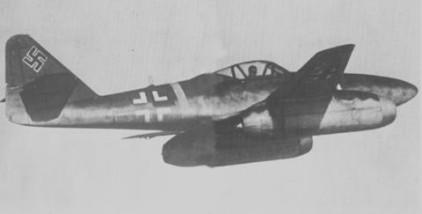 http://www.warbirdpictures.com/LCBW4/Me-262-57.jpg http://www.rb-29.net/HTML/04.PAAvtnArt/PAS...Air/Me262sA.jpg (I Like this picture) This is REALLY coool, a group of people re-creating ME 262's that are flyable, and not sitting in museums. http://www.stormbirds.com/project/index.html -------------------- C'est pas l' histoire d'un jour
Qui rime avec amour, Plutôt un long séjour Mais pas: un "pour toujours" |
|
|
|
| flatliner |
03/13/06 9:27am
Post
#11
|
|
Major General Group: {MOB} Regs Posts: 1773 Joined: January 25th 2006 Member No.: 1553 |
Hey feezy,
I own a copy of "Janes WW2 fighters" or something like that and that messer is really a step up in the simulation. There are only a few flyable aircraft in the game, but the FockerWulfe in the game is an offensive machine.. so many rounds can be fired... the Messer is elusive and quick. Just my 2 cents on 2 planes on a 10 year old game... LOL |
|
|
|
| Blinky |
03/14/06 12:56pm
Post
#12
|
|
Major Group: {MOB} Regs Posts: 772 Joined: August 8th 2005 From: Tampere, Finland Member No.: 1287 Xfire: blinkieb |
QUOTE(flatliner @ 03/13/06 9:27am)  Hey feezy, I own a copy of "Janes WW2 fighters" or something like that and that messer is really a step up in the simulation. There are only a few flyable aircraft in the game, but the FockerWulfe in the game is an offensive machine.. so many rounds can be fired... the Messer is elusive and quick. Just my 2 cents on 2 planes on a 10 year old game... LOL Hey Flat Have you ever tried Il-2 Sturmovik WW2 flight simulation series? Best flight sim IMO, has many great parts and add-ons. I believe you Feezy would love Il-2 Sturmovik Forgotten Battles where you can fly Finnish Air Forces Me-109 G-6´s against russians. As you are such a fan of Finland, which I appreciate a lot, you should give it a try some day. -------------------- |
|
|
|
| FeezyWeezy |
03/14/06 1:26pm
Post
#13
|
|
Major Group: Banned Posts: 609 Joined: January 14th 2006 From: Gone Member No.: 1533 |
[quote name='+KS+ Blinky Bill' date='03/14/06 6:56pm' post='99142'] [quote post='98973' date='03/13/06 9:27am' name='flatliner']
Have you ever tried Il-2 Sturmovik WW2 flight simulation series? Best flight sim IMO, has many great parts and add-ons. I believe you Feezy would love Il-2 Sturmovik Forgotten Battles where you can fly Finnish Air Forces Me-109 G-6´s against russians. As you are such a fan of Finland, which I appreciate a lot, you should give it a try some day. [/quote] I'll check that flight sim out... and btw. I'm no Finland fan... I'm a Finnish Patriot I even follow Finnish politics, economics and news a bit I'll post more weapons when I remember something cool to post here. The next thing that I will post is probaly something like the german super drug, Yokosuka MXY 7... only axis weaponry...  -------------------- C'est pas l' histoire d'un jour
Qui rime avec amour, Plutôt un long séjour Mais pas: un "pour toujours" |
|
|
|
| Blinky |
03/14/06 2:21pm
Post
#14
|
|
Major Group: {MOB} Regs Posts: 772 Joined: August 8th 2005 From: Tampere, Finland Member No.: 1287 Xfire: blinkieb |
[quote name='FeezyWeezy' date='03/14/06 1:26pm' post='99152']
[quote name='+KS+ Blinky Bill' date='03/14/06 6:56pm' post='99142'] [quote post='98973' date='03/13/06 9:27am' name='flatliner'] Have you ever tried Il-2 Sturmovik WW2 flight simulation series? Best flight sim IMO, has many great parts and add-ons. I believe you Feezy would love Il-2 Sturmovik Forgotten Battles where you can fly Finnish Air Forces Me-109 G-6´s against russians. As you are such a fan of Finland, which I appreciate a lot, you should give it a try some day. [/quote] I'll check that flight sim out... and btw. I'm no Finland fan... I'm a Finnish Patriot I even follow Finnish politics, economics and news a bit I'll post more weapons when I remember something cool to post here. The next thing that I will post is probaly something like the german super drug, Yokosuka MXY 7... only axis weaponry... [/quote] Oooppss....! Sorry, my bad, lol..  Here´s more information about that flight sim: http://www.virtualpilots.fi/feature/photor...s/fb-event2003/ -------------------- |
|
|
|
| FeezyWeezy |
03/16/06 9:03am
Post
#15
|
|
Major Group: Banned Posts: 609 Joined: January 14th 2006 From: Gone Member No.: 1533 |
Thanks for the link buddy
I hope to get some cash for it and I'll get it... seems awsome...I repeat: I'll be your wingman That link was...touching -------------------- C'est pas l' histoire d'un jour
Qui rime avec amour, Plutôt un long séjour Mais pas: un "pour toujours" |
|
|
|
|
1 User(s) are reading this topic (1 Guests and 0 Anonymous Users)
0 Members:


|
Lo-Fi Version | Time is now: 05/03/26 11:32am |
Invision Power Board
© 2026 IPS, Inc.