Help - Search - Members - Calendar
Full Version: Ships of the second world WAR!!
{MOB} Forums > MOB Discussion Forum - PUBLIC > Miscellaneous/Off Topic
Spartan
Thought I'ed start with The pacific though the bismark and vessels of the atlantic are welcome on the post.

Yamato
Yamato, lead ship of a class of two 65,000-ton (over 72,800-tons at full load) battleships, was built at Kure, Japan. She and her sister, Musashi were by far the largest battleships ever built, even exceeding in size and gun caliber (though not in weight of broadside) the U.S. Navy's abortive Montana class. Their nine 460mm (18.1-inch) main battery guns, which fired 1460kg (3200 pound) armor piercing shells, were the largest battleship guns ever to go to sea, and the two ships' scale of armor protection was also unsurpassed.

Commissioned in December 1941, just over a week after the start of the Pacific war, Yamato served as flagship of Combined Fleet commander Isoroku Yamamoto during the critical battles of 1942. During the following year, she spent most of her time at Truk, as part of a mobile naval force defending Japan's Centeral Pacific bases. Torpedoed by USS Skate (SS-305) in December 1943, Yamato was under repair until April 1944, during which time her anti-aircraft battery was considerably increased. She then took part in the Battle of the Philippine Sea in June and the Battle of Leyte Gulf in October. During the latter action, she was attacked several times by U.S. Navy aircraft, and fired her big guns in an engagement with U.S. escort carriers and destroyers off the island of Samar.

Yamato received comparatively light damage during the Leyte Gulf battle, and was sent home in November 1944. Fitted with additional anti-aircraft machine guns, she was based in Japan during the winter of 1944-45. Attacked by U.S. Navy carrier planes in March 1945, during raids on the Japanese home islands, she was again only lightly damaged. The following month, she was assigned to take part in the suicidal "Ten-Go" Operation, a combined air and sea effort to destroy American naval forces supporting the invasion of Okinawa. On 7 April 1945, while still some 200 miles north of Okinawa, Yamato was attacked by a massive force of U.S. carrier planes and sunk.

After the war, the great battleship became an object of intense fascination in Japan, as well as in foreign countries. Yamato's remains were located and examined in 1985 and again examined, more precisely, in 1999. She lies in two main parts in some 1000 feet of water. Her bow portion, severed from the rest of the ship in the vicinity of the second main battery turret, is upright. The midships and stern section is upside down nearby, with a large hole in the lower starboard side close to the after magazines.

IPB Image

Yall Know the drill!
Spartan
The infamous tirpitz
Tirpitz, a 44,755-ton Bismarck class battleship, was built at Wilhelmshaven, Germany. Commissioned in February 1941, she operated in the Baltic during her first several months of service, conducting trials and training, as well as combat missions in connection with the invasion of the Soviet Union.

In January 1942, Tirpitz steamed to Norwegian waters, where she remained for the remainder of her career. Initially based at Trondheim, and later in fjords further north, she was a constant threat to supply lines between the Western Allies and the Soviets. Though Tirpitz never actually came into contact with Allied shipping, and only fired her guns at enemy targets during a September 1943 raid on shore facilities at Spitzbergen, her great power caused the U.S. and British navies to divert scarce resources to counter her and generated intense efforts to put her out of action.

In late September 1943, a British midget submarine raid planted explosives near Tirpitz, causing serious shock damage when they exploded. In February 1944, while she was under repair, the German battleship was the target of a raid by Soviet bombers that produced one near-miss. In early April, as her repairs were completing, Tirpitz was attacked by British carrier-based planes, receiving several hits and serious damage and casualties. Further repairs lasted until June, and she was again attacked by British planes in July and August, though the resulting damage was not serious. In mid-September, she was hit in the bow by very heavy bombs dropped by Royal Air Force heavy bombers. Moved to Tromsø in October, she was the target of further raids. Finally, on 12 November, Tirpitz was hit and near-missed by several very heavy bombs, causing massive damage. She listed heavily, suffered an ammunition explosion and rolled over. Her wreck was largely scrapped in place after the war.


H.M.S (her maqesties ship) Hood
HMS Hood, a 42,100-ton battlecruiser built at Clydebank, Scotland, was completed in March 1920. For more than two decades, she was the World's largest warship and, with her long, low hull and finely balanced silhouette, was to many the embodiment of "big-gun" era seapower. During her travels in European waters and far away, Hood actively represented Great Britain throughout her career. Her first cruise, in 1920, was to Scandanavia. The next year she went down to Gibraltar and Spain and in 1922 visited Brazil and the West Indies. After a brief call on Denmark and Norway in 1923, Hood was flagship on a eleven-month cruise around the World, accompanied by the smaller battlecruiser Repulse and a number of light cruisers. In 1925, she called on Lisbon to help commemorate Portugal's contributions to navigation and exploration.

For ten years after 1925, Hood was assigned to the Royal Navy's Home and Atlantic Fleets, operating primarily around Europe, with a visit to the West Indies in 1932. She served with the Mediterranean Fleet in 1936-39, protecting British interests during the Spanish Civil War. Back with the Home Fleet after mid-1939, Hood operated in the North Atlantic and North Sea through the first part of World War II and received minor damage in a German air attack on 26 September 1939, an event that demonstrated the relative ineffectiveness of contemporary anti-aircraft gunfire. In June and July 1940, the battlecruiser was in the Mediterranean area. She was flagship during the 3 July Mers-el-Kebir battle, the most dramatic and destructive of several incidents in which the British Navy seized, interned, destroyed or attempted to destroy the warships of their recent ally, France. These acts were undertaken on Government orders to allay fears that the French Navy might fall into German hands.

Hood spent the remainder of her service operating from Scapa Flow, covering the North Sea and Atlantic from the threat of German surface raiders. She was now elderly, overloaded, and burdened with an inadequate armoring arrangement. However, her great operational value had acted through the 1930s to prevent the Royal Navy from taking her out of service for a badly-needed modernization, and now it was too late. In May 1941, in company with the new battleship Prince of Wales, she was sent out to search for the German battleship Bismarck, which had left Norway for the Atlantic. On the morning of 24 May, the two British capital ships found the enemy to the west of Iceland. In the resulting Battle of the Denmark Strait, one or more of Bismarck's fifteen-inch shells got into Hood's after magazines. They erupted in a massive explosion. The great ship sank in moments with all but three of her large crew, an event that shocked the Royal Navy, the British nation and the entire World. HMS Hood's remains were located and photographed by a British deep sea expedition in July 2001.

IPB Image
Hellfighter
Not too many naval buffs here methinx Sparta.... tongue.gif
Undertow
He ya go Spartan. My Grandfather (god rest his soul) fought in WWII on a destroyer. It was the Selfridge 357 porter class. See if you can find any history on that ship and some of its battles. I'd be interested in that.
FeezyWeezy
The second USS Selfridge (DD-357)

IPB Image

The second USS Selfridge (DD-357) was a Porter-class destroyer in the United States Navy. She named for Rear Admiral Thomas O. Selfridge (1804-1902) and his son, Thomas O. Selfridge, Jr. (1836-1924).

Selfridge was laid down by the New York Shipbuilding Corporation at Camden in New Jersey on 18 December 1933, launched on 18 April 1936 and commissioned at Philadelphia on 25 November 1936, Commander H.D. Clarke in command..

Selfridge conducted her shakedown cruise in the Mediterranean in January and February 1937 and returned to the east coast, via the Caribbean, in March. From April into August, she underwent post-shakedown overhaul at, and conducted training exercises out of Philadelphia, Pennsylvania. In September, Presidential escort duties took her to Poughkeepsie, New York; and, in October, she proceeded to Norfolk, Virginia, whence she got underway for the Panama Canal Zone and duty with the Battle Force in the Pacific. Diverted back to Norfolk for another Presidential escort mission in early November, she got underway again for the west coast on 9 December.

Selfridge transited the Panama Canal and joined the Battle Force as flagship of Destroyer Squadron (Des-Ron) 4 on 13 December and reached San Diego, California on the 22d. Except for fleet problems and exercises, she remained in the southern California area for the next two years. In 1940, she was reassigned to Pearl Harbor, whence she operated until after the Japanese attack on Pearl Harbor|. That day, Selfridge, having just completed an escort run from Palmyra Island, was moored in berth X-9. Within five minutes of the start of hostilities, Selfridge's guns were firing on the enemy planes. By 1300, manned by a mixed crew from various ships, she was underway and soon thereafter joined other ships in patrolling off Oahu.

During the remainder of the month, Selfridge patrolled the Hawaiian area and, screening Saratoga, participated in the abortive attempt to reinforce Wake Island. In January 1942, she continued operations in the Saratoga group until that carrier was torpedoed some 500 miles southwest of Oahu on the 11th. Selfridge then screened the carrier back to Pearl Harbor. Exercises and patrols in the Hawaiian area followed until 20 January when she assumed escort duty for a merchant ship on a Canton Island run. After arriving at Canton on the 27th, she patrolled off the island until the merchant ship completed offloading, then started back to Hawaii. En route, on the 30th, Selfridge depth charged and may have damaged an enemy submarine.

IPB Image
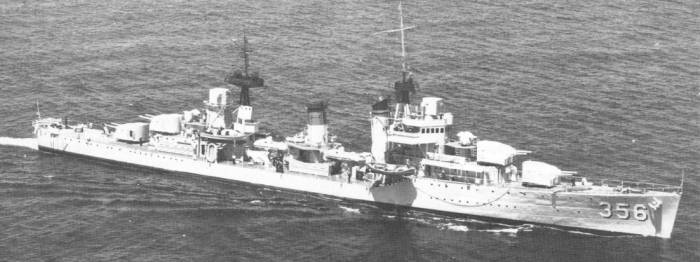
The First USS DD-356 Porter (same class)

Selfridge returned to Pearl Harbor on 6 February and was underway again on the 9th to escort Saratoga to Bremerton, Washington for permanent repairs. In mid-March, she returned to Hawaii in the screen of a convoy and, by the end of the month, had escorted more supplies to Canton. In April, she carried Marine Corps personnel and mail to Palmyra and Christmas islands, then proceeded to Bora Bora in the Society Islands, to rendezvous with and escort convoys carrying reinforcements to the Samoan and Tonga groups. On 21 May, she departed the latter group for the New Hebrides and Australia; where, by the end of the month, she had commenced coastal escort work. A unit of TF 44, she remained in Australian waters into July; then, with others of the force, proceeded to the Fiji Islands to rehearse for Operation Watchtower, the assault and occupation of Guadalcanal and Tulagi.

Soon after 0120 on 7 August, TF 44, now designated TG 62.6, the screening group for the transports, arrived in the Guadalcanal area. At 0620, Selfridge opened fire on a small gasoline carrier entering Tulagi harbor. A few hours later, the transports moved in toward the beaches. At 1320, the Japanese sent in a high level bombing attack. Shortly thereafter, they followed that strike with a dive bomber attack. On the 8th, Selfridge continued to screen the transports and, after a noon bombing attack, picked up two Japanese airmen. On the morning of the 9th, she assisted survivors of the Battle of Savo Island and, with Ellet, sank the badly-damaged Australian cruiser, Canberra; then, toward evening, departed the area to escort the transports to Noumea.

For the remainder of the month, the Australian group (TF-44) screened the carriers of the air support group. On the 31st, the ships headed back to Brisbane; and, for the next nine months, Selfridge continued to operate with that force in the Coral Sea to prevent a Japanese landing at Port Moresby and to cover Allied shipping to the Papuan peninsula.

In May, Selfridge was reassigned to the 3rd Fleet. On the 12th, she arrived at Noumea. Through the summer, she operated with cruisers of TF 36, later TF 37, and participated in exercises with TF's 38, 39, and 34. In late September, as a unit of the 3d Fleet's amphibious force, she escorted an LST convoy to Vella Layella, then commenced nighttime patrols up “the Slot” to intercept Japanese shipping.

IPB Image

On the night of 6 October, Selfridge, O'Bannon, and Chevalier intercepted an enemy force of six destroyers, three destroyer transports, and smaller armed craft some 12 miles off Marquana Bay as it attempted to evacuate land forces from Vella Lavella. In the ensuing Battle of Vella Lavella, Chevalier was torpedoed and damaged beyond repair. She was sunk on the 7th by an American torpedo. Selfridge and O'Bannon were both heavily damaged; Selfridge by an enemy torpedo, O'Bannon by enemy action compounded by collision with Chevalier just after the latter had gone dead in the water. Personnel casualties on board Selfridge amounted to 13 killed, 11 wounded, and 36 missing.

Temporary repairs to Selfridge were made at Purvis Bay and at Noumea. Permanent repairs, including the installation of a new bow, were made at Mare Island; and, after refresher training out of San Diego, she returned to Pearl Harbor on 10 May 1944 in time to join the forces staging for the invasion of the Mariana Islands. Initially assigned to TG 50.11, she joined TF 58, the fast carrier force, at Majuro in early June; and, on the 11th, screened Bunker Hill as sweeps were conducted over Guam. On the 13th, she participated in a shore bombardment of Saipan to cover minesweeping operations off that target island; then shifted to night fire. On the 14th, she joined the fire support unit; and, on the 15th, screened the transport area as the assault troops landed on Saipan. From then to the 17th, she rotated between daytime screening activities and nightime harassment duty. On the latter date, word of a Japanese force moving in from the Philippines reached the assault force, and Selfridge rejoined TF 58 and took station as the linking vessel between TG's 58.7 and 58.3. On the 19th, the Battle of the Philippine Sea raged; but none of the enemy's aircraft came within range of Selfridge's guns. On the 20th and 21st, the Japanese proceeded westward. On the 24th, Selfridge rejoined the transport screen off Saipan; and, on the 26th, resumed fire support duties.

Selfridge departed Saipan on 11 July; and, screening the transports, arrived at Eniwetok on the 15th. Three days later, she was underway again to return to the Marianas with reinforcements for the Guam assault. She arrived off Agat on the 22d, the day after the initial assault and, for the next three weeks, provided screening and fire support services and conducted anti-boat and barge patrols. On 10 August, she sailed for Eniwetok, whence, she returned to Pearl Harbor. On 21 August, she received orders back to the Atlantic.

Transiting the Panama Canal on 7 September, Selfridge proceeded to New York for an abbreviated overhaul after which she joined TF 65; and, serving as flagship, commenced transatlantic escort duty for convoys plying between the east coast and Tunisia. Continuing that duty until after the fall of Germany in May 1945, she completed her last run at New York on 7 June. Upkeep and training exercises in the Caribbean and off the Maine coast took her through August; and, on 15 September, she returned to New York to prepare for inactivation.

Selfridge earned four battle stars during World War II.

On 15 October 1945, Selfridge was decommissioned, struck from the Navy list on 1 November 1945 and scrapped in October 1947.

IPB Image
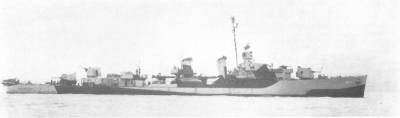
Selfridge (DD-357) in late-wartime disruptive camouflage paint. Originally designed for use as destroyer squadron leaders, the ships of the Porter class were extensively modernized during World War II to give them a better antiaircraft capability.

FeezyWeezy
Undertow, if you want more info...I'll look into it if you want...
banno22
nice boats u posted the only boats i know of is H.M.S hood bismark http://www.voodoo.cz/battleships/ this link has got some of the boats they used in the WW2 mobrules.gif
This is a "lo-fi" version of our main content. To view the full version with more information, formatting and images, please click here.
Invision Power Board © 2001-2026 Invision Power Services, Inc.