
 Notable People of WW2, Hero's, veterans, leaders, the famous and alike. Notable People of WW2, Hero's, veterans, leaders, the famous and alike. |


| FeezyWeezy |
 03/19/06 1:54pm 03/19/06 1:54pm
Post
#1
|
|
Major  Group: Banned Posts: 609 Joined: January 14th 2006 From: Gone Member No.: 1533  |
Ok, time for another chapter of hostory facts. I'll start with some WW2 Aces.
Erich Hartmann  The highest scoring ace of all time was the great German Luftwaffe experte Erich Hartmann with 352 aerial kills. Flying Bf 109s (Me-109s) against the overmatched Soviet MiGs and Yaks for almost three years, he accumulated his unrivalled score. Hartmann claimed, that of all his accomplishments, he was proudest of the fact that he never lost a wingman. He is also reputed to have said. "Get close .. when he fills the entire windscreen ... then you can't possibly miss." Hartmann was born in 1922, in Weissach, Wurttemberg. At age 19 (1941), he joined the Luftwaffe and was posted to Jagdgeschwader 52 (JG 52) on the Eastern Front in October, 1942. He scored his first kill in November, and only achieved his second three months later. In the first half of 1943, he worked out some of the tactics which would prove so successful later on. If he was attacked from behind, he would send his wingman down low and out in front. Then he would get behind the enemy and fire a short, quick accurate burst, waiting "until the enemy aircraft filled the windscreen." He would normally content himself with one victory; he was willing to wait for another day. His natural talents began to tell: excellent eyesight, lightning reflexes, an aggressive spirit, and an ability to stay cool while in combat.  A Messerschmitt Bf 109G-6 Kursk As JG 52 retreated along with German ground forces in 1943, Hartmann's score began to mount. The great Kursk offensive, Operation Zitadelle, began on July 5. The Luftwaffe planned to screen the Wehrmacht's panzers from the Soviet Il-2 Sturmoviks, armored tank-busting aircraft, armed with twin 37mm cannon. Hartmann's Staffel 7 of JG 52 moved up to Ugrim, only 14 kilometers behind the front. As the Panther and Tiger tanks moved up, Junkers Ju.52 transports flew in supplies. On the morning of the 5th, four of Staffel 7's pilots did not return, apparently their compasses misled them, due to extraordinary iron ore deposits in the area. Hartmann was promoted to Staffelkapitan on the spot. The offensive ground forward slowly on the 6th and 7th; obviously the Russians had dug in and prepared defensive lines in depth. July 7, 1943 On the morning of July 7, 1943, sun rose over Ugrim in the northern Ukraine about 3AM. Staffel 7's Me.109 G10's lay scattered around, in the deep grass of the Ugrim airfield. Hartmann's personal plane, decorated with a large Roman numeral 'I' and the name Usch in a red heart. (Usch Paetch was his fiancee, whom he wrote to daily.) In the comfortable summer weather, the pilots slept in tents. On waking, Hartmann dressed in a gray shirt, blue-gray trousers, and gray shoes. He washed up and shaved in a small stream and ate breakfast, two eggs, cooked by a couple of Russian girls. He and the other three pilots in his Schwarm were assigned to cover an F.W.189 on a dawn reconnaissance mission. Erich joked with his crew chief, 'Bimel' Merten, and strapped himself into the cockpit. At 3:04, the recon plane started and Hartmann set Messerschmitt's flaps and checked the fuel while Merten cranked the starter. The DB 605's twelve cylinders coughed, belched smoke, and then caught smoothly. His three comrades followed him to the take-off spot. He gunned the engine while stomping on the brakes. When he released them, his 109 shot forward and quickly reached 160 km/hour. He gently pulled back on the stick and was airborne; the other three followed him closely. They all banked left as they went through post-take-off routines: retract landing gear, close radiator flaps, ease back on the throttle, and check gauges, guns, and gunsight. They climbed to 1300 meters as they flew northeast and then swung southward, with the Fw 189 in view. The flight proceeded uneventfully and the recon plane headed for Ugrim. Hartmann's radio crackled with a report from Adler, the German forward spotting post; a group of ten to twenty Russian planes were headed west. Hartmann throttled up a bit, gained altitude, and turned his Schwarm toward the east without sighting anything for several minutes.  Drawing of Hartmann's Bf-109G Messerschmitt "Gustav" 6 Sturmoviks Soon enough, many large Il-2's came into view. With its armor and rear gunner, the Sturmovik was a tough target. With the Sturmoviks closing head-on, Hartmann unhesitatingly ordered an attack. He dived down below them, picking up airspeed, then banked around and came up behind and beneath them, aiming for his target's vulnerable ventral oil radiator. The Il-2's flew straight on. Hartmann's Bf 109 roared along, doing over 400 MPH; Hartmann streaked into a Sturmovik's blind spot. At 200 yards, its wingspan filled his gunsight ring; still he closed in to 150, then 100 yards before firing. He briefly triggered his 20mm cannon and his two 12mm machine guns, for about one and a half seconds, before his speed carried him in front of them. As other Bf 109s struck their targets, Hartmann glanced back and saw blue flames and black sooty smoke streaming from the Sturmovik's radiator. His twenty-second victory of the war. Under the deadly attack of the Messerschmitts, the formation of Russian airplanes began to break up. Having regained altitude, Hartmann again zoomed down below the tail of an Il-2. He checked his own rear and stabilized his aircraft. This Russian pilot, alerted to the danger, spotted him and turned sharply to evade. The young blond ace matched the turn and instantly estimated the lead needed for a deflection shot. At 150 meters, he opened fire, and his bullets tore into the side of the Russian tank-buster. More blue flame and black smoke poured from his twenty-third victim's oil radiator. As the remaining scattered Russian planes fled eastward, Hartmann radioed his Staffel to return to Ugrim. About 4AM, as they approached the field, Hartmann waggled his wings twice, indicating his two victories. On landing, Mertem and other ground crew gathered around him, offering congratulations. Hartmann walked to the operations tent to file his Gefechtsbericht, his after-action report. Early reports from the Adler posts already showed more Russian air activity than on the 5th or 6th. Four pilots sat in their planes, ready to take-off in less than a minute. Hartmann soon fell asleep by his own machine. But only briefly. Two More Sorties By 5:50, he was back in the air, leading a flight of 109s on a frei chase, and he soon found more Il-2s, escorted by fighters. The Messerchmitts attacked successfully, with Hartmann downing another Il-2 and an LaGG-3 fighter. Within an hour, he was back on the ground, with four victories for the day. Late that afternoon, he led the Staffel up again, to the northeast. They found a group of Soviet LaGG-3 fighters, which they engaged in a sprawling dogfight. It was over quickly and Hartmann had shot down three enemy fighters, making it seven for the day, his largest score so far.  Experte He reached 50 by August of 1943. Within the month, he had reached 80, and was promoted to lead 9./JG52. Earlier in the war, 25 or 50 victories would have earned a German fighter pilot the Knight's Cross. By late 1943, Hartmann had to down 148 before he earned his Knight's Cross. By March 2, 1944, he had reached a total of 202, earning him the Oak Leaves. He was the fourth Luftwaffe fighter pilot to reach 250, the first to reach 300, and the only one to reach 350. The Diamonds 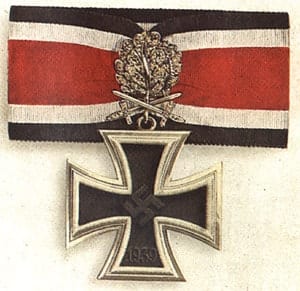 He was awarded the Third Reich's highest regularly awarded military decoration: The Knight's Cross to the Iron Cross with Oak Leaves, Swords and Diamonds. To be accurate, the highest military decoration was "The Grand Cross to the Iron Cross." It was only awarded once to Hermann Göring. The second highest military decoration was "The Knight's Cross to the Iron Cross with Golden Oak Leaves, Swords and Diamonds" and was also awarded only once to the Stuka ace Hans-Ulrich Rudel. Thus, Hartmann's medal, "The Knight's Cross to the Iron Cross with Oak Leaves, Swords and Diamonds," was, to be precise, the third highest German military decoration through WW2, was awarded to 27 soldiers, 12 of whom were Luftwaffe pilots. Near the end of WWII, in early May 1945, the Luftwaffe command ordered Hartmann, then Gruppenkommandeur of famous Jagdgeschwader 52, and his Commodore, Hermann Graf (another pilot, who had earned the "diamonds" to the Knight's Cross) to fly to the British sector. Both officers disregarded this order, because they felt responsible for Jagdgeschwader 52's pilots, ground crew, family members, and other civilians, who had joined the squadron, seeking protection against fierce aggression by the Czechs. The officers ordered the destruction of the unit's aircraft, and then the unit moved west in direction of territory already occupied by US troops. On May 8th, 1945, the soldiers and civilans surrendered to US troops in the region between Bavaria (German provence) and Czech border. But on May 17th, the US Army delivered all of these German troops and civilians to the Red Army. Like all others, Hartmann was then deported to Siberia, where he was sentenced to 50 years of hard labor. (Hartmann has since been rehabitated by Russian justice, which declared those sentences illegal in 1995.) The Soviets pressured him to support a build-up of an East German air force and tried to turn him into an undercover agent against the West. Hartmann refused, even though the Soviets threatened to kidnap and kill his wife and daughter, living in West Germany. Hartmann did not return to Germany until 1955, when the last German POWs were released along with the establishing of diplomatic relations between West Germany and the Soviet Union. In 1956, Hartmann joined the newly established West German Luftwaffe and contributed to the build-up of new fighter units. In 1959, he became the first commodore of Jagdgeschwader 71 "Richthofen." Erich Hartmann died in 1993. http://wernerhartenstein.tripod.com/hartma...9;s%20grave.jpg Hartmann's grave, Weil im Schönbuch near Stuttgart -------------------- C'est pas l' histoire d'un jour
Qui rime avec amour, Plutôt un long séjour Mais pas: un "pour toujours" |
   |

 
|
  |
Replies
| FeezyWeezy |
03/20/06 9:11am
Post
#2
|
|
Major Group: Banned Posts: 609 Joined: January 14th 2006 From: Gone Member No.: 1533 |
George Beurling "Buzz" "Screwball"
Our Canadian that wanted to go China, fly for Finland but ended up in a UK Spitfire.  George Beurling was born in Verdun, Quebec in 1921. His parents had high hopes for George, wanting him to go to University and study medicine. Mostly George wanted only to fly, "Ever since I can remember, airplanes and to get up in them into the free sky had been the beginning and end of my thoughts and ambitions". This was borne out in his school marks, which were barely above passing. He had taken his first flight by age 9, and hung around LaSalle Road airport outside of Verdun every chance he got. He often made the chances, skipping school to watch airplanes and do odd jobs for the mechanics. When he was sent to his room he spent hours building model airplanes. He sold these creations and used the money to buy flying lessons. The only books he was interested in were about flying, especially tales about the WWI aces. He studied the tactics and aerial battles of WWI, discussing them and arguing with anyone who had the time. Other kids bullied him because of his obsession with flying, and when he was chased home one day his father bought boxing gloves and taught to fight. He also said, "George I don't want you to look for a fight, but I don't want you to run away." His home life made a distinct impression on him and his personality. His father was a devout Presbyterian church goer, but something early in his adult life made him switch allegience to a stern Evangelical sect called the Exclusive Brethren. They had absolute faith in the Bible. For the Beurlings there were daily bible studies, frequent reading of the Scriptures and weekly attendance at church. The Brethren were dead set against pleasures of the flesh, or for that matter, most other pleasures. It took years before they got a radio, and tobacco and alcohol were shunned. To that end, George never did take up drinking, smoking or swearing. Still, George managed to have fun in and around Verdun and on his relative's farm. He was athletic and became a good swimmer, although he didn't participate in team sports. One day at the Verdun airport, one of the pilots offered to take him up for a spin in an airplane if he got his parent's permission. He rushed home and asked them. His mother jokingly said, "Sure George, you can go to the moon." He got his first flight and was totally hooked on flying. He first took the controls of an airplane when he was 12, and soloed in the winter of 1938. He saved up enough money to afford a weekly lesson, but it was too slow for him. He quit school in grade 9 and left home, taking a train to Gravenhurst, Ontario. There he got a job hauling air freight into the bush for mining companies. It was dull work, but he got many hours of flying time logged and was responsible for navigating as co-pilot, building up a great store of practical experience in "seat-of-the-pants" flying. After getting his pilots license he headed west to Vancouver hoping to get a commercial license. Then he planned to join the Chinese airforce flying against the Japanese invading Manchuria. Beurling tried everything that came along his way that had anything to do with flying. In Edmonton he joined a flying competition that included several RCAF pilots. He won the event. He was anything but humble on receiving the prize. He told the crowd that if the pilots from the RCAF was the best Canada could do, then they were in trouble. Several years later when he was rejected by the RCAF, he attributed the rejection to his comments in Edmonton, and carried a chip on his shoulder for the rest of his life. Beurling often claimed that the WWI German ace, Ernst Udet, taught him how aerial combat maneouvers. However, it simply wasn't true. In the mid-thirties Udet was in California flying as a stunt pilot in Holleywood, but he had left for Germany and the newly founded Luftwaffe by the time Beurling was flying. While trying to get to China George snuck into the U.S.A. on a tramp steamer and was caught. He was thrown into jail for two months and then released. By then WWII was on and George went into the first RCAF recruiting post and presented himself for duty, but his poor academic record got him booted out of the recruiting station. He took this to be a personal slight because he had made remarks against RCAF pilots in Edmonton. However, the RCAF at the time were very small, under equipped in aircraft and at the time were accepting only pilots with good educations. These men founded the core of the British Commonwealth Air Training Plan, teaching others to fly for combat. As the Russians and Fins were in battle against each other he decided to head to Europe and join the Finnish airforce fighting against the Russians. The Finnish embassy in Montreal insisted on his parents permission as he was still only 18. His parents refused to give it. Determined to get into the fighting he signed onto a munitions ship, the Valparaiso going to England, a sign of real despiration. The trip over was very hazardous as the German U-Boats were highly active in the north Atlantic, sinking ships at will. Once in Glasgow he went to the RAF recruiting office. They were impressed with his flying abilities, but told him that they would need a birth certificate before they would sign him. Unfortunately, George hadn't brought his birth certificate along. Off back across the Atlantic he went for the document, surviving a direct torpedo hit on his ship. And then back again to England. This time the English signed him immediately. The Channel Front  [url="http://hedgehoghollow.com/buzz/bbspit.html"]"Buzz" Beurling's Spitfire The photo shown is creditied to "Cecil Brown, Beurling family."[/url] Beurling was sent to a large training school in the north of England for a short time, as he was already a licensed pilot. The next stage of training a fighter pilot was to an Operational Training School (OTS) flying Supermarine Spitfires. He studied under the ace Ginger Lacy, who was eventually renowned for shooting down 30 Germans, including the Heinkel 111 bomber that had hit Buckingham Palace. Beurling got his first taste of warfare while on leave to London. During an air raid he was astounded by seeing a little girl playing with a doll while bombs fell nearby and shrapnel screamed through the air. Rushing to her, he saw her arm had been blown off, and she was in shock. He scooped her up and carried her to an aid station. Another girl was pinned in a basement room while water from a ruptured main filled it. A doctor hurriedly amputated her leg and carried her to safety. These incidents hardened the naive Beurling. Up to then he had thought that the war was a great adventure for those who could fly. In the final stages of fighter training he astounded instructors with his air-to-air gunnery, consistently scoring direct hits on the droge targets. Ginger Lacy offered him a commission on the spot, but perhaps distrusting officers, or more likely due a lack of self confidence, he turned it down. He announced that he preferred to live with the Sargeant Pilots. Once posted to 403 Sqdn, RCAF he was again offered a commission, and he again turned it down. He apparently felt that he had more in common with the NCOs and enlisted men on the base than with the officers. He was quite popular with the fitters and riggers that looked after his aircraft, as he took an interest in the aircraft and their work. He would take them up in the squadron hack, a Miles Magister, for aerobatic displays. He also occasionally joined them in pubs, although he drank only soft drinks, and their quarters for bull sessions afterwards. His fitter, George Demare, tells of an incident when he flew with Beurling. My excitement began with a routine takeoff followed by our buzzing of a rugby game in progress. Down over the goal posts we flew, causing the startled players to hug the ground, then up over the other goal posts and away. Next we swooped down over a herd of cattle, then over a potato field so low we had to climb to clear the hedge at the far end. More excitement was provided by flying between two trees with inches to spare. Following those low-level escapades, it was up into the skies with a spiral climb, then a variety of loops, turns, stalls, and spins. For the grand finale Beurling took us into a power dive - straight down at a horrendous speed. Alas! the ground was so near I abandoned all hope. Then less than 100 feet from the ground Beurling executed a vertical hairpin turn and we were skybound again. After a few more aerial manoeuvres we came in for a smooth landing. When I emerged smiling, Beurling patted my shoulder and said "Good flying!" These activities gained him his first nickname "Buzz". His commanding officer placed him in the Tail-End-Charlie position. At this time the British were still flying in a flight of 4 aircraft, with three flying in a V, and with one aircraft flying behind and slightly above the others. This pilot was to weave back and forth inside the V watching for the enemy behind them. It was nearly impossible to maintain this position, while weaving and looking out for enemy aircraft. The Tail-End-Charlie frequently did not make it back to base as the Germans attacked him first. It was a seriously flawed tactic that the English eventually abandoned, but it cost many pilots their lives. The Germans used a loose finger-four formation, with two planes flying as a pair. They could see behind each other and attack targets as well. One day in March, 1942 on a sweep over northern France in Spitfire Vs, George recalled: "we were in the air, our tails in the sun, vulnerable to attack, when I reported Huns." However, nothing was visible. He was told to maintain radio silence! "Five minutes later we got bounced and I got shot." Disregarding instructions he pulled out of formation with three Focke-Wulf 190s on his tail. His engine hood was shot away, a shell splinter grazed his ribs and he figured himself for dead meat, when he got an idea. He dropped his landing gear and flaps, slowing instantly, and the Germans overshot him. Now being in a poor position they sped away to their base. On returning to base he lit into his commanding officer in front of everyone. While justified, it showed poor discipline on his part. Shortly after he was transferred to 41 Squadron, RAF. He had more problems with his new commanding officer, but he downed his first German. At 24,000 ft over Calais, five FW-190s attacked him while in the Tail-End-Charley position. Cannon shells slammed into his wings knocking out his own cannons. Again, cunning saved his hide. He pulled straight up into the sun, the FW-190s followed and shot past him, as they had more speed, having just pulled out of a dive. As they climbed past him, he lined up on the middle plane and fired his four 0.303 Browning machine guns. A German aircraft exploded, tearing off the wings and splitting the fusilage. Back on the ground he was chewed out for breaking formation! Beurling responded "Six of us broke formation, five Jerries and I". Yet again, two days later, over Calais he was in the Tail-End-Charlie position when he spotted a flight of 190s below them and heading their way. The rest of the flight ignored his warnings, as usual. This time he didn't wait to be on the receiving end of the German's cannons. He peeled out of formation and dove on the Germans, scoring a perfect deflection shot on the lead plane. It fell away smoking and crashed into the sea. Once again he was reprimanded for disobeying orders by leaving formation. Disgusted with the crass stupidity of his commanding officers, he offered to take the place of a married pilot who didn't relish being posted to Malta, and was promptly granted permission to leave.  Getting to Malta was problematic, as the Germans and Italians were trying to cut it off and pound it to pieces. Any ship getting within range of Axis bombers flying from Sicily were in grave danger and German U-boats prowled the waters. The 16 new Spitfire Mk Vs and their pilots destined for Malta were shipped in the aircraft carrier HMS Eagle. When they were within flying range of Malta (600 miles) the pilots were given instructions on the heading and approximate distance to the island and flew off the deck of the Eagle. This was difficult to do as the Spitfire was never designed for this. The technicians onboard Eagle put wedges in the flaps to hold them at 50% (Spitfires had only 2 flap settings, full up and full down), then the pilots had to rev their engines to the max while standing on their brakes. The deck officer waited until the Eagle rose on a wave and signalled them off. Once off the deck the Spitfire would drop close to the ocean before flying. Once altitude was gained, the pilots dropped flaps all the way, the wedges fell out and then retracted their flaps. The Germans did their best to confuse the new pilots by giving false instructions in English, but most pilots were not fooled by this ruse. Beurling had just landed in his brand new Spitfire, when the cockpit hood was whipped back, the groundcrew pulled him out and another pilot climbed into the cockpit. As soon as it was refueled and armed it roared off to confront an inbound flight of Axis fighters and bombers. He had landed in the middle of an air raid. Many Spitfires were destroyed on the ground before they had a chance to get into the fight.   Allied Spitfires on the defense. Malta being bombed. His commanding officer of 249 Squadron RAF on Malta was S/L Stanley Grant, with FL Laddie Lucas his flight commander. He proved to be a good judge of character. He said of George, "Beurling was untidy, with a shock of fair, touseled hair above penetrating blue eyes. He smiled a lot and the smile came straight out of those striking eyes. His sallow complexion was in keeping with his part Scandinavian ancestry. He was high strung, brash and outspoken. He was a rebel, yes; but I suspected that his rebelliousness came from some mistaken feeling of inferiority. I judged that what Beurling needed most was not to be smacked down but to be encouraged. His ego mattered very much to him, and from what he told me of his treatment in England, a deliberate attempt had been made to assassinate it. I made him a promise that I would give him my trust and that if he abused it he would be on the next aircraft out of Malta. When I said all this those startling blue eyes peered incredulously at me as if to say that, after all his past experience of human relations, he didn't believe it. He was soon to find out that a basis for confidence and mutual trust did exist. He never once let me down." He arrived at the height of the siege of Malta by the German Luftwaffe and Italian Regia Aeronautica. They were pounding the island night and day to blast it into submission. Malta was the perfect location to stage interception raids on Axis ships trying to reinforce General Rommel in North Africa. Their main airbase, Takali Field, was a shambles. There was a small shack for an ops room, the revetments for aircraft were made of broken rock and sandbags, and slit trenches abounded. It was blinding white and hot as hades in the day. Every morning the operational pilots would have to go out and sit in their aircraft on 1 minute notice. As the sun rose higher the all metal fighters heated up like ovens, with a scantily clad pilot sweating in it.  A German photo of Takali Airfield "On the 12th I got my first real feel of Malta action when Raoul Daddo-Langlois - "Daddy Longlegs" - and Berkeley-Hill, Jack Rae and I were sent up to intercept 15 Me 109s. The enemy planes split us and Berkeley-Hill and I found ourselves alone. About four Jerries jumped B-H, and I pulled up sharply under one and blew his tail off. He went down vertically. Nobody saw him hit the deck, but Berkeley-Hill had seen my burst hit so I was credited with a damaged." "In those moments of combat I proved to myself that I had the stuff to match flying and shooting with the gentlemen from Sicily. That's what I wanted to find out. As we walked away from our Spits, Daddy Longlegs grinned and said: "Good show, Beurling!" I felt swell." During the following lull in fighting Beurling made copious notes in a black book that he carried with him. In it, he made detailed calculations on the angles, speeds and shots that he had made and missed so he could work out how to hit the target the next time. He developed a set of equations that he committed to memory that allowed him to perfect the art of the deflection shot. Deflection shooting was difficult at that time as the Spitfire V had only a ring and bead for an aiming device. Learning how to lead a plane so your shells hit the same space as the aircraft did at the same time was tricky to learn. Many never did, but he mastered it. On July 6 he got to put into practice what he had learned when 8 Spits were sent to intercept 3 Italian Cant bombers heading for Malta. They were escorted by no less than 30 Macchi 200 fighters. Beurling led the assault diving straight through the Macchi formations and pulling up to fire on a big, Cant bomber. His first burst hit the pilot blowing off his head, the second took out an engine. Despite the damage, it made it back to base in Sicily flown by the bomber aimer/observer. Beurling turned quickly and fired directly into an Italian fighter, knocking it down in flames. He lined up another Italian fighter but it dove sharply to get away. Beurling followed all the way from 20,000 feet to 5,000. The Italian had no choice but to pull up and George caught him square in his sights. The Macchi blew up. Later the same day he led an attack on 2 Junkers Ju-88s escorted by 20 Bf-109s. A wild dogfight broke out and 2 German fighter pilots headed right for Beurling. He circled tightly and caught a 109 with a long burst from 800 yards and at a nearly impossible angle. He hit the fuel tanks and it went down in flames. In one day he increased his kill to 5 and became an ace. Back at base the other pilots snubbed him by not throwing an acknowledgement party of his ace status. He was only interested in attacking Germans. He admitted that he was a loner, but Lucas explained to him in simple, direct language that if he didn't fly as a team, he would be posted into the desert at some even more God-awful post than Malta. George flew with his wingman as well as he was able, however, over Malta most dogfights ended up being a single Spitfire against many enemy aircraft. It was on Malta that he received his second nickname, "Screwball". Lucas recounts, Beurling pulled up a chair. He sat there, bent over this moving mass of activity, his eyes riveted on it, preparing for the kill. Every few minutes he would slowly lift his foot, taking particular care not to frighten the multitude, pause and - thump! Down would go his flying boot to crush another hundred or so flies to death. Those bright eyes sparkled with delight at the extent of the destruction. Each time he stamped his foot to swell the total destroyed, a satisfied transatlantic voice would be heard to mutter "the goddam screwballs!" So George Beurling became "Screwball" to 249, to Malta and to the world. It was an endearing appellation. It suited him exactly. What's more he like it. It helped his ego. It made him feel he was now regarded as an established member of the team. He felt the gaze beginning to be focused on him. At last he was a figure in his own right.... George took to hunting the ubiquitous lizards around Takali airfield with his .38 pistol. He would go out alone and stand motionless waiting for a lizard to get within a prescribed range where he estimated they were roughly the size of a German fighter at 250 yards. This was his preferred range for firing. He often hit the lizards with a single bullet. He was completely focussed on being the best fighter pilot that he could be. Malta was a hectic station, with frequent, large scale raids by Germans and Italians. But the AA gunners on Malta quickly became the most proficient in the world with the constant practice they had. Many Axis aircraft were knocked down by the islands ground defences, as well as the Spitfires. By July 11 he had shot down two Bf-109s, three Macchi 202s, had a probable kill on a 109 and damaged a Junkers 88 bomber.  Malta Anti-Air Guns. His markmanship had become a legend. He once reported he had fired 5 cannon shells into the cockpit of an enemy plane. Allied soldiers found the plane with 5 cannon holes in the cockpit. A fellow Spitfire pilot said of Beurling, "He was so successful for many reasons, but the two most important were his eyesight and his knack for deflection shooting. He used to report sighting of aircraft many seconds before others saw them, and he knew whether he hit them in the front, centre or rear of their airplane and he usually used minimum ammunition." Lucas stated, "He had an instinctive feel for an aircraft. He quickly got to know its characteristics and extremes - and the importance of doing so. He wasn't a wild pilot who went in for all sorts of hair-raising manoeuvres, throwing his aircraft all over the sky. Not at all. George Beurling was one of the most accurate pilots I ever saw. A pair of sensitive hands gave his flying a smoothness unusual in a wartime fighter pilot ... This acute sensitivity told him that a Spitfire was only a fine gun platform if it was flown precisely. He therefore set out to make himself the master of the airplane. He never let it fly him." He never shot haphazardly at an aircraft that was too far away. He liked to fire from about 250 yards with several short, hard bursts. That was usually enough. On July 14 he ended up on the receiving end of some German lead. Three Bf-109s and 2 Italian Reggiane 2001 fighter/bombers jumped him. He turned towards the Italians figuring they could do less damage to him, as they were not equipped with cannons, but his aircraft was shot up pretty bad. Back at base he counted 23 holes in his aircraft. He got even a while later downing his first Reggiane and damaging a Ju-88. Beurling waxed hot and cold on his Italian opponents. In a 1943 interview he referred to the Italians as "ice-cream merchants", saying: "The Eyeties are comparatively easy to shoot down. Oh, they're brave enough. In fact, I think the Eyeties have more courage than the Germans, but their tactics aren't so good. They are very good gliders, but they try to do clever acrobatics and looping. But they will stick it even if things are going against them, whereas the Jerries will run." On July 27 Beurling dealt the Italians a hard blow by killing their leading ace, Captain Furio Niclot and shooting down his wingman, Serg. Magg. Faliero Gelli. Together they had knocked down 8 Spitfires over Malta. Gelli never saw him coming, he hit the wingman's radiator and engine sending him down to crash on an island. He was captured and made a prisoner and thus survived the war. Niclot was killed outright seconds later. Beurling was lining up on a third Macchi when two Bf-109s came up after him. He peeled off and attacked the Germans, hitting the leader in the fuel tanks and sending him down in flames. He was on a roll. He landed, refueled and went back up to attack four Bf-109s. He shot down one in flames and received credit for a damaged plane that limped out of the fight smoking badly. For his amazing day's work he received the Distinguished Flying Medal.  Distinguished Flying Medal Near the end of July he shot down another Bf-109, and his superior officers finally had to promote him to an officer and ordered him to accept. The press were anxious to interview him, and it wouldn't do to have the top fighter pilot in Malta be a Sergeant Pilot. So he became a Pilot Officer, much to his disgust. He, and many of the surviving pilots, were exhausted by the physical demands of fighter combat, stress, heat, poor nutrition and a form of dysentery they called "the Dog". Beurling had lost 50 lbs since arriving in Malta, the Germans and Italians were close to shutting down the island by cutting off it's food supplies. He was bed ridden for a week, but managed to drag himself into the air to battle the Messerschmitts that circled Malta. Several flights of Bf-109s jumped him. He managed a short burst that brought down a German, but his comrades shot Beurling's plane to pieces. He crash landed in a field because his parachute was too loose for him to jump out. By the end of August he collected a shared victory over a Ju-88 that had been separated from it's fighter escort. He was again bed-ridden for several weeks due to continued weakness from the poor quality food. In the middle of September he took a plane up but got it badly shot up by a German. He took revenge a few days later when he attacked 18 German fighters. One blew up when he hit the oxygen bottles, another fell away smoking and a third went down in flames. Then came October. The Axis powers pulled out all of the stops to crush Malta. It was a vicious battle, half of Beurling's squad was shot down in one week. His only close friend, a fellow Quebecer, was killed. After that he had no more friends, it was easier that way. The air war over Malta became a real grudge match. Pilots on both sides were shot in the air while they hung from their parachuts, or while they floated in the water. Several Italians who landed on Malta were tortured and killed before the British troops could capture them. Little sympathy was shown by either side towards their opponents. By the 14th of October Beurling had shot down 5 more German planes, three in one day. He should have been awarded the VC for that effort. Three flights of Spitfires scrambled to intercept 95 Axis planes. Beurling spotted them first, but his radio died and he couldn't contact the others. He piled into the Axis formations, damaging a Junkers 88, and downing 2 Bf-109s. Going home he came across a damaged Ju-88 and shot it down. Actually the huge enemy formations worked in his favour, as the large number of German and Italian fighters couldn't attack him all at once. They either got in each other's way or no one attacked him. Like Bishop he adopted the fast sneak attack and a quick withdrawal method. He could usually count on damaging or downing the first aircraft he attacked, and he got out with the resulting confusion. Then he could circle and pick off stragglers or wait for a favourable chance to attack again. His last fight over Malta was, as usual, spectacular. He led 8 Spitfires in an attack on 8 Ju-88 bombers and 50 fighters. He cut out a bomber and shot it down, but the rear gunner hit him in a finger and forearm. He attacked and damaged a 109 in front of him, but two behind him shredded his tail and wings with cannon fire. He dove fast for the water, losing the Germans. Coming out of the dive he spotted a 109 below him and shot it down. But that attracted attention from more Germans. "I'd been so intent on the guy in my sights and on Willie's tail that I'd forgotten I had a tail of my own." "Just as I shot Willie's pal down, a Messerschmitt nailed me from behind, right in the belly of the Spit. A chunk of shell smashed into my right heel. Another went between my left arm and body, nicking me in the elbow and ribs. Shrapnel spattered into my left leg. The controls were blasted. The throttle was jammed wide open and there I was in a full-power spin, on my way down from around 18,000 feet. I threw the hood away and tried to get out, but the spin was forcing me back into the seat. "That is it," I said to myself. "This is what it's like when you're going to die." I didn't panic. If anything, I was resigned to it. What the hell, this was the way I'd always wanted to go. Then I snapped out of it and began to struggle again. The engine was streaming flame but I managed to wriggle out of the cockpit and onto the port wing from which I could bail into the inside of the spin. I was down to 2,000 feet. At about 1,000 I managed to slip off. Before I dared pull the ripcord I must have been around 500. The chute opened with a crack like a cannon shell and I found myself floating gently down, the damnedest experience in contrasts I'll ever have. I caught my breath, pulled off a glove and dropped it to get some idea of the distance between me and the sea. A breeze caught it and the glove went up past my face. I laughed like a fool, then tugged off my flying boots and dropped them. Just as I did I hit the water. He was rescued shortly after by a launch from shore. When they got there he was floating in blood-stained water babbling about the bible that his mother had given him. The rescue squad searched his pockets and found it. He was patched up as well as they could on Malta and spent some time in hospital before being sent back to Britain. The flight back was in a Liberator bomber converted to a transport. The nineteen passengers rode in the bomb bay and fusilage without seats. George flew along with fellow Canadian ace "Billy the Kid" Williams and fighter pilot A.H. Donaldson. The aircraft ran into a ferocious thunder storm near Gibralter. Low on gas there was no alternate landing strip so, with poor visibility the pilot forced the bomber down. He couldn't control the plane well enough on descent into Gibralter and missed two thirds of the runway. The aircraft touched down too late and the pilot tried to pull back up. With the engines at full throttle but not generating enough power yet they crashed into the water. Beurling said afterwards that he could tell from the way the plane behaved that it was going to stall so he opened the emergency door and jumped just as the plane hit the water. He managed to swim the 160 yds to shore, despite a heavy cast on his foot. Only Donaldson, Beurling and another passenger survived. Beurling was hospitalized with shock and an infection in his wounded heel.  He was sent back to rest in Canada and Prime Minister Mackenzie King milked his presence with a "photo-op" and nearly messed everything up by being late. Beurling was worn out after a 21 hour flight across the Atlantic.  The next day he was given a hero's welcome parade through Verdun and Montreal. People lined the parade route despite a cold, slashing rain. Nearly 10,000 people packed the Verdun arena to see their hometown hero. The CBC sent an announcer to broadcast the whole spectacle to the rest of Canada. Being big about it, AC deNiverville, the senior officer for the RCAF No. 3 Training Command admitted that they made a mistake in not taking Beurling when he applied.  "This is one of the mistakes that the RCAF has made, and let us hope we will not make many more like that. We owe, the Royal Air Force a debt for being wiser than we were and readily accepting him." It was then George's turn on the podium. He spoke for just over four minutes. Opening with "This is no place for me, I'm a fighter pilot, not a speech maker." He continued, apologising for not always looking excited to be in Victory Loan Drives, but he was exhausted, bewildered and excited. He had gone in a few weeks from desperate, kill-or-be-killed battle to an overwhelming, adoring public. He was undoubtedly suffering from battle fatigue. The persona that George put forward for the public and the press was that of a hard-hearted, professional killer. He made statements like this on dog-fighting: "I wonder if he is going to blow or fry. There is no time for any other kind of thought. There is always someone on your tail and you have to be pretty sharp. There is no time to loiter around. You have to be hard-hearted too. You must blaze away whenever you are in a position to get his oxygen bottles or gas tanks." He gave a press interview that has been retained in the National Archives of Canada. In it he described a horrifying scene that, according to his brother David, haunted him in nightmares for years. In it he is attacking an Italian fighter aircraft. From Brian Nolan's book Hero, he quotes: "I came right up underneath his tail. I was going faster than he was; about fifty yards behind. I was tending to overshoot. I weaved off to the right, and he looked out to his left. I weaved to the left and he looked out to his right. So, he still didn't know I was there. About this time I closed up to about thirty yards, and I was on his portside coming in at about a fifteen-degree angle. Well, twenty-five to thirty yards in the air looks as if you're right on top of him because there is no background, no perspective there and it looks pretty close. I could see all the details in his face because he turned and looked at me just as I had a bead on him. One of my can shells caught him in the face and blew his head right off. The body slumped and the slipstream caught the neck, the stub of the neck, and the blood streamed down the side of the cockpit. It was a great sight anyway. The red blood down the white fusilage. I must say it gives you a feeling of satisfaction when you actually blow their brains out." He was undernourished after the starvation diet on Malta, and his wound in his heel festered. He was secretly admitted to the Royal Victoria Hospital for several weeks. He was allowed out only for his twenty-second birthday so he could enjoy his mother's chocolate cake. Following a full physical recuperation, although one foot was permanently shorter than the other, he was sent to help sell war bonds all across Canada. He made appearances at flight training schools, army camps and factories. He promoted Victory Bonds and enlistment. But he was a poor public speaker and he resented the boring work. When asked by a reporter about it he snapped "if I were ever asked to do that again I'd tell them to go to hell or else ask for a commission on the bonds I sold". In March, 1943 he was near the end of the bond drive in Vancouver. It was there he met Diana Whittall, the daughter of a respected Vancouver family. They dated, and went out swimming while he was there. They would marry 14 months later. By the spring of 1943 he was fit for duty. He griped that the RCAF was pressuring the RAF into transferring him, however, it turned out that he applied for the transfer with a letter to AC deNiverville. [color="#800080"][/color] The rest of the GREAT story about one hack of a Canadian Ace. This post has been edited by FeezyWeezy: 03/20/06 9:12am -------------------- C'est pas l' histoire d'un jour
Qui rime avec amour, Plutôt un long séjour Mais pas: un "pour toujours" |
|
|
|
Posts in this topic
FeezyWeezy Notable People of WW2 03/19/06 1:54pm +KS+ Blinky Bill Ok, before Feezy explodes this forum with gigant i... 03/19/06 2:35pm FeezyWeezy
[b]Eino Ilmari Juutilainen
[size=3][img]http://... 03/19/06 2:40pm +KS+ Blinky Bill If anyone is a friend of books, here´s list of bo... 03/19/06 3:09pm Sparta THE INFAMOUS RED BARON!!!
I know He i... 03/19/06 10:25pm Sparta Maj. Richard I. Bong
Bong grew up on a farm near [... 03/19/06 10:40pm Slimshady Well I would also like to mention my left nut. It ... 03/19/06 11:51pm
+KS+ Blinky Bill Ok, before Feezy explodes this forum with gigant i... 03/19/06 2:35pm FeezyWeezy
[b]Eino Ilmari Juutilainen
[size=3][img]http://... 03/19/06 2:40pm +KS+ Blinky Bill If anyone is a friend of books, here´s list of bo... 03/19/06 3:09pm Sparta THE INFAMOUS RED BARON!!!
I know He i... 03/19/06 10:25pm Sparta Maj. Richard I. Bong
Bong grew up on a farm near [... 03/19/06 10:40pm Slimshady Well I would also like to mention my left nut. It ... 03/19/06 11:51pm
 Maj. H8Red
Well I would also like to mention my left nut. It... 03/20/06 12:13am Undertow :hysterical: 03/20/06 1:17am UNDEAD 1 i have to say its very interesting-can you find so... 03/20/06 9:01am Lord Lipton wow guys. way to do your research. 03/20/06 9:23am FeezyWeezy I'm sorry to putt this person here, between al... 03/20/06 11:21am UNDEAD 1 VERY interesting cant wait forthe next! 03/20/06 2:15pm FeezyWeezy Albert Speer
The "Good" Nazi
[img]http:... 03/20/06 5:09pm UNDEAD 1 where do you find this info?
anyway you can do ro... 03/21/06 3:41am FeezyWeezy Erwin Johannes Eugen Rommel
[b][size=4]"Wüs... 03/21/06 12:03pm UNDEAD 1 thank you ,its always been unclear to me how he di... 03/21/06 12:34pm Undertow Alright, Feezy. Give me some history on Hans Joach... 03/21/06 12:47pm FeezyWeezy Hans Joachim Marseille
[size=4]"Der Stern von... 03/21/06 3:07pm FeezyWeezy Simo Häyhä
"Valkoinen Kuolema"
[img]ht... 03/21/06 10:23pm UNDEAD 1 WHOS NEXT? im addicted now! how about a german... 03/22/06 7:45pm FeezyWeezy Its time for a group of people which are related t... 03/22/06 10:52pm Sparta Theres little I can Say for those german Snipers
... 03/22/06 10:29pm Stickman I have read that the in the German air force in bo... 03/22/06 10:48pm FeezyWeezy I have read that the in the German air force in b... 03/22/06 11:17pm FeezyWeezy I have read that the in the German air force in b... 03/26/06 6:45am FeezyWeezy Operation Windsor, Carpiquet Aerodrome.
[b]Battl... 03/25/06 4:29pm UNDEAD 1 HOW COME THERES NOT A MAP FOR THIS BATTLE! do ... 03/25/06 5:46pm Hellfighter HOW COME THERES NOT A MAP FOR THIS BATTLE! ..... 03/26/06 9:22am FeezyWeezy Well maybe Bob and I can make a map about this one... 03/25/06 6:04pm UNDEAD 1 HEY HELL,for your info- about 8 years ago i was w... 03/27/06 3:38am Hellfighter HEY HELL,for your info- about 8 years ago i was ... 03/27/06 9:07am FeezyWeezy I will do Gen. Paulas, Tukegee Airmen and some ger... 03/27/06 7:56am UNDEAD 1 feezy i have to say these bios are very interestin... 03/27/06 10:23am FeezyWeezy Well I could find any detailed record from the num... 03/27/06 3:09pm FeezyWeezy [b]"Night Ghost of St. Trond"
[b][size=... 03/28/06 9:32am Hellfighter You've got to wonder, if the Allies new there ... 03/28/06 9:47am FeezyWeezy It was hard to figure out who killed who at most t... 03/28/06 3:59pm Hellfighter It was hard to figure out who killed who at most ... 03/28/06 7:48pm Hellfighter
[size="1"]Ramming attack was a tactic i... 03/28/06 8:00pm FeezyWeezy [size=3]Special Operations Executive
[size=2]Whe... 03/29/06 9:49am UNDEAD 1 before i played cod i played bf 1942. that was the... 03/29/06 11:06am FeezyWeezy before i played cod i played bf 1942. that was th... 03/29/06 12:55pm UNDEAD 1 [size=3]The Mustang was the best plane, very fast.... 03/29/06 7:26pm FeezyWeezy Matthäus Hetzenauer
[size=1]Born on December 23... 03/29/06 11:24am Radiation My people are not famous. Maybe in thier own resp... 03/29/06 1:34pm FeezyWeezy Klaus Barbie
http://worldatwar.net/biography/b/ba... 03/29/06 3:07pm Stickman Years ago I had a girlfriend (who looked remarkabl... 03/29/06 4:42pm FeezyWeezy Lyudmila Mikhailovna Pavlichenko [size=1][img]http... 03/30/06 4:23pm Leadmagnet Do one on Dieppe....Another "sacrifice" ... 03/30/06 6:42pm Hellfighter Do one on Dieppe....Another "sacrifice... 04/01/06 9:19pm UNDEAD 1 getting backed up? when do you play feezy,hehe... 03/30/06 7:00pm FeezyWeezy Time for one of the best Aces during the Finnish W... 03/30/06 9:58pm FeezyWeezy [size=5][b]Tuskegee Airmen
[size=1][size=3]... 04/02/06 9:22pm Hellfighter [size=3][size=5][b]Tuskegee Airmen
[size=3]By t... 04/03/06 1:50am FeezyWeezy [b]Bram van der Stok
"Bob Vanderstok"
[b... 04/12/06 12:07pm Hellfighter Hi Feezy, can you tell us in a short piece Spain... 04/12/06 4:56pm FeezyWeezy I'm only doing this because I feel crap person... 04/19/06 8:51am FeezyWeezy [b]Galland Borthers
[size=4][b]Adolf
[img]http:/... 04/30/06 8:36pm
Maj. H8Red
Well I would also like to mention my left nut. It... 03/20/06 12:13am Undertow :hysterical: 03/20/06 1:17am UNDEAD 1 i have to say its very interesting-can you find so... 03/20/06 9:01am Lord Lipton wow guys. way to do your research. 03/20/06 9:23am FeezyWeezy I'm sorry to putt this person here, between al... 03/20/06 11:21am UNDEAD 1 VERY interesting cant wait forthe next! 03/20/06 2:15pm FeezyWeezy Albert Speer
The "Good" Nazi
[img]http:... 03/20/06 5:09pm UNDEAD 1 where do you find this info?
anyway you can do ro... 03/21/06 3:41am FeezyWeezy Erwin Johannes Eugen Rommel
[b][size=4]"Wüs... 03/21/06 12:03pm UNDEAD 1 thank you ,its always been unclear to me how he di... 03/21/06 12:34pm Undertow Alright, Feezy. Give me some history on Hans Joach... 03/21/06 12:47pm FeezyWeezy Hans Joachim Marseille
[size=4]"Der Stern von... 03/21/06 3:07pm FeezyWeezy Simo Häyhä
"Valkoinen Kuolema"
[img]ht... 03/21/06 10:23pm UNDEAD 1 WHOS NEXT? im addicted now! how about a german... 03/22/06 7:45pm FeezyWeezy Its time for a group of people which are related t... 03/22/06 10:52pm Sparta Theres little I can Say for those german Snipers
... 03/22/06 10:29pm Stickman I have read that the in the German air force in bo... 03/22/06 10:48pm FeezyWeezy I have read that the in the German air force in b... 03/22/06 11:17pm FeezyWeezy I have read that the in the German air force in b... 03/26/06 6:45am FeezyWeezy Operation Windsor, Carpiquet Aerodrome.
[b]Battl... 03/25/06 4:29pm UNDEAD 1 HOW COME THERES NOT A MAP FOR THIS BATTLE! do ... 03/25/06 5:46pm Hellfighter HOW COME THERES NOT A MAP FOR THIS BATTLE! ..... 03/26/06 9:22am FeezyWeezy Well maybe Bob and I can make a map about this one... 03/25/06 6:04pm UNDEAD 1 HEY HELL,for your info- about 8 years ago i was w... 03/27/06 3:38am Hellfighter HEY HELL,for your info- about 8 years ago i was ... 03/27/06 9:07am FeezyWeezy I will do Gen. Paulas, Tukegee Airmen and some ger... 03/27/06 7:56am UNDEAD 1 feezy i have to say these bios are very interestin... 03/27/06 10:23am FeezyWeezy Well I could find any detailed record from the num... 03/27/06 3:09pm FeezyWeezy [b]"Night Ghost of St. Trond"
[b][size=... 03/28/06 9:32am Hellfighter You've got to wonder, if the Allies new there ... 03/28/06 9:47am FeezyWeezy It was hard to figure out who killed who at most t... 03/28/06 3:59pm Hellfighter It was hard to figure out who killed who at most ... 03/28/06 7:48pm Hellfighter
[size="1"]Ramming attack was a tactic i... 03/28/06 8:00pm FeezyWeezy [size=3]Special Operations Executive
[size=2]Whe... 03/29/06 9:49am UNDEAD 1 before i played cod i played bf 1942. that was the... 03/29/06 11:06am FeezyWeezy before i played cod i played bf 1942. that was th... 03/29/06 12:55pm UNDEAD 1 [size=3]The Mustang was the best plane, very fast.... 03/29/06 7:26pm FeezyWeezy Matthäus Hetzenauer
[size=1]Born on December 23... 03/29/06 11:24am Radiation My people are not famous. Maybe in thier own resp... 03/29/06 1:34pm FeezyWeezy Klaus Barbie
http://worldatwar.net/biography/b/ba... 03/29/06 3:07pm Stickman Years ago I had a girlfriend (who looked remarkabl... 03/29/06 4:42pm FeezyWeezy Lyudmila Mikhailovna Pavlichenko [size=1][img]http... 03/30/06 4:23pm Leadmagnet Do one on Dieppe....Another "sacrifice" ... 03/30/06 6:42pm Hellfighter Do one on Dieppe....Another "sacrifice... 04/01/06 9:19pm UNDEAD 1 getting backed up? when do you play feezy,hehe... 03/30/06 7:00pm FeezyWeezy Time for one of the best Aces during the Finnish W... 03/30/06 9:58pm FeezyWeezy [size=5][b]Tuskegee Airmen
[size=1][size=3]... 04/02/06 9:22pm Hellfighter [size=3][size=5][b]Tuskegee Airmen
[size=3]By t... 04/03/06 1:50am FeezyWeezy [b]Bram van der Stok
"Bob Vanderstok"
[b... 04/12/06 12:07pm Hellfighter Hi Feezy, can you tell us in a short piece Spain... 04/12/06 4:56pm FeezyWeezy I'm only doing this because I feel crap person... 04/19/06 8:51am FeezyWeezy [b]Galland Borthers
[size=4][b]Adolf
[img]http:/... 04/30/06 8:36pm |
1 User(s) are reading this topic (1 Guests and 0 Anonymous Users)
0 Members:

|
Lo-Fi Version | Time is now: 05/04/26 3:48am |
Invision Power Board
© 2026 IPS, Inc.