
 Notable People of WW2, Hero's, veterans, leaders, the famous and alike. Notable People of WW2, Hero's, veterans, leaders, the famous and alike. |


| FeezyWeezy |
 03/19/06 1:54pm 03/19/06 1:54pm
Post
#1
|
|
Major  Group: Banned Posts: 609 Joined: January 14th 2006 From: Gone Member No.: 1533  |
Ok, time for another chapter of hostory facts. I'll start with some WW2 Aces.
Erich Hartmann  The highest scoring ace of all time was the great German Luftwaffe experte Erich Hartmann with 352 aerial kills. Flying Bf 109s (Me-109s) against the overmatched Soviet MiGs and Yaks for almost three years, he accumulated his unrivalled score. Hartmann claimed, that of all his accomplishments, he was proudest of the fact that he never lost a wingman. He is also reputed to have said. "Get close .. when he fills the entire windscreen ... then you can't possibly miss." Hartmann was born in 1922, in Weissach, Wurttemberg. At age 19 (1941), he joined the Luftwaffe and was posted to Jagdgeschwader 52 (JG 52) on the Eastern Front in October, 1942. He scored his first kill in November, and only achieved his second three months later. In the first half of 1943, he worked out some of the tactics which would prove so successful later on. If he was attacked from behind, he would send his wingman down low and out in front. Then he would get behind the enemy and fire a short, quick accurate burst, waiting "until the enemy aircraft filled the windscreen." He would normally content himself with one victory; he was willing to wait for another day. His natural talents began to tell: excellent eyesight, lightning reflexes, an aggressive spirit, and an ability to stay cool while in combat.  A Messerschmitt Bf 109G-6 Kursk As JG 52 retreated along with German ground forces in 1943, Hartmann's score began to mount. The great Kursk offensive, Operation Zitadelle, began on July 5. The Luftwaffe planned to screen the Wehrmacht's panzers from the Soviet Il-2 Sturmoviks, armored tank-busting aircraft, armed with twin 37mm cannon. Hartmann's Staffel 7 of JG 52 moved up to Ugrim, only 14 kilometers behind the front. As the Panther and Tiger tanks moved up, Junkers Ju.52 transports flew in supplies. On the morning of the 5th, four of Staffel 7's pilots did not return, apparently their compasses misled them, due to extraordinary iron ore deposits in the area. Hartmann was promoted to Staffelkapitan on the spot. The offensive ground forward slowly on the 6th and 7th; obviously the Russians had dug in and prepared defensive lines in depth. July 7, 1943 On the morning of July 7, 1943, sun rose over Ugrim in the northern Ukraine about 3AM. Staffel 7's Me.109 G10's lay scattered around, in the deep grass of the Ugrim airfield. Hartmann's personal plane, decorated with a large Roman numeral 'I' and the name Usch in a red heart. (Usch Paetch was his fiancee, whom he wrote to daily.) In the comfortable summer weather, the pilots slept in tents. On waking, Hartmann dressed in a gray shirt, blue-gray trousers, and gray shoes. He washed up and shaved in a small stream and ate breakfast, two eggs, cooked by a couple of Russian girls. He and the other three pilots in his Schwarm were assigned to cover an F.W.189 on a dawn reconnaissance mission. Erich joked with his crew chief, 'Bimel' Merten, and strapped himself into the cockpit. At 3:04, the recon plane started and Hartmann set Messerschmitt's flaps and checked the fuel while Merten cranked the starter. The DB 605's twelve cylinders coughed, belched smoke, and then caught smoothly. His three comrades followed him to the take-off spot. He gunned the engine while stomping on the brakes. When he released them, his 109 shot forward and quickly reached 160 km/hour. He gently pulled back on the stick and was airborne; the other three followed him closely. They all banked left as they went through post-take-off routines: retract landing gear, close radiator flaps, ease back on the throttle, and check gauges, guns, and gunsight. They climbed to 1300 meters as they flew northeast and then swung southward, with the Fw 189 in view. The flight proceeded uneventfully and the recon plane headed for Ugrim. Hartmann's radio crackled with a report from Adler, the German forward spotting post; a group of ten to twenty Russian planes were headed west. Hartmann throttled up a bit, gained altitude, and turned his Schwarm toward the east without sighting anything for several minutes.  Drawing of Hartmann's Bf-109G Messerschmitt "Gustav" 6 Sturmoviks Soon enough, many large Il-2's came into view. With its armor and rear gunner, the Sturmovik was a tough target. With the Sturmoviks closing head-on, Hartmann unhesitatingly ordered an attack. He dived down below them, picking up airspeed, then banked around and came up behind and beneath them, aiming for his target's vulnerable ventral oil radiator. The Il-2's flew straight on. Hartmann's Bf 109 roared along, doing over 400 MPH; Hartmann streaked into a Sturmovik's blind spot. At 200 yards, its wingspan filled his gunsight ring; still he closed in to 150, then 100 yards before firing. He briefly triggered his 20mm cannon and his two 12mm machine guns, for about one and a half seconds, before his speed carried him in front of them. As other Bf 109s struck their targets, Hartmann glanced back and saw blue flames and black sooty smoke streaming from the Sturmovik's radiator. His twenty-second victory of the war. Under the deadly attack of the Messerschmitts, the formation of Russian airplanes began to break up. Having regained altitude, Hartmann again zoomed down below the tail of an Il-2. He checked his own rear and stabilized his aircraft. This Russian pilot, alerted to the danger, spotted him and turned sharply to evade. The young blond ace matched the turn and instantly estimated the lead needed for a deflection shot. At 150 meters, he opened fire, and his bullets tore into the side of the Russian tank-buster. More blue flame and black smoke poured from his twenty-third victim's oil radiator. As the remaining scattered Russian planes fled eastward, Hartmann radioed his Staffel to return to Ugrim. About 4AM, as they approached the field, Hartmann waggled his wings twice, indicating his two victories. On landing, Mertem and other ground crew gathered around him, offering congratulations. Hartmann walked to the operations tent to file his Gefechtsbericht, his after-action report. Early reports from the Adler posts already showed more Russian air activity than on the 5th or 6th. Four pilots sat in their planes, ready to take-off in less than a minute. Hartmann soon fell asleep by his own machine. But only briefly. Two More Sorties By 5:50, he was back in the air, leading a flight of 109s on a frei chase, and he soon found more Il-2s, escorted by fighters. The Messerchmitts attacked successfully, with Hartmann downing another Il-2 and an LaGG-3 fighter. Within an hour, he was back on the ground, with four victories for the day. Late that afternoon, he led the Staffel up again, to the northeast. They found a group of Soviet LaGG-3 fighters, which they engaged in a sprawling dogfight. It was over quickly and Hartmann had shot down three enemy fighters, making it seven for the day, his largest score so far.  Experte He reached 50 by August of 1943. Within the month, he had reached 80, and was promoted to lead 9./JG52. Earlier in the war, 25 or 50 victories would have earned a German fighter pilot the Knight's Cross. By late 1943, Hartmann had to down 148 before he earned his Knight's Cross. By March 2, 1944, he had reached a total of 202, earning him the Oak Leaves. He was the fourth Luftwaffe fighter pilot to reach 250, the first to reach 300, and the only one to reach 350. The Diamonds 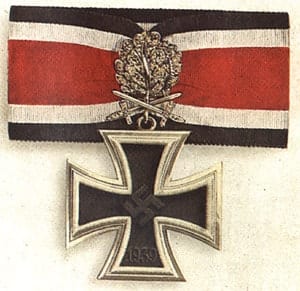 He was awarded the Third Reich's highest regularly awarded military decoration: The Knight's Cross to the Iron Cross with Oak Leaves, Swords and Diamonds. To be accurate, the highest military decoration was "The Grand Cross to the Iron Cross." It was only awarded once to Hermann Göring. The second highest military decoration was "The Knight's Cross to the Iron Cross with Golden Oak Leaves, Swords and Diamonds" and was also awarded only once to the Stuka ace Hans-Ulrich Rudel. Thus, Hartmann's medal, "The Knight's Cross to the Iron Cross with Oak Leaves, Swords and Diamonds," was, to be precise, the third highest German military decoration through WW2, was awarded to 27 soldiers, 12 of whom were Luftwaffe pilots. Near the end of WWII, in early May 1945, the Luftwaffe command ordered Hartmann, then Gruppenkommandeur of famous Jagdgeschwader 52, and his Commodore, Hermann Graf (another pilot, who had earned the "diamonds" to the Knight's Cross) to fly to the British sector. Both officers disregarded this order, because they felt responsible for Jagdgeschwader 52's pilots, ground crew, family members, and other civilians, who had joined the squadron, seeking protection against fierce aggression by the Czechs. The officers ordered the destruction of the unit's aircraft, and then the unit moved west in direction of territory already occupied by US troops. On May 8th, 1945, the soldiers and civilans surrendered to US troops in the region between Bavaria (German provence) and Czech border. But on May 17th, the US Army delivered all of these German troops and civilians to the Red Army. Like all others, Hartmann was then deported to Siberia, where he was sentenced to 50 years of hard labor. (Hartmann has since been rehabitated by Russian justice, which declared those sentences illegal in 1995.) The Soviets pressured him to support a build-up of an East German air force and tried to turn him into an undercover agent against the West. Hartmann refused, even though the Soviets threatened to kidnap and kill his wife and daughter, living in West Germany. Hartmann did not return to Germany until 1955, when the last German POWs were released along with the establishing of diplomatic relations between West Germany and the Soviet Union. In 1956, Hartmann joined the newly established West German Luftwaffe and contributed to the build-up of new fighter units. In 1959, he became the first commodore of Jagdgeschwader 71 "Richthofen." Erich Hartmann died in 1993. http://wernerhartenstein.tripod.com/hartma...9;s%20grave.jpg Hartmann's grave, Weil im Schönbuch near Stuttgart -------------------- C'est pas l' histoire d'un jour
Qui rime avec amour, Plutôt un long séjour Mais pas: un "pour toujours" |
   |

 
|
  |
Replies
| FeezyWeezy |
03/20/06 5:09pm
Post
#2
|
|
Major Group: Banned Posts: 609 Joined: January 14th 2006 From: Gone Member No.: 1533 |
Albert Speer
The "Good" Nazi 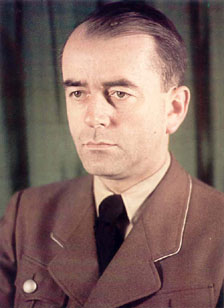 Albert Speer March 19, 1905 – September 1, 1981 Albert Speer was born Berthold Konrad Hermann Albert Speer in Mannheim, Germany, the second of three sons. Although Speer was an architect, he originally wanted to become a mathematician when he was young, he ended up following in the footsteps of his father and grandfather and studied architecture. He began his architectural studies at the Karlsruhe Institute of Technology; his decision to study locally instead of at one of the more prestigious institutes was dictated by the inflation of 1923. In 1924 when the inflation had stabilised, Speer transferred his studies to the more esteemed Munich Institute of Technology. In 1925 he transferred again, this time to the Berlin Institute of Technology. It was there that he was under the tutelage of Heinrich Tessenow, Speer had a high regard for Tessenow and when he passed his exams in 1927 he became Tessenow's assistant. His duties as assistant involved teaching seminar classes three days a week. Although Tessenow himself never agreed with Nazism, a number of his students did, and it was they who persuaded Speer to attend a Nazi Party rally in a Berlin beer-hall in December 1930. Speer claims to have been apolitical as a young man; nevertheless, he did attend the rally. He was surprised to find Hitler dressed in a neat blue suit, rather than the brown uniform seen on Nazi Party posters. Speer claimed to have been quite affected, not only with Hitler's proposed solutions to the threat of communism and his renunciation of the Treaty of Versailles, but also with the man himself. Several weeks later he attended another rally, though this one was presided over by Joseph Goebbels. Speer was disturbed by the way he had whipped the crowd into a frenzy, playing on their hopes. Although Goebbels' performance offended Speer, he could not shake the impressions Hitler made on him. The next day he joined the Nazi Party as member number 474,481. In this same year (1931) he married Margarete Weber  Speer and family He met and fell in love with Margarete Weber, a lovely open minded girl. After a period couple and after completing studies they got married without the blessing of the Speer family as his fiancee was not of the same class but later things sorted out anyway.  Margarete Weber and Albert Speer Speer's first major commission as a Party member came in 1932 when Karl Hanke (whose villa Speer previously worked on) recommended him to Goebbels to help renovate the new District Headquarters in Berlin, and, later, to renovate Goebbels' Propaganda Ministry. Goebbels was impressed with his work and recommended him to Hitler, who assigned him to help Paul Troost renovate the Chancellery in Berlin. Speer's most notable work on this assignment was the addition of the famous balcony from which Hitler often presented himself to crowds that assembled below. Speer subsequently became a prominent member of Hitler's inner circle and a very close friend to him, winning a special place with Hitler that was unique amongst the Nazi leadership. Hitler, according to Speer, was very contemptuous towards anybody he viewed as part of the bureaucracy, and prized fellow artists like Speer whom he felt a certain kinship with, especially as Hitler himself had previously entertained architectural ambitions.  Speer and Hitler making plans for new constructions. Together they shared the passion for architecture and became close friends both professionally and private. When Troost died in 1934, Speer was chosen to replace him as the Party's chief architect. One of his first commissions after promotion was perhaps the most familiar of his designs: the Zeppelintribune, the Nuremberg parade grounds seen in Leni Riefenstahl's propaganda masterpiece, Triumph of the Will. In his autobiography, Speer claimed that, upon seeing the original design, he made a derogatory remark to the effect that the parade ground would resemble a "rifle club" meet. He was then challenged to create a new design.  The Zeppelintribune The grounds were based on ancient Doric architecture of the Pergamon Altar in Anatolia, but magnified to an enormous scale, capable of holding two hundred and forty thousand people. At the 1934 Party rally on the parade grounds, Speer surrounded the site with one hundred and thirty anti-aircraft searchlights. This created the effect of a "cathedral of light," (which referenced columns) or, as it was called by British Ambassador Sir Neville Henderson, a "cathedral of ice".  1934 Party rally Nuremberg was also to be the site of many more official Nazi buildings, most of which were never built; for example, the German Stadium would have held another four hundred thousand spectators as the site of the Aryan Games, a proposed replacement for the Olympic Games. While planning these buildings, Speer invented the theory of "ruin value." According to this theory, enthusiastically supported by Hitler, all new buildings would be constructed in such a way that they would leave aesthetically pleasing ruins thousands of years in the future. Such ruins would be a testament to the greatness of the Third Reich, just as ancient Greek or Roman ruins were symbols of the greatness of their civilizations. In 1937 Speer designed the German Pavilion for the 1937 international exposition in Paris. Speer's work was located directly across from the Soviet Pavilion and was designed to represent a massive defense against the onslaught of communism. Both pavilions were awarded gold medals for their designs.  German Pavilion, Paris - 1937 Speer was also directed to make plans to rebuild Berlin, which was to become the capital of a "Greater Germany" — Welthauptstadt Germania. The first step in these plans was the Olympic Stadium for the 1936 Summer Olympics, designed by Werner March. Speer also designed the new Reichs Chancellery, which included a vast hall designed to be twice as long as the Hall of Mirrors in the Palace of Versailles. Hitler wanted him to build a third, even larger Chancellery, although it was never begun. The second Chancellery was damaged by the Battle of Berlin in 1945 and was eventually demolished by the Soviet occupiers after the war.  Reichs Chancellery - Destroyed on purpose after the war by the allies. Almost none of the other buildings planned for Berlin were ever built. Berlin was to be reorganized along a central three-mile-(five km) long avenue. At the north end, Speer planned to build the Volkshalle — an enormous domed building, based on St. Peter's Basilica in Rome. The dome of the building would have been impractically large; it would be over seven hundred feet (over two hundred meters) high and eight hundred feet (three hundred meters) in diameter, sixteen times larger than the dome of St. Peter's. At the southern end of the avenue would be an arch based on the Arc de Triomphe in Paris, but again, much larger; it would be almost four hundred feet (120 m) high, and the Arc de Triomphe would have been able to fit inside its opening. The outbreak of World War II in 1939 led to the abandonment of these plans.  The model of the arch Speer made for Hitlers 50th birthday. During his involvement in the rebuilding of Berlin, he was allegedly responsible for the forced evictions of Jews from their houses to make room for his grand plans, and for re-housing German citizens affected by this work. He was also listed as being present at the 1943 Posen Conference, a charge Speer later contested by saying that he had in fact left early. Speer did have an architectural rival: Hermann Giesler, whom Hitler also favored. There were frequent clashes between the two in regard to architectural matters and in closeness to Hitler. Hitler was always a strong supporter of Speer, in part because of Hitler's own frustrated artistic and architectural visions. A strong affinity developed between Hitler and the ambitious young architect early in their professional relationship. For Speer, serving as architect for the head of the German state and being given virtual carte blanche as to expenses, presented a tremendous opportunity. For Hitler, Speer seemed to be capable of translating Hitler's grandiose visions into tangible designs which expressed what Hitler felt were National Socialist principles. 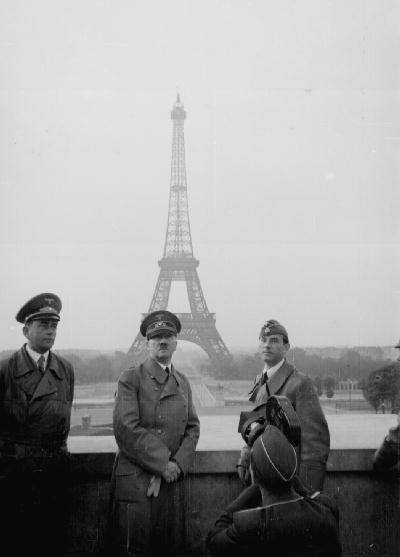 Adolf Hitler visits Paris with architect Albert Speer (left) June 23, 1940 After Minister of Armaments and War Production Fritz Todt was killed in an airplane crash in 1942, Hitler appointed Speer as his successor in all of his posts. Hitler's affinity for Speer and the architect's efficiency and avoidance of party squabbling are believed to have been considerations in Speer's promotion. In his autobiography, Speer recounts that the power-hungry but lazy Hermann Göring raced to Hitler's headquarters upon word of Todt's death, hoping to claim the office. Hitler instead presented Göring with the fait accompli of Speer's appointment. Faced with this new responsibility, Speer tried to put the German economy on a war footing comparable to that of the Allied nations, but found himself incessantly hindered by party politics and lack of cooperation from the Nazi hierarchy. Nevertheless, by slowly centralizing almost all industry control and cutting through the dense bureaucracy, he succeeded in multiplying war production four times over the next two and a half years, with it actually reaching its peak in 1944 during the height of the Allied strategic bombing campaign. Another big hurdle in his way was the Nazi policy excluding women from factory work, a serious hindrance in war production and a problem unknown to Germany's enemies, who all made full use of the female workforce. To fill this gap, Speer made heavy use of foreign labor, a considerable portion of it forced labor. Speer was considered one of the more "rational" members of the Nazi hierarchy, in contrast to the raging Hitler, grotesque Göring, fanatical Goebbels, and perverse Himmler. Speer's name was found on the list of members of a post-Hitler government envisioned by the July 20 plot to kill Hitler. However, the list had an annotation "if possible" by his name, which Speer credits with helping save his life from the extensive purges that followed the scheme's failure. By his own account, Speer considered assassinating Hitler in 1945 by releasing poison gas into the air intake vent on the Führerbunker, but backed down for a number of reasons. Independent evidence for this is sparse. Some credit his revelation of this plan at the Nuremberg trials as being pivotal in sparing him the death sentence, which the Soviets had pushed for.  Albert Speer at the Nuremberg trials Hitler continued to consider Speer trustworthy, though this trust waned near the war's end as Speer, at considerable risk, campaigned clandestinely to prevent the implementation of Hitler's scorched earth policy on both German soil and occupied territories. Speer worked in association with General Gotthard Heinrici, whose troops fighting in the east retreated to the American-held lines and surrendered there instead of following Hitler's orders to make what would have been a suicidal effort to hold off the Soviets from Berlin. Speer even confessed to Hitler shortly before the dictator's suicide that he had disobeyed, and indeed actively hindered, Hitler's "scorched-earth" decree. According to Speer's autobiography, Speer visited the Führerbunker towards the end and stated gently but bluntly to Hitler that the war was lost and expressed his opposition to the systematic destruction of Germany while reaffirming his affection and faith in Hitler. This conversation, it is said, brought Hitler to tears. In disfavor, Speer was excluded from the new cabinet Hitler outlined in his final political testament, where Speer was to be replaced by his subordinate, Karl-Otto Saur. SOUND FRAGMENT: http://www.bbc.co.uk/bbcfour/audiointerviews/profilepages/speera1.shtml PHOTOS: http://hatemonitor.csusb.edu/images/dartmouth/ALbertSpeerNurembergTrial.jpg http://hatemonitor.csusb.edu/images/dartmouth/NurembergTrial_Jan5.jpg http://perso.wanadoo.fr/d-d.natanson/nuremberg.jpg Immediately after the war, there seemed to be little indication that Speer would be charged with war crimes. Speer traveled unprotected and openly participated in the so-called Flensburg government for weeks, in the presence of Allied officers. Upon request, he actually held a series of widely-attended lectures for officials of the Allied occupying powers on various topics, including the mistakes made by the Nazi government in industrial and economic affairs (although he never during these lectures spoke about slave labor) and the effectiveness of the Allied strategic bombing campaigns. Some journalists and spectators even expected that Speer would be appointed by the occupying powers to help restore Germany's economy. However, any such speculation ended when, after one of these lectures, he was arrested and sent to Nuremberg for trial. At the Nuremberg trials after the war Speer was one of the few officials to express remorse and plead guilty, but was sentenced to 20 years' imprisonment in Spandau Prison, West Berlin, largely for his use of slave labor. At the trials, the prosecution introduced as evidence a photograph of Speer visiting the Mauthausen concentration camp, where he is clearly shown surrounded by emaciated prisoners. The prosecution claimed this proved Speer was well aware of the Holocaust. However, Speer held that he was only given a "V.I.P." tour of the concentration camp, meaning he was never shown the more vile side of the camp's purpose. According to interviews after his imprisonment, as well as his memoirs, Speer adopted a "see no evil" attitude towards the Nazi atrocities. For example, through one of his friends, Karl Hanke, he learned of Auschwitz and the large number of deaths taking place there. He then purposely avoided visiting the camp or trying to get more information on what was taking place. In his autobiography, he claims that he had no direct involvement or knowledge of the Holocaust, although he faults himself for blinding himself to its existence. He certainly was aware, at least, of harsh conditions for the slave labor and some critics believe that his books understate his role in the atrocities of the era. Newly released documents suggest that Speer knew a lot more about the atrocities than he was telling, but hard evidence for that remains very thin. One problem with assessments of Speer's complicity in the Holocaust comes from his status in post-war Germany - he became a symbol for people who were involved with the Nazi regime yet did not have (or claimed not to have had) any part in the regime's atrocities. Even today, German historians such as Joachim Fest tend to have a high opinion of him, while non-German historians take a lower view. (Speer created) a market for people who said "believe me, I didn't know anything about (the Holocaust). Just look at the Führer's friend, he didn't know about it either."  The Spandau Diaries, by Albert Speer http://www.dataphone.se/~ms/speer/more.htm A site with more books about Speer, and his work. His time in prison, painstakingly documented in his secret prison diary which was later released as The Spandau Diaries, was described as consisting mainly of a mind-numbing and pedantically enforced daily routine, incessant petty personal rivalry between the seven prisoners, a pervasive and bloated prison bureaucracy, and the passing of many false hopes of premature release. After some time Speer, and most of the others, had established secret lines of communication to the outside world via sympathetic prison staff. Speer made full use of this by, amongst other things, writing innumerable letters to his family (which were restricted to one outgoing page per month under official regulation) and even having money spent on his behalf from a special bank account for a variety of benign purposes. Speer, as recounted in his diary, made a deliberate effort to make as productive use of his time as possible. In the first decade, this took the form of putting on paper the first draft of his tell-all memoirs, an act Speer considered to be his "duty" to history and his people, he being the sole surviving member of Hitler's inner circle and in possession of knowledge and a degree of objectivity that no other had. As the prison directors both forbade the writing of a memoir and recorded each sheet of paper given to the prisoners, he wrote much of his memoir secretly on toilet paper, tobacco wrappings, and any other material he could get his hands on, and then had the pages systematically smuggled out. All the while Speer devoted much of his energy and time towards reading books from the prison library, which was organized by fellow prisoner and ex-Grand Admiral Erich Raeder. Speer was, more so than the others, a voracious reader and he completed well over 500 books in the first three years alone. His tastes ranged from Greek drama to famous plays to architectural books and journals, partly from which he collected information for a book he intended to write on the history and function of windows in architecture. Later, Speer took to the prison garden for enjoyment and work. Heretofore the garden was divided up into small personal plots for each prisoner with the produce of the garden being used in the prison kitchen. When regulations began to slacken in this regard, Speer was allowed to build an ambitious garden, complete with a meandering path, rock garden, and a wide variety of flowers. The garden was even, humorously, centered around a "north-south axis", which was to be the core design element of Speer and Hitler's new Berlin. Speer then took up a "walking tour of the world" by ordering geography and travel books from the local library and walking laps in the prison garden visualizing his journey. Meticulously calculating every metre traveled, he began in northern Germany, went through the Balkans, Persia, India, and Siberia, then crossed the Bering Strait and continued southwards, finally ending his sentence in central Mexico. His release from prison in 1966 was a world-wide media event. He then revised and published the several semi-autobiographical books he had begun in prison. His books, most notably Inside the Third Reich and The Spandau Diaries, which were secretly written during his incarceration and systematically smuggled out, provide a unique and personal look into the personalities of the Nazi era and have become much valued by historians. Speer died of a cerebral hemorrhage in London, England, on September 1, 1981 exactly 42 years after World War II began. Albert Speer and Henry King at Heidelberg in July 1981 http://www.lauferfilm.com/king/ Another nice Image: http://www.fpp.co.uk/Irving/photos/Speer/image1.html http://www.knerger.de/Die_Personen/politik...litiker_25.html Speer's son, also named Albert, became a successful architect in his own right, and was responsible for the design of Expo 2000 (the world exposition that took place in Hanover in the year 2000), design of the Shanghai International Automobile City and the Beijing Olympic complex. His daughter Hilde Schramm became a noted left-wing parliamentarian -------------------- C'est pas l' histoire d'un jour
Qui rime avec amour, Plutôt un long séjour Mais pas: un "pour toujours" |
|
|
|
Posts in this topic
 FeezyWeezy Notable People of WW2 03/19/06 1:54pm
 +KS+ Blinky Bill Ok, before Feezy explodes this forum with gigant i... 03/19/06 2:35pm FeezyWeezy
[b]Eino Ilmari Juutilainen
[size=3][img]http://... 03/19/06 2:40pm +KS+ Blinky Bill If anyone is a friend of books, here´s list of bo... 03/19/06 3:09pm Sparta THE INFAMOUS RED BARON!!!
I know He i... 03/19/06 10:25pm Sparta Maj. Richard I. Bong
Bong grew up on a farm near [... 03/19/06 10:40pm Slimshady Well I would also like to mention my left nut. It ... 03/19/06 11:51pm
+KS+ Blinky Bill Ok, before Feezy explodes this forum with gigant i... 03/19/06 2:35pm FeezyWeezy
[b]Eino Ilmari Juutilainen
[size=3][img]http://... 03/19/06 2:40pm +KS+ Blinky Bill If anyone is a friend of books, here´s list of bo... 03/19/06 3:09pm Sparta THE INFAMOUS RED BARON!!!
I know He i... 03/19/06 10:25pm Sparta Maj. Richard I. Bong
Bong grew up on a farm near [... 03/19/06 10:40pm Slimshady Well I would also like to mention my left nut. It ... 03/19/06 11:51pm
 Maj. H8Red
Well I would also like to mention my left nut. It... 03/20/06 12:13am Undertow :hysterical: 03/20/06 1:17am UNDEAD 1 i have to say its very interesting-can you find so... 03/20/06 9:01am FeezyWeezy George Beurling "Buzz" "Screwball... 03/20/06 9:11am Lord Lipton wow guys. way to do your research. 03/20/06 9:23am FeezyWeezy I'm sorry to putt this person here, between al... 03/20/06 11:21am UNDEAD 1 VERY interesting cant wait forthe next! 03/20/06 2:15pm UNDEAD 1 where do you find this info?
anyway you can do ro... 03/21/06 3:41am FeezyWeezy Erwin Johannes Eugen Rommel
[b][size=4]"Wüs... 03/21/06 12:03pm UNDEAD 1 thank you ,its always been unclear to me how he di... 03/21/06 12:34pm Undertow Alright, Feezy. Give me some history on Hans Joach... 03/21/06 12:47pm FeezyWeezy Hans Joachim Marseille
[size=4]"Der Stern von... 03/21/06 3:07pm FeezyWeezy Simo Häyhä
"Valkoinen Kuolema"
[img]ht... 03/21/06 10:23pm UNDEAD 1 WHOS NEXT? im addicted now! how about a german... 03/22/06 7:45pm FeezyWeezy Its time for a group of people which are related t... 03/22/06 10:52pm Sparta Theres little I can Say for those german Snipers
... 03/22/06 10:29pm Stickman I have read that the in the German air force in bo... 03/22/06 10:48pm FeezyWeezy I have read that the in the German air force in b... 03/22/06 11:17pm FeezyWeezy I have read that the in the German air force in b... 03/26/06 6:45am FeezyWeezy Operation Windsor, Carpiquet Aerodrome.
[b]Battl... 03/25/06 4:29pm UNDEAD 1 HOW COME THERES NOT A MAP FOR THIS BATTLE! do ... 03/25/06 5:46pm Hellfighter HOW COME THERES NOT A MAP FOR THIS BATTLE! ..... 03/26/06 9:22am FeezyWeezy Well maybe Bob and I can make a map about this one... 03/25/06 6:04pm UNDEAD 1 HEY HELL,for your info- about 8 years ago i was w... 03/27/06 3:38am Hellfighter HEY HELL,for your info- about 8 years ago i was ... 03/27/06 9:07am FeezyWeezy I will do Gen. Paulas, Tukegee Airmen and some ger... 03/27/06 7:56am UNDEAD 1 feezy i have to say these bios are very interestin... 03/27/06 10:23am FeezyWeezy Well I could find any detailed record from the num... 03/27/06 3:09pm FeezyWeezy [b]"Night Ghost of St. Trond"
[b][size=... 03/28/06 9:32am Hellfighter You've got to wonder, if the Allies new there ... 03/28/06 9:47am FeezyWeezy It was hard to figure out who killed who at most t... 03/28/06 3:59pm Hellfighter It was hard to figure out who killed who at most ... 03/28/06 7:48pm Hellfighter
[size="1"]Ramming attack was a tactic i... 03/28/06 8:00pm FeezyWeezy [size=3]Special Operations Executive
[size=2]Whe... 03/29/06 9:49am UNDEAD 1 before i played cod i played bf 1942. that was the... 03/29/06 11:06am FeezyWeezy before i played cod i played bf 1942. that was th... 03/29/06 12:55pm UNDEAD 1 [size=3]The Mustang was the best plane, very fast.... 03/29/06 7:26pm FeezyWeezy Matthäus Hetzenauer
[size=1]Born on December 23... 03/29/06 11:24am Radiation My people are not famous. Maybe in thier own resp... 03/29/06 1:34pm FeezyWeezy Klaus Barbie
http://worldatwar.net/biography/b/ba... 03/29/06 3:07pm Stickman Years ago I had a girlfriend (who looked remarkabl... 03/29/06 4:42pm FeezyWeezy Lyudmila Mikhailovna Pavlichenko [size=1][img]http... 03/30/06 4:23pm Leadmagnet Do one on Dieppe....Another "sacrifice" ... 03/30/06 6:42pm Hellfighter Do one on Dieppe....Another "sacrifice... 04/01/06 9:19pm UNDEAD 1 getting backed up? when do you play feezy,hehe... 03/30/06 7:00pm FeezyWeezy Time for one of the best Aces during the Finnish W... 03/30/06 9:58pm FeezyWeezy [size=5][b]Tuskegee Airmen
[size=1][size=3]... 04/02/06 9:22pm Hellfighter [size=3][size=5][b]Tuskegee Airmen
[size=3]By t... 04/03/06 1:50am FeezyWeezy [b]Bram van der Stok
"Bob Vanderstok"
[b... 04/12/06 12:07pm Hellfighter Hi Feezy, can you tell us in a short piece Spain... 04/12/06 4:56pm FeezyWeezy I'm only doing this because I feel crap person... 04/19/06 8:51am FeezyWeezy [b]Galland Borthers
[size=4][b]Adolf
[img]http:/... 04/30/06 8:36pm
Maj. H8Red
Well I would also like to mention my left nut. It... 03/20/06 12:13am Undertow :hysterical: 03/20/06 1:17am UNDEAD 1 i have to say its very interesting-can you find so... 03/20/06 9:01am FeezyWeezy George Beurling "Buzz" "Screwball... 03/20/06 9:11am Lord Lipton wow guys. way to do your research. 03/20/06 9:23am FeezyWeezy I'm sorry to putt this person here, between al... 03/20/06 11:21am UNDEAD 1 VERY interesting cant wait forthe next! 03/20/06 2:15pm UNDEAD 1 where do you find this info?
anyway you can do ro... 03/21/06 3:41am FeezyWeezy Erwin Johannes Eugen Rommel
[b][size=4]"Wüs... 03/21/06 12:03pm UNDEAD 1 thank you ,its always been unclear to me how he di... 03/21/06 12:34pm Undertow Alright, Feezy. Give me some history on Hans Joach... 03/21/06 12:47pm FeezyWeezy Hans Joachim Marseille
[size=4]"Der Stern von... 03/21/06 3:07pm FeezyWeezy Simo Häyhä
"Valkoinen Kuolema"
[img]ht... 03/21/06 10:23pm UNDEAD 1 WHOS NEXT? im addicted now! how about a german... 03/22/06 7:45pm FeezyWeezy Its time for a group of people which are related t... 03/22/06 10:52pm Sparta Theres little I can Say for those german Snipers
... 03/22/06 10:29pm Stickman I have read that the in the German air force in bo... 03/22/06 10:48pm FeezyWeezy I have read that the in the German air force in b... 03/22/06 11:17pm FeezyWeezy I have read that the in the German air force in b... 03/26/06 6:45am FeezyWeezy Operation Windsor, Carpiquet Aerodrome.
[b]Battl... 03/25/06 4:29pm UNDEAD 1 HOW COME THERES NOT A MAP FOR THIS BATTLE! do ... 03/25/06 5:46pm Hellfighter HOW COME THERES NOT A MAP FOR THIS BATTLE! ..... 03/26/06 9:22am FeezyWeezy Well maybe Bob and I can make a map about this one... 03/25/06 6:04pm UNDEAD 1 HEY HELL,for your info- about 8 years ago i was w... 03/27/06 3:38am Hellfighter HEY HELL,for your info- about 8 years ago i was ... 03/27/06 9:07am FeezyWeezy I will do Gen. Paulas, Tukegee Airmen and some ger... 03/27/06 7:56am UNDEAD 1 feezy i have to say these bios are very interestin... 03/27/06 10:23am FeezyWeezy Well I could find any detailed record from the num... 03/27/06 3:09pm FeezyWeezy [b]"Night Ghost of St. Trond"
[b][size=... 03/28/06 9:32am Hellfighter You've got to wonder, if the Allies new there ... 03/28/06 9:47am FeezyWeezy It was hard to figure out who killed who at most t... 03/28/06 3:59pm Hellfighter It was hard to figure out who killed who at most ... 03/28/06 7:48pm Hellfighter
[size="1"]Ramming attack was a tactic i... 03/28/06 8:00pm FeezyWeezy [size=3]Special Operations Executive
[size=2]Whe... 03/29/06 9:49am UNDEAD 1 before i played cod i played bf 1942. that was the... 03/29/06 11:06am FeezyWeezy before i played cod i played bf 1942. that was th... 03/29/06 12:55pm UNDEAD 1 [size=3]The Mustang was the best plane, very fast.... 03/29/06 7:26pm FeezyWeezy Matthäus Hetzenauer
[size=1]Born on December 23... 03/29/06 11:24am Radiation My people are not famous. Maybe in thier own resp... 03/29/06 1:34pm FeezyWeezy Klaus Barbie
http://worldatwar.net/biography/b/ba... 03/29/06 3:07pm Stickman Years ago I had a girlfriend (who looked remarkabl... 03/29/06 4:42pm FeezyWeezy Lyudmila Mikhailovna Pavlichenko [size=1][img]http... 03/30/06 4:23pm Leadmagnet Do one on Dieppe....Another "sacrifice" ... 03/30/06 6:42pm Hellfighter Do one on Dieppe....Another "sacrifice... 04/01/06 9:19pm UNDEAD 1 getting backed up? when do you play feezy,hehe... 03/30/06 7:00pm FeezyWeezy Time for one of the best Aces during the Finnish W... 03/30/06 9:58pm FeezyWeezy [size=5][b]Tuskegee Airmen
[size=1][size=3]... 04/02/06 9:22pm Hellfighter [size=3][size=5][b]Tuskegee Airmen
[size=3]By t... 04/03/06 1:50am FeezyWeezy [b]Bram van der Stok
"Bob Vanderstok"
[b... 04/12/06 12:07pm Hellfighter Hi Feezy, can you tell us in a short piece Spain... 04/12/06 4:56pm FeezyWeezy I'm only doing this because I feel crap person... 04/19/06 8:51am FeezyWeezy [b]Galland Borthers
[size=4][b]Adolf
[img]http:/... 04/30/06 8:36pm |
1 User(s) are reading this topic (1 Guests and 0 Anonymous Users)
0 Members:


|
Lo-Fi Version | Time is now: 05/03/26 9:01pm |
Invision Power Board
© 2026 IPS, Inc.