
 Notable People of WW2, Hero's, veterans, leaders, the famous and alike. Notable People of WW2, Hero's, veterans, leaders, the famous and alike. |


| FeezyWeezy |
 03/19/06 1:54pm 03/19/06 1:54pm
Post
#1
|
|
Major  Group: Banned Posts: 609 Joined: January 14th 2006 From: Gone Member No.: 1533  |
Ok, time for another chapter of hostory facts. I'll start with some WW2 Aces.
Erich Hartmann  The highest scoring ace of all time was the great German Luftwaffe experte Erich Hartmann with 352 aerial kills. Flying Bf 109s (Me-109s) against the overmatched Soviet MiGs and Yaks for almost three years, he accumulated his unrivalled score. Hartmann claimed, that of all his accomplishments, he was proudest of the fact that he never lost a wingman. He is also reputed to have said. "Get close .. when he fills the entire windscreen ... then you can't possibly miss." Hartmann was born in 1922, in Weissach, Wurttemberg. At age 19 (1941), he joined the Luftwaffe and was posted to Jagdgeschwader 52 (JG 52) on the Eastern Front in October, 1942. He scored his first kill in November, and only achieved his second three months later. In the first half of 1943, he worked out some of the tactics which would prove so successful later on. If he was attacked from behind, he would send his wingman down low and out in front. Then he would get behind the enemy and fire a short, quick accurate burst, waiting "until the enemy aircraft filled the windscreen." He would normally content himself with one victory; he was willing to wait for another day. His natural talents began to tell: excellent eyesight, lightning reflexes, an aggressive spirit, and an ability to stay cool while in combat.  A Messerschmitt Bf 109G-6 Kursk As JG 52 retreated along with German ground forces in 1943, Hartmann's score began to mount. The great Kursk offensive, Operation Zitadelle, began on July 5. The Luftwaffe planned to screen the Wehrmacht's panzers from the Soviet Il-2 Sturmoviks, armored tank-busting aircraft, armed with twin 37mm cannon. Hartmann's Staffel 7 of JG 52 moved up to Ugrim, only 14 kilometers behind the front. As the Panther and Tiger tanks moved up, Junkers Ju.52 transports flew in supplies. On the morning of the 5th, four of Staffel 7's pilots did not return, apparently their compasses misled them, due to extraordinary iron ore deposits in the area. Hartmann was promoted to Staffelkapitan on the spot. The offensive ground forward slowly on the 6th and 7th; obviously the Russians had dug in and prepared defensive lines in depth. July 7, 1943 On the morning of July 7, 1943, sun rose over Ugrim in the northern Ukraine about 3AM. Staffel 7's Me.109 G10's lay scattered around, in the deep grass of the Ugrim airfield. Hartmann's personal plane, decorated with a large Roman numeral 'I' and the name Usch in a red heart. (Usch Paetch was his fiancee, whom he wrote to daily.) In the comfortable summer weather, the pilots slept in tents. On waking, Hartmann dressed in a gray shirt, blue-gray trousers, and gray shoes. He washed up and shaved in a small stream and ate breakfast, two eggs, cooked by a couple of Russian girls. He and the other three pilots in his Schwarm were assigned to cover an F.W.189 on a dawn reconnaissance mission. Erich joked with his crew chief, 'Bimel' Merten, and strapped himself into the cockpit. At 3:04, the recon plane started and Hartmann set Messerschmitt's flaps and checked the fuel while Merten cranked the starter. The DB 605's twelve cylinders coughed, belched smoke, and then caught smoothly. His three comrades followed him to the take-off spot. He gunned the engine while stomping on the brakes. When he released them, his 109 shot forward and quickly reached 160 km/hour. He gently pulled back on the stick and was airborne; the other three followed him closely. They all banked left as they went through post-take-off routines: retract landing gear, close radiator flaps, ease back on the throttle, and check gauges, guns, and gunsight. They climbed to 1300 meters as they flew northeast and then swung southward, with the Fw 189 in view. The flight proceeded uneventfully and the recon plane headed for Ugrim. Hartmann's radio crackled with a report from Adler, the German forward spotting post; a group of ten to twenty Russian planes were headed west. Hartmann throttled up a bit, gained altitude, and turned his Schwarm toward the east without sighting anything for several minutes.  Drawing of Hartmann's Bf-109G Messerschmitt "Gustav" 6 Sturmoviks Soon enough, many large Il-2's came into view. With its armor and rear gunner, the Sturmovik was a tough target. With the Sturmoviks closing head-on, Hartmann unhesitatingly ordered an attack. He dived down below them, picking up airspeed, then banked around and came up behind and beneath them, aiming for his target's vulnerable ventral oil radiator. The Il-2's flew straight on. Hartmann's Bf 109 roared along, doing over 400 MPH; Hartmann streaked into a Sturmovik's blind spot. At 200 yards, its wingspan filled his gunsight ring; still he closed in to 150, then 100 yards before firing. He briefly triggered his 20mm cannon and his two 12mm machine guns, for about one and a half seconds, before his speed carried him in front of them. As other Bf 109s struck their targets, Hartmann glanced back and saw blue flames and black sooty smoke streaming from the Sturmovik's radiator. His twenty-second victory of the war. Under the deadly attack of the Messerschmitts, the formation of Russian airplanes began to break up. Having regained altitude, Hartmann again zoomed down below the tail of an Il-2. He checked his own rear and stabilized his aircraft. This Russian pilot, alerted to the danger, spotted him and turned sharply to evade. The young blond ace matched the turn and instantly estimated the lead needed for a deflection shot. At 150 meters, he opened fire, and his bullets tore into the side of the Russian tank-buster. More blue flame and black smoke poured from his twenty-third victim's oil radiator. As the remaining scattered Russian planes fled eastward, Hartmann radioed his Staffel to return to Ugrim. About 4AM, as they approached the field, Hartmann waggled his wings twice, indicating his two victories. On landing, Mertem and other ground crew gathered around him, offering congratulations. Hartmann walked to the operations tent to file his Gefechtsbericht, his after-action report. Early reports from the Adler posts already showed more Russian air activity than on the 5th or 6th. Four pilots sat in their planes, ready to take-off in less than a minute. Hartmann soon fell asleep by his own machine. But only briefly. Two More Sorties By 5:50, he was back in the air, leading a flight of 109s on a frei chase, and he soon found more Il-2s, escorted by fighters. The Messerchmitts attacked successfully, with Hartmann downing another Il-2 and an LaGG-3 fighter. Within an hour, he was back on the ground, with four victories for the day. Late that afternoon, he led the Staffel up again, to the northeast. They found a group of Soviet LaGG-3 fighters, which they engaged in a sprawling dogfight. It was over quickly and Hartmann had shot down three enemy fighters, making it seven for the day, his largest score so far.  Experte He reached 50 by August of 1943. Within the month, he had reached 80, and was promoted to lead 9./JG52. Earlier in the war, 25 or 50 victories would have earned a German fighter pilot the Knight's Cross. By late 1943, Hartmann had to down 148 before he earned his Knight's Cross. By March 2, 1944, he had reached a total of 202, earning him the Oak Leaves. He was the fourth Luftwaffe fighter pilot to reach 250, the first to reach 300, and the only one to reach 350. The Diamonds 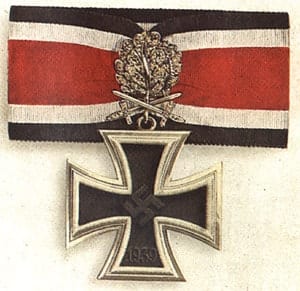 He was awarded the Third Reich's highest regularly awarded military decoration: The Knight's Cross to the Iron Cross with Oak Leaves, Swords and Diamonds. To be accurate, the highest military decoration was "The Grand Cross to the Iron Cross." It was only awarded once to Hermann Göring. The second highest military decoration was "The Knight's Cross to the Iron Cross with Golden Oak Leaves, Swords and Diamonds" and was also awarded only once to the Stuka ace Hans-Ulrich Rudel. Thus, Hartmann's medal, "The Knight's Cross to the Iron Cross with Oak Leaves, Swords and Diamonds," was, to be precise, the third highest German military decoration through WW2, was awarded to 27 soldiers, 12 of whom were Luftwaffe pilots. Near the end of WWII, in early May 1945, the Luftwaffe command ordered Hartmann, then Gruppenkommandeur of famous Jagdgeschwader 52, and his Commodore, Hermann Graf (another pilot, who had earned the "diamonds" to the Knight's Cross) to fly to the British sector. Both officers disregarded this order, because they felt responsible for Jagdgeschwader 52's pilots, ground crew, family members, and other civilians, who had joined the squadron, seeking protection against fierce aggression by the Czechs. The officers ordered the destruction of the unit's aircraft, and then the unit moved west in direction of territory already occupied by US troops. On May 8th, 1945, the soldiers and civilans surrendered to US troops in the region between Bavaria (German provence) and Czech border. But on May 17th, the US Army delivered all of these German troops and civilians to the Red Army. Like all others, Hartmann was then deported to Siberia, where he was sentenced to 50 years of hard labor. (Hartmann has since been rehabitated by Russian justice, which declared those sentences illegal in 1995.) The Soviets pressured him to support a build-up of an East German air force and tried to turn him into an undercover agent against the West. Hartmann refused, even though the Soviets threatened to kidnap and kill his wife and daughter, living in West Germany. Hartmann did not return to Germany until 1955, when the last German POWs were released along with the establishing of diplomatic relations between West Germany and the Soviet Union. In 1956, Hartmann joined the newly established West German Luftwaffe and contributed to the build-up of new fighter units. In 1959, he became the first commodore of Jagdgeschwader 71 "Richthofen." Erich Hartmann died in 1993. http://wernerhartenstein.tripod.com/hartma...9;s%20grave.jpg Hartmann's grave, Weil im Schönbuch near Stuttgart -------------------- C'est pas l' histoire d'un jour
Qui rime avec amour, Plutôt un long séjour Mais pas: un "pour toujours" |
   |

 
|
  |
Replies
| FeezyWeezy |
03/21/06 3:07pm
Post
#2
|
|
Major Group: Banned Posts: 609 Joined: January 14th 2006 From: Gone Member No.: 1533 |
Hans Joachim Marseille
"Der Stern von Afrika"  Hans Joachim Marseille, a young German fighter pilot, was the most amazing, unique, and lethal ace of World War 2. A non-conformist and brilliant innovator, he developed his own personal training program and combat tactics, and achieved amazing results, including 17 victories in one day, and an average lethality ratio of just 15 gun rounds per victory. Marseille was described by Adolf Galland, the most senior German ace, with these words : "He was the unrivaled virtuoso among the fighter pilots of World War 2. His achievements were previously considered impossible." Marseille, who later became one of the ten most highly decorated German pilots of World War 2 and was nicknamed "The Star of Africa" by the German propaganda, ("Jochen" by his friends), had a very unpromising and problematic start. At age 20 he graduated the Luftwaffe's fighter pilot school just in time to participate in the Battle Of Britain in the summer of 1940. He initially served in fighter wing 52 under Johannes Steinhoff (176 victories). In his third combat sortie he shot down a Spitfire and by the end of the Battle Of Britain he had seven victories, but he was also shot down four times, and his behavior on the ground got him into trouble. A charming person, he had such busy night life that sometimes he was too tired to be allowed to fly the next morning. He also loved American Jazz music, which was very politically incorrect in the Nazi military. As a result, he was transferred to another unit as a punishment for "Insubordination". His new unit, fighter wing 27, was relocated in April 1941 to the hot desert of North Africa, where he quickly achieved two more victories but was also shot down again and still had disciplinary problems. Luckily for him, his new Wing Commander, Eduard Neumann, recognized that there might be a hidden potential in the unusual young pilot and helped him get on the right track. With his problems on the ground finally over, Marseille began to deeply analyze his combat activity, and started to improve his abilities as a fighter pilot with an intense self-training program, both physical and professional, that he developed for himself. Marseille's self-training program: Vision - Marseille decided to adapt his eyes to the powerful desert sun and the dry desert atmosphere and to adapt his body to the desert's conditions. He stopped wearing sun glasses, deliberately exposed his eyes to the desert sun, and shifted from alcohol to milk. He also noticed that in the intensely lit dry desert atmosphere, aircraft can be detected from greater distances than over Europe and deduced that hiding and surprise are less practical over the desert than in the cloudy sky over Europe. G-Force - Marseille worked endlessly to strengthen his abdominal and leg muscles in order to enhance his ability to sustain higher G-Force and for longer durations during dogfights better than the average fighter pilot. G-Force is the enormous centrifugal force experienced when a fighter aircraft makes sharp turns during dogfight. The modern G-suit that helps pilots sustain it was not yet invented in World War 2. Aerobatics - Marseille used every opportunity to perform breathtaking aerobatics. In addition to free entertainment to his friends on the ground, this also gave him an outstanding control and confidence in extremely maneuvering his Messerschmitt 109 aircraft. Marksmanship - Marseille spent his unused ammunition practicing firing at ground objects and trained a lot not just in plain strafing but also in high deflection shooting while in a sharp turn, which is much harder. Intelligence - he began to read every possible intelligence information he could find in order to maximize his knowledge and understanding of the enemy. Tactics - That's where Marseille marked himself as a great innovator of air warfare, and he kept improving. He claimed that in the perfect visual conditions over the desert, large formations are in a visual disadvantage against highly maneuvering single aircraft. He preferred to fight alone, with a single wingman providing warnings from a safe distance. He claimed that when fighting alone in a short range dogfight, he could quickly fire at anything he saw, while the attacked formation's pilots were confused, hesitated, and switched to a defensive position that further increased the lone attacker's chances. He also claimed that fighting alone eliminates the high risk of firing at or colliding with a wingman in such extreme maneuvering. Marseille said that in such conditions, there's a lower chance and too little time for the usual chase attack method, and preferred to use high angle deflection firing from short range while making a sharp turn. In doing so, he never used his gun sight and instead fired a very short burst at the passing target in the split second when its leading edge, its propeller, disappeared from his eyes behind his aircraft's nose. He calculated that when firing a short burst at this position, his gun rounds will hit the target's engine and cockpit, and he trained in this unorthodox aiming method on his friends (without firing) many times and perfected his ability to use it. He deduced that over the desert, a fighter pilot can become "invisible" only by extreme maneuvers at close range, and that the intensity of the maneuvering was more important than the speed of flying. The Hans Joachim Marseille that emerged from this self-training program was a fighter pilot with superior abilities. He saw enemy aircraft before others did and from greater distances, he could sustain higher G-Force and for longer durations, he made unbelievably sharp turns and generally achieved better performance with the Me-109 than others. He greatly outmaneuvered his enemies, nullifying the significant numerical advantage they had, often becoming "invisible" to the enemy pilots by maneuvering so fast, and using his high-deflection short range firing method he achieved an amazing record of lethality, shooting down enemy aircraft with just 15 gun rounds on average. The Star Of Africa  Marseille adding kills to his tail. He first demonstrated his new abilities on Sept. 24, 1941. During a fighter sweep, he suddenly broke formation and hurried to a direction where no one saw anything. When the formation caught up with him, he already shot down a bomber. Later the same day, his formation of six Me-109s met a formation of 16 Hurricanes. Marseille and his wingman were ordered to provide cover to the other four Me-109s which attacked the Hurricanes, but after three Hurricanes were shot down, Marseille told his wingman to cover him and attacked a formation of four Hurricanes. He dived at them, leveled at their altitude, and shot down two Hurricanes in a single burst while in a sharp turn. He then dived below the Hurricanes to gather some speed again, and then climbed back to them and shot down a third Hurricane. At that stage, the two formations disengaged each other, but Marseille climbed alone to a higher altitude and later dived at the retreating Hurricanes and shot down a 4th Hurricane, his 5th victory that day, and only then flew alone back to base. "I believe now I got it" he said to a friend.  This was the beginning of his amazing series of dogfight victories, which lasted a year until his death in an accident. His most "classic" combat, by some analysts, was on June 6, 1942 at noon. While in a bomber escort mission, he saw a formation of 16 P-40 Tomahawk fighter and ground attack aircraft, but initially remained with his formation, escorting the German bombers. After ten minutes, he left his formation with the escorted bombers and flew alone to attack the 16 Tomahawks, but his faithful wingman followed him. Marseille climbed above a tight formation of four, then dived at them. From a range of just 200ft he selected his first victim and turned at him. From a very short range of just 150ft he fired and shot it down. He then pulled up, turned, and dived at his 2nd victim, shooting it down from a range of 150ft. The others began to dive, but Marseille dived at them, turned at his 3rd victim and shot it down at altitude of about 3500ft (1km). He passed thru the smoke from his 3rd victim and leveled at low altitude, and then climbed again. He then dived again, at his 4th victim. He fired from just 100ft, but his guns didn't fire, so he fired his machine guns from very short range and passed thru the debris from his 4th victim. At the moment he hit his 4th victim, his 3rd victim hit the ground after falling 3500ft, approximately 15 seconds between victories, an indication of Marseille's speed. The remaining Tomahawks were now all at very low altitude. He leveled at them and quickly closed distance. He found himself beside one of the Tomahawks, he turned at him and fired, hitting his 5th victim in the engine and the cockpit. He climbed again, watched the remaining Tomahawks, selected a target, dived, levelled, and fired, and passed just above his 6th victim. He then climbed to his wingman which observed the battle from 7500ft above, and then, short of fuel and ammunition, flew back to base.  ME-109's in the African dessert. In 11 minutes of combat, fighting practically alone against a large enemy formation, he shot down six victims, five of them in the first six minutes. He was the only attacker in the battle, and not a single round was fired at him. The surviving Tomahawk pilots said in their debriefing that they were attacked "by a numerically superior German formation which made one formation attack at them, shot down six of their friends, and disengaged". In a post-war analysis of this dogfight these pilots testified the same. The 22 years old Hans Joachim Marseille became a star, and he kept improving with experience. On Sept. 1, 1942, a month before his death, he shot down 17 enemies in one day, including 8 victories in 10 minutes, in his 2nd sortie that day. During this month he shot down 54 enemy aircraft. Already the youngest Captain in the German Air Force, he was promoted to Major. He taught his methods to his friends, but none of them was able to match his level of achievements in using these methods. 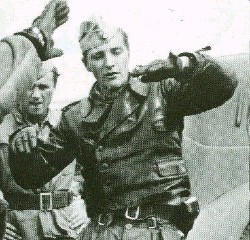 Marseille trying to explain some of his methods. On Sept. 26, he shot down his last victims, making a total of 158 confirmed air victories. He received a new Me-109 aircraft but refused to replace his faithful aircraft. His status was such that only an order by Fieldmarshal Kesselring, the supreme commander of the German forces in the southern front, convinced him three days later to use the new aircraft. The next morning, Sept. 30, 1942, he flew his 382nd combat mission, a fighter sweep over British territory. They met no enemies, and turned back towards the German lines. Marseille then had a technical problem. His new aircraft's engine cooling system failed, the engine caught fire, and his cockpit was full of smoke. Encouraged by his fellows, Marseille flew his burning new Me-109 three more minutes until he was again over German held territory. He then turned his aircraft upside down, jettisoned the canopy, and then released himself and fell outside of the burning fighter. Bailing out is not always safe, and Marseille was hit in the chest by the rudder of his Me-109 and lost consciousness, so he did not open his parachute, and fell down to the ground and died. Already highly decorated, he was posthumously awarded the highest German medal, the Knights Cross with Oak leaves, Swords, and Diamonds. Only 9 other German aces were awarded this medal. On his grave, his comrades wrote his name and rank, and added just one word: undefeated. Kills: 158 154 Fighter aircraft 4 Bomber aircraft 8 victories in 10 minutes, 17 victories in one day, 54 victories in one month. Average lethality ratio of just 15 rounds per victory. Awarded Iron Cross 2nd Class, September 1940 Awarded Iron Cross 1st Class, Fall 1940 Awarded German Cross in Gold, 24 November, 1941 Awarded Knight's Cross, 22 February, 1942 Awarded Knight's Cross with Oak Leaves, 6 June, 1942 Awarded Knight's Cross with Oak Leaves and Swords, 18 June, 1942 Awarded Italian Medaglia d' Oro al Valor Militare, 6 August, 1942 Awarded Knight's Cross with Oak Leaves, Swords, and Diamonds, 3 September, 1942 German Cross in Gold http://www.snyderstreasures.com/images/ger...manCrossFCU.jpg 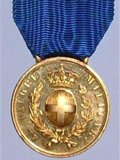 Medaglia d'Oro al Valor Militare. Leutnant - 1 July, 1941 Oberleutnant - April, 1942 Hauptmann - 3 September, 1942 Youngest Captain in the Luftwaffe.  Some stories: With the Messerschmitt's left wingtip pointed vertically toward the bluish-green bay below, the hapless Hurricane fighter stands virtually motionless in front of the young Berliner's windscreen. Through the heavy metal framed canopy of the Messerschmitt Bf-109F-4, the British Hurricane with its yellow, blue, white, and red centered cockade remains clearly recognizable against the crystal blue, cloudless North African sky. Pulling back on the stick, the G forces increase and the gut-wrenching turn tightens. The German pilot's body feels as though several hundred extra pounds have been saddled around him as the high G turn presses his body firmly into his seat. From underneath his black leather and mesh flight helmet, beads of sweat roll down the German's face, burning his eyes as they remain open and fixed on the revi-optical gun sight. 3G, 3.5G, 4G. The strain increases and the young man's arm starts to weaken and grow fatigued. Tired, numb, and aching from a mission already full of air combat, there are no distractions allowed; he mustn't let his quarry get away. A quick, cursory look inside and a firm but positive input with right rudder, Jochen, as he is known by his friends, corrects the aircraft's slight skid. Throttle full aft and maximum power, more pull on the stick and the Messerschmitt starts to gain rapidly on the brown and tan camouflaged British fighter. The Bf-109 begins to shudder under the ever increasing strain of the battle as the airspeed rapidly bleeds off from 300 knots indicated airspeed down to 140 knots. The tan colored Messerschmitt with the sky blue underside responds like the thoroughbred she is. Physics demands the Messerschmitt's nose to drop as the airspeed and corresponding lift falls away. Defying this law of nature, Jochen aggressively applies full top rudder with his heavy, fleece lined leather flying boot and the 109 now hangs precariously between stall and slow flight. A slight indication of stall warning and between 140 and 130 knots indicated airspeed, there is a large metallic clang that momentarily distracts the German pilot as the leading edge slats automatically slam into the extended position. This aeronautical feature increases wing camber and simultaneously decreases stall speed and decreases the British pilot's chances of survival. Like an artist working and molding clay to create the perfect masterpiece, the 22 year old German pilot works his aircraft as an extension of his own body. Sweat pours down his back underneath his black leather flight jacket. There is a definite cold chill in the cockpit at his altitude made even more noticeable by the cool winter sun hanging high and listless in the Libyan sky. The webbed shoulder harnesses bite into his neck and stings as the sweat creeps into the raw and irritated skin. He is suddenly aware of the additional weight of the flight helmet on his head as the crushing forces of high G maneuvering continue to take hold of his thin and nearly frail body. These minor distractions however, no longer affect the German ace. He has been here before and the only thing that now matters is another victory. 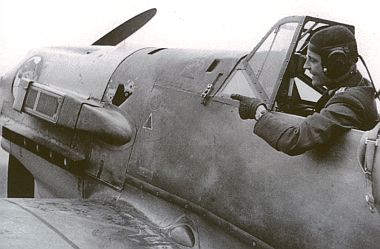 Looking over his left shoulder, the RAF pilot sees the tan Messerschmitt with white wing tips perched ominously off his left hind quarter. The white propeller spinner housing the deadly 20 mm cannon and the twin 7.9 mm machine guns on the nose slowly pulling lead and setting up for the proper firing position. Fear completely grips the British pilot for he now realizes it is no rookie pilot on his tail. Every evasive maneuver attempted has been flawlessly matched and countered by the German pilot who at the same time has been able to close the distance between the two adversaries with every turn. This is definitely an expert he is fighting today! With his fate evidently sealed, the ruddy faced Englishman, paralyzed with fear, takes a final look over his left shoulder to see the Messerschmitt approaching firing position. . . As Jochen's Messerschmitt closes in, the Hurricane begins to disappear beneath the nose of the German warbird. Young Jochen cocks his head slightly to the left and bites down on his lower lip. His large brown eyes see only the space in time where he calculates his deadly ordinance and the enemy plane will meet. It is time. FIRE!!!! The brown leather gloved index finger closes firmly around the red firing trigger and the control column shakes violently in his right hand. The cockpit immediately fills with the acrid smell of cordite as more than thirty pounds of steel per second of 7.9 mm machine gun and 20 mm cannon shells hurtle toward the Hurricane in beautiful yellow colored tracer arcs. A quick two-second burst and the German rolls his aircraft inverted and dives down and away, certain his aim was true. One thousand feet above the melee, the young Berliner's wingman watches the action in amazement, awe, and a certain amount of disbelief. As if by magical forces guiding Jochen's ammunition, the shells and the Hurricane meet in deadly unison. With perfect timing and precision accuracy, the bullets and cannon shells first strike the Hurricane's engine with fantastic, dazzling sparks, immediately rendering it a furnace of uncontrollable fire. Angry orange and red tongues of flame lap hungrily from the engine, belching sickening black and gray smoke extending more than 100 feet behind the stricken airplane. The damage, just beginning, gets worse as the shells quickly walk their way back along the fuselage to the cockpit. The destruction there is swift and complete, reducing the once proud British fighter pilot to a bloody, lifeless form inside the burning cockpit of his winged tomb. "Horrido Jochen!!", exclaims his wingman. "Hast du den aufschlag gesehen?" "Jawohl Jochen!" Within seconds, the 7500 pound Hurricane, a sheet of flaming metal, thunders vertically into the ocean near the Libyan harbor of Tobruk. As German fighter ace Hans-Joachim Marseille turns for home, a total of four, oily black spills are left fouling the otherwise beautiful ocean surface, marking the graves of four British fighter pilots that will be mourned by family and squadron members alike yet celebrated as four more victory marks on the rudder of German fighter ace Hans-Joachim Marseille, known throughout Germany as "The Star of Africa," who is to become the most successful of all German fighter pilots in the North African theater. http://www.warbirdsresourcegroup.org/LRG/hanstate.html  -------------------- C'est pas l' histoire d'un jour
Qui rime avec amour, Plutôt un long séjour Mais pas: un "pour toujours" |
|
|
|
Posts in this topic
 FeezyWeezy Notable People of WW2 03/19/06 1:54pm
 +KS+ Blinky Bill Ok, before Feezy explodes this forum with gigant i... 03/19/06 2:35pm FeezyWeezy
[b]Eino Ilmari Juutilainen
[size=3][img]http://... 03/19/06 2:40pm +KS+ Blinky Bill If anyone is a friend of books, here´s list of bo... 03/19/06 3:09pm Sparta THE INFAMOUS RED BARON!!!
I know He i... 03/19/06 10:25pm Sparta Maj. Richard I. Bong
Bong grew up on a farm near [... 03/19/06 10:40pm Slimshady Well I would also like to mention my left nut. It ... 03/19/06 11:51pm
+KS+ Blinky Bill Ok, before Feezy explodes this forum with gigant i... 03/19/06 2:35pm FeezyWeezy
[b]Eino Ilmari Juutilainen
[size=3][img]http://... 03/19/06 2:40pm +KS+ Blinky Bill If anyone is a friend of books, here´s list of bo... 03/19/06 3:09pm Sparta THE INFAMOUS RED BARON!!!
I know He i... 03/19/06 10:25pm Sparta Maj. Richard I. Bong
Bong grew up on a farm near [... 03/19/06 10:40pm Slimshady Well I would also like to mention my left nut. It ... 03/19/06 11:51pm
 Maj. H8Red
Well I would also like to mention my left nut. It... 03/20/06 12:13am Undertow :hysterical: 03/20/06 1:17am UNDEAD 1 i have to say its very interesting-can you find so... 03/20/06 9:01am FeezyWeezy George Beurling "Buzz" "Screwball... 03/20/06 9:11am Lord Lipton wow guys. way to do your research. 03/20/06 9:23am FeezyWeezy I'm sorry to putt this person here, between al... 03/20/06 11:21am UNDEAD 1 VERY interesting cant wait forthe next! 03/20/06 2:15pm FeezyWeezy Albert Speer
The "Good" Nazi
[img]http:... 03/20/06 5:09pm UNDEAD 1 where do you find this info?
anyway you can do ro... 03/21/06 3:41am FeezyWeezy Erwin Johannes Eugen Rommel
[b][size=4]"Wüs... 03/21/06 12:03pm UNDEAD 1 thank you ,its always been unclear to me how he di... 03/21/06 12:34pm Undertow Alright, Feezy. Give me some history on Hans Joach... 03/21/06 12:47pm FeezyWeezy Simo Häyhä
"Valkoinen Kuolema"
[img]ht... 03/21/06 10:23pm UNDEAD 1 WHOS NEXT? im addicted now! how about a german... 03/22/06 7:45pm FeezyWeezy Its time for a group of people which are related t... 03/22/06 10:52pm Sparta Theres little I can Say for those german Snipers
... 03/22/06 10:29pm Stickman I have read that the in the German air force in bo... 03/22/06 10:48pm FeezyWeezy I have read that the in the German air force in b... 03/22/06 11:17pm FeezyWeezy I have read that the in the German air force in b... 03/26/06 6:45am FeezyWeezy Operation Windsor, Carpiquet Aerodrome.
[b]Battl... 03/25/06 4:29pm UNDEAD 1 HOW COME THERES NOT A MAP FOR THIS BATTLE! do ... 03/25/06 5:46pm Hellfighter HOW COME THERES NOT A MAP FOR THIS BATTLE! ..... 03/26/06 9:22am FeezyWeezy Well maybe Bob and I can make a map about this one... 03/25/06 6:04pm UNDEAD 1 HEY HELL,for your info- about 8 years ago i was w... 03/27/06 3:38am Hellfighter HEY HELL,for your info- about 8 years ago i was ... 03/27/06 9:07am FeezyWeezy I will do Gen. Paulas, Tukegee Airmen and some ger... 03/27/06 7:56am UNDEAD 1 feezy i have to say these bios are very interestin... 03/27/06 10:23am FeezyWeezy Well I could find any detailed record from the num... 03/27/06 3:09pm FeezyWeezy [b]"Night Ghost of St. Trond"
[b][size=... 03/28/06 9:32am Hellfighter You've got to wonder, if the Allies new there ... 03/28/06 9:47am FeezyWeezy It was hard to figure out who killed who at most t... 03/28/06 3:59pm Hellfighter It was hard to figure out who killed who at most ... 03/28/06 7:48pm Hellfighter
[size="1"]Ramming attack was a tactic i... 03/28/06 8:00pm FeezyWeezy [size=3]Special Operations Executive
[size=2]Whe... 03/29/06 9:49am UNDEAD 1 before i played cod i played bf 1942. that was the... 03/29/06 11:06am FeezyWeezy before i played cod i played bf 1942. that was th... 03/29/06 12:55pm UNDEAD 1 [size=3]The Mustang was the best plane, very fast.... 03/29/06 7:26pm FeezyWeezy Matthäus Hetzenauer
[size=1]Born on December 23... 03/29/06 11:24am Radiation My people are not famous. Maybe in thier own resp... 03/29/06 1:34pm FeezyWeezy Klaus Barbie
http://worldatwar.net/biography/b/ba... 03/29/06 3:07pm Stickman Years ago I had a girlfriend (who looked remarkabl... 03/29/06 4:42pm FeezyWeezy Lyudmila Mikhailovna Pavlichenko [size=1][img]http... 03/30/06 4:23pm Leadmagnet Do one on Dieppe....Another "sacrifice" ... 03/30/06 6:42pm Hellfighter Do one on Dieppe....Another "sacrifice... 04/01/06 9:19pm UNDEAD 1 getting backed up? when do you play feezy,hehe... 03/30/06 7:00pm FeezyWeezy Time for one of the best Aces during the Finnish W... 03/30/06 9:58pm FeezyWeezy [size=5][b]Tuskegee Airmen
[size=1][size=3]... 04/02/06 9:22pm Hellfighter [size=3][size=5][b]Tuskegee Airmen
[size=3]By t... 04/03/06 1:50am FeezyWeezy [b]Bram van der Stok
"Bob Vanderstok"
[b... 04/12/06 12:07pm Hellfighter Hi Feezy, can you tell us in a short piece Spain... 04/12/06 4:56pm FeezyWeezy I'm only doing this because I feel crap person... 04/19/06 8:51am FeezyWeezy [b]Galland Borthers
[size=4][b]Adolf
[img]http:/... 04/30/06 8:36pm
Maj. H8Red
Well I would also like to mention my left nut. It... 03/20/06 12:13am Undertow :hysterical: 03/20/06 1:17am UNDEAD 1 i have to say its very interesting-can you find so... 03/20/06 9:01am FeezyWeezy George Beurling "Buzz" "Screwball... 03/20/06 9:11am Lord Lipton wow guys. way to do your research. 03/20/06 9:23am FeezyWeezy I'm sorry to putt this person here, between al... 03/20/06 11:21am UNDEAD 1 VERY interesting cant wait forthe next! 03/20/06 2:15pm FeezyWeezy Albert Speer
The "Good" Nazi
[img]http:... 03/20/06 5:09pm UNDEAD 1 where do you find this info?
anyway you can do ro... 03/21/06 3:41am FeezyWeezy Erwin Johannes Eugen Rommel
[b][size=4]"Wüs... 03/21/06 12:03pm UNDEAD 1 thank you ,its always been unclear to me how he di... 03/21/06 12:34pm Undertow Alright, Feezy. Give me some history on Hans Joach... 03/21/06 12:47pm FeezyWeezy Simo Häyhä
"Valkoinen Kuolema"
[img]ht... 03/21/06 10:23pm UNDEAD 1 WHOS NEXT? im addicted now! how about a german... 03/22/06 7:45pm FeezyWeezy Its time for a group of people which are related t... 03/22/06 10:52pm Sparta Theres little I can Say for those german Snipers
... 03/22/06 10:29pm Stickman I have read that the in the German air force in bo... 03/22/06 10:48pm FeezyWeezy I have read that the in the German air force in b... 03/22/06 11:17pm FeezyWeezy I have read that the in the German air force in b... 03/26/06 6:45am FeezyWeezy Operation Windsor, Carpiquet Aerodrome.
[b]Battl... 03/25/06 4:29pm UNDEAD 1 HOW COME THERES NOT A MAP FOR THIS BATTLE! do ... 03/25/06 5:46pm Hellfighter HOW COME THERES NOT A MAP FOR THIS BATTLE! ..... 03/26/06 9:22am FeezyWeezy Well maybe Bob and I can make a map about this one... 03/25/06 6:04pm UNDEAD 1 HEY HELL,for your info- about 8 years ago i was w... 03/27/06 3:38am Hellfighter HEY HELL,for your info- about 8 years ago i was ... 03/27/06 9:07am FeezyWeezy I will do Gen. Paulas, Tukegee Airmen and some ger... 03/27/06 7:56am UNDEAD 1 feezy i have to say these bios are very interestin... 03/27/06 10:23am FeezyWeezy Well I could find any detailed record from the num... 03/27/06 3:09pm FeezyWeezy [b]"Night Ghost of St. Trond"
[b][size=... 03/28/06 9:32am Hellfighter You've got to wonder, if the Allies new there ... 03/28/06 9:47am FeezyWeezy It was hard to figure out who killed who at most t... 03/28/06 3:59pm Hellfighter It was hard to figure out who killed who at most ... 03/28/06 7:48pm Hellfighter
[size="1"]Ramming attack was a tactic i... 03/28/06 8:00pm FeezyWeezy [size=3]Special Operations Executive
[size=2]Whe... 03/29/06 9:49am UNDEAD 1 before i played cod i played bf 1942. that was the... 03/29/06 11:06am FeezyWeezy before i played cod i played bf 1942. that was th... 03/29/06 12:55pm UNDEAD 1 [size=3]The Mustang was the best plane, very fast.... 03/29/06 7:26pm FeezyWeezy Matthäus Hetzenauer
[size=1]Born on December 23... 03/29/06 11:24am Radiation My people are not famous. Maybe in thier own resp... 03/29/06 1:34pm FeezyWeezy Klaus Barbie
http://worldatwar.net/biography/b/ba... 03/29/06 3:07pm Stickman Years ago I had a girlfriend (who looked remarkabl... 03/29/06 4:42pm FeezyWeezy Lyudmila Mikhailovna Pavlichenko [size=1][img]http... 03/30/06 4:23pm Leadmagnet Do one on Dieppe....Another "sacrifice" ... 03/30/06 6:42pm Hellfighter Do one on Dieppe....Another "sacrifice... 04/01/06 9:19pm UNDEAD 1 getting backed up? when do you play feezy,hehe... 03/30/06 7:00pm FeezyWeezy Time for one of the best Aces during the Finnish W... 03/30/06 9:58pm FeezyWeezy [size=5][b]Tuskegee Airmen
[size=1][size=3]... 04/02/06 9:22pm Hellfighter [size=3][size=5][b]Tuskegee Airmen
[size=3]By t... 04/03/06 1:50am FeezyWeezy [b]Bram van der Stok
"Bob Vanderstok"
[b... 04/12/06 12:07pm Hellfighter Hi Feezy, can you tell us in a short piece Spain... 04/12/06 4:56pm FeezyWeezy I'm only doing this because I feel crap person... 04/19/06 8:51am FeezyWeezy [b]Galland Borthers
[size=4][b]Adolf
[img]http:/... 04/30/06 8:36pm |
2 User(s) are reading this topic (2 Guests and 0 Anonymous Users)
0 Members:

|
Lo-Fi Version | Time is now: 05/05/26 12:15am |
Invision Power Board
© 2026 IPS, Inc.