
 Notable People of WW2, Hero's, veterans, leaders, the famous and alike. Notable People of WW2, Hero's, veterans, leaders, the famous and alike. |


| FeezyWeezy |
 03/19/06 1:54pm 03/19/06 1:54pm
Post
#1
|
|
Major  Group: Banned Posts: 609 Joined: January 14th 2006 From: Gone Member No.: 1533  |
Ok, time for another chapter of hostory facts. I'll start with some WW2 Aces.
Erich Hartmann  The highest scoring ace of all time was the great German Luftwaffe experte Erich Hartmann with 352 aerial kills. Flying Bf 109s (Me-109s) against the overmatched Soviet MiGs and Yaks for almost three years, he accumulated his unrivalled score. Hartmann claimed, that of all his accomplishments, he was proudest of the fact that he never lost a wingman. He is also reputed to have said. "Get close .. when he fills the entire windscreen ... then you can't possibly miss." Hartmann was born in 1922, in Weissach, Wurttemberg. At age 19 (1941), he joined the Luftwaffe and was posted to Jagdgeschwader 52 (JG 52) on the Eastern Front in October, 1942. He scored his first kill in November, and only achieved his second three months later. In the first half of 1943, he worked out some of the tactics which would prove so successful later on. If he was attacked from behind, he would send his wingman down low and out in front. Then he would get behind the enemy and fire a short, quick accurate burst, waiting "until the enemy aircraft filled the windscreen." He would normally content himself with one victory; he was willing to wait for another day. His natural talents began to tell: excellent eyesight, lightning reflexes, an aggressive spirit, and an ability to stay cool while in combat.  A Messerschmitt Bf 109G-6 Kursk As JG 52 retreated along with German ground forces in 1943, Hartmann's score began to mount. The great Kursk offensive, Operation Zitadelle, began on July 5. The Luftwaffe planned to screen the Wehrmacht's panzers from the Soviet Il-2 Sturmoviks, armored tank-busting aircraft, armed with twin 37mm cannon. Hartmann's Staffel 7 of JG 52 moved up to Ugrim, only 14 kilometers behind the front. As the Panther and Tiger tanks moved up, Junkers Ju.52 transports flew in supplies. On the morning of the 5th, four of Staffel 7's pilots did not return, apparently their compasses misled them, due to extraordinary iron ore deposits in the area. Hartmann was promoted to Staffelkapitan on the spot. The offensive ground forward slowly on the 6th and 7th; obviously the Russians had dug in and prepared defensive lines in depth. July 7, 1943 On the morning of July 7, 1943, sun rose over Ugrim in the northern Ukraine about 3AM. Staffel 7's Me.109 G10's lay scattered around, in the deep grass of the Ugrim airfield. Hartmann's personal plane, decorated with a large Roman numeral 'I' and the name Usch in a red heart. (Usch Paetch was his fiancee, whom he wrote to daily.) In the comfortable summer weather, the pilots slept in tents. On waking, Hartmann dressed in a gray shirt, blue-gray trousers, and gray shoes. He washed up and shaved in a small stream and ate breakfast, two eggs, cooked by a couple of Russian girls. He and the other three pilots in his Schwarm were assigned to cover an F.W.189 on a dawn reconnaissance mission. Erich joked with his crew chief, 'Bimel' Merten, and strapped himself into the cockpit. At 3:04, the recon plane started and Hartmann set Messerschmitt's flaps and checked the fuel while Merten cranked the starter. The DB 605's twelve cylinders coughed, belched smoke, and then caught smoothly. His three comrades followed him to the take-off spot. He gunned the engine while stomping on the brakes. When he released them, his 109 shot forward and quickly reached 160 km/hour. He gently pulled back on the stick and was airborne; the other three followed him closely. They all banked left as they went through post-take-off routines: retract landing gear, close radiator flaps, ease back on the throttle, and check gauges, guns, and gunsight. They climbed to 1300 meters as they flew northeast and then swung southward, with the Fw 189 in view. The flight proceeded uneventfully and the recon plane headed for Ugrim. Hartmann's radio crackled with a report from Adler, the German forward spotting post; a group of ten to twenty Russian planes were headed west. Hartmann throttled up a bit, gained altitude, and turned his Schwarm toward the east without sighting anything for several minutes.  Drawing of Hartmann's Bf-109G Messerschmitt "Gustav" 6 Sturmoviks Soon enough, many large Il-2's came into view. With its armor and rear gunner, the Sturmovik was a tough target. With the Sturmoviks closing head-on, Hartmann unhesitatingly ordered an attack. He dived down below them, picking up airspeed, then banked around and came up behind and beneath them, aiming for his target's vulnerable ventral oil radiator. The Il-2's flew straight on. Hartmann's Bf 109 roared along, doing over 400 MPH; Hartmann streaked into a Sturmovik's blind spot. At 200 yards, its wingspan filled his gunsight ring; still he closed in to 150, then 100 yards before firing. He briefly triggered his 20mm cannon and his two 12mm machine guns, for about one and a half seconds, before his speed carried him in front of them. As other Bf 109s struck their targets, Hartmann glanced back and saw blue flames and black sooty smoke streaming from the Sturmovik's radiator. His twenty-second victory of the war. Under the deadly attack of the Messerschmitts, the formation of Russian airplanes began to break up. Having regained altitude, Hartmann again zoomed down below the tail of an Il-2. He checked his own rear and stabilized his aircraft. This Russian pilot, alerted to the danger, spotted him and turned sharply to evade. The young blond ace matched the turn and instantly estimated the lead needed for a deflection shot. At 150 meters, he opened fire, and his bullets tore into the side of the Russian tank-buster. More blue flame and black smoke poured from his twenty-third victim's oil radiator. As the remaining scattered Russian planes fled eastward, Hartmann radioed his Staffel to return to Ugrim. About 4AM, as they approached the field, Hartmann waggled his wings twice, indicating his two victories. On landing, Mertem and other ground crew gathered around him, offering congratulations. Hartmann walked to the operations tent to file his Gefechtsbericht, his after-action report. Early reports from the Adler posts already showed more Russian air activity than on the 5th or 6th. Four pilots sat in their planes, ready to take-off in less than a minute. Hartmann soon fell asleep by his own machine. But only briefly. Two More Sorties By 5:50, he was back in the air, leading a flight of 109s on a frei chase, and he soon found more Il-2s, escorted by fighters. The Messerchmitts attacked successfully, with Hartmann downing another Il-2 and an LaGG-3 fighter. Within an hour, he was back on the ground, with four victories for the day. Late that afternoon, he led the Staffel up again, to the northeast. They found a group of Soviet LaGG-3 fighters, which they engaged in a sprawling dogfight. It was over quickly and Hartmann had shot down three enemy fighters, making it seven for the day, his largest score so far.  Experte He reached 50 by August of 1943. Within the month, he had reached 80, and was promoted to lead 9./JG52. Earlier in the war, 25 or 50 victories would have earned a German fighter pilot the Knight's Cross. By late 1943, Hartmann had to down 148 before he earned his Knight's Cross. By March 2, 1944, he had reached a total of 202, earning him the Oak Leaves. He was the fourth Luftwaffe fighter pilot to reach 250, the first to reach 300, and the only one to reach 350. The Diamonds 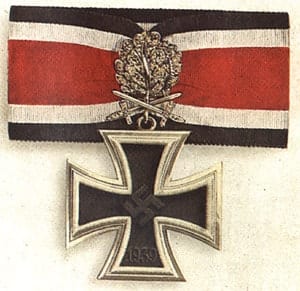 He was awarded the Third Reich's highest regularly awarded military decoration: The Knight's Cross to the Iron Cross with Oak Leaves, Swords and Diamonds. To be accurate, the highest military decoration was "The Grand Cross to the Iron Cross." It was only awarded once to Hermann Göring. The second highest military decoration was "The Knight's Cross to the Iron Cross with Golden Oak Leaves, Swords and Diamonds" and was also awarded only once to the Stuka ace Hans-Ulrich Rudel. Thus, Hartmann's medal, "The Knight's Cross to the Iron Cross with Oak Leaves, Swords and Diamonds," was, to be precise, the third highest German military decoration through WW2, was awarded to 27 soldiers, 12 of whom were Luftwaffe pilots. Near the end of WWII, in early May 1945, the Luftwaffe command ordered Hartmann, then Gruppenkommandeur of famous Jagdgeschwader 52, and his Commodore, Hermann Graf (another pilot, who had earned the "diamonds" to the Knight's Cross) to fly to the British sector. Both officers disregarded this order, because they felt responsible for Jagdgeschwader 52's pilots, ground crew, family members, and other civilians, who had joined the squadron, seeking protection against fierce aggression by the Czechs. The officers ordered the destruction of the unit's aircraft, and then the unit moved west in direction of territory already occupied by US troops. On May 8th, 1945, the soldiers and civilans surrendered to US troops in the region between Bavaria (German provence) and Czech border. But on May 17th, the US Army delivered all of these German troops and civilians to the Red Army. Like all others, Hartmann was then deported to Siberia, where he was sentenced to 50 years of hard labor. (Hartmann has since been rehabitated by Russian justice, which declared those sentences illegal in 1995.) The Soviets pressured him to support a build-up of an East German air force and tried to turn him into an undercover agent against the West. Hartmann refused, even though the Soviets threatened to kidnap and kill his wife and daughter, living in West Germany. Hartmann did not return to Germany until 1955, when the last German POWs were released along with the establishing of diplomatic relations between West Germany and the Soviet Union. In 1956, Hartmann joined the newly established West German Luftwaffe and contributed to the build-up of new fighter units. In 1959, he became the first commodore of Jagdgeschwader 71 "Richthofen." Erich Hartmann died in 1993. http://wernerhartenstein.tripod.com/hartma...9;s%20grave.jpg Hartmann's grave, Weil im Schönbuch near Stuttgart -------------------- C'est pas l' histoire d'un jour
Qui rime avec amour, Plutôt un long séjour Mais pas: un "pour toujours" |
   |

 
|
  |
Replies
| FeezyWeezy |
03/25/06 4:29pm
Post
#2
|
|
Major Group: Banned Posts: 609 Joined: January 14th 2006 From: Gone Member No.: 1533 |
Operation Windsor, Carpiquet Aerodrome.
Battle for Carpiquet Airfield Painted in 1946 by Orville Fisher (1911–1999)  The 7th Canadian Infantry Brigade at Carpiquet airfield on July 4, 1944. Orville Fisher, an official war artist serving in the Canadian Army, used the image of a destroyed, but still standing, aircraft hangar to symbolize this determined, but ultimately unsuccessful, effort. http://archives.cbc.ca/IDC-1-71-221-1119-1..._war/carpiquet/ A CBC Radio Broadcast about Carpiquet http://aerostories.free.fr/events/torture/carpiquet.JPG A Airial Photo of Carpiquet Aerodrome http://www.canadianbattleofnormandyfoundat...es/authie-1.jpg Monument at the Carpiquet airfield http://www.caen.aeroport.fr/ Official site of Modern Caen-Carpiquet Operation Windsor was launched on July 4th, 1944 and it became known to the Canadians that fought in it as the Battle of Carpiquet. Major-General Rod Keller's 3d Division was given a simple enough task: capture Carpiquet airport. It was held by only 150 boys from Kurt Meyer's 12th SS, but the Canadians had no illusions. Operation Windsor would demand four battalions - Brigadier Ken Blackader's 8th Brigade plus the Royal Winnipeg Rifles for a separate attack on the south side of the field. Tanks of the Fort Garry Horse, engineer assault vehicles, a flame-throwing Crocodile tank and all the artillery the division could muster would back the attack. In the event, it seemed little enough. At dawn, the Canadians rose, crossed the start line and walked into fields of waist-high wheat. Suddenly, their rolling artillery barrage seemed to stop forward. Some Canadians never lived to learn that the Germans had dumped their shells on the Canadian barrage line; they probably died thinking they were killed by their own side. The rest kept going, pausing only to mark the bodies of dead and wounded with a symbol hat soon sprouted quickly on the field - a bayoneted rifle jabbed into the dirt. At Carpiquet village, survivors from the North Shores and the Chaudieres waged pitiless warfare in the ruins. For the North Shores, it was the bloodiest day of the campaign: 132 casualties, 46 of them dead. "That first night alone," the padre of the North Shores wrote, "we buried 40 of our boys. You could fancy the wheat field had once been just like any wheat field back home. Now it was torn with shell holes and everywhere you could see the pale upturned faces of the dead." On the opposite side of Carpiquet airfield, the Royal Winnipeg Rifles fared even worse. For them, there was no cover at all. Pillboxes and concrete bunkers, built long before by the Luftwaffe, allowed the Germans to sweep the approaches. Guns and tanks blasted the attackers and when Captain Alec Christian of the Fort Garry Horse brought his squadron forward, half of his tanks were destroyed. At dusk, the remnants of the battalion were ordered back. At Carpiquet, a village on the outskirts of Caen, France, the 3rd Canadian Division, under Major-General Rod Keller, is engaged in the drive to the first major objective of the Allied invasion of Normandy.The target today is an airport defended by a small but formidable force: 150 soldiers from the 12th SS Panzer Division, commanded by Brigadeführer Kurt Meyer. The force assembled for Operation WINDSOR includes battalions from the North Shore Regiment, the Régiment de la Chaudière, the Queen's Own Rifles of Canada and the Royal Winnipeg Rifles, plus The Fort Garry Horse mounted in Sherman tanks, military engineers with assault vehicles, a flame-throwing Crocodile tank, and all the artillery the division can muster.The North Shores, the Chaudières and the Queen's Own will secure the village. The Royal Winnipeg Rifles and The Fort Garry Horse will attack from the south and take the airfield itself. The infantry will advance under the protection of a rolling artillery barrage. The operation begins at dawn and continues all day and all night. When the Germany artillery scores a direct hit on the Canadian barrage line, the infantry keep going without covering fire. The North Shores, Chaudières and Queen's Own fight a vicious battle in the ruins of Carpiquet. For the North Shore Regiment, with 132 casualties including 46 dead, it is the bloodiest day of the entire Normandy campaign. The Royal Winnipeg Rifles, under Lieutenant- Colonel J. M. Meldram, make two full-scale attacks across flat, open country, driven back both times by the constant fire from the pillboxes and concrete bunkers built by the Luftwaffe to defend the airfield. When Captain Alec Christian of The Fort Garry Horse brings his squadron forward to help, half his tanks are destroyed. After a dreadful night of German bombardment and counterattacks, the Canadians in Carpiquet find themselves more or less victorious-at a price: of the 2000 men engaged in the battle, 371 are casualties, including more than 100 dead.  Photos such as this one would have been used during the planning stages of the operation. Notice the significant amount of bomb damage visible in this photo. 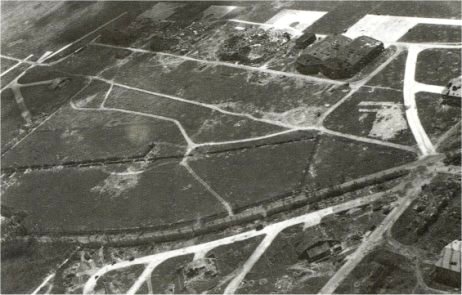 Operation Windsor to seize Carpiquet airfield - is very interesting; the Canadians committed a very reinforced brigade, complete with battleship support, to seize a small area held by only 150 Germans. Amazingly, the Canadians failed to seize the entire airfield and suffered 4-1 casualties. It took 5 days to take Carpiquet Aerodome. The 3rd Canadian Division suffered massive loses.  church of Saint-Martin, Carpiquet A piece from CanHistory about Normandy. A little over a mile to the east of Caen on the main highway connecting Caen with Bayeux the village of Carpiquet sits astride ground several metres higher than the surrounding countryside. Below it to the south was the plain on which the Carpiquet airfield is located. We drove through the village which showed not a trace of the almost total destruction that made it as deadly a killing ground as any other acre of ground in the beachhead or elsewhere in the war. We lingered for only a few minutes since there was nothing Alex could point out to me that would help in describing the fierce fighting that swirled in and around the village. We rode around the west perimeter of the airfield to the administration buildings at the east end. The area around these buildings had been the Queen's Own Rifles' objective, while the hangars at the south end were the focal point of the Royal Winnipeg Rifles attention. It was the Chaudieres job to take out the hangars at the north end close to the village limits. Battlefield intelligence, as it so often happened, was faulty or inadequate in Normandy. The Regiments of 8th Brigade were to soon find this out as they prepared to mount a concerted attack against enemy positions scattered all over the airfield. As Alex mentioned, they were told not to expect too much opposition because there was supposed to be little out there in the naked field that would hold them up. How wrong! How bloody wrong! There was a hell of a lot more out there in the open space of the airfield, and in and around the hangars and control buildings than what our Intelligence people picked up from interrogating prisoners. There had to be at least two dozen hull-down tanks with their powerful 88mm guns covering every square foot of the ground over which the forth-coming attack had to traverse. There were also a few towed 88s and 75s in position around the hangars. As for manpower, here again were the 12th S.S. Hitler Youth manning the tanks, the big guns, the MG nests and the hundreds of individual rifle positions. Also, there was a huge concrete bunker directly behind the control buildings that could shelter an entire company under even the heaviest bombing delivered by our Lancasters. Not too much to worry about? Like hell, there wasn't! 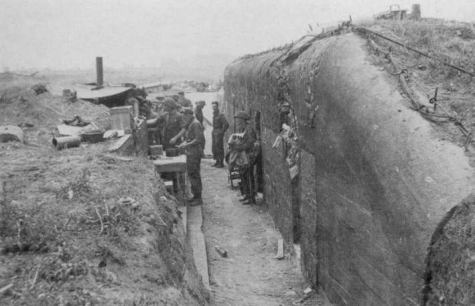 Canadian "Royal Winnipeg Rifles" at a Carpiquet Bunker. For the better of a week 8th Brigade fought the battle of its life at Carpi-quet airfield. It was only after Caen was taken that resistance slackened and the airfield finally taken on July 9th after a stiff artillery bombardment and a combined assault by tanks of the Fort Garry Horse and two companies of the Queen's Own. Alex was amongst those in that intrepid group that crossed the naked airfield under heavy fire to wrest it from the tenacious enemy.  Allied soldier with German HY Prisoner  12.SS-Panzer-Division Logo  In 1943 the 12 SS Hitlerjugend Panzer Division was formed. Mainly from boys born in 1926 who'd been in the Hitlerjugend previously. The division trained in Belgium more specifically in Beverloo. Many NCOs and Officers from the 1 SS Leibstandarte Adolf Hitler (LAH), they were combat veterans with knowledge in successful tactics and training. The training was hard for the teenagers, the LAH NCOs didn't know how to properly train younger soldiers and often pushed them past their limits. However in doing this the 12th SS became one of the hardest units in the German forces. 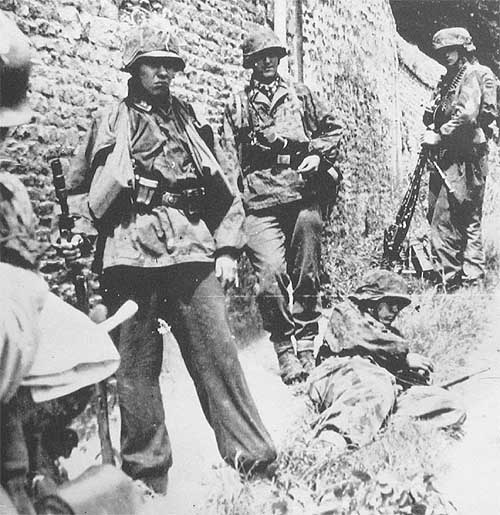 http://www.servicepub.com/pictures.htm On 6 June 1944, the Western Allies launched Operation Overlord, the invasion of Normandy. The HJ, along with the 21.Panzer-Division, was the closest armoured unit to the landing beaches. Due to Hitler's authorisation being required to release the panzer units, the HJ was not ordered to the front until 1430 on 6 June. The division's advance to the areas near Sword and Juno Beaches was severely hampered by incessant allied Jabo (fighter-bomber) attacks. Forward elements of the HJ finally reached their assembly area near Evrecy at 2200 on 6 June. On 7 June, SS-Standartenführer Kurt Meyer's ("Panzermeyer") SS-Panzergrenadier-Regiment 25, along with the II./Abteilung from SS-Obersturmbannfuhrer Max Wunsche's SS-Panzer-Regiment 12, were supported by artillery and ordered to crush advancing Canadian infantry and armour and drive through to the coast, still only a few miles away. In Meyers words they were to "throw the little fish into the sea". Although they destroyed many Canadian tanks and overran a company of the North Nova Scotia Highlanders in Authie, the attack failed to break through the advancing Canadians. Meyer had relied on the shock value of the rapid attacks that had served his units so well on the Eastern front but here in Normandy, as both sides were to discover, effective scouting was a key element to an attack. The 25 Regiment had been forced to launch their attack into the flank of the Canadian advance a full hour before Meyer initially planned to strike. Without support from other units on his own flanks and no reconnaissance information with which to plan his attack it was initially very successful but rapidly lost its momentum. The North Novas in Authie bought time for the other companies of their regiment to establish defensive positions. The Sherbrooke Fusiliers lost over 25 Sherman tanks to the Panzer IV tanks and anti tank guns of 12th SS in the opening minutes of the counterattack. The 12 SS managed to push the portion of the Canadian spearhead they attacked back two miles but the remaining North Nova Scotia Highlanders, without artillery support or any armour halted the 25th regiment and established a firm defence. According to accounts from Canadian prisoners who survived the events, the youth of the Hitler Jugend were frustrated and mad with rage and there were numerous incidences of North Nova prisoners being shot, bludgeoned to death and even run over with a truck while they were being marched along a road. Battle casualties for the day on both sides were virtually even. Both forces suffered approximately 80 killed and around 175 wounded or captured. It was a hard and bloody fight to a draw. Meyer set up his command post in the Abbey Ardennes, whose towers provided an excellent view of the countryside. In the early evening of June 7th, as he planned the regiment's next moves, a further 18 Canadians were interrogated and then executed on the grounds of Abbey. In all over 100 Canadians from several regiments are documented as having been killed after surrendering to the 12SS. Meyer's regiment was deployed near the villages of Authie and Buron, in positions covering the vital Carpiquet Aerodrome. Forced to stay in place to contain the North Nova's brigade they were unavailable the next day to support the 26th Regiment in its attacks. They would remain on the same ground until driven off in vicious hand to hand fighting with the Highland Light Infantry of Canada on July 8th. On 8 June, SS-Panzergrenadier-Regiment 26 under command of SS-Obersturmbannfuhrer Wilhelm Mohnke arrived on the battlefield. Meyers attack had pushed back one part of the Canadian advance but another brigade had occupied a group of small villages two miles into the German line. They crossed behind Meyer's regiment and the 26th took up positions to their west. After planning and positioning the regiment for a powerful thrust the 26th launched an attack towards Norrey-en-Bessin. Their orders were to drive over the Canadians and force a deep wedge between them and the British division to the west. Again, no reconnaissance of the Canadian positions was done and this time the youth of the 12th SS infantry would wade into a maelstrom of defensive fire from firmly established defensive positions. The attack, launched at 0330 hours some 8 hours after Meyer's battle ended, had little initial success. The various companies in the attacking 12th SS failed to co-ordinate their moves towards the Canadians and despite heavy casualties during repeated attempts by the infantry, Canadian artillery and supporting heavy machine guns of the Cameron Highlanders of Ottawa took a heavy toll of each attacking company of SS troops. On the Canadian left where fighting initially began, extremely brave actions on the part of the German infantry managed to push the Winnipeg Rifles out of Norrey in vicious fighting but the attack stalled when the successes could not be followed up. On the Canadian right, over 1,000 12 SS attacked the 250 Canadian troops defending their village areas just as the fight around Norrey was ending. Able to switch defensive fire onto the new threat, artillery, tank and heavy machine gun fire broke up the attacks and killing and wounding many infantry of 12 SS and destroying 8 Panthers of Wunche's supporting panzer company. In some cases the attacking companies broke off their attacks but others pressed in despite casualties only to be forced back by intense small arms fire from the Canadian infantry. When Monke's bloodied companies were withdrawn from their attacks on the other villages near Norrey, the Canadians were sitting in a firm position well within the critical area near Caen and the Carpiquet airfield. Again both sides had suffered serious losses. Again many Canadian prisoners were executed after their surrender. The SS-Aufklärungs-Abteilung 12(reconnaissance battalion) under SS-Sturmbannführer Gerhard Bremer participated in the attacks on June 8th and they were responsible for the after the battle killing of over a dozen Canadian troops. Bremer himself is reported to have been directly involved. The 2nd Battalion of the Monke's 26th Regiment murdered a further 20 some odd men, most from the Winnipeg Rifles in Norrey. Before their capture the men who defended Norrey had inflicted numerous casualties on the 2nd Battalion but the bodies of the murdered Canadians were found well away from the village. Following the battle SS-Aufklärungs-Abteilung 12 deployed to the west of Mohnke's regiment, and by the evening of 8 June the division, having failed in its assignment to drive the Canadians into the sea, they had effectively halted the units of the 3rd Canadian Infantry Division in the Allied advance on Caen. These Canadian units were the only ones in the entire D-Day effort that managed to reach their assigned objectives. Despite the ferocity and local successes of the 12th SS counterattacks, the Division failed to fulfil its orders to throw the attacking allies back into the sea. Once British troops had moved up to the positions now firmly held by the troops of the 3rd Canadian Infantry Division that faced the 12th SS, the British dug in and established a firm line of defence from which they could launch future attacks. The allies were firmly on the continent to stay. The panzer army that contained the 12SS and the 21st Army Group they opposed, settled into a bitter series of battles that would finally lead to the liberation of Normandy -------------------- C'est pas l' histoire d'un jour
Qui rime avec amour, Plutôt un long séjour Mais pas: un "pour toujours" |
|
|
|
Posts in this topic
 FeezyWeezy Notable People of WW2 03/19/06 1:54pm
 +KS+ Blinky Bill Ok, before Feezy explodes this forum with gigant i... 03/19/06 2:35pm FeezyWeezy
[b]Eino Ilmari Juutilainen
[size=3][img]http://... 03/19/06 2:40pm +KS+ Blinky Bill If anyone is a friend of books, here´s list of bo... 03/19/06 3:09pm Sparta THE INFAMOUS RED BARON!!!
I know He i... 03/19/06 10:25pm Sparta Maj. Richard I. Bong
Bong grew up on a farm near [... 03/19/06 10:40pm Slimshady Well I would also like to mention my left nut. It ... 03/19/06 11:51pm
+KS+ Blinky Bill Ok, before Feezy explodes this forum with gigant i... 03/19/06 2:35pm FeezyWeezy
[b]Eino Ilmari Juutilainen
[size=3][img]http://... 03/19/06 2:40pm +KS+ Blinky Bill If anyone is a friend of books, here´s list of bo... 03/19/06 3:09pm Sparta THE INFAMOUS RED BARON!!!
I know He i... 03/19/06 10:25pm Sparta Maj. Richard I. Bong
Bong grew up on a farm near [... 03/19/06 10:40pm Slimshady Well I would also like to mention my left nut. It ... 03/19/06 11:51pm
 Maj. H8Red
Well I would also like to mention my left nut. It... 03/20/06 12:13am Undertow :hysterical: 03/20/06 1:17am UNDEAD 1 i have to say its very interesting-can you find so... 03/20/06 9:01am FeezyWeezy George Beurling "Buzz" "Screwball... 03/20/06 9:11am Lord Lipton wow guys. way to do your research. 03/20/06 9:23am FeezyWeezy I'm sorry to putt this person here, between al... 03/20/06 11:21am UNDEAD 1 VERY interesting cant wait forthe next! 03/20/06 2:15pm FeezyWeezy Albert Speer
The "Good" Nazi
[img]http:... 03/20/06 5:09pm UNDEAD 1 where do you find this info?
anyway you can do ro... 03/21/06 3:41am FeezyWeezy Erwin Johannes Eugen Rommel
[b][size=4]"Wüs... 03/21/06 12:03pm UNDEAD 1 thank you ,its always been unclear to me how he di... 03/21/06 12:34pm Undertow Alright, Feezy. Give me some history on Hans Joach... 03/21/06 12:47pm FeezyWeezy Hans Joachim Marseille
[size=4]"Der Stern von... 03/21/06 3:07pm FeezyWeezy Simo Häyhä
"Valkoinen Kuolema"
[img]ht... 03/21/06 10:23pm UNDEAD 1 WHOS NEXT? im addicted now! how about a german... 03/22/06 7:45pm FeezyWeezy Its time for a group of people which are related t... 03/22/06 10:52pm Sparta Theres little I can Say for those german Snipers
... 03/22/06 10:29pm Stickman I have read that the in the German air force in bo... 03/22/06 10:48pm FeezyWeezy I have read that the in the German air force in b... 03/22/06 11:17pm FeezyWeezy I have read that the in the German air force in b... 03/26/06 6:45am UNDEAD 1 HOW COME THERES NOT A MAP FOR THIS BATTLE! do ... 03/25/06 5:46pm Hellfighter HOW COME THERES NOT A MAP FOR THIS BATTLE! ..... 03/26/06 9:22am FeezyWeezy Well maybe Bob and I can make a map about this one... 03/25/06 6:04pm UNDEAD 1 HEY HELL,for your info- about 8 years ago i was w... 03/27/06 3:38am Hellfighter HEY HELL,for your info- about 8 years ago i was ... 03/27/06 9:07am FeezyWeezy I will do Gen. Paulas, Tukegee Airmen and some ger... 03/27/06 7:56am UNDEAD 1 feezy i have to say these bios are very interestin... 03/27/06 10:23am FeezyWeezy Well I could find any detailed record from the num... 03/27/06 3:09pm FeezyWeezy [b]"Night Ghost of St. Trond"
[b][size=... 03/28/06 9:32am Hellfighter You've got to wonder, if the Allies new there ... 03/28/06 9:47am FeezyWeezy It was hard to figure out who killed who at most t... 03/28/06 3:59pm Hellfighter It was hard to figure out who killed who at most ... 03/28/06 7:48pm Hellfighter
[size="1"]Ramming attack was a tactic i... 03/28/06 8:00pm FeezyWeezy [size=3]Special Operations Executive
[size=2]Whe... 03/29/06 9:49am UNDEAD 1 before i played cod i played bf 1942. that was the... 03/29/06 11:06am FeezyWeezy before i played cod i played bf 1942. that was th... 03/29/06 12:55pm UNDEAD 1 [size=3]The Mustang was the best plane, very fast.... 03/29/06 7:26pm FeezyWeezy Matthäus Hetzenauer
[size=1]Born on December 23... 03/29/06 11:24am Radiation My people are not famous. Maybe in thier own resp... 03/29/06 1:34pm FeezyWeezy Klaus Barbie
http://worldatwar.net/biography/b/ba... 03/29/06 3:07pm Stickman Years ago I had a girlfriend (who looked remarkabl... 03/29/06 4:42pm FeezyWeezy Lyudmila Mikhailovna Pavlichenko [size=1][img]http... 03/30/06 4:23pm Leadmagnet Do one on Dieppe....Another "sacrifice" ... 03/30/06 6:42pm Hellfighter Do one on Dieppe....Another "sacrifice... 04/01/06 9:19pm UNDEAD 1 getting backed up? when do you play feezy,hehe... 03/30/06 7:00pm FeezyWeezy Time for one of the best Aces during the Finnish W... 03/30/06 9:58pm FeezyWeezy [size=5][b]Tuskegee Airmen
[size=1][size=3]... 04/02/06 9:22pm Hellfighter [size=3][size=5][b]Tuskegee Airmen
[size=3]By t... 04/03/06 1:50am FeezyWeezy [b]Bram van der Stok
"Bob Vanderstok"
[b... 04/12/06 12:07pm Hellfighter Hi Feezy, can you tell us in a short piece Spain... 04/12/06 4:56pm FeezyWeezy I'm only doing this because I feel crap person... 04/19/06 8:51am FeezyWeezy [b]Galland Borthers
[size=4][b]Adolf
[img]http:/... 04/30/06 8:36pm
Maj. H8Red
Well I would also like to mention my left nut. It... 03/20/06 12:13am Undertow :hysterical: 03/20/06 1:17am UNDEAD 1 i have to say its very interesting-can you find so... 03/20/06 9:01am FeezyWeezy George Beurling "Buzz" "Screwball... 03/20/06 9:11am Lord Lipton wow guys. way to do your research. 03/20/06 9:23am FeezyWeezy I'm sorry to putt this person here, between al... 03/20/06 11:21am UNDEAD 1 VERY interesting cant wait forthe next! 03/20/06 2:15pm FeezyWeezy Albert Speer
The "Good" Nazi
[img]http:... 03/20/06 5:09pm UNDEAD 1 where do you find this info?
anyway you can do ro... 03/21/06 3:41am FeezyWeezy Erwin Johannes Eugen Rommel
[b][size=4]"Wüs... 03/21/06 12:03pm UNDEAD 1 thank you ,its always been unclear to me how he di... 03/21/06 12:34pm Undertow Alright, Feezy. Give me some history on Hans Joach... 03/21/06 12:47pm FeezyWeezy Hans Joachim Marseille
[size=4]"Der Stern von... 03/21/06 3:07pm FeezyWeezy Simo Häyhä
"Valkoinen Kuolema"
[img]ht... 03/21/06 10:23pm UNDEAD 1 WHOS NEXT? im addicted now! how about a german... 03/22/06 7:45pm FeezyWeezy Its time for a group of people which are related t... 03/22/06 10:52pm Sparta Theres little I can Say for those german Snipers
... 03/22/06 10:29pm Stickman I have read that the in the German air force in bo... 03/22/06 10:48pm FeezyWeezy I have read that the in the German air force in b... 03/22/06 11:17pm FeezyWeezy I have read that the in the German air force in b... 03/26/06 6:45am UNDEAD 1 HOW COME THERES NOT A MAP FOR THIS BATTLE! do ... 03/25/06 5:46pm Hellfighter HOW COME THERES NOT A MAP FOR THIS BATTLE! ..... 03/26/06 9:22am FeezyWeezy Well maybe Bob and I can make a map about this one... 03/25/06 6:04pm UNDEAD 1 HEY HELL,for your info- about 8 years ago i was w... 03/27/06 3:38am Hellfighter HEY HELL,for your info- about 8 years ago i was ... 03/27/06 9:07am FeezyWeezy I will do Gen. Paulas, Tukegee Airmen and some ger... 03/27/06 7:56am UNDEAD 1 feezy i have to say these bios are very interestin... 03/27/06 10:23am FeezyWeezy Well I could find any detailed record from the num... 03/27/06 3:09pm FeezyWeezy [b]"Night Ghost of St. Trond"
[b][size=... 03/28/06 9:32am Hellfighter You've got to wonder, if the Allies new there ... 03/28/06 9:47am FeezyWeezy It was hard to figure out who killed who at most t... 03/28/06 3:59pm Hellfighter It was hard to figure out who killed who at most ... 03/28/06 7:48pm Hellfighter
[size="1"]Ramming attack was a tactic i... 03/28/06 8:00pm FeezyWeezy [size=3]Special Operations Executive
[size=2]Whe... 03/29/06 9:49am UNDEAD 1 before i played cod i played bf 1942. that was the... 03/29/06 11:06am FeezyWeezy before i played cod i played bf 1942. that was th... 03/29/06 12:55pm UNDEAD 1 [size=3]The Mustang was the best plane, very fast.... 03/29/06 7:26pm FeezyWeezy Matthäus Hetzenauer
[size=1]Born on December 23... 03/29/06 11:24am Radiation My people are not famous. Maybe in thier own resp... 03/29/06 1:34pm FeezyWeezy Klaus Barbie
http://worldatwar.net/biography/b/ba... 03/29/06 3:07pm Stickman Years ago I had a girlfriend (who looked remarkabl... 03/29/06 4:42pm FeezyWeezy Lyudmila Mikhailovna Pavlichenko [size=1][img]http... 03/30/06 4:23pm Leadmagnet Do one on Dieppe....Another "sacrifice" ... 03/30/06 6:42pm Hellfighter Do one on Dieppe....Another "sacrifice... 04/01/06 9:19pm UNDEAD 1 getting backed up? when do you play feezy,hehe... 03/30/06 7:00pm FeezyWeezy Time for one of the best Aces during the Finnish W... 03/30/06 9:58pm FeezyWeezy [size=5][b]Tuskegee Airmen
[size=1][size=3]... 04/02/06 9:22pm Hellfighter [size=3][size=5][b]Tuskegee Airmen
[size=3]By t... 04/03/06 1:50am FeezyWeezy [b]Bram van der Stok
"Bob Vanderstok"
[b... 04/12/06 12:07pm Hellfighter Hi Feezy, can you tell us in a short piece Spain... 04/12/06 4:56pm FeezyWeezy I'm only doing this because I feel crap person... 04/19/06 8:51am FeezyWeezy [b]Galland Borthers
[size=4][b]Adolf
[img]http:/... 04/30/06 8:36pm |
1 User(s) are reading this topic (1 Guests and 0 Anonymous Users)
0 Members:

|
Lo-Fi Version | Time is now: 05/04/26 8:14am |
Invision Power Board
© 2026 IPS, Inc.