
 Notable People of WW2, Hero's, veterans, leaders, the famous and alike. Notable People of WW2, Hero's, veterans, leaders, the famous and alike. |


| FeezyWeezy |
 03/19/06 1:54pm 03/19/06 1:54pm
Post
#1
|
|
Major  Group: Banned Posts: 609 Joined: January 14th 2006 From: Gone Member No.: 1533  |
Ok, time for another chapter of hostory facts. I'll start with some WW2 Aces.
Erich Hartmann  The highest scoring ace of all time was the great German Luftwaffe experte Erich Hartmann with 352 aerial kills. Flying Bf 109s (Me-109s) against the overmatched Soviet MiGs and Yaks for almost three years, he accumulated his unrivalled score. Hartmann claimed, that of all his accomplishments, he was proudest of the fact that he never lost a wingman. He is also reputed to have said. "Get close .. when he fills the entire windscreen ... then you can't possibly miss." Hartmann was born in 1922, in Weissach, Wurttemberg. At age 19 (1941), he joined the Luftwaffe and was posted to Jagdgeschwader 52 (JG 52) on the Eastern Front in October, 1942. He scored his first kill in November, and only achieved his second three months later. In the first half of 1943, he worked out some of the tactics which would prove so successful later on. If he was attacked from behind, he would send his wingman down low and out in front. Then he would get behind the enemy and fire a short, quick accurate burst, waiting "until the enemy aircraft filled the windscreen." He would normally content himself with one victory; he was willing to wait for another day. His natural talents began to tell: excellent eyesight, lightning reflexes, an aggressive spirit, and an ability to stay cool while in combat.  A Messerschmitt Bf 109G-6 Kursk As JG 52 retreated along with German ground forces in 1943, Hartmann's score began to mount. The great Kursk offensive, Operation Zitadelle, began on July 5. The Luftwaffe planned to screen the Wehrmacht's panzers from the Soviet Il-2 Sturmoviks, armored tank-busting aircraft, armed with twin 37mm cannon. Hartmann's Staffel 7 of JG 52 moved up to Ugrim, only 14 kilometers behind the front. As the Panther and Tiger tanks moved up, Junkers Ju.52 transports flew in supplies. On the morning of the 5th, four of Staffel 7's pilots did not return, apparently their compasses misled them, due to extraordinary iron ore deposits in the area. Hartmann was promoted to Staffelkapitan on the spot. The offensive ground forward slowly on the 6th and 7th; obviously the Russians had dug in and prepared defensive lines in depth. July 7, 1943 On the morning of July 7, 1943, sun rose over Ugrim in the northern Ukraine about 3AM. Staffel 7's Me.109 G10's lay scattered around, in the deep grass of the Ugrim airfield. Hartmann's personal plane, decorated with a large Roman numeral 'I' and the name Usch in a red heart. (Usch Paetch was his fiancee, whom he wrote to daily.) In the comfortable summer weather, the pilots slept in tents. On waking, Hartmann dressed in a gray shirt, blue-gray trousers, and gray shoes. He washed up and shaved in a small stream and ate breakfast, two eggs, cooked by a couple of Russian girls. He and the other three pilots in his Schwarm were assigned to cover an F.W.189 on a dawn reconnaissance mission. Erich joked with his crew chief, 'Bimel' Merten, and strapped himself into the cockpit. At 3:04, the recon plane started and Hartmann set Messerschmitt's flaps and checked the fuel while Merten cranked the starter. The DB 605's twelve cylinders coughed, belched smoke, and then caught smoothly. His three comrades followed him to the take-off spot. He gunned the engine while stomping on the brakes. When he released them, his 109 shot forward and quickly reached 160 km/hour. He gently pulled back on the stick and was airborne; the other three followed him closely. They all banked left as they went through post-take-off routines: retract landing gear, close radiator flaps, ease back on the throttle, and check gauges, guns, and gunsight. They climbed to 1300 meters as they flew northeast and then swung southward, with the Fw 189 in view. The flight proceeded uneventfully and the recon plane headed for Ugrim. Hartmann's radio crackled with a report from Adler, the German forward spotting post; a group of ten to twenty Russian planes were headed west. Hartmann throttled up a bit, gained altitude, and turned his Schwarm toward the east without sighting anything for several minutes.  Drawing of Hartmann's Bf-109G Messerschmitt "Gustav" 6 Sturmoviks Soon enough, many large Il-2's came into view. With its armor and rear gunner, the Sturmovik was a tough target. With the Sturmoviks closing head-on, Hartmann unhesitatingly ordered an attack. He dived down below them, picking up airspeed, then banked around and came up behind and beneath them, aiming for his target's vulnerable ventral oil radiator. The Il-2's flew straight on. Hartmann's Bf 109 roared along, doing over 400 MPH; Hartmann streaked into a Sturmovik's blind spot. At 200 yards, its wingspan filled his gunsight ring; still he closed in to 150, then 100 yards before firing. He briefly triggered his 20mm cannon and his two 12mm machine guns, for about one and a half seconds, before his speed carried him in front of them. As other Bf 109s struck their targets, Hartmann glanced back and saw blue flames and black sooty smoke streaming from the Sturmovik's radiator. His twenty-second victory of the war. Under the deadly attack of the Messerschmitts, the formation of Russian airplanes began to break up. Having regained altitude, Hartmann again zoomed down below the tail of an Il-2. He checked his own rear and stabilized his aircraft. This Russian pilot, alerted to the danger, spotted him and turned sharply to evade. The young blond ace matched the turn and instantly estimated the lead needed for a deflection shot. At 150 meters, he opened fire, and his bullets tore into the side of the Russian tank-buster. More blue flame and black smoke poured from his twenty-third victim's oil radiator. As the remaining scattered Russian planes fled eastward, Hartmann radioed his Staffel to return to Ugrim. About 4AM, as they approached the field, Hartmann waggled his wings twice, indicating his two victories. On landing, Mertem and other ground crew gathered around him, offering congratulations. Hartmann walked to the operations tent to file his Gefechtsbericht, his after-action report. Early reports from the Adler posts already showed more Russian air activity than on the 5th or 6th. Four pilots sat in their planes, ready to take-off in less than a minute. Hartmann soon fell asleep by his own machine. But only briefly. Two More Sorties By 5:50, he was back in the air, leading a flight of 109s on a frei chase, and he soon found more Il-2s, escorted by fighters. The Messerchmitts attacked successfully, with Hartmann downing another Il-2 and an LaGG-3 fighter. Within an hour, he was back on the ground, with four victories for the day. Late that afternoon, he led the Staffel up again, to the northeast. They found a group of Soviet LaGG-3 fighters, which they engaged in a sprawling dogfight. It was over quickly and Hartmann had shot down three enemy fighters, making it seven for the day, his largest score so far.  Experte He reached 50 by August of 1943. Within the month, he had reached 80, and was promoted to lead 9./JG52. Earlier in the war, 25 or 50 victories would have earned a German fighter pilot the Knight's Cross. By late 1943, Hartmann had to down 148 before he earned his Knight's Cross. By March 2, 1944, he had reached a total of 202, earning him the Oak Leaves. He was the fourth Luftwaffe fighter pilot to reach 250, the first to reach 300, and the only one to reach 350. The Diamonds 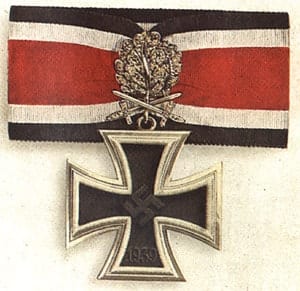 He was awarded the Third Reich's highest regularly awarded military decoration: The Knight's Cross to the Iron Cross with Oak Leaves, Swords and Diamonds. To be accurate, the highest military decoration was "The Grand Cross to the Iron Cross." It was only awarded once to Hermann Göring. The second highest military decoration was "The Knight's Cross to the Iron Cross with Golden Oak Leaves, Swords and Diamonds" and was also awarded only once to the Stuka ace Hans-Ulrich Rudel. Thus, Hartmann's medal, "The Knight's Cross to the Iron Cross with Oak Leaves, Swords and Diamonds," was, to be precise, the third highest German military decoration through WW2, was awarded to 27 soldiers, 12 of whom were Luftwaffe pilots. Near the end of WWII, in early May 1945, the Luftwaffe command ordered Hartmann, then Gruppenkommandeur of famous Jagdgeschwader 52, and his Commodore, Hermann Graf (another pilot, who had earned the "diamonds" to the Knight's Cross) to fly to the British sector. Both officers disregarded this order, because they felt responsible for Jagdgeschwader 52's pilots, ground crew, family members, and other civilians, who had joined the squadron, seeking protection against fierce aggression by the Czechs. The officers ordered the destruction of the unit's aircraft, and then the unit moved west in direction of territory already occupied by US troops. On May 8th, 1945, the soldiers and civilans surrendered to US troops in the region between Bavaria (German provence) and Czech border. But on May 17th, the US Army delivered all of these German troops and civilians to the Red Army. Like all others, Hartmann was then deported to Siberia, where he was sentenced to 50 years of hard labor. (Hartmann has since been rehabitated by Russian justice, which declared those sentences illegal in 1995.) The Soviets pressured him to support a build-up of an East German air force and tried to turn him into an undercover agent against the West. Hartmann refused, even though the Soviets threatened to kidnap and kill his wife and daughter, living in West Germany. Hartmann did not return to Germany until 1955, when the last German POWs were released along with the establishing of diplomatic relations between West Germany and the Soviet Union. In 1956, Hartmann joined the newly established West German Luftwaffe and contributed to the build-up of new fighter units. In 1959, he became the first commodore of Jagdgeschwader 71 "Richthofen." Erich Hartmann died in 1993. http://wernerhartenstein.tripod.com/hartma...9;s%20grave.jpg Hartmann's grave, Weil im Schönbuch near Stuttgart -------------------- C'est pas l' histoire d'un jour
Qui rime avec amour, Plutôt un long séjour Mais pas: un "pour toujours" |
   |

 
|
  |
Replies
| Stickman |
03/22/06 10:48pm
Post
#2
|
 First Lieutenant Group: Forum Member Posts: 115 Joined: October 9th 2005 Member No.: 1374 |
I have read that the in the German air force in both world wars, individual pilots were celebrated much more than in the allied air forces. The allies were more "team oriented". As glory was heaped upon german aces, german tactics often were based on the squadron providing backup for one or two leading aces, allowing them to boost their scores.
Also, German standards for confirming kills were less strict on the German side. With the pilots getting decorations for racking up high kill numbers, and the great propaganda value of such kill scores, it was to nobodies advantage to question kill claims too closely. This is why the top german pilots numbers of kills are so much higher than the top scores of aces of other nations. Comments, Feezy? Or anyone else? --------------------  |
|
|
|
| FeezyWeezy |
03/26/06 6:45am
Post
#3
|
|
Major Group: Banned Posts: 609 Joined: January 14th 2006 From: Gone Member No.: 1533 |
QUOTE(Stickman @ 03/23/06 5:48am)  I have read that the in the German air force in both world wars, individual pilots were celebrated much more than in the allied air forces. The allies were more "team oriented". As glory was heaped upon german aces, german tactics often were based on the squadron providing backup for one or two leading aces, allowing them to boost their scores. Also, German standards for confirming kills were less strict on the German side. With the pilots getting decorations for racking up high kill numbers, and the great propaganda value of such kill scores, it was to nobodies advantage to question kill claims too closely. This is why the top german pilots numbers of kills are so much higher than the top scores of aces of other nations. Comments, Feezy? Or anyone else? Many publications of past times openly disputed the many 100-plus victories claimed by Luftwaffe aces. Since Britain's James "Johnnie" Johnson had scored but 38 victories during the war on the Western Front along with American Richard Bong's 40 in the Pacific, Erich Hartmann's 352 was thought to be Nazi propaganda. It was reasoned early on that the 100-plus scores included damaged and probables given by a liberal system. Some even went so far as to say that the numbers were points awarded by some Luftwaffe scoring system. It is puzzling that no one in the 1950s-60s was casting doubt on Japan's aces' scores. Saburo Sakai's 64 and Hiroyoshi Nishizawa's 103 were never questioned. Sakai's book about his combat experiences, Samurai, vividly depicted most of these kills from his war time flight logs. It was reasoned that since aces that survived many years of the war against a numerically superior enemy would have ample opportunity to score. Japan's pilots never rotated out of combat except for brief relaxation periods or hospital stays for wounds received. Of course there were figures claiming that the top 35 Luftwaffe scorers had amassed 6,848 kills where the Japanese aces seem modest by comparison. Partly due to the flammability of Japanese planes, not many aces survived to score more. Allied pilots almost to a man were taken out of combat and posted to flight schools or given organizational duties after a certain number of missions were flown. Guys like Bong did fudge at times while on training flights in battle areas to shoot down aircraft that "threatened the flight." If he'd been sent to non-combatant areas to train men he would have scored less, of course. The Japanese and German pilots had no such luxury. Both systems in place in the 1930s aimed at producing a few excellent pilots. By contrast Allied thinking was to produce a lot of very good pilots and give them very good or excellent equipment. By rate of attrition the latter theory would triumph as more men were fed into the training systems. Japan and Germany seemed to count on a finite number of individuals with long, rigorous training bounded by very high goals. So we know what worked to win the war. On the other hand, these very circumstances allowed skilled aces to excel in scoring. Most of the high scorers flew and fought for several years. Sakai's score was cut short when in mid-1942 he was severely wounded. He had over two years of recuperation. In Germany it was the same. Pilots were needed for as long as the war would last. During WWI Germany's von Richtofen's 80 victories were not later questioned nor were Britain's Billy Bishop's 72. There were far fewer planes in the air at any time since far fewer even existed. Perhaps the ratio between the top scorers on each side was not relatively lopsided. At any rate the opportunity to encounter enemy aircraft was much lower than WWII. In WWI a rigorous two-part claim system dictated that the enemy aircraft be found on the ground after destruction and that the kill be witnessed by air or ground personnel. Obviously when ships crashed behind enemy lines confirmation was impossible. During the first three-fourths of the war the Germans were favored by the geography of things. By WWII a witness was still absolutely required for a claim to be awarded. German gun cameras were not widespread. As we skip back to WWII we note that most Allied pilots flew 100-150 missions generally before being rotated to non-combatant duties. Dick Bong scored his 40 during 146 missions over 400 hours. Thunderbolt ace, Bob Johnson, tallied 28 after just 91 missions. German pilots by luck and skill survived many more missions forced by the necessity of their country's survival attempt. American bomber crews were relegated to 25 missions for their tours before going home. The average plane and crew lasted just 15 missions before being shot down so the odds weren't with them. But a growing number did make their 25 after long-range fighter escort became common. Germany was fighting on two fronts early on. In the West several pilots excelled in the African desert against British and American enemies. A stand-out was Hans Marseille with 158 victories (151 NA- NorthArfica/7 in Battle of Britain WF- Western front) scored in 382 missions. But since we cannot determine on how many of these missions he or any pilot actually met enemy aircraft we must draw ratios from total missions flown and total victories produced. Before he struck the tail bailing out of his Bf 109G and died in September 1942 he'd been fighting for just two years. When the African campaign closed Marseille's group JG 27 went to the Eastern Front. It stands to reason that he could have doubled the number there if he'd survived. The point is that many did survive. Now we must confront the meat of the large claims. This was the state of affairs on the Russian Front itself. Most aces that ended up there had begun their scoring in the Battle of Britain, like Marseille, with a few even commencing in the Spanish Civil War. When the Luftwaffe entered the area it was easy pickings. This statement is not meant to diminish any ace's score. Many American aces in Europe figured their counterparts in the Pacific had it easier with so many flammable Japanese planes to shoot at. Too many variables make serious comparison valid. But when German fighters and bombers opened up operations the Red Air Force was a sorry outfit. The quality of pilots and equipment was deplorable. Early Soviet aircraft were outdated, poorly armed and armored and had dubious maneuverability. Couple this with unskilled pilots and we have a formula for disaster. The formula was a windfall for Luftwaffe pilots however. Their onslaught resulted in escalating kill totals for pilots that were just "good" much less excellent. This was a target rich environment at first until the Red planes' ranks were decimated. While things did not go as well in the long term on the ground the Luftwaffe rarely failed to stay ahead in the aerial kill-to-loss ratios. Stalin drew in his manufacturing facilities as a squid retracts its wounded tentacles. East of the Ural mountains plants were set up to manufacture weapons for the Soviet forces, which were out of range of Luftwaffe bombers. With a full-bore effort to modernize the Russian aircraft types better planes soon debuted to blunt the German war lance. Were they superior to Bf 109s and FW 190s? This opens an endless debate. Certainly they were produced in vast numbers as the Americans did their planes. Both the USA and USSR had immense natural resources within their national borders and exploited the fact. LaGGs, Yaks, Ilyushins and MiGs were assembled like so many Big Macs at the lunch rush. They swarmed en masse at the fronts to counter the Luftwaffe. But the elements of the big picture were still favoring the German ace. Relative to the time line of the war, the German aces were at the zenith of their strength. They enjoyed sufficient serviceable aircraft and spare parts and possessed the crucial ingredient—experience. It is quite detached to sit over half century hence and state that Luftwaffe aces rapidly escalated their scores. They did, but the intricate details of battles, living conditions and service of planes in the harsh conditions must be recognized. It was not a flight sim experience of safely knocking down several Russian planes a day. Much fighting was over and behind moving battle lines that dictated a sad end if a plane made a forced landing or a bail out was needed. The danger was present from the large numbers of Red fighters and the constant threat of anonymous ground fire. As stated earlier, the typical American pilot was in a combat arena for usually about a year to make his tour. Missions were long and not scheduled every day so the opportunity to encounter enemies to shoot at were reduced. The defenders, on the other hand, had short defensive missions and often flew several sorties a day for years. In Russia even the offensive missions were of short duration due to the forward location of most combatant airfields in relation to the ground action. So, again, multiple missions could be flown in the span of a day. We can conclude that the Luftwaffe had their cake and ate it too with the best circumstances of encountering targets no matter how the war was going in the East or West. So we are left with the math. How many kills did a pilot achieve versus the number of missions flown? This does not take into account any marksmanship or rounds expended per kill as most of this is unknown save for rare cases. We can develop a kill ratio by this method keeping in mind the wild card factor of missions flown where no contact was made. This is regrettable but necessary since those figures do not exist. Certain pilots probably have better KRs, Kill Ratios, than stated but we'll never know. The premier ace Erich Hartmann accumulated 352 kills (K), over a staggering 1,425 missions (M), and made his combat debut (CD) in October 1942 producing a kill ratio (KR) of 4.05. All victories were Eastern Front (EF). Note that any ratio less that Hartmann's 4.05 is better. We divide the number of missions flown by the number of kills credited for our kill ratio. Hartmann got a kill on average every four missions. That's our formula. Click here or on the image below to open a table showing how some top, well-known Luftwaffe pilots rank: The total number of victories does not mean the KR was high. Many were actually better than Hartmann. He excelled due to high number of missions flown. Others with the best KRs had fewer kills and missions flown but scored better in the ratio. Here are the best showing kills and kill ratios only: Relative to kill ratio, Marseille at 2.42 KR ranks 17th and Hartmann at 4.05 KR is only 70th with Galland at 4.09 KR being 72nd. Only a handful of fighter pilots flew 1,000 or more sorties. Hartmann's 1,425 is the highest found recorded. It seems to correlate that more missions equals more total kills with all else on a par. The best baseball players play in more games and have more at-bats to amass high totals. By the same token, other players hit the ball in a higher ratio to times at bat but have played in less games so totals are lower. So it was in the Luftwaffe during World War II. The few superb could not make up for the many average that were rushed through pilot training in Japan and Germany later on. Starting off the war with a "few good men" system never allowed them to balance things out. The few that excelled were highly talented and lucky either by surviving or being immersed in target rich arenas of combat. The reader can be the judge of whether all these claims are valid. Over 200 aces claim 60 or more. We know that confirmation is not always 100 percent. All nation's pilots have over estimated kills in heated battles. Some "probables" land and fly again. Some "damaged" crash and burn. The area where most of these victories occurred is Russia and numbers have never been honestly established nor have simple production figures for all aircraft come forth. It is natural that the closed society of Russia in WWII would not publish that they lost so many planes on such and such dates all the while boasting of high production amounts. Basically by not saying much they are actually saying, "we built a lot of planes but didn't lose that many." Official Soviet figures state that over 36,000 IL-2s alone were built. Published figures for Yak, LaGG and others planes would make at least 100,000. Then with all the rest of the types we know of, a great many more aircraft were constructed. Is over 6,000 kills possible amongst the top 35 Luftwaffe aces against the Red Air Force? Absolutely. This was the method of counting kills: A kill divides by a number of pilots, and each pilot gets a part of a kill (0.25 , 0.33 , 0.5 and so on). And, of course, no-fractional figures are for individual kills. Or: Any kill (individual or shared) counts as individual. Also, it was easy for a pilot to confirm any his claim. Many probable kills counted as sure kills. This post has been edited by FeezyWeezy: 03/26/06 6:46am -------------------- C'est pas l' histoire d'un jour
Qui rime avec amour, Plutôt un long séjour Mais pas: un "pour toujours" |
|
|
|
Posts in this topic
FeezyWeezy Notable People of WW2 03/19/06 1:54pm +KS+ Blinky Bill Ok, before Feezy explodes this forum with gigant i... 03/19/06 2:35pm FeezyWeezy
[b]Eino Ilmari Juutilainen
[size=3][img]http://... 03/19/06 2:40pm +KS+ Blinky Bill If anyone is a friend of books, here´s list of bo... 03/19/06 3:09pm Sparta THE INFAMOUS RED BARON!!!
I know He i... 03/19/06 10:25pm Sparta Maj. Richard I. Bong
Bong grew up on a farm near [... 03/19/06 10:40pm Slimshady Well I would also like to mention my left nut. It ... 03/19/06 11:51pm
+KS+ Blinky Bill Ok, before Feezy explodes this forum with gigant i... 03/19/06 2:35pm FeezyWeezy
[b]Eino Ilmari Juutilainen
[size=3][img]http://... 03/19/06 2:40pm +KS+ Blinky Bill If anyone is a friend of books, here´s list of bo... 03/19/06 3:09pm Sparta THE INFAMOUS RED BARON!!!
I know He i... 03/19/06 10:25pm Sparta Maj. Richard I. Bong
Bong grew up on a farm near [... 03/19/06 10:40pm Slimshady Well I would also like to mention my left nut. It ... 03/19/06 11:51pm
 Maj. H8Red
Well I would also like to mention my left nut. It... 03/20/06 12:13am Undertow :hysterical: 03/20/06 1:17am UNDEAD 1 i have to say its very interesting-can you find so... 03/20/06 9:01am FeezyWeezy George Beurling "Buzz" "Screwball... 03/20/06 9:11am Lord Lipton wow guys. way to do your research. 03/20/06 9:23am FeezyWeezy I'm sorry to putt this person here, between al... 03/20/06 11:21am UNDEAD 1 VERY interesting cant wait forthe next! 03/20/06 2:15pm FeezyWeezy Albert Speer
The "Good" Nazi
[img]http:... 03/20/06 5:09pm UNDEAD 1 where do you find this info?
anyway you can do ro... 03/21/06 3:41am FeezyWeezy Erwin Johannes Eugen Rommel
[b][size=4]"Wüs... 03/21/06 12:03pm UNDEAD 1 thank you ,its always been unclear to me how he di... 03/21/06 12:34pm Undertow Alright, Feezy. Give me some history on Hans Joach... 03/21/06 12:47pm FeezyWeezy Hans Joachim Marseille
[size=4]"Der Stern von... 03/21/06 3:07pm FeezyWeezy Simo Häyhä
"Valkoinen Kuolema"
[img]ht... 03/21/06 10:23pm UNDEAD 1 WHOS NEXT? im addicted now! how about a german... 03/22/06 7:45pm FeezyWeezy Its time for a group of people which are related t... 03/22/06 10:52pm Sparta Theres little I can Say for those german Snipers
... 03/22/06 10:29pm FeezyWeezy I have read that the in the German air force in b... 03/22/06 11:17pm FeezyWeezy Operation Windsor, Carpiquet Aerodrome.
[b]Battl... 03/25/06 4:29pm UNDEAD 1 HOW COME THERES NOT A MAP FOR THIS BATTLE! do ... 03/25/06 5:46pm Hellfighter HOW COME THERES NOT A MAP FOR THIS BATTLE! ..... 03/26/06 9:22am FeezyWeezy Well maybe Bob and I can make a map about this one... 03/25/06 6:04pm UNDEAD 1 HEY HELL,for your info- about 8 years ago i was w... 03/27/06 3:38am Hellfighter HEY HELL,for your info- about 8 years ago i was ... 03/27/06 9:07am FeezyWeezy I will do Gen. Paulas, Tukegee Airmen and some ger... 03/27/06 7:56am UNDEAD 1 feezy i have to say these bios are very interestin... 03/27/06 10:23am FeezyWeezy Well I could find any detailed record from the num... 03/27/06 3:09pm FeezyWeezy [b]"Night Ghost of St. Trond"
[b][size=... 03/28/06 9:32am Hellfighter You've got to wonder, if the Allies new there ... 03/28/06 9:47am FeezyWeezy It was hard to figure out who killed who at most t... 03/28/06 3:59pm Hellfighter It was hard to figure out who killed who at most ... 03/28/06 7:48pm Hellfighter
[size="1"]Ramming attack was a tactic i... 03/28/06 8:00pm FeezyWeezy [size=3]Special Operations Executive
[size=2]Whe... 03/29/06 9:49am UNDEAD 1 before i played cod i played bf 1942. that was the... 03/29/06 11:06am FeezyWeezy before i played cod i played bf 1942. that was th... 03/29/06 12:55pm UNDEAD 1 [size=3]The Mustang was the best plane, very fast.... 03/29/06 7:26pm FeezyWeezy Matthäus Hetzenauer
[size=1]Born on December 23... 03/29/06 11:24am Radiation My people are not famous. Maybe in thier own resp... 03/29/06 1:34pm FeezyWeezy Klaus Barbie
http://worldatwar.net/biography/b/ba... 03/29/06 3:07pm Stickman Years ago I had a girlfriend (who looked remarkabl... 03/29/06 4:42pm FeezyWeezy Lyudmila Mikhailovna Pavlichenko [size=1][img]http... 03/30/06 4:23pm Leadmagnet Do one on Dieppe....Another "sacrifice" ... 03/30/06 6:42pm Hellfighter Do one on Dieppe....Another "sacrifice... 04/01/06 9:19pm UNDEAD 1 getting backed up? when do you play feezy,hehe... 03/30/06 7:00pm FeezyWeezy Time for one of the best Aces during the Finnish W... 03/30/06 9:58pm FeezyWeezy [size=5][b]Tuskegee Airmen
[size=1][size=3]... 04/02/06 9:22pm Hellfighter [size=3][size=5][b]Tuskegee Airmen
[size=3]By t... 04/03/06 1:50am FeezyWeezy [b]Bram van der Stok
"Bob Vanderstok"
[b... 04/12/06 12:07pm Hellfighter Hi Feezy, can you tell us in a short piece Spain... 04/12/06 4:56pm FeezyWeezy I'm only doing this because I feel crap person... 04/19/06 8:51am FeezyWeezy [b]Galland Borthers
[size=4][b]Adolf
[img]http:/... 04/30/06 8:36pm
Maj. H8Red
Well I would also like to mention my left nut. It... 03/20/06 12:13am Undertow :hysterical: 03/20/06 1:17am UNDEAD 1 i have to say its very interesting-can you find so... 03/20/06 9:01am FeezyWeezy George Beurling "Buzz" "Screwball... 03/20/06 9:11am Lord Lipton wow guys. way to do your research. 03/20/06 9:23am FeezyWeezy I'm sorry to putt this person here, between al... 03/20/06 11:21am UNDEAD 1 VERY interesting cant wait forthe next! 03/20/06 2:15pm FeezyWeezy Albert Speer
The "Good" Nazi
[img]http:... 03/20/06 5:09pm UNDEAD 1 where do you find this info?
anyway you can do ro... 03/21/06 3:41am FeezyWeezy Erwin Johannes Eugen Rommel
[b][size=4]"Wüs... 03/21/06 12:03pm UNDEAD 1 thank you ,its always been unclear to me how he di... 03/21/06 12:34pm Undertow Alright, Feezy. Give me some history on Hans Joach... 03/21/06 12:47pm FeezyWeezy Hans Joachim Marseille
[size=4]"Der Stern von... 03/21/06 3:07pm FeezyWeezy Simo Häyhä
"Valkoinen Kuolema"
[img]ht... 03/21/06 10:23pm UNDEAD 1 WHOS NEXT? im addicted now! how about a german... 03/22/06 7:45pm FeezyWeezy Its time for a group of people which are related t... 03/22/06 10:52pm Sparta Theres little I can Say for those german Snipers
... 03/22/06 10:29pm FeezyWeezy I have read that the in the German air force in b... 03/22/06 11:17pm FeezyWeezy Operation Windsor, Carpiquet Aerodrome.
[b]Battl... 03/25/06 4:29pm UNDEAD 1 HOW COME THERES NOT A MAP FOR THIS BATTLE! do ... 03/25/06 5:46pm Hellfighter HOW COME THERES NOT A MAP FOR THIS BATTLE! ..... 03/26/06 9:22am FeezyWeezy Well maybe Bob and I can make a map about this one... 03/25/06 6:04pm UNDEAD 1 HEY HELL,for your info- about 8 years ago i was w... 03/27/06 3:38am Hellfighter HEY HELL,for your info- about 8 years ago i was ... 03/27/06 9:07am FeezyWeezy I will do Gen. Paulas, Tukegee Airmen and some ger... 03/27/06 7:56am UNDEAD 1 feezy i have to say these bios are very interestin... 03/27/06 10:23am FeezyWeezy Well I could find any detailed record from the num... 03/27/06 3:09pm FeezyWeezy [b]"Night Ghost of St. Trond"
[b][size=... 03/28/06 9:32am Hellfighter You've got to wonder, if the Allies new there ... 03/28/06 9:47am FeezyWeezy It was hard to figure out who killed who at most t... 03/28/06 3:59pm Hellfighter It was hard to figure out who killed who at most ... 03/28/06 7:48pm Hellfighter
[size="1"]Ramming attack was a tactic i... 03/28/06 8:00pm FeezyWeezy [size=3]Special Operations Executive
[size=2]Whe... 03/29/06 9:49am UNDEAD 1 before i played cod i played bf 1942. that was the... 03/29/06 11:06am FeezyWeezy before i played cod i played bf 1942. that was th... 03/29/06 12:55pm UNDEAD 1 [size=3]The Mustang was the best plane, very fast.... 03/29/06 7:26pm FeezyWeezy Matthäus Hetzenauer
[size=1]Born on December 23... 03/29/06 11:24am Radiation My people are not famous. Maybe in thier own resp... 03/29/06 1:34pm FeezyWeezy Klaus Barbie
http://worldatwar.net/biography/b/ba... 03/29/06 3:07pm Stickman Years ago I had a girlfriend (who looked remarkabl... 03/29/06 4:42pm FeezyWeezy Lyudmila Mikhailovna Pavlichenko [size=1][img]http... 03/30/06 4:23pm Leadmagnet Do one on Dieppe....Another "sacrifice" ... 03/30/06 6:42pm Hellfighter Do one on Dieppe....Another "sacrifice... 04/01/06 9:19pm UNDEAD 1 getting backed up? when do you play feezy,hehe... 03/30/06 7:00pm FeezyWeezy Time for one of the best Aces during the Finnish W... 03/30/06 9:58pm FeezyWeezy [size=5][b]Tuskegee Airmen
[size=1][size=3]... 04/02/06 9:22pm Hellfighter [size=3][size=5][b]Tuskegee Airmen
[size=3]By t... 04/03/06 1:50am FeezyWeezy [b]Bram van der Stok
"Bob Vanderstok"
[b... 04/12/06 12:07pm Hellfighter Hi Feezy, can you tell us in a short piece Spain... 04/12/06 4:56pm FeezyWeezy I'm only doing this because I feel crap person... 04/19/06 8:51am FeezyWeezy [b]Galland Borthers
[size=4][b]Adolf
[img]http:/... 04/30/06 8:36pm |
1 User(s) are reading this topic (1 Guests and 0 Anonymous Users)
0 Members:


|
Lo-Fi Version | Time is now: 05/03/26 6:22pm |
Invision Power Board
© 2026 IPS, Inc.