
 Tanks on the Battle field, Of WW2 Check it out Tanks on the Battle field, Of WW2 Check it out |


| Spartan |
 03/17/06 4:14pm 03/17/06 4:14pm
Post
#1
|
 Major  Group: Forum Member Posts: 668 Joined: January 19th 2006 From: Miami, Florida Member No.: 1545 Xfire: Cknife187  |
The Panzerkampfwagen IV (PzKpfw IV), more commonly referred to as the Panzer IV, was a tank developed by Nazi Germany and used extensively in WW2. It was designed initially as an infantry-support medium tank, to work in conjunction with the anti-tank crews. Later in the war, it was up-gunned and up-armored, and took over the tank-fighting role. The Panzer IV was the most common German tank of World War II, and was used as the base for many other fighting vehicles, such as tank destroyers and self-propelled antiaircraft guns. By the end of the war nearly 9000 had been built.
 Panzer III n 1936 german industry passed to develope a true battle tank using the experiences got with the previous panzers. Panzer III Ausf. E (Sd.Kfz. 141), armed with a 37mm L46 gun (muzzle speed of 762 m/s), appeared in less than a hundred (previous III models included) during the polish campaign. Circa 300 Panzer III were ready for French campaign, too few to fill the Panzerdivisionen's order of battle and so being often replaced by the light PzKpfw 38(t)s, 35(t)s and IIs; this last operation proved the "foolness" of using 37mm gun against the heavy armored tanks such as the Char B1-bis or the british Matildas. A handful of new Ausf. F, armed with 50mm L42 KwK 38 was tested in the final days of the campaign. Ausf. Fs and heavier armored Ausf. Gs formed the bulk of General Rommel's Afrika Korps when it landed in Libya on 28th February 1941 for reinforcing the Italian anti-tank defence. Experience on the field proved necessity of better tropicalization in both engine filters and turret ventilation.  Sherman M4 In March 1941 the U.S army decided it needed a new tank to replace the Grant M2A1. After looking at five different proposals the Sherman M4 was chosen. Production began early in 1942. The original armament was a 75mm gun capable of firing high explosive shells. Its 500hp engine had a maximum speed of 26mph. This was replaced by a 76mm high-velocity gun in February 1944. The tank's suspension was redesigned and improved by the beginning of 1945. Although inferior to the best German and Soviet tanks in armament and protection, it was superior in terms of reliability, serviceability and cost-effectiveness. The British army used the Sherman Tank at El Aleman in 1942 and by 1943 was the mainstay of Allied operations in Africa and Europe. No picture available. sry guys Like last time i want u guys to do a lil reaserch. --------------------  "Wars come and go, But my soldiers they stay eternal" - Tupac Shakur  |
   |

 
|
  |
Replies
| FeezyWeezy |
03/18/06 10:31am
Post
#2
|
|
Major Group: Banned Posts: 609 Joined: January 14th 2006 From: Gone Member No.: 1533 |
PzKpfw 1 / Panzerkampfwagen I / Panzer I
Link to the full story! <<<  The Panzer I was a light tank produced by Germany in the 1930s, intended as a training tank, but also used extensively in the Spanish Civil War and early World War II. The Panzer I went by many names and designations, with the most common official designation as the Panzerkampfwagen I, or PzKpfw I. It also carried the official vehicle designation of Sonderkraftfahrzeug 101, or SdKfz 101. During the early period of its development, the name Landwirtschaftlicher Schlepper, or L-S, meaning an industrial tractor as a cover name to deflect investigation into the then-illicit German development of tanks. The Panzer I was converted into a number of special-purpose vehicles and self-propelled guns. The Panzer I marked the first production tank design in Germany since the conclusion of World War I. In 1932, specifications for a light (5-ton) tank were made and issued to the German industrial manufacturers Rheinmetall, Krupp, Henschel, MAN and Daimler Benz. In 1933, the design by Krupp was chosen. It was based on the British Carden Loyd Mk IV Tankette, two of which had been secretly purchased from the Soviet Union. The Treaty of Versailles prohibited Germany from producing any tanks, so these versions were referred to as "Landwirtschaftlicher Schlepper" (agricultural tractors). The design was modified in late 1933 to combine the Krupp chassis with the Daimler Benz turret design. In 1934, the resulting tank was designated the Panzer I Ausf A (version A), and production began in July. The original Panzer I was designed as a light tank for reconnaissance and infantry support duties. However, the most important goal of its development was to provide a vehicle to begin forming and training a German tank force. It was to be replaced in the Panzer divisions as soon as possible by more capable purpose-designed combat tanks, although as it turned out, by the start of World War II, the Panzer I was still filling a significant role in these units due to extended time in getting more advanced tanks produced. The tank itself was produced in two primary variants. The original PzKpfw IA was underpowered and was replaced in production by the PzKpfw IB, with a more powerful engine and other improvements. The B model can be identified by the slightly longer hull and extra road wheel necessary for the larger engine. For the most part, the two versions were similar in operation. A few attempts were made to make a heavier armed tank or one able to participate in airborne operations, but few of these were made. By the time of the replacement of the Panzer I, it was long obsolete in any combat role, and thus many of the surviving chassis were converted to other roles. Most attempts to mount guns were less than successful due to the small size of the vehicle, but it was successful as a turret-less tractor, both for training of tank drivers and carrying cargo and munitions to front line units. The Panzer I first saw combat in 1936 in the Spanish Civil War as part of the German forces sent to assist General Franco and the Nationalists. The Panzer I turned out to be underpowered, under-gunned, and outclassed by the Soviet T-26 and BT-5 tanks used by the Republican forces. A number of Panzer Is were captured by the Republican forces, and fitted with 20 mm or 25 mm anti-tank guns. The Panzer I was intended as a training tank, to be replaced by the Panzer III in actual combat. However, because of delays in the production of Panzer IIIs, the Panzer I was the main tank used in the invasion of Poland and was used extensively in the invasions of France, Denmark, and Norway. Fifteen Panzer IAs were purchased by Nationalist China, and saw combat in the Chinese Civil War. After Germany removed the Panzer I from combat they were used extensively for patrolling in the conquered territories and for the training of  Link to the full story! <<< PzKpfw 2 / Panzerkampfwagen II / Panzer II Link to the full story! <<<  In 1934, delays in the design and production of the Panzer III and Panzer IV tanks were becoming apparent. Designs for a stopgap tank were solicited from Krupp, MAN, Henschel, and Daimler-Benz. The final design was based on the Panzer I, but larger and with a turret mounting a 20 mm anti-tank gun. Production began in 1935, but it took another eighteen months for the first combat-ready tank to be delivered. The Panzer II was the main battle tank of the German Panzer divisions beginning with the invasion of France, until it was replaced by the Panzer III and IV in 1940/41. Afterwards, it was used to great effect as a reconnaissance tank. The Panzer II was perhaps tested in the Spanish Civil War and used in the German campaigns in Poland, France, Denmark, Norway, North Africa and Russia. After being removed from front-line duty, it was used on secondary fronts and for patrolling. Most tank versions of the Panzer II were armed with a 2 cm KwK 30 L/55 cannon. Some later versions employed the 2 cm KwK 38 L/55 which was similar. This cannon was based on the 2 cm FlaK 30 anti-aircraft gun, and was capable of firing at a rate of 280 rounds per minute, a very high rate for a tank. The Panzer II also had a 7.92 mm machine gun mounted coaxially with the main gun. The 20 mm cannon proved to be ineffective against many Allied tanks, and experiments were made towards replacing it with a 37 mm cannon, but nothing came of this. Prototypes were built with a 50 mm tank gun, but by then the Panzer II had outlived its usefulness as a tank regardless of armament. Greater success was had by replacing the standard armor-piercing explosive ammunition with a tungsten cored solid ammunition, but due to material shortages this ammunition was in chronically short supply. Later development into a self-propelled gun carriage saw the mounting of a 5 cm PaK 38 antitank gun, but this was seen as insufficient for the time, and the larger 7.62 cm PaK 36® was installed as an effective stop-gap. The main production antitank version was fitted with a 7.5 cm PaK 40 which was very effective. Artillery mounting began with a few 15 cm sIG 33 heavy infantry guns, but most effective was the 10.5 cm leFH 18, for which the Panzer II chassis became the primary carriage for the war. Most of these versions retained a pintle mounted 7.92 mm MG34 machine gun for defense against infantry and air attack. Some notable uses for Panzer II chassis The Wespe (German for wasp) was a German self-propelled artillery vehicle developed and used during World War II. It was based on the Panzer II tank. In 1940, during the Battle of France, it was apparent that the main tank of the German forces, the Panzer II, was unsuitable as a direct combat vehicle; though mechanically sound, it was both under-gunned and under-armoured. Thus, when the need arose for a self-propelled artillery vehicle, the Panzer II was a natural choice, removing the vehicles from frontline service and extending their useable lifespan. The design for the Wespe was produced by Alkett, and was based on the Panzer II Ausf. F chassis. Production of the vehicles was carried out at various plants, mainly in Poland. The conversion process itself proved relatively simple, involving the replacement of the Panzer II turret with a 105 mm howitzer and gun-shield. 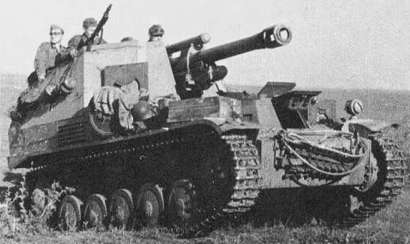 http://www.panzertruppen.org/heer/autopropulsados/wespe.jpg http://www.battletanks.com/images/Wespe_10.5_cm.jpg The Marder II was a tank destroyer based on the Panzer II chassis. 576 were built, 75 from converted Panzer II's. Even in the early stages of Operation Barbarossa, the Wehrmacht already felt the need for a more mobile and more powerful anti-tank solution than the existing towed anti-tank guns or tank destroyers like the Panzerjäger I. This need became urgent in late 1941, with the appearance of the new Soviet tanks like the T-34 and Kliment Voroshilov. As an interim solution, it was decided to use both obsolete tanks like the Panzer II and captured vehicles like the Lorraine as the base for makeshift tank destroyers. The result was the Marder series, which were armed with either the 75 mm PaK 40 anti-tank guns or the Soviet 76.2mm F-22 Model 1936 divisional field gun, of which large numbers had been captured. The Marder II was first produced in June 1942 and was armed with a 75mm Pak 40/2 L/46.  -------------------- C'est pas l' histoire d'un jour
Qui rime avec amour, Plutôt un long séjour Mais pas: un "pour toujours" |
|
|
|
Posts in this topic
Sparta Tanks on the Battle field 03/17/06 4:14pm FeezyWeezy Ok I had my Breakfast and Coffee... time for Panze... 03/18/06 11:56am FeezyWeezy k, played some Barb and now it's time for the ... 03/18/06 2:15pm Sparta Iamma call u the history man dude 03/18/06 3:08pm FeezyWeezy Ok, played some with Blinky and his Finnish friend... 03/18/06 5:27pm FeezyWeezy [size=4][b][size=4]PzKpfw 6 / Panzerkampfwagen VI ... 03/18/06 7:01pm Sparta Tiger tank
After years of research for a heavy n... 03/18/06 8:15pm FeezyWeezy Panzerkampfwagen VI Ausf. B / Tiger II
[b][size=1... 03/18/06 9:24pm Sparta Thats my boy finding the shit i dont lol
:D :D ... 03/18/06 11:08pm Sparta Japanese Type 95
[color=#000000]The Japanese ... 03/19/06 12:20am FeezyWeezy Well its just crap that you find nice pictures and... 03/19/06 7:50am Sparta True :P 03/19/06 9:52am +KS+ Blinky Bill Man..., this topic is getting bigger and wider all... 03/19/06 11:37am
FeezyWeezy Ok I had my Breakfast and Coffee... time for Panze... 03/18/06 11:56am FeezyWeezy k, played some Barb and now it's time for the ... 03/18/06 2:15pm Sparta Iamma call u the history man dude 03/18/06 3:08pm FeezyWeezy Ok, played some with Blinky and his Finnish friend... 03/18/06 5:27pm FeezyWeezy [size=4][b][size=4]PzKpfw 6 / Panzerkampfwagen VI ... 03/18/06 7:01pm Sparta Tiger tank
After years of research for a heavy n... 03/18/06 8:15pm FeezyWeezy Panzerkampfwagen VI Ausf. B / Tiger II
[b][size=1... 03/18/06 9:24pm Sparta Thats my boy finding the shit i dont lol
:D :D ... 03/18/06 11:08pm Sparta Japanese Type 95
[color=#000000]The Japanese ... 03/19/06 12:20am FeezyWeezy Well its just crap that you find nice pictures and... 03/19/06 7:50am Sparta True :P 03/19/06 9:52am +KS+ Blinky Bill Man..., this topic is getting bigger and wider all... 03/19/06 11:37am
 FeezyWeezy Man..., this topic is getting bigger and wider al... 03/19/06 12:29pm Sparta Hey dont forget ur buddy sparta 03/19/06 12:08pm +KS+ Blinky Bill This may go a little bit off topic but just had to... 03/20/06 5:38am Maj. H8Red that's it I'm buyin a friggin tank :P 03/20/06 12:05pm Sparta I call shotty hate :flm 03/20/06 1:05pm Hellfighter oh sure - lump in tank destroyers, assault guns, a... 03/20/06 5:27pm FeezyWeezy I'll do that tomorrow 03/20/06 5:48pm Sparta THE Brits
The 79th Armoured Division was a special... 03/20/06 6:37pm FeezyWeezy If u ask me The brits arent important in the 2nd ... 03/20/06 6:50pm Sparta Not battle wise they rock in that direction but ia... 03/20/06 7:00pm Sparta [b]M-22 Locust light Airborne tank
World War II st... 03/20/06 9:45pm Sparta Just for You Hellfighter!
Three Black Americ... 03/20/06 10:02pm Hellfighter Just for You Hellfighter!
.........
Hope ya ... 03/20/06 11:30pm Sparta For Hellfighter Bout Woman soldiers
As in World W... 03/21/06 4:46pm Hellfighter [u][b]For Hellfighter Bout Woman soldiers
[cente... 03/21/06 6:07pm Sparta Iam Sry I got a bit Off topic But I've returne... 03/21/06 5:46pm Sparta sent ya an Xfire friend invite there Hellfighter ;... 03/21/06 7:02pm Hellfighter sent ya an Xfire friend invite there Hellfighter ... 03/21/06 8:47pm Sparta Ok so I took a long Nap And well Guess the Ruskie ... 03/21/06 7:17pm Sparta Wow longest thread ever made by urs truely :mobrul... 03/21/06 8:34pm Sparta Gotta Please the Masses LOl
http://www.24hourmuse... 03/21/06 9:37pm Hellfighter ok Sparta-to help you out :P , here are some other... 03/22/06 3:07pm
FeezyWeezy Man..., this topic is getting bigger and wider al... 03/19/06 12:29pm Sparta Hey dont forget ur buddy sparta 03/19/06 12:08pm +KS+ Blinky Bill This may go a little bit off topic but just had to... 03/20/06 5:38am Maj. H8Red that's it I'm buyin a friggin tank :P 03/20/06 12:05pm Sparta I call shotty hate :flm 03/20/06 1:05pm Hellfighter oh sure - lump in tank destroyers, assault guns, a... 03/20/06 5:27pm FeezyWeezy I'll do that tomorrow 03/20/06 5:48pm Sparta THE Brits
The 79th Armoured Division was a special... 03/20/06 6:37pm FeezyWeezy If u ask me The brits arent important in the 2nd ... 03/20/06 6:50pm Sparta Not battle wise they rock in that direction but ia... 03/20/06 7:00pm Sparta [b]M-22 Locust light Airborne tank
World War II st... 03/20/06 9:45pm Sparta Just for You Hellfighter!
Three Black Americ... 03/20/06 10:02pm Hellfighter Just for You Hellfighter!
.........
Hope ya ... 03/20/06 11:30pm Sparta For Hellfighter Bout Woman soldiers
As in World W... 03/21/06 4:46pm Hellfighter [u][b]For Hellfighter Bout Woman soldiers
[cente... 03/21/06 6:07pm Sparta Iam Sry I got a bit Off topic But I've returne... 03/21/06 5:46pm Sparta sent ya an Xfire friend invite there Hellfighter ;... 03/21/06 7:02pm Hellfighter sent ya an Xfire friend invite there Hellfighter ... 03/21/06 8:47pm Sparta Ok so I took a long Nap And well Guess the Ruskie ... 03/21/06 7:17pm Sparta Wow longest thread ever made by urs truely :mobrul... 03/21/06 8:34pm Sparta Gotta Please the Masses LOl
http://www.24hourmuse... 03/21/06 9:37pm Hellfighter ok Sparta-to help you out :P , here are some other... 03/22/06 3:07pm |
2 User(s) are reading this topic (2 Guests and 0 Anonymous Users)
0 Members:


|
Lo-Fi Version | Time is now: 06/26/26 5:47pm |
Invision Power Board
© 2026 IPS, Inc.