Help - Search - Members - Calendar
Full Version: Tanks on the Battle field
{MOB} Forums > MOB Discussion Forum - PUBLIC > Miscellaneous/Off Topic
Spartan
The Panzerkampfwagen IV (PzKpfw IV), more commonly referred to as the Panzer IV, was a tank developed by Nazi Germany and used extensively in WW2. It was designed initially as an infantry-support medium tank, to work in conjunction with the anti-tank crews. Later in the war, it was up-gunned and up-armored, and took over the tank-fighting role. The Panzer IV was the most common German tank of World War II, and was used as the base for many other fighting vehicles, such as tank destroyers and self-propelled antiaircraft guns. By the end of the war nearly 9000 had been built.

IPB Image


Panzer III
n 1936 german industry passed to develope a true battle tank using the experiences got with the previous panzers. Panzer III Ausf. E (Sd.Kfz. 141), armed with a 37mm L46 gun (muzzle speed of 762 m/s), appeared in less than a hundred (previous III models included) during the polish campaign. Circa 300 Panzer III were ready for French campaign, too few to fill the Panzerdivisionen's order of battle and so being often replaced by the light PzKpfw 38(t)s, 35(t)s and IIs; this last operation proved the "foolness" of using 37mm gun against the heavy armored tanks such as the Char B1-bis or the british Matildas. A handful of new Ausf. F, armed with 50mm L42 KwK 38 was tested in the final days of the campaign. Ausf. Fs and heavier armored Ausf. Gs formed the bulk of General Rommel's Afrika Korps when it landed in Libya on 28th February 1941 for reinforcing the Italian anti-tank defence. Experience on the field proved necessity of better tropicalization in both engine filters and turret ventilation.


IPB Image


Sherman M4
In March 1941 the U.S army decided it needed a new tank to replace the Grant M2A1. After looking at five different proposals the Sherman M4 was chosen. Production began early in 1942. The original armament was a 75mm gun capable of firing high explosive shells. Its 500hp engine had a maximum speed of 26mph. This was replaced by a 76mm high-velocity gun in February 1944. The tank's suspension was redesigned and improved by the beginning of 1945.

Although inferior to the best German and Soviet tanks in armament and protection, it was superior in terms of reliability, serviceability and cost-effectiveness. The British army used the Sherman Tank at El Aleman in 1942 and by 1943 was the mainstay of Allied operations in Africa and Europe.

No picture available. sry guys

Like last time i want u guys to do a lil reaserch.

FeezyWeezy
PzKpfw 1 / Panzerkampfwagen I / Panzer I

Link to the full story! <<<
IPB Image

The Panzer I was a light tank produced by Germany in the 1930s, intended as a training tank, but also used extensively in the Spanish Civil War and early World War II.

The Panzer I went by many names and designations, with the most common official designation as the Panzerkampfwagen I, or PzKpfw I. It also carried the official vehicle designation of Sonderkraftfahrzeug 101, or SdKfz 101. During the early period of its development, the name Landwirtschaftlicher Schlepper, or L-S, meaning an industrial tractor as a cover name to deflect investigation into the then-illicit German development of tanks. The Panzer I was converted into a number of special-purpose vehicles and self-propelled guns.


The Panzer I marked the first production tank design in Germany since the conclusion of World War I. In 1932, specifications for a light (5-ton) tank were made and issued to the German industrial manufacturers Rheinmetall, Krupp, Henschel, MAN and Daimler Benz. In 1933, the design by Krupp was chosen. It was based on the British Carden Loyd Mk IV Tankette, two of which had been secretly purchased from the Soviet Union. The Treaty of Versailles prohibited Germany from producing any tanks, so these versions were referred to as "Landwirtschaftlicher Schlepper" (agricultural tractors). The design was modified in late 1933 to combine the Krupp chassis with the Daimler Benz turret design. In 1934, the resulting tank was designated the Panzer I Ausf A (version A), and production began in July.

The original Panzer I was designed as a light tank for reconnaissance and infantry support duties. However, the most important goal of its development was to provide a vehicle to begin forming and training a German tank force. It was to be replaced in the Panzer divisions as soon as possible by more capable purpose-designed combat tanks, although as it turned out, by the start of World War II, the Panzer I was still filling a significant role in these units due to extended time in getting more advanced tanks produced.

The tank itself was produced in two primary variants. The original PzKpfw IA was underpowered and was replaced in production by the PzKpfw IB, with a more powerful engine and other improvements. The B model can be identified by the slightly longer hull and extra road wheel necessary for the larger engine. For the most part, the two versions were similar in operation. A few attempts were made to make a heavier armed tank or one able to participate in airborne operations, but few of these were made. By the time of the replacement of the Panzer I, it was long obsolete in any combat role, and thus many of the surviving chassis were converted to other roles. Most attempts to mount guns were less than successful due to the small size of the vehicle, but it was successful as a turret-less tractor, both for training of tank drivers and carrying cargo and munitions to front line units.


The Panzer I first saw combat in 1936 in the Spanish Civil War as part of the German forces sent to assist General Franco and the Nationalists. The Panzer I turned out to be underpowered, under-gunned, and outclassed by the Soviet T-26 and BT-5 tanks used by the Republican forces. A number of Panzer Is were captured by the Republican forces, and fitted with 20 mm or 25 mm anti-tank guns.

The Panzer I was intended as a training tank, to be replaced by the Panzer III in actual combat. However, because of delays in the production of Panzer IIIs, the Panzer I was the main tank used in the invasion of Poland and was used extensively in the invasions of France, Denmark, and Norway.

Fifteen Panzer IAs were purchased by Nationalist China, and saw combat in the Chinese Civil War.

After Germany removed the Panzer I from combat they were used extensively for patrolling in the conquered territories and for the training of

IPB Image
Link to the full story! <<<


PzKpfw 2 / Panzerkampfwagen II / Panzer II

Link to the full story! <<<
IPB Image

In 1934, delays in the design and production of the Panzer III and Panzer IV tanks were becoming apparent. Designs for a stopgap tank were solicited from Krupp, MAN, Henschel, and Daimler-Benz. The final design was based on the Panzer I, but larger and with a turret mounting a 20 mm anti-tank gun. Production began in 1935, but it took another eighteen months for the first combat-ready tank to be delivered.

The Panzer II was the main battle tank of the German Panzer divisions beginning with the invasion of France, until it was replaced by the Panzer III and IV in 1940/41. Afterwards, it was used to great effect as a reconnaissance tank. The Panzer II was perhaps tested in the Spanish Civil War and used in the German campaigns in Poland, France, Denmark, Norway, North Africa and Russia. After being removed from front-line duty, it was used on secondary fronts and for patrolling.

Most tank versions of the Panzer II were armed with a 2 cm KwK 30 L/55 cannon. Some later versions employed the 2 cm KwK 38 L/55 which was similar. This cannon was based on the 2 cm FlaK 30 anti-aircraft gun, and was capable of firing at a rate of 280 rounds per minute, a very high rate for a tank. The Panzer II also had a 7.92 mm machine gun mounted coaxially with the main gun.

The 20 mm cannon proved to be ineffective against many Allied tanks, and experiments were made towards replacing it with a 37 mm cannon, but nothing came of this. Prototypes were built with a 50 mm tank gun, but by then the Panzer II had outlived its usefulness as a tank regardless of armament. Greater success was had by replacing the standard armor-piercing explosive ammunition with a tungsten cored solid ammunition, but due to material shortages this ammunition was in chronically short supply.

Later development into a self-propelled gun carriage saw the mounting of a 5 cm PaK 38 antitank gun, but this was seen as insufficient for the time, and the larger 7.62 cm PaK 36® was installed as an effective stop-gap. The main production antitank version was fitted with a 7.5 cm PaK 40 which was very effective. Artillery mounting began with a few 15 cm sIG 33 heavy infantry guns, but most effective was the 10.5 cm leFH 18, for which the Panzer II chassis became the primary carriage for the war. Most of these versions retained a pintle mounted 7.92 mm MG34 machine gun for defense against infantry and air attack.

Some notable uses for Panzer II chassis

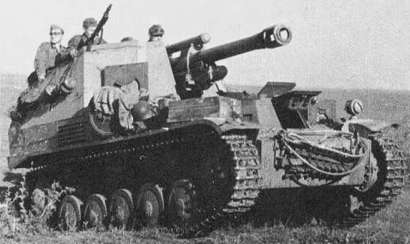
The Wespe (German for wasp) was a German self-propelled artillery vehicle developed and used during World War II. It was based on the Panzer II tank.

In 1940, during the Battle of France, it was apparent that the main tank of the German forces, the Panzer II, was unsuitable as a direct combat vehicle; though mechanically sound, it was both under-gunned and under-armoured. Thus, when the need arose for a self-propelled artillery vehicle, the Panzer II was a natural choice, removing the vehicles from frontline service and extending their useable lifespan.

The design for the Wespe was produced by Alkett, and was based on the Panzer II Ausf. F chassis. Production of the vehicles was carried out at various plants, mainly in Poland. The conversion process itself proved relatively simple, involving the replacement of the Panzer II turret with a 105 mm howitzer and gun-shield.
IPB Image
http://www.panzertruppen.org/heer/autopropulsados/wespe.jpg
http://www.battletanks.com/images/Wespe_10.5_cm.jpg


The Marder II was a tank destroyer based on the Panzer II chassis. 576 were built, 75 from converted Panzer II's.

Even in the early stages of Operation Barbarossa, the Wehrmacht already felt the need for a more mobile and more powerful anti-tank solution than the existing towed anti-tank guns or tank destroyers like the Panzerjäger I. This need became urgent in late 1941, with the appearance of the new Soviet tanks like the T-34 and Kliment Voroshilov.

As an interim solution, it was decided to use both obsolete tanks like the Panzer II and captured vehicles like the Lorraine as the base for makeshift tank destroyers. The result was the Marder series, which were armed with either the 75 mm PaK 40 anti-tank guns or the Soviet 76.2mm F-22 Model 1936 divisional field gun, of which large numbers had been captured.

The Marder II was first produced in June 1942 and was armed with a 75mm Pak 40/2 L/46.

IPB Image


FeezyWeezy
Ok I had my Breakfast and Coffee... time for Panzer III

PzKpfw 3 / Panzerkampfwagen III / Panzer III

Link to the full story! <<<
IPB Image
Aus N Panzer III

The Panzerkampfwagen III (PzKpfw III), more commonly referred to as the Panzer III, was a tank developed in the 1930s by Nazi Germany and used extensively in World War II. It was designed to fight other AFVs, serving alongside the infantry-support Pzkpfw IV. It soon became obsolete in this role, and for most purposes was supplanted by up-gunned Panzer IVs, though some would continue to be used for infantry support until late in the war.

On January 11, 1934, following specifications laid down by Heinz Guderian, the Army Weapons Department drew up plans for a medium tank with a maximum weight of 24,000 kg and a top speed of 35 km/h. It was intended as the main tank of the German Panzer divisions, capable of engaging and destroying opposing tank forces.

Daimler-Benz, Krupp, MAN, and Rheinmetall all produced prototypes. Testing of the prototypes took place in 1936 and 1937, leading to the Daimler-Benz design being chosen for production. The first Panzer III A came off the assembly line in May of 1937, and a total of ten, two of which were unarmed, were produced in 1937. Mass production of the tank, then in model III F, began in 1939.

Between 1937 and 1940, attempts were made to standardize parts between Krupp's Panzer IV and Daimler-Benz's Panzer III.

Much of the early development work on the Panzer III was a quest for a suitable suspension. Several variaties of leaf-spring suspensions were tried on ausf A through D before the torsion-bar suspension of the ausf E was standardized. The Panzer III, along with the Soviet KV heavy tank, was one of the first tanks to use this suspension design.

The Panzer III was intended as the main battle tank of the German forces. However, it proved to be inferior to the T-34 tank of the Soviet Union and was replaced by an upgunned version of the Panzer IV, which could carry a high-velocity 75mm gun.

In 1942, the ausf N model of the Panzer III was created with an L/24 75mm gun, but this was a low-velocity gun designed for anti-infantry and close-support work.

IPB Image

The Panzer III was used in the campaigns against Poland, France, the Soviet Union and in North Africa. Some were still in use in Normandy and Arnhem in 1944.

In the Polish and French campaigns, the Panzer III formed a small part of the German armored forces. Only a few hundred ausf A through F were available in these campaigns, most armed with the 37mm gun. They were the best medium tank available to the Germans and outclassed most of their opponents such as the Polish 7TP, French R-35 and H-35 light tanks, and Somua S-35 cavalry tanks.

By the time of the German invasion of the Soviet Union (Operation Barbarossa), the Panzer III was numerically the most important German tank. By this time the majority of the available tanks (including re-armed ausf E and F, plus new ausf G and H models) had the L/42 50mm gun. The tanks used in North Africa also had the 50mm L/42. The Panzer III was outclassed by the Soviet T-34 and KV tanks, although German tactical skill, crew training, and the good ergonomics of the Panzer III all contributed to a rough 6:1 favorable kill ratio for German tanks of all types in 1941.

With the appearance of the T-34, rearming the Panzer III with a more powerful L/60 50mm gun was prioritized. The ausf J and L versions had this longer gun, thicker armor, and some simplified features. These versions were available throughout 1942 and into 1943. In addition, to counter Soviet antitank rifles, in 1943 the ausf M version began the use of spaced armor skirts on the turret and hull. By then, however, the Panzer III was beginning to be relegated to secondary roles, as it was replaced as the main German medium tank by the Panzer IV and Panther. The final version, ausf N, mounted a short 75mm howitzer for use in Infantry support.

The Panzer III was a good, but not outstanding, tank in terms of armor, armament and mobility. However, it was well-designed in that it had a three-man turret crew (gunner, loader and commander), leaving the commander free to concentrate on commanding the tank and maintaining situational awareness. Although other medium tanks of the time also had this feature, most tanks of the late 1930s had less than three men in the turret crew. These other tanks, which may look impressive on paper, lacked this key element of "fightability". The French Somua S-35 was a classic example of a tank that appeared to be the equal of the Panzer III on paper, with a good gun and strong armor, but with its one-man turret crew it was hopelessly outclassed by the Panzer III.

The Panzer III chassis was the basis for the Sturmgeschutz III assault gun, probably the most important German self-propelled gun of the war.

Some notable uses for Panzer III chassis

IPB Image

Flammpanzer III

Installing a flamethrower system into the Panzer III turret was something new, because the turret with the spray tube still was 360° traversable by installing a packing box connection in the flame oil delivery pipe. The spray tube and the co-axially mounted MG 34 could be elevated from -10° to +20°. Another MG 34 was mounted in the superstructure front plate. The tank carried 1020 lites of flame fuel and 3750 rounds for the MG's.
Again the pressure for propelling the flame fuel was given by a Koebe-pump. With 15-17 athmospheres and a flow rate of 7.8l/s there were ranges up to 60m achievable.
The armor protection consisted of 57mm plates on turretfront, 30mm at turret side and rear. Chassis was protected 80mm at the front, 30mm at the sides and 50mm at the rear. The length was 6.41m, width was 2.97m and height 2.5m. The tank weighted 23.8tons, the Maybach HL120TRM engine gave 265hp at 2600rpm, so the tank got a maximum speed of 40km/h. The step climbing ability was 60cm and the fording depth 80cm. Trenchcrossing ability was 2m and the ground pressure was 1,04 kg/cm2. In February 1943 production of the Flammpanzer III began, which were ordered because of the streetfighting experiences in Stalingrad and should be used there, what never happened. 100 Panzer III Ausf.M were taken from production line of Miag and were converted by Wegmann in Kassel to Flammpanzer. In April 1943 the conversion of all 100 tanks was already finished. Most of them were sent to the eastern front where mainly the Division 'Großdeutschland' and the 6.Pz.Div got Flammpanzer III. Also the 1.PzDiv, the 11.PzDiv, the 14.PzDiv and the 24.PzDiv got Flammpanzer III. At the eastern front most of the Flammpanzer III got side skirts for protection. In Italy Flammpanzer III were issued to the 16.PzDiv and the 26.PzDiv.
On 31st December 1943 all in all 32 Flammpanzer III were reported of which 15 were operational


There where Flammpanzers using Panzer II chassis and other Panzer versions. Like the Tiger.

http://www.geocities.com/capecanaveral/lab...7/eflamm.html#6

Sturmgeschütz III

Link to the full story! <<<

IPB Image
Assault Gun Battalion (Rynnäkkötykkipataljoona, Ryn.Tyk.P) - Sturmkanone 40 or StuG IIIG (Sturmgeschütz III Ausf. G, "Sturmi") Finnish Sturmgeschütz III.
Note the von Rosen Cross.
(thanks to Blinky for this info)


The Sturmgeschütz assault gun was one of Germany's most produced Armored fighting vehicle during World War II. It was built on the chassis of the Panzer III tank. Initially intended as a mobile, armoured light gun for infantry support, the StuG was continually modified until, by 1942, it was widely employed as a tank destroyer.

The Sturmgeschütz series is probably best known for its excellent price-to-performance ratio. By the end of the war, over 10,500 had been built.

The Sturmgeschütz III originated from an initial proposal that Colonel Erich von Manstein submitted to General Beck in 1935 in which he suggested that Sturmartillerie (Assault Artillery) units should be used in a direct-fire support role for infantry divisions. To that end, on June 15, 1936, Daimler-Benz AG received an order to develop an armoured infantry support vehicle capable of mounting a 75 mm (2.95 in) artillery piece. The gun was to have a limited traverse of a minimum of 25 degrees and be mounted in a fully enclosed superstructure that provided overhead protection for the crew. The height of the vehicle was not to exceed that of the average man.

Daimler-Benz AG used the chassis and running gear of its recently designed Panzerkampfwagen III medium tank as a basis for the new vehicle. Prototype manufacture was passed over to Alkett, which produced five examples in 1937 of the experimental 0-series StuG based upon the PzKpfw III Ausf. B. These prototypes featured a mild steel superstructure and Krupp's short-barreled 75 mm Sturmkanone 37 L/24.

As the StuG III was intended to fill an anti-infantry close support combat role, early models were fitted with a low-velocity 75 mm StuK 37 L/24 gun, firing high explosive shells. After the Germans encountered the Soviet T-34, the StuG III were armed with the high-velocity 75 mm StuK 40 L/43 (Spring 1942) or 75 mm L/48 (Autumn 1942) anti-tank gun.

Later models of the StuG III had a 7.92mm MG34 mounted on the hull for added anti-infantry protection.

In 1944 the Finnish army received 59 StuG III from Germany and used them against Soviet Union. These Stug III's destroyed at least 87 enemy tanks, for a loss of only 8 StuG's (some of these were destroyed by the crew before they abandonded the vehicle). After the war most of surviving vehicles were used as main battle tanks of the Finnish army.

After the Second World War, the Soviet Union gave some of the captured German vehicles to Syria, which continued to use them at least until the Six Days War (1967).

IPB Image


Edit: Repaired some links and some resizing.

FeezyWeezy
k, played some Barb and now it's time for the Panzer IV..

PzKpfw 4 / Panzerkampfwagen IV / Panzer IV

Link to the full story! <<<
IPB Image
PzKpfw IV Ausf E.

The Panzerkampfwagen IV (PzKpfw IV), more commonly referred to as the Panzer IV, was a tank developed by Nazi Germany and used extensively in World War II. It was designed initially as an infantry-support medium tank, to work in conjunction with the anti-tank Pzkpfw III. Later in the war, it was up-gunned and up-armored, and took over the tank-fighting role. The Panzer IV was the most common German tank of World War II, and was used as the base for many other fighting vehicles, such as tank destroyers and self-propelled antiaircraft guns. By the end of the war nearly 9000 had been built.

The Panzer IV was the workhorse of the German tank corps, being produced and used in all theatres of combat throughout the war. The design was upgraded repeatedly to deal with the changing threats from enemy forces.

On January 11, 1934, following specifications laid down by Heinz Guderian, the Army Weapons Department drew up plans for a medium tank with a maximum weight of 24,000 kg and a top speed of 35 km/h. It was intended in a support and anti-infantry role, using a low-velocity, large-caliber gun firing high-explosive shells. It was not required to deal with enemy tanks on equal terms.

Krupp, Rheinmetall, and MAN all produced prototypes, which were tested in 1935. As a result of the trials, the Krupp design was selected for full-scale production. The first Panzer IV A came off the assembly line in October of 1937, with a total of 35 being produced over the next six months.

Between 1937 and 1940, attempts were made to standardize parts between Krupp's Panzer IV and Daimler-Benz's Panzer III.

IPB Image


The Panzer IV was originally intended principally to deal with infantry and fortifications, while the Panzer III dealt with enemy armoured units. To this end it was equipped with the 75 mm KwK 37 L/24 gun, which was effective against soft targets but lacked much armour penetration. It had poor accuracy, because the barrel was very short (1800 mm), giving a low muzzle velocity. For comparison the L/48 Gun is 3600 mm long.Combat experience showed that increasingly the 50 mm L/60 gun mounted on late-model Panzer III was unable to deal with enemy tanks at long range. Panzer IIIs struggled against T-34s of the Soviet Union and M4 Shermans of the United States, both of which had guns in the 75 or 76 mm calibre.

The Panzer IV's design already mounted a 75 mm gun and it was the obvious choice for the next medium tank development. As the Wehrmacht needed a tank with good anti-tank capabilities to deal with the T34, the production of the Panzer IV model F was changed to an improved model with a redesigned turret carrying a new, more powerful 75 mm L/43 anti-tank gun. The sprocket and idler wheels were altered to take wider tracks more able to support the increased weight of a larger gun. This required a change in naming conventions: the old 75 L24-equipped Pz-IV F was renamed Pz-IV F1, and the new 75 L/43-equipped was named Pz-IV F2. The Pz-IV F2 was later renamed Pz-IV G and production continued under this name with minor improvements. In late 1942 the Pz-IV G gun was upgraded to the even longer 75 L/48 gun. Early model Panzer IV tanks were often upgraded for increased combat efficiency. From 1943, for example, surviving Panzer IV models E/F were given additional armor and the 75 L48 gun.

The aforementioned upgrades allowed the Panzer IV to keep pace with newer designs such as the Sherman and the T-34. Production continued and was stepped up even while the more effective Panther medium tank was in service, because of the Panzer IV's low cost and greater reliability.

Small numbers of Panzer IV were supplied by Germany to its allies. Bulgaria received 88 vehicles and used them against Germans in late 1944. Finland bought 15 Panzer IV Ausf Js, which arrived too late to fight against the Soviets the Continuation War (1941-44) or against German troops in the following Lapland War (1944-45) and served as training vehicles until 1962. Small numbers were also given to Hungary, Romania, Spain and Yugoslavia (Chetniks). In 1950s/1960s Syria bought several dozens of Panzer IVs from USSR, France, Czechoslovakia and Spain and employed them in the 1965 conflict over Jordan headwaters (often referred to as Water War) and in the Six Days War (1967).

IPB Image
PzKpfw IV Ausf H.


Some notable uses for Panzer IV chassis

Flakpanzer IV Möbelwagen

IPB Image

http://www.lexikon-der-wehrmacht.de/Waffen/Bilderseiten/flakpanzer-R.htm

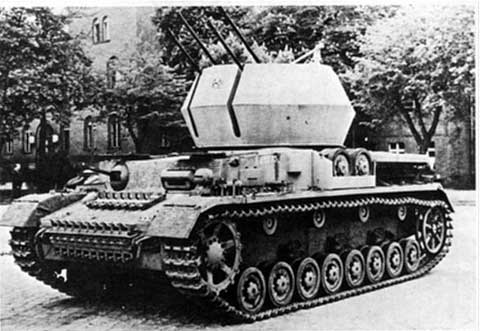
The Flakpanzer IV (Sd.Kfz. 161/3), nicknamed Möbelwagen ("Furniture Van") because of its boxy turret (when closed), was an anti-aircraft gun carrier built on the chassis of the Panzer IV. It was used by the German Wehrmacht in the European Theater of World War II.

In 1943, due to the waning ability of the Luftwaffe to combat enemy ground-attack aircraft, ground-based anti-aircraft weaponry was becoming increasingly important to the Wehrmacht. In early 1943, the idea of creating a gun platform on the chassis of the Panzer IV was first proposed. The initial design used a 20mm quad-gun ("Flakvierling") that was deemed too weak for the latest aircraft, which were constantly flying higher and faster. Only a single prototype with this gun was produced before the design was rejected. A second design with an upgraded single 37mm Flak 43 was approved as a temporary stopgap until better Flakpanzers could be created. This design was designated Flakpanzer IV, and the first production models were put into service on the Western Front in April of 1944.

The Möbelwagen was built on Panzer IV chassis that had been damaged on the Eastern Front and returned to the factory for repair. These were fitted with an open-top superstructure that provided the gun mount. Around this, four hinged 20mm armored plates were placed. These plates had two basic operating positions: they could be lowered for full 360 degree traverse, allowing flat or low-level firing, or they could be half-closed, being pinned together to hang slightly open. In this position, they had notches that allowed the gun full rotation, but only for firing at airborne targets. Still, both of these positions left the crew extremely vulnerable. The fully closed position was only used for transport, when the plates would give the crew some protection from small arms fire and shrapnel.

Though the Möbelwagen was intended to be a stopgap, it served the anti-aircraft platoons of the Panzer Divisions extremely well on the Western Front. Despite this, fewer than 300 were produced, and it was eventually succeeded by the first true Flakpanzers: the Wirbelwind and the Ostwind, both of which provided the crew with armored protection and full rotation when firing at either ground or air targets.


Flakpanzer IV Wirbelwind

IPB Image

The Flakpanzer IV Wirbelwind (Whirlwind in German) was an anti-aircraft vehicle based on the Panzer IV. It was developed in 1944 as a successor to the earlier AA tank Möbelwagen.

The Panzer IV's turret was removed and replaced with an open-top, nine-sided turret which housed a quadruple 20mm Flakvierling 38. A closed-top design would have been preferable, but this was not possible due to the heavy smoke generation of the 4 flak guns. Production of the tank was carried out by Ostbau Werke in Sagan, Silesia.

By the time the Wirbelwind was introduced to service, 20mm shells were no longer very effective against aircraft; the Wirbelwind was soon replaced by the Ostwind which was equipped with a single 37mm Flak 43.

It is believed that either 87 or 105 Wirbelwinds were produced during the war, but due to discrepancies between the recorded production numbers at Ostbau Werke and Wehrmacht service records, the exact number will probably never be known. In any case, there were too few of them to have any major influence on the war.

Flakpanzer IV Ostwind

IPB Image

The Ostwind's main improvement over the Wirbelwind was its increased range. It also had slightly better armoring on its turret, as well as a second MG34.

Approximately 45 of these vehicles were built.


Brummbär / Sturmpanzer IV

IPB Image

The Sturmpanzer IV was a development of the Panzer IV tank and designed to provide direct infantry fire support, especially in urban areas. Earlier vehicles like the StuG III were not completely adequate for this role and therefore it was decided in early 1942 to develop a new vehicle.

The result was the Sturmpanzer IV, which used a Panzer IV chassis with a new, fixed superstructure housing the 150 mm Sturmhaubitze (StuH) 43 L/12 gun.

The original design of the Sturmpanzer IV suffered from a series of flaws, which were gradually solved during the production process. The most important flaw was the high weight and recoil of the StuH 43 gun, which overloaded the Panzer IV chassis and made the entire vehicle top-heavy. Furthermore, early vehicles suffered from transmission failures and were underpowered.

Another significant flaw was the absence of a machine gun which made it easy for enemy infantry to attack the vehicle at close range. Early vehicles carried a MP 40 sub-machine gun inside, which could be fired through firing ports in the side of the superstructure.

In October 1943 it was decided that the Sturmpanzer IV's superstructure as well as the StuH 43 gun needed to be redesigned to fix these flaws. A new and lighter version of the StuH 43 gun was produced, the StuH 43/1 L/12. This gun was used from the second production series onwards.

A new superstructure was added in mid-1944 which featured a redesigned gun collar, as well as a general reduction in height of the superstructure. This redesign also introduced a ball mount in the front superstructure for a MG34 machine gun.


Jagfpanzer IV

IPB Image
A Jagdpanzer IV with the long 75mm L/70 gun.


The Jagdpanzer IV, Sd.Kfz. 162, was a tank destroyer based on the Panzer IV chassis built in three main variants. It was developed against the wishes of Heinz Guderian, the inspector general of the Panzertruppen, as a replacement for the Stug III. Guderian objected against the, in his eyes, needless diversion of resources from Panzer IV tank production, as the Stug III and Stug IV were still more than adequate for their role.

Nevertheless in late 1942 the Wehrmacht's arms bureau, the Waffenamt, called for a new tank destroyer design based on the Panzer IV, which would be armed with the same 75 mm gun as fitted to the Panther: the PaK 42 L/70.

Unlike previous tank destroyers like the Marder series, this gun was to be mounted directly into the Jagdpanzer's superstructure, keeping its silhouette as low as possible.

The Jagdpanzer IV kept the basis chassis of the Panzer IV tank, but the original vertical front plate was replaced by a sharp edged nose. Internally, the layout was changed to accommodate the new superstructure, moving the fuel tanks and ammunition racks. Because the Jagdpanzer lacked a turret, the engine which originally powered the Panzer IV's turret could be eliminated.

Jagdpanzer IV served in the anti-tank sections of Panzer and SS Panzer divisions. They fought in Normandy, the Battle of the Bulge and on the Eastern Front (WWII). They were very successful tank destroyers but performed badly when used out of role as substitutes for tanks or assault guns.

In the later stages of the war however, they were increasingly used as tank substitutes, because there was often nothing else available.

Spartan
Iamma call u the history man dude
FeezyWeezy
Ok, played some with Blinky and his Finnish friends on CTF Barb/Smolensk... Time for tank number 5...yawn.

PzKpfw 5 / Panzerkampfwagen V
Panzer V / Panther


Link to the full story! <<<
IPB Image
Panzer V Ausf. A

The Panther was a tank of Germany in World War II that served from mid-1943 to end of the war in Europe in 1945. It was intended as a counter to the T-34, and to replace the Panzer IV and III, though it served along with them and the heavier Tigers until the end of the war.

Until 1944 it was designated as the Panzerkampfwagen V Panther and had the Ordnance inventory designation of Sd.Kfz. 171. On 27 February 1944, Hitler ordered that the tank only be known as Panther.

The Panther was a direct response to the Soviet T-34. First encountered on 23 June 1941, the T-34 decisively outclassed the existing Panzer IV and Panzer III. At the insistence of General Heinz Guderian a team was dispatched to the Eastern Front to assess the T-34. Among the features of the Soviet tank considered most significant were the sloping armour, which gave much improved shot deflection and also increased the apparent armour thickness against penetration, the wide track and large road wheels which improved mobility over soft ground, and the long, over-hanging gun. Daimler-Benz (DB) and Maschinenfabrik Augsburg-Nürnberg AG (MAN) were tasked with designing a new 30-35 ton tank, designated VK3002, by April 1942 (apparently in time to be shown to Hitler for his birthday).

IPB Image
Panzer V Ausf. G

The two proposals were delivered in April 1942. The Daimler-Benz (DB) design was a direct 'homage' to the T-34, side-stepping the German propensity for over-engineering, and hence complexity, to produce a clean, simple design resembling the T-34 in hull and turret form, diesel engine, drive system, leaf spring suspension, track layout, and other features. The MAN design was more conventional to German thinking; it was higher and wider with a substantial turret placed far back on the hull, a petrol engine, torsion bar suspension and a characteristically German internal crew layout. The MAN design was accepted in May 1942, in spite of Hitler's preference for the DB design. A mild steel prototype was produced by September 1942 and after testing at Kummersdorf was officially accepted. It was put into immediate production with the very highest priority. The start of production was delayed however, mainly because there were too few specialized machine tools needed for the machining of the hull. Finished tanks were produced in December and suffered from reliability problems as a result of this haste. The demand for this tank was so high the manufacturing was soon expanded out of MAN to include Daimler-Benz and in 1943 the firms of Maschinenfabrik Niedersachsen-Hannover and Henschel.

The initial production target was 250 a month at MAN; this was increased to 600 a month in January 1943. Despite determined efforts, this figure was never reached due to disruption by Allied bombing, manufacturing bottlenecks and other difficulties. Production in 1943 averaged 148 per month. In 1944, it averaged 315 a month (3777 having been built that year), peaking with 380 in July and ending around the end of March 1945 with at least 6000 built in total. Strength peaked on 1 September 1944 at 2304, but that same month a record number of 692 tanks were reported lost
(source: T.L. Jentz (1999) Die deutsche Panzertruppe Band 2).


If the over-hanging gun and sloping armour are ignored, the Panther was a conventional German design. The tank's weight had increased to 43 tons from the planned 35. It was powered by a 700 horsepower (520 kW), 23 litre Maybach HL 230 V-12 petrol engine. The engine drove eight double-interleaved steel and rubber bogie wheels on each side suspended on staggered torsion bar suspension. Tank control was accomplished through a ZF AK-7-200 synchromesh gearbox and a MAN single radius steering system, that allowed a single, fixed radius of turn at each gear. The bigger the gear, the bigger was the turning radius. If the radius was bigger than desired, the steering brakes could be used to tighten the turn. The weakest part in the tank were, throughout its career the final drive units. The main reason for this was that the units could not be manufactured using hollow gears due to the shortage of suitable gear cutting machinery in Germany during the war. The final drives were in fact so weak that their fatigue life was as low as 150 km. The crew was made up of five members: driver, radio operator, gunner, loader, and commander. The armour consisted of a homogeneous steel glacis plate, welded but also interlocked for strength. Original models only had a maximum of 60 mm of armour. This was soon increased to 80mm. On the production of the Ausf. D and later models, the armor had a maximum thickness of 120 mm. A 5mm armored Skirt and Zimmerit coating also became standard.

The main gun was a 75 mm Rheinmetall KwK 42 L/70 with 79 rounds supported by two MG 34 machine guns. 75 mm was not a particularly large calibre for the time. Nonetheless, the Panther's gun was one of the most powerful tank guns of WWII, due to the large propellant charge and the long barrel, which gave it a very high muzzle velocity. The flat trajectory also made hitting targets much easier, since aiming was less sensitive to range. The 75 mm gun actually had more penetrating power than the 88 mm gun of the Tiger I, although not of the Tiger II.

The Panther was the first Axis tank design where modern features were more prominent than early WWII-era ones. The rule-of-thumb among Allied tank crews of Sherman-to-Panther ratio necessary for destruction of a single Panther was 5:1, or the same as with the Tiger. Once the problems caused by the vulnerability of the engine and the transmission were solved, it proved to be a most effective fighting vehicle, being as effective as the Tiger, but less demanding to produce and logistically far less troublesome. Captured Panthers proved to be extremely popular vehicles among Soviet troops, who received them as rewards for extraordinary achievements in combat, and who sought (contrary to regulations that captured Tigers and Panthers should not be repaired but abandoned and destroyed after mechanical failure) to keep them in service as long as possible. Even the Pantherfibel service manual was translated into Russian and provided to crews of captured Panzers.

IPB Image

The Panther first saw mass action around the Kursk on 5 July 1943. Early tanks were plagued with mechanical problems: the track and suspension often broke and the engine was dangerously prone to over-heating and bursting into flames. Initially, more Panthers were disabled by their own failings than by enemy action. For example, the XLVIII Panzer Corps reported on July 10th, 1943, that they had 38 Panthers operational and 131 awaiting repair, out of about 200 they had started with on July 5. Heinz Guderian, who had not wanted Hitler to order them into combat so soon, later remarked about the Panther's performance in the battle, "they burnt too easily, the fuel and oil systems were insufficiently protected, and the crews were lost due to lack of training." However, Guderian also stated that the firepower and frontal armour were good. While many of the Panthers used at Kursk were damaged or suffered from mechanical difficulties, only small number was lost for good and the tanks also achieved success, destroying several Soviet tanks.

IPB Image

After Kursk, the problems of early D. model were fixed, making the Panther a very formidable tank.

The tank remained a major German tank until the end of the war. Later versions of the Panzer IV with long 75 mm guns were cheaper to produce and more reliable and so it remained in production alongside the Panther.

Panthers saw the most service on the Eastern Front, though by the D-Day landings of June 1944, Panzer units stationed in France were also receiving Panther tanks, which were used to good effect on that front. Approximately half of the German tanks in France were Panthers.

http://www.pkymasehist.fi/panssarit.html (for blinky)
http://www.chars-francais.net/images/archi...panther_011.jpg (nice picture)
http://www.military.cz/german/armour/tanks...WW2/Panther.htm (if someone is able to read this AT all, its maybe nice biggrin.gif )


My opinion is that this is the BEST german tank of whole World War 2


Some notable uses for Panzer V chassis

Jagdpanther

IPB Image

A heavy tank destroyer design based on the 88 mm gun and the Panther tank chassis was ordered in late 1942 as design SdKfz 173. Production started in early 1944; at the same time Hitler specified the Jagdpanther ("hunting panther") name.

To accommodate the gun, the sides of the Panther tank were extended up to provide a roomy interior, while maintaining a very low profile. Both the Panther Ausf. G and Jagdpanther had side armor of increased elevation to enhance this effect even further and to harmonize production.

It was armed with the same long-barrelled 88 mm gun as the Tiger II, with a 7.92 mm machine gun in the front glacis plate for local defence. Despite the limited gun movement traverse (left/right), the Jagdpanther was considered a very good machine. A powerful engine gave it a good power-to-weight ratio resulting in good performance on the battlefield. The low profile meant that it was easily camouflaged.

Two variants can be distinguished, one with a narrow steel-band around the main gun mount and the other with a heavy cast protection, which was bolted to the hull.

All this made the Jagdpanther widely and rightly feared, especially when operating in defensive positions. Because it was based on the existing Panther chassis, the vehicle did not suffer too many mechanical problems

IPB Image


Panther II


IPB Image

Design work on the Panther II began in February 1943. The main aim was to secure maximum interchangeability of parts with the Tiger II heavy tank in order to ease manufacturing. The Panther II had a hull similar to the Tiger Ausf. B, and also shared identical wheels, track, suspension and brakes. One of the parts to be changed was the gun-mantlet, which had to become smaller. This was referred to in German as "Turm mit schmaler Blende" (narrow-mantlet turret).

The Panther II project never got further than one single chassis, that now can be seen in the Patton museum. (See
photo at axishistory.com.)

Later in the war, in March 1944, the work started again on a Panther turret with a smaller front. This led to the development of the Schmalturm (narrow turret). In August a Versuchsturm (trials turret) was completed. This was mounted on the chassis of a regular Panther Ausf. G.

In that same period, development of the Panther led to the Ausf. F, slated for production in April 1945. The key-points for this mark of Panther were the new Schmalturm with it improved armour-protection, an extended front hullroof which was also slightly thicker. A number of Ausf. F hulls were under construction at Daimler Benz and Ruhstahl-Hattingen steelworks.

The only difference between the Panther 1 and the Panther 2 was running gear, and increased armour protection. The turret was exactly the same on both types. The Panther 2 was only designed with the 7.5 cm Kw.K. L/70 in mind, and the 8.8 cm Kw.K. L/71 idea didn't enter into consideration after the Panther 2 project had been dropped.

IPB Image


FeezyWeezy
PzKpfw 6 / Panzerkampfwagen VI Ausf. E / Tiger I

Link to the full story! <<<
IPB Image


Originally developed under the name Pzkw VI Ausf. H the tank was redesigned as Ausf. E (Ausführung Ger. "version") in March 1943. The tank was also known as the Mark VI-E, Panzer VI-E, PzKpfw VI-E or Sd.Kfz. 181 (Sonderkraftfahrzeug 181), although in general it was commonly known as the Tiger I or simply the Tiger.

The Tiger I was in use from late 1942 until the German surrender in 1945. It was given its nickname by Ferdinand Porsche. The design served as the basis for other armoured vehicles, including the Tiger II, or King Tiger tank, and the Sturmtiger self-propelled gun.

The Tiger's crew training manual, the Tigerfibel, became a souvenir item after WWII.


The Tiger differed from earlier German tanks principally in its design philosophy. The German tanks that preceded the Tiger balanced mobility, protection, and firepower. They were sometimes outgunned by their opponents, but greatly superior German tactics offset this disadvantage.

The Tiger I represented a new approach that emphasized firepower and armour at the expense of mobility. Design studies for a new heavy tank had been started in the late 1930s, without any production planning. The real impetus for the Tiger was provided by the quality of the Soviet T-34. Although the general design and layout were broadly similar to the previous medium tank, the Panzer IV, the Tiger weighed more than twice as much. This was due to its substantially thicker armour, the larger main gun, and the consequently greater volume of fuel and ammunition storage, larger engine, and more solidly-built transmission and suspension. The Tiger I had front armour up to 102 mm thick, as opposed to the 80 mm front armour of contemporary models of the Panzer IV, with 80 mm on the sides and back. This was very effective at stopping anti-tank rounds of most WWII tank guns at common engagement distances especially from the front. At closer ranges and on the sides, the tank was more vulnerable. Its roof armour was 25 mm or 40 mm thick, similar to most medium tanks of the day.

Armour plates were mostly flat, with interlocking construction. The weld joints were also of high quality, being stepped and welded rather than riveted. A petrol engine in the rear drove front sprockets, which were mounted quite low on the vehicle. The suspension used torsion bars, similar to the Panzer III. The turret had a full circular floor basket with 157 cm headroom. The gun breech and firing mechanism were derived from the famous German "88" dual purpose flak gun. The 88 mm Kwk 36 L/56 gun was the variant chosen for the Tiger and was, along with the Tiger II's 88 mm Kwk 43 L/71, one of the most effective and feared tank guns of WW2. The Tiger's gun had a very flat trajectory and extremely accurate Zeiss TZF 9b sights. In British war-time firing trials, five successive hits were scored on a 16"x18" target at a range of 1,200 yards. Tigers were reported to have knocked out enemy tanks at ranges greater than a mile (1,600 m), although most WW2 engagements were fought at much closer range.

The size of the Tiger forced the introduction of new and complex technologies, giving the engineers a series of technical challenges which were never entirely surmounted. The eleven-ton turret had a hydraulic motor powered by mechanical drive from the engine; even so, a full rotation took about a minute. The tank had triple interleaving road wheels, giving a better cross country ride, but also making maintenance more difficult. The steel and rubber wheels were mounted on sixteen independent interleaved torsion bar axles, leading on one side and trailing on the other. The interleaving wheels gave a relatively soft and stable ride for such a large vehicle. This complex system had a number of drawbacks; one was that the wheels could become packed with mud or snow that could then freeze. The Soviets discovered this and on occasion timed their attacks in the early morning, when the Tigers were more likely to be immobilized.

The tracks were an unprecedented 725 mm wide. To meet rail-freight size restrictions, the outer row of wheels had to be removed, and narrower 520 mm tracks installed.

The tank was too heavy for most bridges, so it was designed to ford four-metre deep water. This required unusual mechanisms for ventilation and cooling. Submersion required perhaps 30 minutes of preparation. The turret and gun had to be locked in the forward position so they could be sealed.

Another new feature was the hydraulically-controlled pre-selector gearbox and semi-automatic transmission. The extreme weight of the tank also meant a new steering system. Instead of the clutch-and-brake designs of lighter vehicles, a variation on the British Merritt-Brown single radius system was used. The Tiger's steering system was of twin radius type, meaning that two different, fixed radii of turn could be achieved at each gear, the smallest radius on the first gear was four metres. Since the vehicle had an eight-speed gearbox, it thus had sixteen different radii of turn. If a smaller radius was needed, the tank could be turned by using brakes. The steering system was easy to use and ahead of its time. However, the tank's automotive features left much to be desired. When used to tow an immobilized Tiger, the engine often became over heated and sometimes resulted in an engine breakdown or fire. The low-mounted sprocket limited the obstacle-clearing height. The tracks also had a bad tendency to override the sprocket, resulting in immobilization. If a track overrode and jammed, two Tigers were normally needed to tow the tank. The jammed track was also a big problem itself, since due to high tension, it was often impossible to disintegrate the track by removing the track pins. It was sometimes simply blown apart with an explosive charge. The standard German Famo recovery tractor could not tow the tank; up to three tractors were usually needed to tow one Tiger.

IPB Image

The engine was initially a 590 hp (440 kW) 21 litre Maybach petrol design, which was found to be underpowered; this was soon upgraded to a 23.88 litre HL 230 P45.

The internal layout was typical of German tanks. Forward was an open crew compartment, with the driver and radio-operator seated at the front, either side of the gearbox. Behind them the turret floor was surrounded by panels forming a continuous level surface. This helped the loader to retrieve the ammunition, which was stowed in both sponsons. Two men were seated in the turret; the gunner to the left of the gun, and the commander behind him. The loader had the luxury of a folding seat in the turret. The rear of the tank held an engine room flanked by two floodable rear compartments each containing a fuel tank, radiator, and fans.

Although the Tiger I was one of the most heavily armed and armoured tanks of WWII, a formidable opponent of Allied tankers, the design was conservative and had some serious drawbacks. The flat armour plates were unsophisticated in comparison to the sloped armour of the Soviet T-34, requiring a massive increase in weight to provide for sufficient protection. The tank's weight put severe stress on the suspension, while the complex wheel design put a severe strain on field maintenance. The sophisticated transmission system was also prone to breakdowns.

A major problem with the Tiger was its very high production cost. During the Second World War over 40,000 American Sherman and 58,000 Soviet T-34s were produced, compared to 1,350 Tiger I and 500 Tiger II tanks. The German designs were expensive in terms of time, raw materials and reichsmarks, the Tiger I costing over twice as much as a contemporary Panzer IV and four times that of a Stug. III assault gun.

IPB Image

Henschel & Sohn began development of the Tiger in spring of 1937. After various side-tracks, in 1941 Henschel and three other companies (Porsche, MAN, and Daimler-Benz) submitted designs for a 35-ton tank with a 75 mm main gun. The emergence of the Soviet T-34 rendered these designs nearly obsolete; according to Henschel designer Erwin Adlers "There was great consternation when it was discovered that the Soviet tanks were superior to anything available to the Wehrmacht". An immediate weight increase to 45 tons and an increase in gun calibre to 88 mm was ordered. The due date for new prototypes was set for April 20, 1942, Adolf Hitler's birthday. With the limited design time, the existing lighter designs were used as the basis for the new tank. This increased weight caused much stress on the various components of the tank and considerably reduced reliability. Unlike the Panther tank, the design did not incorporate any of the innovations of the T-34: the deflection benefits of sloping armor were absent but the thickness and weight of the Tiger's armour more than made up for its lack of sloping armour.

Porsche and Henschel submitted prototype designs and they were compared at Rastenburg before Hitler. The Henschel design was accepted but was fitted with the turret from the Porsche design. Production of the Panzerkampfwagen VI Ausf. E began in August 1942. At the same time, ninety of the Porsche version were also ordered. These were not used but the hulls were converted into the Panzerjäger Tiger, also known as Ferdinand, and after Hitler's orders of February 1 and 27, 1944, Elefant.

The Tiger was essentially still at the prototype stage when first hurried into service, and therefore changes, both small and large, were made throughout the production run. A redesigned turret with a lower, safer cupola was the most significant change. To cut costs, the submersion capability was dropped. An external air-filtration system was dropped.


Some notable uses for Panzer V chassis


Tiger-Mörser / Sturmtiger

IPB Image
Sturmtiger firing a rocket

The Tiger-Mörser, 38cm RW61 auf Sturm(panzer)mörser Tiger, or Sturmmörser Tiger, more commonly known as the Sturmtiger or Sturmpanzer VI, was a World War II German assault gun built on the Panzer VI Tiger I chassis armed with a large naval mortar, the 38cm SturmMörser RW61 L/5.4.

The idea for a heavy infantry support vehicle capable of demolishing heavily defended buildings or fortified areas with a single shot came out of the experiences of the Battle of Stalingrad in 1942. At the time, the Wehrmacht had only the Sturminfanteriegeschütz 33 available, a Sturmgeschütz III variant armed with a 150 mm heavy infantry gun. Twelve of them were lost in the fighting at Stalingrad.

Its succesor, the Sturmpanzer IV Brummbär was in production from early 1943, but the Wehrmacht still saw a need for a similar, but heavier armoured and armed vehicle. Therefore a decision was made to create a new vehicle based on the Tiger tank and arm it with a 210 mm howitzer.

However, this weapon turned out not to be available at the time and was therefore replaced by a 380 mm mortar rocket launcher, which was adapted from a Kriegsmarine depth charge launcher.

The first prototype was ready and presented to Adolf Hitler in October 1943. Production was approved in April of 1944, after extensive testing. Between August and December, 18 Sturmtigers were completed. Production was slow partially because the Sturmtigers were built on battle damaged or retired Tiger 1 tanks rather than newly built vehicles.


IPB Image

The main armament was the 380mm Raketenwerfer 61 L/5.4, a breech loading rocket launcher/mortar, which fired short range rocket propelled projectiles. These projectiles were roughly 1.5 metre in length and could either contain a high explosive charge of 125 kg or a shaped charge for use against fortifications, which could penetrate up to 2.5 metres of reinforced concrete. The stated range of the former was 5650 meters. The weight of the complete rounds was 345-351 kilo. A normal charge first accelerated the projectile to 45 m/s, the 40 kg rocketcharge then boosted this to about 250 m/s.

The design of the rocket launcher caused some problems, as the hot rocket exhaust could not be vented into the fighting compartment but neither could the barrel withstand the pressure if the gasses were not vented. Therefore a ring of ventilation shafts were put around the barrel which channelled the exhaust and gave the weapon somewhat of a pepperbox appearance.

Because of the bulkiness of the ammunition, only 14 rounds could be carried, of which one was already loaded, with another in the loading tray. The rest were carried in two storage racks. To help with the loading of ammunition into the vehicle, a loading crane was fitted at the rear of the superstructure, next to the loading hatch. Even then, the entire five man crew had to help with the loading.


Panzerjäger Tiger / Elefant

IPB Image

The Panzerjäger Tiger (P) Elefant (Sd.Kfz. 184) was an anti-tank Panzerjäger of the German Wehrmacht
in World War II. They were originally built under the name Ferdinand, after their designer.

The design evolved from cruder, improvised designs of 1941-42, as well as the later, but still defective, Marder designs. The chassis was created from the 90 Porsche Tiger I models already built with new tracks and an all-steel wheel arrangement: three twin bogies on side sprung torsion bars driven from the rear breast. The engines were placed in the middle of the hull to give room for the armament at the rear in a simple box structure on top of this chassis. The driver and radio operator were in a separate compartment at the front. A 88 mm PaK 43/2 L/71 gun was fitted. This gun was not the same famous 88 mm gun that had found fame as an anti-aircraft gun and improvised anti-tank gun in the Western Desert. This new gun fired a different, longer cartridge than the Flak 18 or 36 guns. As fitted the gun was capable of only 25° traverse and a similarly limited elevation.

IPB Image

Porsche AG had manufactured about one hundred hulls for their proposal of the Tiger tank, the 'Porsche Tiger' in the Nibelungenwerke factory in St. Valentin Austria. Since Henschel's design was chosen for production, the Porsche hulls were of no use. It was therefore decided that the Porsche hulls are to be used as the basis of a new heavy tank destroyer, mounting the Krupp's newly developed Pak 43/2 anti-tank gun. Ninety hulls were converted. The two unreliable air cooled engines in each hull were replaced by two 300 hp Maybach HL 120 TRM engines powering two generators that drove two electric motors which in turn powered the drive sprockets. Add-on armor of 100 mm was bolted to the front plates, incresing the plate's thickness to 200 millimetres. A large housing for the gun and most of the vehicle's crew was mounted in the rear end of the vehicle. The work was completed in just a few months in the spring of 1943. After deployment in Russia, forty-eight of the fifty surviving vehicles were modified by addition of improved vision capabilities and gun-ports and one or two MG 34s as anti-infantry weapons. This increased the weight to 70 t. These were named Elefant by Hitler's orders of February 1st and 27th 1944.


Spartan

Tiger tank
After years of research for a heavy next generation tank, German designers were eventually required to quickly produce one by Hitler's 53rd birthday in April 1942. It would be armed with the most powerful German gun, the 88mm, which was used both as a heavy anti-aircraft gun and as an anti-tank gun. Two prototypes were ready for Hitler's birthday, and one, by Henschel, was selected for production. Officially marked Panzer VI, it was the first German tank which was given a name, they named it Tiger. 1350 Tigers were produced between August 1942 and August 1944, when production shifted to the heavier and even more powerful Tiger II, which was named King Tiger.

There were only two variants of the Tiger, a gunless command tank, and a strange heavy rockets launcher version of which only 10 were produced. The gunless command tank was equipped with a winch for its secondary role of tank tow, a sign of the many technical problems that caused the loss of many German tanks.

The Tiger was an outstanding design. Many modern tanks are remote descendants of it. It had an extremely powerful gun and matching optics, which allowed it to kill every other tank from a longer range. It had very thick armor which made it almost indestructible from front. But it was also very complex for production and maintenance, unlike its American and Russian enemies which were mass produced in great numbers and were very reliable in the field.

Its complex suspension wheels system, designed to carry its heavy weight, could get stuck with stones and even with mud, a severe problem for a tank. This was particularly severe in the Russian winter, where frozen mud totally immobilized Tigers during the night, making them sitting ducks in the morning, when the Russians attacked. It also had two sets of tracks, one for roads and one for the field and combat, an even greater complexity.

The Tiger was a heavy tank (55 tons) with a crew of five. It carried 84 rounds for its killer 88mm gun, and was also armed with two machine guns, one coaxial and one above the front hull, with almost 6000 rounds. It was slower than other tanks and had a road range of just 100km, which was an increasing problem as Germany's fuel supply was decimated towards the end of the war, but in the battlefield its firepower and protection were unmatched.


IPB Image


Russian T-34

The T-34 is a Soviet Medium tank produced from 1940 to 1958 It was the world's best tank when the Soviet Union entered WW2, and is credited as the war's most effective and influential design. First produced in 1940, at the Khpz factory in Kharkov (Kharkiv, Ukraine), it was the mainstay of Soviet Armoured forces throughout WWII, and widely exported afterwards. It was the most-produced tank of the war, and the second most-produced tank of all time, after its successor, the T-54/55 series. A few T-34s remained in use until the 1990s.

The T-34 was developed from the BT series of Fast Tanks, and was intended to replace both the BT tank and the T-26 infantry tank in service. At its introduction, it was the tank with the best balance of firepower, mobility, and protection in existence, although initially its battlefield effectiveness suffered from the unsatisfactory ergonomic layout of its crew compartment, lack of radios and poor tactical employment.

In late 1943, the improved T-34-85 was introduced, with a more powerful gun. The design and construction of the tank were continuously refined during the war to improve effectiveness and decrease costs, allowing steadily greater numbers of tanks to be fielded. By 1945, the versatile and cost-effective T-34 had replaced many light and heavy tanks in service, and accounted for nearly all Soviet tank production. It was influential in the development of the late twentieth-century concept of the main battle tank.

Thanks To http://en.wikipedia.org/wiki/T-34 for the Info

IPB Image


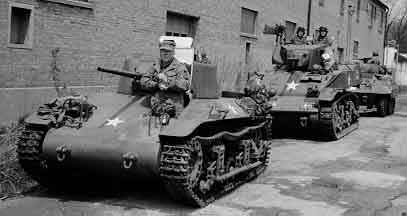
M5A1 little Stuart Tank : During the 1930's the United States Army did not consider tanks to be a relevant weapon on the battlefield. Consequently, little research and development was performed. German victories in Europe exploiting firepower and mobility of tank warfare rekindled interest in tanks among U.S. military leaders, resulting in development plans for a light tank. Several models of the light tank were developed, including the M1, M2 and M3 series. In 1942 production began on the M5 series light tank at the Cadillac Division of General Motors Corporation. There was no M4 light tank designation in order to avoid confusion with the M4 medium tank, then under production. In September of 1942 design improvements were made, culminating in the M5A1, the ultimate refinement of the 1930's vintage U.S. light tank technology. A total production of 6810 M5A1 tanks occurred from 1942 to 1944.
This tank was manufactured by Cadillac Motor Car Company in 1942. Cadillac was chosen to build the M5A1 because Cadillac engines and transmissions were readily available to replace the Continental radials of the earlier light tank models that were in short supply. The M5A1 is the most advanced version of the "Stuart" light tank series used by the U.S., England, Poland, France, Russia and China in World War II.The M5 made its debut in the invasion of Casablanca in French North Africa. By 1943, and at the time of the invasion of Sicily, the M5A1 was becoming the standard light tank of the American armored divisions. Because of limited firepower, the M5A1 eventually took on reconnaissance and escort duties in Italy and, after the invasion of Normandy, throughout Europe. In the Pacific theater, the M5A1 made its debut at Roi-Namur in February of 1944 and on Saipan, the same year. The M5A1 was quite effective against most Japanese armor, even the Japanese Type 97 Chi-Ha medium tank typically used in the Pacific theater. The 37 mm main gun, although obsolete in Europe, was found to be effective against Japanese targets. Consequently, many other vehicles carrying the 37 mm gun, such as the M8 armored car and M3 anti-tank gun were retained and used in the Pacific theater.

IPB Image


FeezyWeezy
Panzerkampfwagen VI Ausf. B / Tiger II

IPB Image
Unlike Spartan noted before, the picture is a Köningstiger.


The Panzerkampfwagen VI Ausf. B was a German heavy tank of the Second World War. Although heavily armed and armoured it was blighted by mechanical failures in action. It was also known as Sonderkraftfahrzeug 182 (Sd. Kfz. 182), or informally Tiger II, Königstiger or King Tiger in German and by the British as Royal Tiger.

The Tiger II was partially derived from the Tiger I, and was intended to share many components with a planned Panther II. The design followed the same concept as the Tiger I, but was intended to be even more formidable. The Tiger II chassis supplied the basis for the Jagdtiger turretless tank destroyer. The Tiger II weighed about 68 tons, was protected by 185 mm of frontal armor, and was armed with the 88 mm KwK 43 L/71 gun. This was the most powerful gun carried by any WW2 tank.

The very heavy armor and powerful, long-range gun gave the Tiger II the advantage against virtually all opposing tanks. This was especially true on the Western Front, where the British and US forces had almost no heavy tanks with which to oppose it. In a defensive position it was difficult to destroy. Offensively it performed with less success, and its performance was a great disappointment to Hitler when it first saw action.

The Tiger II was developed late in the war and made in relatively small numbers (about 560 total). Like all German tanks, it had a gasoline engine. However, this same engine powered the much lighter Panther and Tiger I tanks. The Tiger II was under-powered, like many heavy tanks of WW2, and consumed a lot of fuel.

The US "Super Pershing" T-26 was developed in response to the Tiger I and Tiger II. The Tiger II was widely photographed due to its large size and propaganda value.

IPB Image

There were two very similar designs for the tank, one from Henschel and one from Porsche. However, the turrets were both made and designed by Krupp for each design. Porsche had thought they would win the contract and manufactured 60 vehicles, although some sources state that only 50 were produced. Nonetheless, the Porsche design was beaten by Henschel. Among the reasons given for this were that the Porsche design used too much copper, but another reason is that it had a distinctive curved turret face. The shape of the turret face made it a shot trap. A shot trap is any part of a tank where a deflected shell is not deflected safely away from the tank but instead can be deflected so that it hits another part of the tank. The shot trap was located right under the mantelet, and if a shell hit there, it could jam the turret or if the round was powerful enough, it could possibly blow off the entire turret. Porsche specified a drivetrain whereby the engine generated electrical power and final drive was by electric motors rather than mechanical transmission. Although none of the Porsche versions were produced, approximately 60 turrets were fitted to the standard hull and saw action. The Porsche version of the tanks can be identified by the curved turret face, and a somewhat narrower turret with a bulge on the left side to accommodate the commander's cupola.

IPB Image
Captured King Tiger


With the Third Reich hard pressed, the Tiger IIs were sent directly from the factories into combat. As a result of the abandonment of post-production testing and preliminary trials, the tanks had numerous technical issues. Notably, the steering control would often break down under the stress of the vehicle's weight. In addition, not only were the engines prone to overheating and failure, but they were also considered to be extremely fuel inefficient. This can be attributed to the fact that it used the 700hp Maybach engine of the far smaller Panther tank. The engine had to constantly run at full power just to get the tank moving. Henschel & Son's chief designer Erwin Adlers explained the "The breakdowns can be attributed to the fact that the Tiger II had to go straight into series production without the benefit of test results." The engine and drivetrain was overburdened by the weight and would have required more testing to weed out problems, a common problem among heavy tanks that pushed the limits of powerplants and transmissions.

Overall, the Tiger II was a formidable tank in spite of its problems. The Tiger II's 88 mm armament could destroy most Allied AFVs at a range far outside the effective range of the enemy AFV's armament.


Some notable uses for Panzer VI chassis

Jagdtiger

IPB Image

It featured very heavy armor and a powerful 128 mm L/55 PaK44 gun capable of defeating any tank fielded in World War II, even at long ranges (+3500 meters) It had 250 mm armor on the front glacis, which made it invulnerable to any frontal fire. However, the Jagdtiger had no turret, and the main gun had a limited traverse of only 10 degrees. As a result, the entire vehicle had to turn to aim at enemy tanks. It suffered from the same maladies as the King Tiger: an underpowered engine, frequent breakdowns, and poor maneuverability. These problems, along with the lack of a turret, made it vulnerable to infantry with anti-tank weapons and allied air raids. When properly supported, the Jagdtiger had the potential to be a formidable opponent, especially at longer ranges. However, Jagdtigers were deployed in limited numbers due to the small production, further reduced by equipment shortages, low reliability, and gasoline shortages. About 20% were lost in combat; most were blown up because of mechanical breakdowns, or abandoned because of lack of spare tracks/gasoline in the desperate final stages of the war. The gun used a two part ammunition, which meant two loaders were used to insert the projectile and propelling charge separately. This resulted in slow rate of fire. The tremendous amount of smoke would often give away the position of the tank, in addition to momentarily blinding the crew.

IPB Image

150 Jadgtigers were ordered. About eighty were produced in total. Production figures vary depending on source and other factors such as if prototypes are included and if ones made after VE day are included. Totals range from about 77 to 85 produced from July 1944 to April of 1945. Approximately 48 from July 1944 to the end of December 1944; 36 from January to April 1945, serial numbers from 305001 to 305088 (such as examples from May 45, and pre-production prototypes, and whether incomplete chassis's count). Some sources say no more vehicles were completed after February. Towards the end some were lacking important equipment and could not be used operationally, or could not be deployed to units.


Panzerkampfwagen VII Löwe

IPB Image
This is computer model of the Löwe, as there where none made.

The Panzerkampfwagen VII Löwe (Lion) was a design for a superheavy tank created by Krupp for the Nazi German government during World War II. The project never left the drawing board, and was dropped in late 1942 in favor of the Panzer VIII Maus.


The Löwe was designed in two variants:

Leichter Löwe – crew of five, 1000-hp engine, weight of 76 tons, 100-mm frontal armor, rear-mounted turret, 105 mm L/70 high velocity gun and a coaxial machine gun, top speed 27 km/h.

Schwerer Löwe – crew of five, 1000-hp engine, weight of 90 tons, 120-mm frontal armor, center-mounted turret, 105 mm L/70 high velocity gun and a coaxial machine gun, top speed 23 km/h.


When shown the designs, German Chancellor Adolf Hitler ordered the Leichter Löwe dropped and the Schwerer Löwe re-designed with a 150-mm main gun, 140-mm frontal armor, and a top speed of 30 km/h.

No prototype of either design was ever built. Some parts of the Schwerer Löwe design were used in the Königstiger, however, and that model proved to be expensive to produce and too large to fit across small bridges.


Panzer VIII Maus


IPB Image

The Panzerkampfwagen VIII Maus (Sd.Kfz 205) is the heaviest tank with completed working prototypes of World War II. The basic design known as the VK70001/Porsche Type 2005 was suggested by Ferdinand Porsche to Adolf Hitler in June of 1942, who subsequently approved it. The design up to then had been the culmination of work done by Porsche who had won the contract for the heavy tank that March. Work on the design began in earnest; the first prototype, to be ready in 1943 was initially to receive the name Mammut (Mammoth). This was reportedly changed to Mäuschen (Mousie) in December of 1942 and finally Maus (Mouse) in February of 1943.

The tank's hull was 10.1 metres long, 3.67 metres wide and 3.66 metres tall. Weighing about 188 tonnes (or about 207 short tons), the Maus's main armament was a 128 mm cannon with a coaxial 75 mm gun and steel armour ranging from 40-240 mm. A total of nine were in various stages of completion when the war ended with two completed. The Maus would have had a crew of either 5 or 6 and a total production of between 150 and 200 was planned for one version of it.

The principal problem in development of the Maus was finding a powerful enough engine for its weight that could be carried in the tank. Though the design called for a maximum speed of 20 km/h, no engine was found that could power the prototype to more than 13 km/h under ideal conditions. The weight also made it impossible to cross most bridges. It could ford due to its size or submerge and use a snorkel.

The Maus was relatively slow moving and logistically demanding, but could potentially have been a formidable weapon in certain defensive positions where extensive movement was not required. In an assault, it would have a level of usefulness most similar to British Infantry tanks which also sacrificed mobility for armor protection.

IPB Image

The initial plan for the Maus was for the prototype to have been completed by the summer of 1943, with monthly production scheduled to run at five vehicles per month after delivery of the prototype. The work on the Maus would be divided between Krupp, responsible for the chassis, armament and turret and Alkett, who would be responsible for final assembly.

The Maus tank was originally designed to weigh approximately 100 tons and be armed with a 150mm main gun and a 20mm co-axial secondary gun. Other armament solutions were also looked at: various versions of 150mm, naval 127mm and 128 mm guns. Hitler himself insisted that the armament chosen should be a 128mm main gun with a coaxial 75mm gun. This decision was taken in January of 1943.

By May 1943, a wooden mockup of the final Maus configuration was ready and presented to Hitler, who approved it for mass production and ordered a first series of 150. At this point, the estimated weight of the Maus was 188 tons.

Development work on the Maus continued, but in October 1943 Hitler cancelled the order, which was followed in November by the order to stop development of the Maus altogether.

Nevertheless, work continued and the first, turretless prototype, the V1 was assembled by Alkett in December 1943. Tests started the same month, with a mock turret fitted of the same weight as the real turret.

The principal problem with the Maus that emerged from this test was its power-to-weight ratio. There was no engine powerful enough to give it anything like the 20 km/h demanded by the design specifications. The modified Daimler-Benz MB 509 engine used in the prototype was only able to move at 13 km/h and only under ideal conditions. The suspension system used by the Maus also had to be adjusted to enable it to take the tank's weight.

Another issue found was that the Maus was simply too heavy to cross bridges. As a result an alternative system was developed, where the Maus would instead ford the rivers it needed to cross. Due to its size it could ford relatively deep streams, but for deeper ones it was to submerge and drive across the river bottom. Another Maus would supply power to it via cable until it reached the other side, and the crew receive air through a large snorkel, which would permit going down to 45 feet underwater.

In March 1944 the second prototype, the V2 was delivered, which differed in many details from the V1 prototype. In Mid-1944, this V2 prototype was fitted with a powerplant and the first produced Maus turret. This turret was fitted with a 128mm KwK 44 L/55 gun, with coaxial 75mm KwK 44 L/36.5 gun and 7.92mm MG34 as secondary armament. The V1 prototype was supposed to be fitted with the second produced turret, but this never happened.

By July 1944, Krupp was in the process of producing four more Maus hulls, but they were ordered to halt production and scrap these. Krupp stopped all work on it in August 1944. Meanwhile, the V2 prototype started tests in September 1944, fitted with a Daimler-Benz MB 517 diesel engine, new electric steering system and a Skoda Works designed running gear and tracks.

There was as also a special railroad car made for transporting the Maus prototypes

IPB Image

Most of the life of the working Maus prototypes was in testing around Kummersdorf and at the proving grounds in Böblingen, but the V1 and V2 versions were also involved in one known mission in a combat area that ended in both tanks being over-run and captured by Soviet forces. One fully operational design and one with a dummy turret were ordered to flee the factory development complex at Kummersdorf to avoid advancing Soviet forces. A prototype with a dummy turret broke down several miles away from the factory and was abandoned. The second continued further and was reported also to have broken down, and then scuttled by the crew. Some sources state the second prototype was destroyed by enemy fire and not scuttled.

One Maus tank is currently in the Kubinka Tank Museum in Russia, which consists of either the partially complete turret and hulls in the factory, or one turret and one hull from each of the two prototypes that attempted to flee, or some combination of the two.


PzKpfw IX and PzKpfw X - The Paper Panzers

IPB Image
Panzer IX


Panzer IX and Panzer X only existed as projects on drawing boards. Although, there is no real blueprints showing the realistic look of both vehicles. PzKpfw X was to be wider but lower than Maus and was to be surely armed with 88mm or even 128mm gun. Both designs were very advanced and modern including many features which can be found in modern tanks of today. According to the latest research it appears that those two modern looking tanks were not even considered by the designers but instead were propaganda sketches published in the "Signal" magazine in 1944, to misinform the Allies about the German tank development.


IPB Image
Panzer X

Spartan
Thats my boy finding the shit i dont lol
biggrin.gif biggrin.gif biggrin.gif biggrin.gif biggrin.gif biggrin.gif biggrin.gif biggrin.gif biggrin.gif biggrin.gif biggrin.gif
Spartan
Japanese Type 95
The Japanese tank with the highest production number. It took part in all the campaigns in the Far-East and the Pacific area. Despite its failings (lack of protection, insufficient gun, ...) its mobility made it popular with its crews. It stayed in production until 1943, long after better tanks had been produced. It stayed in service until the end. Identification: Much larger than the tankette Type 94 TK or 97 Te-Ke, it did not have the trailing idler of the tankettes. The Type 98 Ke-Ni is very similar, but it had a third bogie, while the Ha-Go had only two.

Weight: 8.1 tons
Crew: three
Armour: hull front, sides and rear 12 mm; turret front, sides and rear 12 mm
Armament: one 37-mm Type 94 gun mounted in turret; one 7.7-mm Type 97 machine-gun mounted in turret; one 7.7-mm Type 97 machine-gun mounted in hull
Engine: one 110 hp six-cylinder air-cooled diesel engine
Dimensions: width 6 feet, 9 inches; length 14 feet, 4.5 inches; height 7 feet, 2 inches
Max Speed: 30 mph Max Range: 110 miles


IPB Image

Crusier Mark II

IPB ImageThe A10 was developed by Sir John Carden in 1934 by adaption of the A9 design. The two sub-turrets present on the A9 were removed, and extra armour bolted onto that already present on the front and sides of the hull, along with all faces of the turret, providing approximately twice the armor in most areas.

There was no separation between the driver's compartment and the fighting compartments. The turret armament consisted of a QF 2-pounder (40 mm) gun and a coaxial Vickers machine gun. There was a BESA machine gun mounted in the hull in a barbette to the right of the driver. This was added to give extra firepower but at the expense of simplicity - the Vicker and the BESA using different ammunition. The tank had a total crew of 5 (Commander, gunner, loader, driver and hull machine-gunner).

It used the same suspension and engine as the A9 and as a result it was slower than the A9. The A10 entered service in December 1939, but was something of an oddity - it had been intended to sacrifice speed for armour like an Infantry tank, but was still relatively poorly armoured, and was, as a result, not effective. Total production was 175 vehicles including the 30 CS versions

IPB Image
FeezyWeezy
Well its just crap that you find nice pictures and that they cant be linked remotely...
Spartan
True tongue.gif
Blinky
Man..., this topic is getting bigger and wider all the time. Is there any limit for this information flood..?? LOL laugh.gif Now I know what im gonna read when next stormy winterday comes. Seems that MOB has it´s own General Patton ------------> Feezy tongue.gif

Thanks Feezy for the links and glad I could help you for your research. It´s being a pleasure to play together with you, sorry I had a crappy evening yesterday.

For more information on Carl-Gustaf von Rosen:

http://surfcity.kund.dalnet.se/swedish_avi...weden_rosen.htm
Spartan
Hey dont forget ur buddy sparta
FeezyWeezy
QUOTE(+KS+ Blinky Bill @ 03/19/06 5:37pm) *
Man..., this topic is getting bigger and wider all the time. Is there any limit for this information flood..?? LOL laugh.gif Now I know what im gonna read when next stormy winterday comes. Seems that MOB has it´s own General Patton ------------> Feezy tongue.gif
Thanks Feezy for the links and glad I could help you for your research. It´s being a pleasure to play together with you, sorry I had a crappy evening yesterday.

For more information on Carl-Gustaf von Rosen:

http://surfcity.kund.dalnet.se/swedish_avi...weden_rosen.htm


No worry Blinky, I had great fun yesterday.. enjoy playing with you. If I wasn't MOB, than I would join the Blinky Comunity. with all your buddies biggrin.gif

Blinky
This may go a little bit off topic but just had to link this. If you wanna be a tank commander, here´s your chance to try it on your backyard... biggrin.gif

Men are always boys, their toys just get bigger....lol

http://www.mark-1-tank.co.uk/
Maj. H8Red
that's it I'm buyin a friggin tank tongue.gif
Spartan
I call shotty hate flamethrowingsmiley.gif
Hellfighter
oh sure - lump in tank destroyers, assault guns, and armoured cars under tanks definition but leave out the Brit. tanks,,,! I'm waiting for your piece on the British 79th Armoured Division's collection of 'funnies'. rolleyes.gif
FeezyWeezy
I'll do that tomorrow
Spartan
THE Brits
The 79th Armoured Division was a specialist British Army armoured unit formed as part of the preparations for the Normandy invasion of 6 June 1944. The unit comprised armoured vehicles modified for specialist roles, intended to assist with the landing phase of the operation.

The unit was commanded by Major General (later Sir) Percy Hobart, and the strange-looking tanks it operated were known as Hobart's Funnies. They included tanks that floated, could clear mines, carry and lay bridges, and roadways - anything that would enable the invasion force to get ashore and break through the German defences. The unit did not operate as a single division, its vehicles were distributed as small units across the Divisions taking part in the landings and subsequent operations.

The Division was further used during the Rhine crossings, (Operation Plunder), to transport the assault troops and to re-supply.

If u ask me The brits arent important in the 2nd world war
FeezyWeezy
QUOTE(Sparta @ 03/21/06 12:37am) *
If u ask me The brits arent important in the 2nd world war


I highly disagree on this, just by looking upon Malta, North Africa, Battle of Britain, European Naval, SE Operations, D-Day landings, Road to Rome... Italy...must I go on?

Spartan
Not battle wise they rock in that direction but iam speaking of in like whats the word um popularity there we go
they wernt truely recognized is what i meant tongue.gif my bad lol
Spartan
M-22 Locust light Airborne tank
World War II strategists in the U.S. became aware of the effectiveness of airborne assault forces by studying German victories achieved in Europe. They were also aware of the vulnerability of lightly armed airborne infantry alone and behind enemy lines without direct support from a main force. Because of increasing interest in an air delivered light tank by experienced field commanders and the British, the Ordinance Department formulated a design concept requiring the development of a light tank that would aid airborne units during critical mission phases and be sufficiently light in weight to be delivered by airborne means. The light tank would support the airborne infantry until reinforcements from the main force arrived. In May of 1941 design began on the M22 Locust light tank at the Marmon-Herrington Company. Production began in April 1943 and ended in February 1944 with a total production of 830 tanks. Under lend-lease, 260 Locusts were given to the British.
IPB Image

Development of the M22 continued by the Ordinance Department, but engineering problems dealing with excessive weight and poor performance were encountered. Testing showed the impracticalities of utilizing American aircraft at that time. Hoisting the tank hull under a C54 cargo plane and placing the turret in the plane proved cumbersome and time consuming. Because of the lack of a good air delivery system and disappointing performance of the vehicle, the Ordinance Department became less enthusiastic for any further development. However, the British were still interested in the vehicle and 260 were delivered with the remaining vehicles utilized for training purposes in the US. The British were more active than the US in airborne tank development having airborne tanks of their own such as the Tetrarch, Alexto and Hopkins. The British outfitted the 37mm guns with an extruder adapter (squeeze-bore) that reduced the projectile from 37mm to 30mm increasing velocity to 4000 ft/sec from 2700 ft/sec. A new high mass and shatter resistant tungsten carbide ammunition was developed for this application. Twelve of the tanks were landed using the giant Hamilcar glider during the Rhine crossing on March 24, 1945. The British airborne crossing of the Rhine river, called Operation Varsity, utilized over 50 large Hamilcar Gliders delivering airborne tanks and other equipment for the 6th Airborne Armored Reconnaissance Regiment, Royal Armored Corps, of the British forces. One Locust tank was credited with killing over 100 enemy soldiers.
IPB Image


M24 Chaffee[u]
The M24 Chaffee -- arguably tongue.gif the best light tank of World War II -- was a fast light armoured vehicle with the ability to deliver relatively large caliber direct fire with the excellent 75 mm M6 gun. More than 4.000 produced by Cadillac and Massey-Harris during 1943-45. The first reached Europe in late 1944, where they proved very effective and highly reliable.

However, at the outset of the Korean War American forces equiped with the with M24 Chaffees performed poorly against the enemy's T-34/85s, and these US units were soon augmented with M26 Pershings and M46 Pattons, along with M4A3E8 Shermans with the long 76mm gun. It remained in American service until 1953, by which time it wa totally replaced by the the M41 Bulldog.

After 1945 the M24 Chaffee was used by many American allies. The French army used them in Indo-China, including at the battle of Dien Bien Phu. Though obsolete by the mid-1960's, it remains in service in some countries. In Taiwan the platform has been re-equipped with a 90mm gun. flamethrowingsmiley.gif
Spartan
Just for You Hellfighter!

Three Black American rank battalions were activated during World War II. They were the 758th, 761st and 784th. The 761st was the first of these to go into combat. The battalion was activated in April 1942 at Camp Clairborne, Louisiana. General J. McNair gave birth to the idea of utilizing Black soldiers in the Armored Force. Many were opposed to the idea. One such individual who was opposed was one of Americas’ most famous generals,- George S. Patton, Jr., tank commander of the Third Army. Orders were issued to organize the first Black tank battalion in our nation’s history - the “758th. A cadre from the 758the was then used to organize the 761st. Many thought it was enough to have Black men in the armored division. However, it became a battle to get into battle. During World War II, the army was segregated, but due to the tenacious efforts of Eleanor Roosevelt as well as prominent Black leaders and the Black press, the 761st was given the opportunity to go into combat. After nearly a year of intensive training at the Central Army Installation of Camp Hood, the 761st departed and following a brief stay at Camp Shanks, New York, were enroute to the European Theater of Operations. Ironically, General Patton had requested that the best remaining separate Tank Battalion be sent to him in Europe. He would then later tell the men that he had asked for them because he had heard that they were good, and that he had only the best in his third army.

In October 1944, the 761st landed in France on the Normandy peninsula. True to their battle cry the courageous World War II Black Panthers came out fighting.

Hope ya like laugh.gif
Hellfighter
QUOTE(Sparta @ 03/20/06 10:02pm) *
Just for You Hellfighter!

.........
Hope ya like laugh.gif


Thanks lots, Sparta
I actually have a very significant mini library of books about black units in military history [and most especially in all arms of the U.S military starting in the American War of Independance] which over time I'll post about in the forum if there are interests raised. Currently I delve into female fighting units / individuals in the military throughout history... which I'll definately share at some point. In sticking to this thread for now I'll mention a bit about segregated [at those times officers were White at/above the rank of Captain]-Black armoured units besides the Tank units you mentioned - briefly, because as you might know me by now I ramble on a bit about things I get into when I post.....

Here's an excerpt from a Patton website on his review and thoughts of the 761st prior to them going into combat;


QUOTE
As the 761st was about to enter combat, Patton reviewed the battalion and made a speech to the men which offered a guarded vote of confidence in their abilities:

"Men, you're the first Negro tankers to ever fight in the American Army. I would never have asked for you if you weren't good. I have nothing but the best in my Army. I don't care what color you are as long as you go up there and kill those Kraut sons of bitches. Everyone has their eyes on you and is expecting great things from you. Most of all your race is looking forward to you. Don't let them down and damn you, don't let me down!"

However, like many Army officers, General Patton expressed his doubts about using black men in combat. On returning to headquarters following the review, he remarked, "They gave a good first impression, but I have no faith in the inherent fighting ability of the race."

Despite the outstanding performance of the 761st under his command, Patton was not compelled to change his perceptions about black soldiers. In War As I Knew It, he relates the interaction described above, and comments, "Individually they were good soldiers, but I expressed my belief at the time, and have never found the necessity of changing it, that a colored soldier cannot think fast enough to fight in armor."


Even though he had such prejudices initially he found their combat prowess necessary in spearheading his armoured thrusts and the unit remained in combat for 183 straight hellish days!

The units

Cavalry brigades
[mechanised units] sent to N.Africa.... 4th and 5th Coloured Cavalry brigades.
Cavalry Regiments [mechanised units] sent to N. Africa... 9th,10th [remember the famous 'Buffalo Soldiers' of the wild west......] 27th, 28th
Cavalry Regiments
Reconnaissance squadrons
[armoured car units] sent to N.Africa.... 5th, 35th

'Coloured' Tank Destroyer Battalions [s-p = self propelled afvs]
not sent overseas.... 646th [s-p], 649th, 659th [towed AT guns], 669th [towed AT guns], 795th[s-p], 827th [s-p] 828th [s-p], 829th [towed AT guns], 846th [towed AT guns]
serving in NW Europe.... 614th [towed AT guns],
serving in Europe then Italy.... 679th [towed AT guns]

'Coloured' Tank Battalions
758th served in Europe alonside the 92nd Coloured Infantry Division
761st and 784th served in NW Europe, with their companies usually deployed to various infantry divisions.
The 761st was particularly devastating as a fighting force with terrific firing and combat skills.Apparently they had potent women-charming skills too and were very 'popular' in their stay in England prior to going into combat on the mainland. Most notable in their combat records were their roles in the battle of the Bulge and spearheading the initial thrusts into the Siegfried Line [yes, I spelled it wrong in my sig] assisting in liberating Buchenwald concentration camp, then ending up the furthest western unit into Eastern Europe, oddly enough the German citizens in the area they would later occupy, got along with the tankers very nicely compared to their treatment back at their camp quarters in the U.S. One major reason for their success was the men of all races and ranks coming together for the most part working together as an high-moraled elite and deadly tank unit. On the other hand, the 92nd coloured Div. in Italy performed patchily in Italy, poor leadership, blatant prejudices, and mistrust being the prime culprits.
-> a good source http://www.761st.com/index.php?page=DiNicolo

It should be noted Sparta, that Mrs.Roosevelt was incredibly instrumental in her agressive efforts to see everyone get 'their shot' at equality and everyone participating in the war effort to their full potential regardless of race and sex. She was a true 'damn the torpedoes, full steam ahead' type of person. Anyway I'm starting to ramble so I'll leave the tons of very interesting related material for future posts..... like entire African Divisions fighting against the Japanese, the American-Japanese Nisei Regt [the most decorated unit in the US forces!], all-women military units in the Soviet army/airforce etc.............................................................


Spartan
For Hellfighter Bout Woman soldiers
As in World War One, women played a vital part in this country’s success in World War Two. But, as with World War One, women at the end of World War Two, found that the advances they had made were greatly reduced when the soldiers returned from fighting abroad.

At the end of World War Two, those women who had found alternate employment from the normal for women, lost their jobs. The returning soldiers had to be found jobs and many wanted society to return to normal. Therefore by 1939, many young girls found employment in domestic service - 2 million of them, just as had happened in 1914. Wages were still only 25p a week.

When women found employment in the Civil Service, in teaching and in medicine they had to leave when they got married.

However, between the wars, they had got full voting equality with men when in 1928 a law was passed which stated that any person over the age of 21 could vote - male and female.

The war once again gave women the opportunity to show what they could do.

Evacuation:

Young mothers with young children were evacuated from the cities considered to be in danger. In all, 3.5 million children were evacuated though many went with a teacher. As young children were normally taught by females, many of those who went with the children were women. The fact that women were seen to be the people who taught the youngest was something that had been going on for years.

The Women's Land Army:

As in World War One, women were called on to help on the land and the Women’s Land Army (WLA) was re-formed in July 1939. Their work was vital as so many men were being called up into the military.

In August 1940, only 7,000 women had joined but with the crisis caused by Hitler’s U-boats, a huge drive went on from this date on to get more women working on the land. Even Churchill feared that the chaos caused by the U-boats to our supplies from America would starve out Britain.

The government tried to make out that the work of the WLA was glamorous and adverts showed it as this. In fact, the work was hard and young women usually worked in isolated communities. Many lived in years old farm workers cottages without running water, electricity or gas. Winter, in particular, could be hard especially as the women had to break up the soil by hand ready for sowing. However, many of the women ate well as there was a plentiful supply of wild animals in the countryside - rabbit, hares, pheasant and partridges. They were paid 32 shillings a week - about £1.60.

IPB Image
Spartan
Iam Sry I got a bit Off topic But I've returned wit THE SS!!
For the 1939 invasion of Poland, three SS regiments ("Deutschland", "Der Führer", and "Germania") were grouped into a division, the SS-Verfügungstruppe ("Special-Purpose Troops"). After Poland, one regiment ("Germania") was sent to form another division (5.SS-Division Wiking), and a new third regiment was created (SS Regiment 11); this became the 2nd SS Division Reich ("Empire").

In November 1942, the division became a Panzergrenadier division and its name was changed to 2.SS-Panzergrenadier-Division Das Reich. In 1943 the division was reorganized as a Panzer division by adding the 2.SS Panzer Regiment, thus creating the 2.SS-Panzer-Division "Das Reich".

After fighting on the Eastern Front for a long time, the division was recalled from battle for refitting. Most of Das Reich was stationed in the southern French town of Montauban north of Toulouse gaining new equiptment and freshly trained SS men. The joint allied invasion of Normandy, meant that the division was in action again, and was pulled up to support the defence of France alongside the 3rd SS Division Totenkopf and 1st SS Division Leibstandarte SS Adolf Hitler fighting north of Caen.

Das Reich was trapped in the Falaise Pocket for some time, before escaping to the west. After the substantial losses in the Allied summer campaign, the Wermacht was pushed back almost to the borders of Germany in late 1944. In the second week of December, 1944, the German army was ready to make it's counter-offensive to reclaim the port of Antwerp, and regain the initiative in the west. The German Ardennes offensive opened a large break in the American lines. Das Reich played a role in the Battle of the Bulge.

IPB Image


Major gains were made, but by December 25, the German offensive was halted. The sieged town of Bastogne was never captured, eventhough numerous attempts were made to enter the city. Das Reich's panzer commander Ernst Barkmann became famous for the creation of Barkmann's Corner, where he destroyed numerous American tanks in small skirmishes.

After the Ardennes debacle, SS division Das Reich was again pulled back, this time to Germany, for refitting. The crisis in the south-east saw Das Reich in the thick of it. The failed German counter-offensive around Budapest saw Das Reich pushed back into Germany, after fighting in Vienna and Prague.

The remnants of the division in the south surrendered to the Americans in May 1945.

The division is infamous for the massacre of 642 French civilians in the village of Oradour-sur-Glane, on 10 June 1944, in Limousin region. A trial was held in the post war years, but very few of the accused perpetrators were punished. Apart from this, Das Reich was of the front-line SS divisions that had an illustrious, mostly crime free career. Only the Regiment "Der Führer" was held responsible for the massacre.

The SS Division Das Reich was one of the thirty-eight divisions fielded by the Waffen-SS during World War II. It is one of the most well-known and reasearched of all the SS divisons. Das Reich was composed of some of the best, most well trained and battle-hardened troops in the world at the time.

Hellfighter
QUOTE(Sparta @ 03/21/06 4:46pm) *
For Hellfighter Bout Woman soldiers


IPB Image


Good again Sparta.... but I'll definately peak your interest in future threads with facts about Soviet female fighter pilots/bomber crews;snipers/infantry[Stalingrad]/front line medics in WW2- real Amazon women {West Africa] who battled the Foreign Legion, AA crews in England in WW2, Allied female test pilots, females impersonating men to fight at major battles throughout history [American Civil War... Waterloo], female rebels in central American armies [80s], then there's the duel Achilles had with a Xena type Warrior at Troy [ok that was myth-based]..... ahhh I'm rambling - must stay on topic laugh.gif

ok late edit... first link relates to thread, the second link is a good source of books that I highly recommend for an eye-opening read... I have few of the books myself.

http://aufrecht.org/duri/ch22.html
http://www.amazon.com/gp/richpub/listmania...5Fencoding=UTF8
Spartan
sent ya an Xfire friend invite there Hellfighter wink.gif
Spartan
Ok so I took a long Nap And well Guess the Ruskie Is-2 Is next!

RUSSIAN IS-2
The IS-2 was the most powerfully armed tank in WWII, and its improved fire control system meant it could fight Panthers and Tigers on more than equal terms. Heavy Guard Tank Regiments were equipped with the IS-2 in February 1944. The armor of 150mm on the hull and 100mm on the turret made it impervious even to the 75mm gun of the Panther. The tank was improved several times before the end of WWII. Improvements included a 700 hp engine, a 5-speed gearbox and a new radio. Major shortcomings included a slow rate of fire, storage for only 28 rounds and internal splintering of the armor when hit. The long gun was extremely powerful but it required two-part ammunition. Nevertheless, the tank proved very effective in combat versus both the Tiger and the Tiger II. A total of 4,392 were produced.

IPB Image


Specifications Yall know Weapons and Performance

Crew: 4
Weight: 46,000 kg
Length: 9.90 m
Width: 3.09 m
Height: 2.73 m
Max speed: 37 km/h (on road)
Max range: 240 km (on road)
Engine: One V-2-IS (V-2K) V-12 diesel
(447 kW)
Power-to-weight ratio: 9.72 kW/tonne
Vertical obstacle climb: 1.00 m
Gradient: 40.0 %
Trench crossing: 2.49 m
Main armament: 122-mm gun
Secondary armament: One 12.7-mm machine-gun
One 7.62-mm machine-gun
Armour: 132 mm (max)

IPB Image


There Ends This tank AND on tO THE NeXt laugh.gif
Spartan
Wow longest thread ever made by urs truely mobrules.gif
Hellfighter
QUOTE(Sparta @ 03/21/06 7:02pm) *
sent ya an Xfire friend invite there Hellfighter wink.gif


ok, but I hardly ever use it....
still waiting for pics of 79th Div's funnies to be posted.... rolleyes.gif
Spartan
Gotta Please the Masses LOl

IPB Image
Hellfighter
ok Sparta-to help you out tongue.gif , here are some other funnies;

IPB Image
Ark... trench/ramp bridger

IPB Image
Flail
IPB Image
Petard... much like the Jerry Brumbar

IPB Image
Centaur dozer

IPB Image
Crab

Link for detailed info on all of these;

http://www.answers.com/topic/hobart-s-funnies


This is a "lo-fi" version of our main content. To view the full version with more information, formatting and images, please click here.
Invision Power Board © 2001-2026 Invision Power Services, Inc.