
 Tanks on the Battle field, Of WW2 Check it out Tanks on the Battle field, Of WW2 Check it out |


| Spartan |
 03/17/06 4:14pm 03/17/06 4:14pm
Post
#1
|
 Major  Group: Forum Member Posts: 668 Joined: January 19th 2006 From: Miami, Florida Member No.: 1545 Xfire: Cknife187  |
The Panzerkampfwagen IV (PzKpfw IV), more commonly referred to as the Panzer IV, was a tank developed by Nazi Germany and used extensively in WW2. It was designed initially as an infantry-support medium tank, to work in conjunction with the anti-tank crews. Later in the war, it was up-gunned and up-armored, and took over the tank-fighting role. The Panzer IV was the most common German tank of World War II, and was used as the base for many other fighting vehicles, such as tank destroyers and self-propelled antiaircraft guns. By the end of the war nearly 9000 had been built.
 Panzer III n 1936 german industry passed to develope a true battle tank using the experiences got with the previous panzers. Panzer III Ausf. E (Sd.Kfz. 141), armed with a 37mm L46 gun (muzzle speed of 762 m/s), appeared in less than a hundred (previous III models included) during the polish campaign. Circa 300 Panzer III were ready for French campaign, too few to fill the Panzerdivisionen's order of battle and so being often replaced by the light PzKpfw 38(t)s, 35(t)s and IIs; this last operation proved the "foolness" of using 37mm gun against the heavy armored tanks such as the Char B1-bis or the british Matildas. A handful of new Ausf. F, armed with 50mm L42 KwK 38 was tested in the final days of the campaign. Ausf. Fs and heavier armored Ausf. Gs formed the bulk of General Rommel's Afrika Korps when it landed in Libya on 28th February 1941 for reinforcing the Italian anti-tank defence. Experience on the field proved necessity of better tropicalization in both engine filters and turret ventilation.  Sherman M4 In March 1941 the U.S army decided it needed a new tank to replace the Grant M2A1. After looking at five different proposals the Sherman M4 was chosen. Production began early in 1942. The original armament was a 75mm gun capable of firing high explosive shells. Its 500hp engine had a maximum speed of 26mph. This was replaced by a 76mm high-velocity gun in February 1944. The tank's suspension was redesigned and improved by the beginning of 1945. Although inferior to the best German and Soviet tanks in armament and protection, it was superior in terms of reliability, serviceability and cost-effectiveness. The British army used the Sherman Tank at El Aleman in 1942 and by 1943 was the mainstay of Allied operations in Africa and Europe. No picture available. sry guys Like last time i want u guys to do a lil reaserch. --------------------  "Wars come and go, But my soldiers they stay eternal" - Tupac Shakur  |
   |

 
|
  |
Replies
| FeezyWeezy |
03/18/06 2:15pm
Post
#2
|
|
Major Group: Banned Posts: 609 Joined: January 14th 2006 From: Gone Member No.: 1533 |
k, played some Barb and now it's time for the Panzer IV..
PzKpfw 4 / Panzerkampfwagen IV / Panzer IV Link to the full story! <<<  PzKpfw IV Ausf E. The Panzerkampfwagen IV (PzKpfw IV), more commonly referred to as the Panzer IV, was a tank developed by Nazi Germany and used extensively in World War II. It was designed initially as an infantry-support medium tank, to work in conjunction with the anti-tank Pzkpfw III. Later in the war, it was up-gunned and up-armored, and took over the tank-fighting role. The Panzer IV was the most common German tank of World War II, and was used as the base for many other fighting vehicles, such as tank destroyers and self-propelled antiaircraft guns. By the end of the war nearly 9000 had been built. The Panzer IV was the workhorse of the German tank corps, being produced and used in all theatres of combat throughout the war. The design was upgraded repeatedly to deal with the changing threats from enemy forces. On January 11, 1934, following specifications laid down by Heinz Guderian, the Army Weapons Department drew up plans for a medium tank with a maximum weight of 24,000 kg and a top speed of 35 km/h. It was intended in a support and anti-infantry role, using a low-velocity, large-caliber gun firing high-explosive shells. It was not required to deal with enemy tanks on equal terms. Krupp, Rheinmetall, and MAN all produced prototypes, which were tested in 1935. As a result of the trials, the Krupp design was selected for full-scale production. The first Panzer IV A came off the assembly line in October of 1937, with a total of 35 being produced over the next six months. Between 1937 and 1940, attempts were made to standardize parts between Krupp's Panzer IV and Daimler-Benz's Panzer III.  The Panzer IV was originally intended principally to deal with infantry and fortifications, while the Panzer III dealt with enemy armoured units. To this end it was equipped with the 75 mm KwK 37 L/24 gun, which was effective against soft targets but lacked much armour penetration. It had poor accuracy, because the barrel was very short (1800 mm), giving a low muzzle velocity. For comparison the L/48 Gun is 3600 mm long.Combat experience showed that increasingly the 50 mm L/60 gun mounted on late-model Panzer III was unable to deal with enemy tanks at long range. Panzer IIIs struggled against T-34s of the Soviet Union and M4 Shermans of the United States, both of which had guns in the 75 or 76 mm calibre. The Panzer IV's design already mounted a 75 mm gun and it was the obvious choice for the next medium tank development. As the Wehrmacht needed a tank with good anti-tank capabilities to deal with the T34, the production of the Panzer IV model F was changed to an improved model with a redesigned turret carrying a new, more powerful 75 mm L/43 anti-tank gun. The sprocket and idler wheels were altered to take wider tracks more able to support the increased weight of a larger gun. This required a change in naming conventions: the old 75 L24-equipped Pz-IV F was renamed Pz-IV F1, and the new 75 L/43-equipped was named Pz-IV F2. The Pz-IV F2 was later renamed Pz-IV G and production continued under this name with minor improvements. In late 1942 the Pz-IV G gun was upgraded to the even longer 75 L/48 gun. Early model Panzer IV tanks were often upgraded for increased combat efficiency. From 1943, for example, surviving Panzer IV models E/F were given additional armor and the 75 L48 gun. The aforementioned upgrades allowed the Panzer IV to keep pace with newer designs such as the Sherman and the T-34. Production continued and was stepped up even while the more effective Panther medium tank was in service, because of the Panzer IV's low cost and greater reliability. Small numbers of Panzer IV were supplied by Germany to its allies. Bulgaria received 88 vehicles and used them against Germans in late 1944. Finland bought 15 Panzer IV Ausf Js, which arrived too late to fight against the Soviets the Continuation War (1941-44) or against German troops in the following Lapland War (1944-45) and served as training vehicles until 1962. Small numbers were also given to Hungary, Romania, Spain and Yugoslavia (Chetniks). In 1950s/1960s Syria bought several dozens of Panzer IVs from USSR, France, Czechoslovakia and Spain and employed them in the 1965 conflict over Jordan headwaters (often referred to as Water War) and in the Six Days War (1967).  PzKpfw IV Ausf H. Some notable uses for Panzer IV chassis Flakpanzer IV Möbelwagen  http://www.lexikon-der-wehrmacht.de/Waffen/Bilderseiten/flakpanzer-R.htm The Flakpanzer IV (Sd.Kfz. 161/3), nicknamed Möbelwagen ("Furniture Van") because of its boxy turret (when closed), was an anti-aircraft gun carrier built on the chassis of the Panzer IV. It was used by the German Wehrmacht in the European Theater of World War II. In 1943, due to the waning ability of the Luftwaffe to combat enemy ground-attack aircraft, ground-based anti-aircraft weaponry was becoming increasingly important to the Wehrmacht. In early 1943, the idea of creating a gun platform on the chassis of the Panzer IV was first proposed. The initial design used a 20mm quad-gun ("Flakvierling") that was deemed too weak for the latest aircraft, which were constantly flying higher and faster. Only a single prototype with this gun was produced before the design was rejected. A second design with an upgraded single 37mm Flak 43 was approved as a temporary stopgap until better Flakpanzers could be created. This design was designated Flakpanzer IV, and the first production models were put into service on the Western Front in April of 1944. The Möbelwagen was built on Panzer IV chassis that had been damaged on the Eastern Front and returned to the factory for repair. These were fitted with an open-top superstructure that provided the gun mount. Around this, four hinged 20mm armored plates were placed. These plates had two basic operating positions: they could be lowered for full 360 degree traverse, allowing flat or low-level firing, or they could be half-closed, being pinned together to hang slightly open. In this position, they had notches that allowed the gun full rotation, but only for firing at airborne targets. Still, both of these positions left the crew extremely vulnerable. The fully closed position was only used for transport, when the plates would give the crew some protection from small arms fire and shrapnel. Though the Möbelwagen was intended to be a stopgap, it served the anti-aircraft platoons of the Panzer Divisions extremely well on the Western Front. Despite this, fewer than 300 were produced, and it was eventually succeeded by the first true Flakpanzers: the Wirbelwind and the Ostwind, both of which provided the crew with armored protection and full rotation when firing at either ground or air targets. Flakpanzer IV Wirbelwind 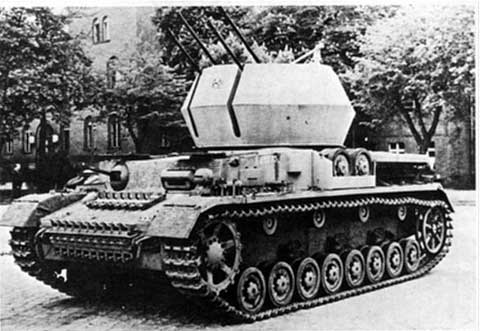 The Flakpanzer IV Wirbelwind (Whirlwind in German) was an anti-aircraft vehicle based on the Panzer IV. It was developed in 1944 as a successor to the earlier AA tank Möbelwagen. The Panzer IV's turret was removed and replaced with an open-top, nine-sided turret which housed a quadruple 20mm Flakvierling 38. A closed-top design would have been preferable, but this was not possible due to the heavy smoke generation of the 4 flak guns. Production of the tank was carried out by Ostbau Werke in Sagan, Silesia. By the time the Wirbelwind was introduced to service, 20mm shells were no longer very effective against aircraft; the Wirbelwind was soon replaced by the Ostwind which was equipped with a single 37mm Flak 43. It is believed that either 87 or 105 Wirbelwinds were produced during the war, but due to discrepancies between the recorded production numbers at Ostbau Werke and Wehrmacht service records, the exact number will probably never be known. In any case, there were too few of them to have any major influence on the war. Flakpanzer IV Ostwind  The Ostwind's main improvement over the Wirbelwind was its increased range. It also had slightly better armoring on its turret, as well as a second MG34. Approximately 45 of these vehicles were built. Brummbär / Sturmpanzer IV  The Sturmpanzer IV was a development of the Panzer IV tank and designed to provide direct infantry fire support, especially in urban areas. Earlier vehicles like the StuG III were not completely adequate for this role and therefore it was decided in early 1942 to develop a new vehicle. The result was the Sturmpanzer IV, which used a Panzer IV chassis with a new, fixed superstructure housing the 150 mm Sturmhaubitze (StuH) 43 L/12 gun. The original design of the Sturmpanzer IV suffered from a series of flaws, which were gradually solved during the production process. The most important flaw was the high weight and recoil of the StuH 43 gun, which overloaded the Panzer IV chassis and made the entire vehicle top-heavy. Furthermore, early vehicles suffered from transmission failures and were underpowered. Another significant flaw was the absence of a machine gun which made it easy for enemy infantry to attack the vehicle at close range. Early vehicles carried a MP 40 sub-machine gun inside, which could be fired through firing ports in the side of the superstructure. In October 1943 it was decided that the Sturmpanzer IV's superstructure as well as the StuH 43 gun needed to be redesigned to fix these flaws. A new and lighter version of the StuH 43 gun was produced, the StuH 43/1 L/12. This gun was used from the second production series onwards. A new superstructure was added in mid-1944 which featured a redesigned gun collar, as well as a general reduction in height of the superstructure. This redesign also introduced a ball mount in the front superstructure for a MG34 machine gun. Jagfpanzer IV  A Jagdpanzer IV with the long 75mm L/70 gun. The Jagdpanzer IV, Sd.Kfz. 162, was a tank destroyer based on the Panzer IV chassis built in three main variants. It was developed against the wishes of Heinz Guderian, the inspector general of the Panzertruppen, as a replacement for the Stug III. Guderian objected against the, in his eyes, needless diversion of resources from Panzer IV tank production, as the Stug III and Stug IV were still more than adequate for their role. Nevertheless in late 1942 the Wehrmacht's arms bureau, the Waffenamt, called for a new tank destroyer design based on the Panzer IV, which would be armed with the same 75 mm gun as fitted to the Panther: the PaK 42 L/70. Unlike previous tank destroyers like the Marder series, this gun was to be mounted directly into the Jagdpanzer's superstructure, keeping its silhouette as low as possible. The Jagdpanzer IV kept the basis chassis of the Panzer IV tank, but the original vertical front plate was replaced by a sharp edged nose. Internally, the layout was changed to accommodate the new superstructure, moving the fuel tanks and ammunition racks. Because the Jagdpanzer lacked a turret, the engine which originally powered the Panzer IV's turret could be eliminated. Jagdpanzer IV served in the anti-tank sections of Panzer and SS Panzer divisions. They fought in Normandy, the Battle of the Bulge and on the Eastern Front (WWII). They were very successful tank destroyers but performed badly when used out of role as substitutes for tanks or assault guns. In the later stages of the war however, they were increasingly used as tank substitutes, because there was often nothing else available. -------------------- C'est pas l' histoire d'un jour
Qui rime avec amour, Plutôt un long séjour Mais pas: un "pour toujours" |
|
|
|
Posts in this topic
 Sparta Tanks on the Battle field 03/17/06 4:14pm
 FeezyWeezy [b]PzKpfw 1 / Panzerkampfwagen I / Panzer I
[b][u... 03/18/06 10:31am FeezyWeezy Ok I had my Breakfast and Coffee... time for Panze... 03/18/06 11:56am Sparta Iamma call u the history man dude 03/18/06 3:08pm FeezyWeezy Ok, played some with Blinky and his Finnish friend... 03/18/06 5:27pm FeezyWeezy [size=4][b][size=4]PzKpfw 6 / Panzerkampfwagen VI ... 03/18/06 7:01pm Sparta Tiger tank
After years of research for a heavy n... 03/18/06 8:15pm FeezyWeezy Panzerkampfwagen VI Ausf. B / Tiger II
[b][size=1... 03/18/06 9:24pm Sparta Thats my boy finding the shit i dont lol
:D :D ... 03/18/06 11:08pm Sparta Japanese Type 95
[color=#000000]The Japanese ... 03/19/06 12:20am FeezyWeezy Well its just crap that you find nice pictures and... 03/19/06 7:50am Sparta True :P 03/19/06 9:52am +KS+ Blinky Bill Man..., this topic is getting bigger and wider all... 03/19/06 11:37am
FeezyWeezy [b]PzKpfw 1 / Panzerkampfwagen I / Panzer I
[b][u... 03/18/06 10:31am FeezyWeezy Ok I had my Breakfast and Coffee... time for Panze... 03/18/06 11:56am Sparta Iamma call u the history man dude 03/18/06 3:08pm FeezyWeezy Ok, played some with Blinky and his Finnish friend... 03/18/06 5:27pm FeezyWeezy [size=4][b][size=4]PzKpfw 6 / Panzerkampfwagen VI ... 03/18/06 7:01pm Sparta Tiger tank
After years of research for a heavy n... 03/18/06 8:15pm FeezyWeezy Panzerkampfwagen VI Ausf. B / Tiger II
[b][size=1... 03/18/06 9:24pm Sparta Thats my boy finding the shit i dont lol
:D :D ... 03/18/06 11:08pm Sparta Japanese Type 95
[color=#000000]The Japanese ... 03/19/06 12:20am FeezyWeezy Well its just crap that you find nice pictures and... 03/19/06 7:50am Sparta True :P 03/19/06 9:52am +KS+ Blinky Bill Man..., this topic is getting bigger and wider all... 03/19/06 11:37am
 FeezyWeezy Man..., this topic is getting bigger and wider al... 03/19/06 12:29pm Sparta Hey dont forget ur buddy sparta 03/19/06 12:08pm +KS+ Blinky Bill This may go a little bit off topic but just had to... 03/20/06 5:38am Maj. H8Red that's it I'm buyin a friggin tank :P 03/20/06 12:05pm Sparta I call shotty hate :flm 03/20/06 1:05pm Hellfighter oh sure - lump in tank destroyers, assault guns, a... 03/20/06 5:27pm FeezyWeezy I'll do that tomorrow 03/20/06 5:48pm Sparta THE Brits
The 79th Armoured Division was a special... 03/20/06 6:37pm FeezyWeezy If u ask me The brits arent important in the 2nd ... 03/20/06 6:50pm Sparta Not battle wise they rock in that direction but ia... 03/20/06 7:00pm Sparta [b]M-22 Locust light Airborne tank
World War II st... 03/20/06 9:45pm Sparta Just for You Hellfighter!
Three Black Americ... 03/20/06 10:02pm Hellfighter Just for You Hellfighter!
.........
Hope ya ... 03/20/06 11:30pm Sparta For Hellfighter Bout Woman soldiers
As in World W... 03/21/06 4:46pm Hellfighter [u][b]For Hellfighter Bout Woman soldiers
[cente... 03/21/06 6:07pm Sparta Iam Sry I got a bit Off topic But I've returne... 03/21/06 5:46pm Sparta sent ya an Xfire friend invite there Hellfighter ;... 03/21/06 7:02pm Hellfighter sent ya an Xfire friend invite there Hellfighter ... 03/21/06 8:47pm Sparta Ok so I took a long Nap And well Guess the Ruskie ... 03/21/06 7:17pm Sparta Wow longest thread ever made by urs truely :mobrul... 03/21/06 8:34pm Sparta Gotta Please the Masses LOl
http://www.24hourmuse... 03/21/06 9:37pm Hellfighter ok Sparta-to help you out :P , here are some other... 03/22/06 3:07pm
FeezyWeezy Man..., this topic is getting bigger and wider al... 03/19/06 12:29pm Sparta Hey dont forget ur buddy sparta 03/19/06 12:08pm +KS+ Blinky Bill This may go a little bit off topic but just had to... 03/20/06 5:38am Maj. H8Red that's it I'm buyin a friggin tank :P 03/20/06 12:05pm Sparta I call shotty hate :flm 03/20/06 1:05pm Hellfighter oh sure - lump in tank destroyers, assault guns, a... 03/20/06 5:27pm FeezyWeezy I'll do that tomorrow 03/20/06 5:48pm Sparta THE Brits
The 79th Armoured Division was a special... 03/20/06 6:37pm FeezyWeezy If u ask me The brits arent important in the 2nd ... 03/20/06 6:50pm Sparta Not battle wise they rock in that direction but ia... 03/20/06 7:00pm Sparta [b]M-22 Locust light Airborne tank
World War II st... 03/20/06 9:45pm Sparta Just for You Hellfighter!
Three Black Americ... 03/20/06 10:02pm Hellfighter Just for You Hellfighter!
.........
Hope ya ... 03/20/06 11:30pm Sparta For Hellfighter Bout Woman soldiers
As in World W... 03/21/06 4:46pm Hellfighter [u][b]For Hellfighter Bout Woman soldiers
[cente... 03/21/06 6:07pm Sparta Iam Sry I got a bit Off topic But I've returne... 03/21/06 5:46pm Sparta sent ya an Xfire friend invite there Hellfighter ;... 03/21/06 7:02pm Hellfighter sent ya an Xfire friend invite there Hellfighter ... 03/21/06 8:47pm Sparta Ok so I took a long Nap And well Guess the Ruskie ... 03/21/06 7:17pm Sparta Wow longest thread ever made by urs truely :mobrul... 03/21/06 8:34pm Sparta Gotta Please the Masses LOl
http://www.24hourmuse... 03/21/06 9:37pm Hellfighter ok Sparta-to help you out :P , here are some other... 03/22/06 3:07pm |
1 User(s) are reading this topic (1 Guests and 0 Anonymous Users)
0 Members:


|
Lo-Fi Version | Time is now: 06/26/26 5:56pm |
Invision Power Board
© 2026 IPS, Inc.