

 Notable People of WW2, Hero's, veterans, leaders, the famous and alike. Notable People of WW2, Hero's, veterans, leaders, the famous and alike. |

  |
| UNDEAD 1 |
 03/21/06 3:41am 03/21/06 3:41am
Post
#16
|
|
Major General  Group: {MOB} Posts: 2753 Joined: January 17th 2006 Member No.: 1540 Xfire: UNDEADJAMES  |
where do you find this info?
anyway you can do rommel? --------------------  |
   |

 
|
| FeezyWeezy |
03/21/06 12:03pm
Post
#17
|
|
Major  Group: Banned Posts: 609 Joined: January 14th 2006 From: Gone Member No.: 1533 |
Erwin Johannes Eugen Rommel
"Wüstenfuchs"  Rommel was born in Heidenheim, approximately 45 kilometres from Ulm, in the state of Württemberg. He was baptised on the November 17, 1891. He was the second son of a Protestant Headmaster of the secondary school at Aalen, Erwin Rommel the elder and Helene von Luz, a daughter of a prominent local dignitary. The couple also had three more children, two sons, Karl and Gerhard, and a daughter, Helene. Later recalling his childhood, Rommel (The Desert Fox) wrote that "my early years passed very happily". At the age of fourteen, Rommel and a friend built a full-scale glider that was able to fly, although not very far. Young Erwin considered becoming an engineer; however, on his father's insistence, he joined the local 124th Württemberg Infantry Regiment as an officer cadet in 1910 and, shortly after, was sent to the Officer Cadet School in Danzig.  Officer Cadet Rommel While at Cadet School, early in 1911, Rommel met his future wife, Lucie Maria Mollin. He graduated in November 1911 and was commissioned as a Lieutenant January 1912. Rommel and Lucie married in 1916, and in 1928, they had a son, Manfred, who would later become the mayor of Stuttgart. Scholars Bierman and Smith argue that, during this time, Rommel also had an affair with Walburga Stemmer in 1912 and that relationship produced a daughter named Gertrud.  Manfred Rommel at age, 15. http://www.firstworldwar.com/features/graphics/ironcrosses.jpg A Iron Cross awarded in 1914. Note that there is no hooked cross in the centre.  Erwin Rommel, 1917 During World War I, Rommel served in France, as well as on the Romanian and Italian fronts, during which time he was wounded three times and awarded the Iron Cross — First and Second Class. Rommel became the youngest recipient of Prussia's highest medal, the Pour le Mérite, an honour traditionally reserved for generals only and which he received after fighting in the mountains of west Slovenia – Battle of the Isonzo – Soca front. The award came as a result specifically from the Battle of Longarone, and the capture of Mount Matajur, Slovenia, and its defenders, numbering 150 Italian officers, 7000 men and 81 artillery guns. His batallion also played a key role in the decisive victory of the Central Powers over the Italian Army at the Battle of Caporetto. After the war Rommel held battalion commands, and was instructor at the Dresden Infantry School from 1929-1933 and the Potsdam War Academy from 1935 to 1938. Rommel's war diaries, Infanterie greift an published in 1937, became a highly regarded military textbook, and also attracted the attention of Adolf Hitler, who placed him in charge of the training of the Hitler Jugend that same year, all the while retaining his place at Potsdam. In 1937 it was rumoured that Rommel travelled to the United States where he studied tactics used by Confederate General Nathan Bedford Forrest. In the town of Clifton, Tennessee there is a log book at the Russ Hotel with his and several other German signatures, though this has never been verified. The similarity between Rommel and Forrest can be seen in his tactics used in North Africa. In 1938, Rommel, now a colonel, was appointed commandant of the War Academy at Wiener Neustadt. Here Rommel started his follow up to Infanterie greift an, Panzer greift an . Rommel was removed after a short time; however, he was placed in command of Adolf Hitler's personal protection battalion Führer-Begleitbattalion.  Infanterie greift an - by E. Rommel In the autumn of 1938 Hitler selected Rommel to be in charge of the Wehrmacht unit assigned to protect him during his visits to occupied Czechoslovakia. Just prior to the invasion of Poland he was promoted to Major General and made commander of the Führer-Begleitbattalion, responsible for the safety of Adolf Hitler's mobile headquarters during the campaign. In 1940, only three months before the invasion of France, Rommel was given command of the 7th Panzer Division, later nicknamed Gespenster-Division (the "Ghost Division", due to the speed and surprise it was consistently able to achieve, to the point that even the German High Command lost track of where it was), for Fall Gelb ("Case Yellow"), the invasion of France and the Low Countries. Remarkably, this was Rommel's first command of a Panzer unit. He showed considerable skill in this operation, repulsing a counter-attack by the BEF (British Expeditionary Force) at Arras. 7th Panzer was one of the first German units to reach the English Channel (on 10 June) and would capture the vital port of Cherbourg (19 June). As a reward Rommel was promoted and appointed commander of the 5th Light Division (later reorganized and redesignated as the 21st Panzer) and of the 15th Panzer Division, which were sent to Libya in early 1941 to aid the defeated and demoralized Italian troops, forming the Deutsches Afrika Korps. It was in Africa where Rommel achieved his greatest fame as a commander.  Erwin Rommel at the front with his Africa Corps http://www.vahistory.org/WWII/nara/ww060.jpg Rommel spent most of 1941 building his organization and re-forming the shattered Italian units, who had suffered a string of defeats at the hands of British Commonwealth forces under Major General Richard O'Connor. An offensive pushed the Allied forces back out of Libya, but it stalled a relatively short way into Egypt, and the important port of Tobruk, although surrounded, was still held by Allied forces under an Australian General, Leslie Morshead. The Allied Commander-in-Chief, General Archibald Wavell made two unsuccessful attempts to relieve Tobruk (Operation Brevity and Operation Battleaxe).  Erwin Rommel and Major General Stefan Frolich. Following the costly failure of Battleaxe, Wavell was relieved by Commander-in-Chief India, General Claude Auchinleck. Auchinleck launched a major offensive to relieve Tobruk (Operation Crusader) which eventually succeeded. During the confusion caused by the Crusader operation, Rommel and his staff several times ended up behind Allied lines. On one occasion he visited a New Zealand Army field hospital, which was still under Allied control. "[Rommel] inquired if anything was needed, promised the British [sic] medical supplies and drove off unhindered." (General Fritz Bayerlein, The Rommel Papers, chapter 8.) Crusader was a defeat for Rommel. After several weeks of fighting Rommel ordered the withdrawal of all his forces from the area around Tobruk (December 7, 1941) and retreated back towards El Agheila. The Allies followed, attempting to cut off the retreating troops as they had done in 1940 but Rommel launched a counter-attack on January 20, 1942 and mauled the Allied forces. The Afrika Korps retook Benghazi and the Allies pulled back to the Tobruk area and commenced building defensive positions. In the early summer of 1942 (May 24, 1942) Rommel's army attacked. In a classic blitzkrieg, Rommel outflanked the Allies at Gazala, surrounded and reduced the strongpoint at Bir Hakeim and forced the Allies to quickly retreat, in the so-called "Gazala Gallop", to avoid being completely cut off. Tobruk, isolated and alone, was now all that stood between the Afrika Korps and Egypt. On 21 June 1942, after a swift, coordinated and fierce combined arms assault, the city surrendered along with its 33,000 defenders. Only at the fall of Singapore, earlier that year, had more British Commonwealth troops been captured. Allied forces were comprehensively beaten. Within weeks they had been pushed back far into Egypt.  "Wüstenfuchs" Rommel's offensive was eventually stopped at the small railway town of El Alamein, just sixty miles from Alexandria. The First Battle of El Alamein was lost by Rommel due to a combination of supply problems (created by RAF and Royal Navy interdiction, assisted by Ultra) and improved Allied tactics. Although the Allied forces had their backs to the wall, they were close to their supplies and had fresh troops on hand to reinforce her positions. Auchinleck's tactics of continually attacking the weaker Italian forces during the battle forced Rommel to use the Afrika Korps in a "fire brigade" role and gave Auchinleck the initiative. Rommel tried again to break through Allied lines during the Battle of Alam Halfa. He was decisively stopped by the newly arrived Allied commander, Lieutenant General Bernard Montgomery, who had achieved overwhelming material superiority. With Allied forces from Malta interdicting his supplies at sea, and the massive distances they had to cover in the desert, Rommel could not hold the El Alamein position forever. Still, it took a large set piece battle, the Second Battle of El Alamein, to force his troops back. After the defeat at El Alamein, despite urgings from Hitler and Mussolini, Rommel's forces did not again stand and fight until they had entered Tunisia. Even then, their first battle was not against the British Commonwealth's Eighth Army, but against the U.S. II Corps. Rommel inflicted a sharp reversal on the American forces at the Battle of the Kasserine Pass.   El Alamein grave memorial. Turning once again to face the British Commonwealth forces in the old French border defences of the Mareth Line, Rommel could only delay the inevitable. Ultra was a major factor that led to the defeat of his forces. He left Africa after falling ill, and the men of his former command eventually became prisoners of war. Some historians contrast Rommel's withdrawal of his army back to Tunisia against Hitler's dreams of much greater success than even his capture of Tobruk (in sharp contrast to the fate suffered by the German 6th Army at the Battle of Stalingrad under the command of Friedrich Paulus which stood its ground and was annihilated). Some sources state that during this period, there was a failed Allied attempt to capture Rommel from his headquarters, 250 miles behind enemy lines.  The Famous Atlantic Wall Back in Germany, Rommel was for some time virtually "unemployed". However, when the tide of war shifted against Germany, Hitler made Rommel the commander of Army Group B, responsible for defending the French coast against a possible Allied invasion. Dismayed with the situation he found, the slow building pace and realizing he had just months before an invasion, Rommel invigorated the whole fortification effort along the Atlantic coast, under his direction work was significantly sped up, millions of mines laid, and thousands of tank traps and obstacles were set up on beaches and throughout the countryside. After his battles in Africa, Rommel concluded that any offensive movements would be impossible due to the overwhelming Allied air superiority. He argued that the tank forces should be dispersed in small units and kept in heavily fortified positions located as close to the front as possible, so they wouldn't have to move far and en masse when the invasion started. He wanted the invasion stopped right on the beaches. However his commander, Gerd von Rundstedt, felt that there was no way to stop the invasion near the beaches due to the equally overwhelming firepower of the Royal Navy. He felt the tanks should be formed into large units well inland near Paris, where they could allow the Allies to extend into France and then be cut off. When asked to pick a plan, Hitler then vacillated and placed them in the middle, far enough to be useless to Rommel, not far enough to watch the fight for von Rundstedt. Rommel's plan nearly came to fruition anyway.  Inspection of the Atlantic Wall During D-Day several tank units, notably the 12th SS Panzer Division, were close enough to the beaches to potentially create serious havoc. Hitler refused however to release the panzer reserves as he believed the Normandy landings were a diversion. Hitler and the German High Command expected the main allied assault in the Pas de Calais, thanks to the success of a secret allied deception campaign (Operation Fortitude). Facing only small scale German attacks, the allies quickly secured the beachhead. http://outbreakmore.bravepages.com/outbreakmore.htm Erwin Rommel in his staff car. On July 17, 1944 Rommel's staff car was strafed by an RCAF Spitfire, and he was hospitalized with major head injuries. In the meantime, after the failed July 20 Plot against Adolf Hitler a major crackdown was conducted throughout the Wehrmacht. As the investigation proceeded, numerous connections started appearing that tied Rommel with the conspiracy, in which many of his closest aides were deeply involved. At the same time, local Nazi party officials reported on Rommel's extensive and scornful criticism of Nazi leadership during the time he was hospitalized. Bormann was certain of Rommel's involvement, Goebbels was not. The true extent of Rommel's knowledge of, or involvement with, the plot is still unclear. After the war, however, his wife maintained that Rommel had been against the plot as it was carried out. It has been stated that Rommel wanted to avoid giving future generations of Germans the perception that the war was lost because of a backstab, the infamous Dolchstoßlegende, as it was commonly believed by some Germans following WWI. Instead, he favored a coup where Hitler would be taken alive and made to stand trial before the public. Due to Rommel's popularity with the German people, Hitler gave him an option to commit suicide with cyanide or face a humiliating sham trial before Roland Freisler's "People's Court" and the murder of his family and staff. Rommel ended his own life on October 14, 1944, and was buried with full military honours. After the war his diary was published as The Rommel Papers. He is the only member of the Third Reich establishment to have a museum dedicated to his person and his career. His grave can be found in Herrlingen, a short distance west of Ulm. -------------------- C'est pas l' histoire d'un jour
Qui rime avec amour, Plutôt un long séjour Mais pas: un "pour toujours" |
|
|
|
| UNDEAD 1 |
03/21/06 12:34pm
Post
#18
|
|
Major General Group: {MOB} Posts: 2753 Joined: January 17th 2006 Member No.: 1540 Xfire: UNDEADJAMES |
thank you ,its always been unclear to me how he died or should i say the circumstances surrounding his death.the allies are lucky hitler didnt listen to him fully.
gen paulas? -------------------- |
|
|
|
| Undertow |
03/21/06 12:47pm
Post
#19
|
 Colonel Group: Forum Member Posts: 1217 Joined: June 28th 2005 From: Michigan Member No.: 1221 |
Alright, Feezy. Give me some history on Hans Joachim-Marseille.
-------------------- |
|
|
|
| FeezyWeezy |
03/21/06 3:07pm
Post
#20
|
|
Major Group: Banned Posts: 609 Joined: January 14th 2006 From: Gone Member No.: 1533 |
Hans Joachim Marseille
"Der Stern von Afrika"  Hans Joachim Marseille, a young German fighter pilot, was the most amazing, unique, and lethal ace of World War 2. A non-conformist and brilliant innovator, he developed his own personal training program and combat tactics, and achieved amazing results, including 17 victories in one day, and an average lethality ratio of just 15 gun rounds per victory. Marseille was described by Adolf Galland, the most senior German ace, with these words : "He was the unrivaled virtuoso among the fighter pilots of World War 2. His achievements were previously considered impossible." Marseille, who later became one of the ten most highly decorated German pilots of World War 2 and was nicknamed "The Star of Africa" by the German propaganda, ("Jochen" by his friends), had a very unpromising and problematic start. At age 20 he graduated the Luftwaffe's fighter pilot school just in time to participate in the Battle Of Britain in the summer of 1940. He initially served in fighter wing 52 under Johannes Steinhoff (176 victories). In his third combat sortie he shot down a Spitfire and by the end of the Battle Of Britain he had seven victories, but he was also shot down four times, and his behavior on the ground got him into trouble. A charming person, he had such busy night life that sometimes he was too tired to be allowed to fly the next morning. He also loved American Jazz music, which was very politically incorrect in the Nazi military. As a result, he was transferred to another unit as a punishment for "Insubordination". His new unit, fighter wing 27, was relocated in April 1941 to the hot desert of North Africa, where he quickly achieved two more victories but was also shot down again and still had disciplinary problems. Luckily for him, his new Wing Commander, Eduard Neumann, recognized that there might be a hidden potential in the unusual young pilot and helped him get on the right track. With his problems on the ground finally over, Marseille began to deeply analyze his combat activity, and started to improve his abilities as a fighter pilot with an intense self-training program, both physical and professional, that he developed for himself. Marseille's self-training program: Vision - Marseille decided to adapt his eyes to the powerful desert sun and the dry desert atmosphere and to adapt his body to the desert's conditions. He stopped wearing sun glasses, deliberately exposed his eyes to the desert sun, and shifted from alcohol to milk. He also noticed that in the intensely lit dry desert atmosphere, aircraft can be detected from greater distances than over Europe and deduced that hiding and surprise are less practical over the desert than in the cloudy sky over Europe. G-Force - Marseille worked endlessly to strengthen his abdominal and leg muscles in order to enhance his ability to sustain higher G-Force and for longer durations during dogfights better than the average fighter pilot. G-Force is the enormous centrifugal force experienced when a fighter aircraft makes sharp turns during dogfight. The modern G-suit that helps pilots sustain it was not yet invented in World War 2. Aerobatics - Marseille used every opportunity to perform breathtaking aerobatics. In addition to free entertainment to his friends on the ground, this also gave him an outstanding control and confidence in extremely maneuvering his Messerschmitt 109 aircraft. Marksmanship - Marseille spent his unused ammunition practicing firing at ground objects and trained a lot not just in plain strafing but also in high deflection shooting while in a sharp turn, which is much harder. Intelligence - he began to read every possible intelligence information he could find in order to maximize his knowledge and understanding of the enemy. Tactics - That's where Marseille marked himself as a great innovator of air warfare, and he kept improving. He claimed that in the perfect visual conditions over the desert, large formations are in a visual disadvantage against highly maneuvering single aircraft. He preferred to fight alone, with a single wingman providing warnings from a safe distance. He claimed that when fighting alone in a short range dogfight, he could quickly fire at anything he saw, while the attacked formation's pilots were confused, hesitated, and switched to a defensive position that further increased the lone attacker's chances. He also claimed that fighting alone eliminates the high risk of firing at or colliding with a wingman in such extreme maneuvering. Marseille said that in such conditions, there's a lower chance and too little time for the usual chase attack method, and preferred to use high angle deflection firing from short range while making a sharp turn. In doing so, he never used his gun sight and instead fired a very short burst at the passing target in the split second when its leading edge, its propeller, disappeared from his eyes behind his aircraft's nose. He calculated that when firing a short burst at this position, his gun rounds will hit the target's engine and cockpit, and he trained in this unorthodox aiming method on his friends (without firing) many times and perfected his ability to use it. He deduced that over the desert, a fighter pilot can become "invisible" only by extreme maneuvers at close range, and that the intensity of the maneuvering was more important than the speed of flying. The Hans Joachim Marseille that emerged from this self-training program was a fighter pilot with superior abilities. He saw enemy aircraft before others did and from greater distances, he could sustain higher G-Force and for longer durations, he made unbelievably sharp turns and generally achieved better performance with the Me-109 than others. He greatly outmaneuvered his enemies, nullifying the significant numerical advantage they had, often becoming "invisible" to the enemy pilots by maneuvering so fast, and using his high-deflection short range firing method he achieved an amazing record of lethality, shooting down enemy aircraft with just 15 gun rounds on average. The Star Of Africa  Marseille adding kills to his tail. He first demonstrated his new abilities on Sept. 24, 1941. During a fighter sweep, he suddenly broke formation and hurried to a direction where no one saw anything. When the formation caught up with him, he already shot down a bomber. Later the same day, his formation of six Me-109s met a formation of 16 Hurricanes. Marseille and his wingman were ordered to provide cover to the other four Me-109s which attacked the Hurricanes, but after three Hurricanes were shot down, Marseille told his wingman to cover him and attacked a formation of four Hurricanes. He dived at them, leveled at their altitude, and shot down two Hurricanes in a single burst while in a sharp turn. He then dived below the Hurricanes to gather some speed again, and then climbed back to them and shot down a third Hurricane. At that stage, the two formations disengaged each other, but Marseille climbed alone to a higher altitude and later dived at the retreating Hurricanes and shot down a 4th Hurricane, his 5th victory that day, and only then flew alone back to base. "I believe now I got it" he said to a friend.  This was the beginning of his amazing series of dogfight victories, which lasted a year until his death in an accident. His most "classic" combat, by some analysts, was on June 6, 1942 at noon. While in a bomber escort mission, he saw a formation of 16 P-40 Tomahawk fighter and ground attack aircraft, but initially remained with his formation, escorting the German bombers. After ten minutes, he left his formation with the escorted bombers and flew alone to attack the 16 Tomahawks, but his faithful wingman followed him. Marseille climbed above a tight formation of four, then dived at them. From a range of just 200ft he selected his first victim and turned at him. From a very short range of just 150ft he fired and shot it down. He then pulled up, turned, and dived at his 2nd victim, shooting it down from a range of 150ft. The others began to dive, but Marseille dived at them, turned at his 3rd victim and shot it down at altitude of about 3500ft (1km). He passed thru the smoke from his 3rd victim and leveled at low altitude, and then climbed again. He then dived again, at his 4th victim. He fired from just 100ft, but his guns didn't fire, so he fired his machine guns from very short range and passed thru the debris from his 4th victim. At the moment he hit his 4th victim, his 3rd victim hit the ground after falling 3500ft, approximately 15 seconds between victories, an indication of Marseille's speed. The remaining Tomahawks were now all at very low altitude. He leveled at them and quickly closed distance. He found himself beside one of the Tomahawks, he turned at him and fired, hitting his 5th victim in the engine and the cockpit. He climbed again, watched the remaining Tomahawks, selected a target, dived, levelled, and fired, and passed just above his 6th victim. He then climbed to his wingman which observed the battle from 7500ft above, and then, short of fuel and ammunition, flew back to base.  ME-109's in the African dessert. In 11 minutes of combat, fighting practically alone against a large enemy formation, he shot down six victims, five of them in the first six minutes. He was the only attacker in the battle, and not a single round was fired at him. The surviving Tomahawk pilots said in their debriefing that they were attacked "by a numerically superior German formation which made one formation attack at them, shot down six of their friends, and disengaged". In a post-war analysis of this dogfight these pilots testified the same. The 22 years old Hans Joachim Marseille became a star, and he kept improving with experience. On Sept. 1, 1942, a month before his death, he shot down 17 enemies in one day, including 8 victories in 10 minutes, in his 2nd sortie that day. During this month he shot down 54 enemy aircraft. Already the youngest Captain in the German Air Force, he was promoted to Major. He taught his methods to his friends, but none of them was able to match his level of achievements in using these methods. 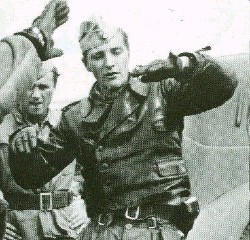 Marseille trying to explain some of his methods. On Sept. 26, he shot down his last victims, making a total of 158 confirmed air victories. He received a new Me-109 aircraft but refused to replace his faithful aircraft. His status was such that only an order by Fieldmarshal Kesselring, the supreme commander of the German forces in the southern front, convinced him three days later to use the new aircraft. The next morning, Sept. 30, 1942, he flew his 382nd combat mission, a fighter sweep over British territory. They met no enemies, and turned back towards the German lines. Marseille then had a technical problem. His new aircraft's engine cooling system failed, the engine caught fire, and his cockpit was full of smoke. Encouraged by his fellows, Marseille flew his burning new Me-109 three more minutes until he was again over German held territory. He then turned his aircraft upside down, jettisoned the canopy, and then released himself and fell outside of the burning fighter. Bailing out is not always safe, and Marseille was hit in the chest by the rudder of his Me-109 and lost consciousness, so he did not open his parachute, and fell down to the ground and died. Already highly decorated, he was posthumously awarded the highest German medal, the Knights Cross with Oak leaves, Swords, and Diamonds. Only 9 other German aces were awarded this medal. On his grave, his comrades wrote his name and rank, and added just one word: undefeated. Kills: 158 154 Fighter aircraft 4 Bomber aircraft 8 victories in 10 minutes, 17 victories in one day, 54 victories in one month. Average lethality ratio of just 15 rounds per victory. Awarded Iron Cross 2nd Class, September 1940 Awarded Iron Cross 1st Class, Fall 1940 Awarded German Cross in Gold, 24 November, 1941 Awarded Knight's Cross, 22 February, 1942 Awarded Knight's Cross with Oak Leaves, 6 June, 1942 Awarded Knight's Cross with Oak Leaves and Swords, 18 June, 1942 Awarded Italian Medaglia d' Oro al Valor Militare, 6 August, 1942 Awarded Knight's Cross with Oak Leaves, Swords, and Diamonds, 3 September, 1942 German Cross in Gold http://www.snyderstreasures.com/images/ger...manCrossFCU.jpg 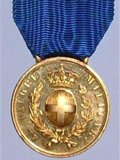 Medaglia d'Oro al Valor Militare. Leutnant - 1 July, 1941 Oberleutnant - April, 1942 Hauptmann - 3 September, 1942 Youngest Captain in the Luftwaffe.  Some stories: With the Messerschmitt's left wingtip pointed vertically toward the bluish-green bay below, the hapless Hurricane fighter stands virtually motionless in front of the young Berliner's windscreen. Through the heavy metal framed canopy of the Messerschmitt Bf-109F-4, the British Hurricane with its yellow, blue, white, and red centered cockade remains clearly recognizable against the crystal blue, cloudless North African sky. Pulling back on the stick, the G forces increase and the gut-wrenching turn tightens. The German pilot's body feels as though several hundred extra pounds have been saddled around him as the high G turn presses his body firmly into his seat. From underneath his black leather and mesh flight helmet, beads of sweat roll down the German's face, burning his eyes as they remain open and fixed on the revi-optical gun sight. 3G, 3.5G, 4G. The strain increases and the young man's arm starts to weaken and grow fatigued. Tired, numb, and aching from a mission already full of air combat, there are no distractions allowed; he mustn't let his quarry get away. A quick, cursory look inside and a firm but positive input with right rudder, Jochen, as he is known by his friends, corrects the aircraft's slight skid. Throttle full aft and maximum power, more pull on the stick and the Messerschmitt starts to gain rapidly on the brown and tan camouflaged British fighter. The Bf-109 begins to shudder under the ever increasing strain of the battle as the airspeed rapidly bleeds off from 300 knots indicated airspeed down to 140 knots. The tan colored Messerschmitt with the sky blue underside responds like the thoroughbred she is. Physics demands the Messerschmitt's nose to drop as the airspeed and corresponding lift falls away. Defying this law of nature, Jochen aggressively applies full top rudder with his heavy, fleece lined leather flying boot and the 109 now hangs precariously between stall and slow flight. A slight indication of stall warning and between 140 and 130 knots indicated airspeed, there is a large metallic clang that momentarily distracts the German pilot as the leading edge slats automatically slam into the extended position. This aeronautical feature increases wing camber and simultaneously decreases stall speed and decreases the British pilot's chances of survival. Like an artist working and molding clay to create the perfect masterpiece, the 22 year old German pilot works his aircraft as an extension of his own body. Sweat pours down his back underneath his black leather flight jacket. There is a definite cold chill in the cockpit at his altitude made even more noticeable by the cool winter sun hanging high and listless in the Libyan sky. The webbed shoulder harnesses bite into his neck and stings as the sweat creeps into the raw and irritated skin. He is suddenly aware of the additional weight of the flight helmet on his head as the crushing forces of high G maneuvering continue to take hold of his thin and nearly frail body. These minor distractions however, no longer affect the German ace. He has been here before and the only thing that now matters is another victory. 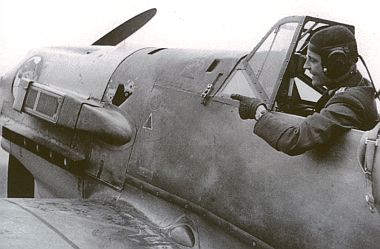 Looking over his left shoulder, the RAF pilot sees the tan Messerschmitt with white wing tips perched ominously off his left hind quarter. The white propeller spinner housing the deadly 20 mm cannon and the twin 7.9 mm machine guns on the nose slowly pulling lead and setting up for the proper firing position. Fear completely grips the British pilot for he now realizes it is no rookie pilot on his tail. Every evasive maneuver attempted has been flawlessly matched and countered by the German pilot who at the same time has been able to close the distance between the two adversaries with every turn. This is definitely an expert he is fighting today! With his fate evidently sealed, the ruddy faced Englishman, paralyzed with fear, takes a final look over his left shoulder to see the Messerschmitt approaching firing position. . . As Jochen's Messerschmitt closes in, the Hurricane begins to disappear beneath the nose of the German warbird. Young Jochen cocks his head slightly to the left and bites down on his lower lip. His large brown eyes see only the space in time where he calculates his deadly ordinance and the enemy plane will meet. It is time. FIRE!!!! The brown leather gloved index finger closes firmly around the red firing trigger and the control column shakes violently in his right hand. The cockpit immediately fills with the acrid smell of cordite as more than thirty pounds of steel per second of 7.9 mm machine gun and 20 mm cannon shells hurtle toward the Hurricane in beautiful yellow colored tracer arcs. A quick two-second burst and the German rolls his aircraft inverted and dives down and away, certain his aim was true. One thousand feet above the melee, the young Berliner's wingman watches the action in amazement, awe, and a certain amount of disbelief. As if by magical forces guiding Jochen's ammunition, the shells and the Hurricane meet in deadly unison. With perfect timing and precision accuracy, the bullets and cannon shells first strike the Hurricane's engine with fantastic, dazzling sparks, immediately rendering it a furnace of uncontrollable fire. Angry orange and red tongues of flame lap hungrily from the engine, belching sickening black and gray smoke extending more than 100 feet behind the stricken airplane. The damage, just beginning, gets worse as the shells quickly walk their way back along the fuselage to the cockpit. The destruction there is swift and complete, reducing the once proud British fighter pilot to a bloody, lifeless form inside the burning cockpit of his winged tomb. "Horrido Jochen!!", exclaims his wingman. "Hast du den aufschlag gesehen?" "Jawohl Jochen!" Within seconds, the 7500 pound Hurricane, a sheet of flaming metal, thunders vertically into the ocean near the Libyan harbor of Tobruk. As German fighter ace Hans-Joachim Marseille turns for home, a total of four, oily black spills are left fouling the otherwise beautiful ocean surface, marking the graves of four British fighter pilots that will be mourned by family and squadron members alike yet celebrated as four more victory marks on the rudder of German fighter ace Hans-Joachim Marseille, known throughout Germany as "The Star of Africa," who is to become the most successful of all German fighter pilots in the North African theater. http://www.warbirdsresourcegroup.org/LRG/hanstate.html  -------------------- C'est pas l' histoire d'un jour
Qui rime avec amour, Plutôt un long séjour Mais pas: un "pour toujours" |
|
|
|
| FeezyWeezy |
03/21/06 10:23pm
Post
#21
|
|
Major Group: Banned Posts: 609 Joined: January 14th 2006 From: Gone Member No.: 1533 |
Simo Häyhä "Valkoinen Kuolema" 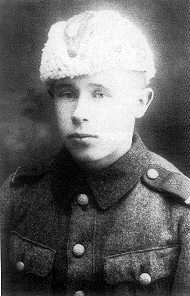 December 17, 1905 – April 1, 2002 He was born in the small town of Rautjärvi near the present-day border with Russia. His parents where Juho and Katriina Häyhä. Häyhä was a small man, only 160 cm tall. He went to a public school and even though he had the smarts for further education, he decided to become a farmer like his father. In 1925, Häyhä started his compulsory military training in the Finnish Army from which he received an honorable discharge as a corporal. As a civilian again, he was transferred into the "suojeluskunta" in his hometown. This was the Finnish equivalent of the National Guard or Militia, established for the country's protection after Finland had gained independence from Russia on Dec. 6th, 1917. Here Häyhä underwent extensive training and target shooting, and also participated in many rifle competitions. His rifle was an old Russian Mosin-Nagant bolt action in 7.62x53R, the M91. In the end of the 1920's he found himself placed fifth in a sharpshooting competition. That prompted him to start seriously practicing the art. His friends decided to see what he can do: he placed 16 shots in a small target 150 meters away in one minute. Word started to spread of the farmer boy and his phenomenal ability. In autumn 1939, as tension between Finland and the Soviet Union grew, Finnish reservists were called up for an extra period of training. This was when Häyhä was introduced to his main weapon, an originally Russian Mosin-Nagant M28. He was also an accurate shot with the Suomi K31 Submachine gun . As the Winter War began, Simo Häyhä was called upon to go to war, and he knew that he would be fighting for a good cause - to try to stop the Russians from taking his farm, hometown, and country. At the beginning of the war, the Russians mounted massive attacks. But it turned out that most of their troops were very inexperienced. Coming from different parts of the large USSR, they often spoke different languages, a fact that added to the confusion. Their attacks were mostly along roads, while the Finns were spread out in the surrounding terrain.  Häyhä was stationed in the Kollaa area north of Lake Ladoga with 34 Infantry Regiment. The winter of 1939-40 was to become a very cold one with a lot of snow and temperatures mostly between -20 to -40 Celsius. Dressed in a white snow camouflage suit, Häyhä would disappear into the snowy surroundings. Just before Christmas, on December 21st, Häyhä made a personal record by killing 25 enemies in one day. By Christmas evening 1939, Häyhä had 138 confirmed kills. Häyhä's equipment for a day in the field was his warm winter uniform, white snowsuit, large mitts, 50 to 60 rounds of ammo, rifle, knife, a few hand-grenades, and some dry food and sugar cubes. After Christmas 1939, as the number of confirmed kills started to mount, a Russian sniper killed several Finnish soldiers, among them 3 officers. Häyha was send out and hunt the sniper. So started Häyhä's first sniper duel. The Russian belonged to the Red Army's 56 Infantry Division, and was even a Communist Party member. He was equipped with a Mosin-Nagant M91 rifle with a 3x scope. Häyha prevered a scopeless riffle as that would make his small frame a advantage. A scope forced the sniper to lift his head up too much, providing a good target, and Häyhä was more than happy with his good old Spitz. The Russian sniper had made one sure kill that day, and now he was waiting for another target to show itself. The sun was setting, he was tired and rose to his knees. Häyhä, who had been waiting patiently, saw the sun reflecting in the Russian's scope lens. The distance was about 450 meters. Häyhä had been ordered to try to eliminate the Russian sniper, and he did not fail. His bullet struck the Russian in the head, killing him instantly. Häyhä could have used a scope-equipped rifle, but he liked the open sights because he was used to them and he was able to keep his head lower and present a lower profile and target. In February 1940 a Swedish businessman decided to donate to the Finnish army a special edition of the SAKO infantry rifle M/28-30, nicknamed Pystykorva, the Spitz, after the shape of its iron sight. It was to be given to the best sniper of the IV Army Corps. In a ceremony at the local military headquarters the freshly promoted Sergeant Major Häyhä, with 216 kills, was awarded the weapon. 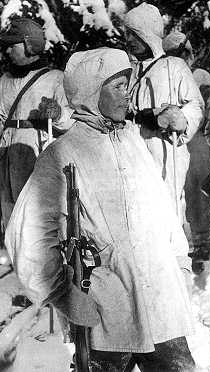 The Russians sustained heavy losses during the Winter War. The Finns often used what was called "Motti"-tactics. This meant that on certain stretches of the front they would evade the attacking Russians and let them through the lines. Then the Finns would join from opposite sides and attack the enemy from the back. In the so-called "General Motti" action in late February 1940, the Russians lost 310 officers and several thousand men. During the battles, Russian soldiers being turned around by Finnish gunfire, were seen running, incoherently screaming "Belaja smert" (= "White Death"). The war had now been drawing attention abroad, and volunteers were arriving from several countries. In early March Häyhä was assigned to a partisan unit that was to take back an important position at Ulismaajärvi from the enemy. But on March 2, 1940, the Russians started a large offensive with enormous firepower of artillery, tanks, infantry, and aircraft. It continued for several days. On March 6, by noontime, the Finns had sustained heavy losses. While covering his fleeing fellow soldiers, after 40 kills by his own count, Häyhä was shot from 20 meter square in the jaw, and lost consciousness. He was evacuated from the area by a Finnish patrol and was taken to hospital by train. Häyhä's war had ended. He woke up from a coma on March 13th, 1940, the day peace was declared. It was concluded that the bullet that struck Häyhä was explosive. Large quantities of this ammunition were later found in enemy possession. March 13th the war was over. Nobody had heard from Häyhä until a notice that Simo Häyhä had died from his injuries. One of his relatives, Aarre Häyhä, was fetching the post, when he met a friend who condolenced him over the loss. Aarre replied: "Nonsense, I just got a letter from him from the hospital. There he is, growing fat." "That can't be, I read it in the paper!" "So did Simo, that's why he wrote me. 'Call off the funeral, there's no corpse!'" In April a medal of honour was conceived, one that would be awarded to the most achieved people who had served on the front, the Kollaa Cross. The first cross was given to Marshal Carl Gustaf Emil Mannerheim, the second to President Kallio, the third to a Colonel Antero Svensson. The fourth went to Simo Häyhä. In August 28th 1940 Häyhä was, by an order of Mannerheim, promoted from Sergeant Major to Second Lieutenant in a jump unheard of before or after in Finnish military history. In 1941 he wanted to join in on the Continuation War, but his injury was deemed too serious to allow him to fight. His head count would never increase from the over 500 confirmed ones he had scored over those three winter months. Häyhä killed at least 505 Red Army soldiers by sniping them one by one.The unofficial Finnish frontline figure from the battle field of Kollaa places the number of Häyhä's sniper kills at 542. But his kill where made up by both Sniper and Submachine Gun kills, as he had over a 100 confirmed SMG kills. It's the largest count recorded in military history, and even the runner-ups with over 400 kills scored theirs over a much longer period than three months. For all intents and purposes, Simo Häyhä is the greatest sniper to have ever lived. Simo Häyhä passed away the 1st of April, 2002 in Hamina at the age of 96.  Simo Häyhä signing his book in 2000. In 1998 Häyhä wrote a book. The book "Valkoinen Kuolema" (=White Death) is a non-fiction work about one man's struggle to protect his home and country against an outside aggressor. It is also a book about self-determination and the bravery of one small nation against incredible odds. It describes a young man's road to becoming one of the major snipers of World War II. The book (ISBN 952-5170-05-5), published by Revontuli of Finland, is written in a casual, easy to read style. Unfortunately for most readers, it is written in Finnish and, unless translated, unavailable.  When being asked how he had become such a good shot, his answer was short: "Practice." About his record he has been noted to say: "I did what I was told to as well as I could."  7,62 mm Military Rifle M/28-30, "Suojeluskuntain Pystykorva" Nickname "Suojeluskuntain pystykorva" ("Spitz of Civil Guard") came from same origin as with infantry rifle M/27 of Finnish military. Shape of upwards pointing protective brackets located both sides of front sight blade reminded ears of popular Finnish dog breed. The same nickname was also used from M/28 rifle. The Finnish stand at Kollaa is often referred to as "The miracle of Kollaa," as the Finnish action here was most heroic. The Finnish forces in the region were under the command of Major General Uiluo Tuompo and they faced the 9th and 14th Soviet Armies. At one point the Finns at Kollaa were facing 12 divisions, some 160,000 men. The Red Army losses in this arena were staggering as the brave Finns took their toll on the communist invaders. There have been those that called the Finnish defense of this key region "fanatical", and it was in the Kollaa area were the famous battle of "Killer Hill" took place with 32 Finns battling 4,000 Soviet soldiers. These were the hunting grounds of Simo Häyhä and it should be noted that even against massive odds the Kollaa positions were still in Finnish hands at the end of the war (March 1940). Mattila, Häyhä's farm, ended up 1.5km on the wrong side of the border. 430 000 people in Finland were left without a home, among them Häyhä and his family. Although the Russians had gained 10% of the Finnish territory, it came at a high price. They had lost one million men in the short conflict. "We gained 22,000 square miles of territory. Just enough land to bury our dead", a Russian General later remarked. The Soviet army which invaded Finland in late 1939, massed approximately 1,500,000 troops. By the time peace was declared in March of 1940, Russia had managed to steal 22,000 square miles of Finnish territory. For it they paid an extraordinarily high price. The Soviets lost 1,000,000 of those men, killed by Finn soldiers or by the harsh winter. They also lost 1000 aircraft and 2,300 tanks. For their efforts they managed to wrest away the homes and property of some 420,000 Finnish nationals, but at a price of 40 Russian soldiers killed for every Finnish soldier killed. 25,000 Finns died as a result of this conflict with another 55,000 wounded. The message is clear. Large aggressors may win the war, but they generally lose the battle. This war cost them dearly. Hitler, seeing how "small" Finland stood up to the Russian bear, decided to invade the Soviet Union as a result of the failing of her Army. In a twist of fate, Death on a major scale was then visited upon Russia for her transgressions, and likewise on Germany for hers. http://www.mosinnagant.net/finland/simohayha.asp http://guns.connect.fi/gow/hayha.html Personal note: Häyhä is the best sniper of the second world war. Some might point to the all famous Vasili Zaitsev or Major König. Häyha made over 500 kills during 3 winter months, while Zaitsev took out killed 225 soldiers and officers of the Wehrmacht and other Axis armies, including 11 snipers. The duel between Zaitsev and Major Heinz Thorvald Major is depicted in the fictionalized film Enemy at the Gates. There is a substancial chance that the duel was pure propaganda. Some sources claim that Zaitsev's performance was not unique and that an unknown Soviet soldier, identified only as Zikan, also killed 224 German soldiers by 20 November. http://notesofasniper.com/ Book about Zaitsev. There is alot of rumors and myths around Mr. Zaitsev and the fact that Häyhä used a non-scoped M/28-30, made over 500 kills in 3 months and stayed so shy after this all... makes him a true hero. The best sniper that ever walked earths soil. If there are any flaws in the text that I have to be credited personaly. The complete piece is a gathering of a total of 6 pieces. Parts have been totaly retypt and parts can be wrong. - FeezyWeezy, 22 march, 2006, 04:00 -------------------- C'est pas l' histoire d'un jour
Qui rime avec amour, Plutôt un long séjour Mais pas: un "pour toujours" |
|
|
|
| UNDEAD 1 |
03/22/06 7:45pm
Post
#22
|
|
Major General Group: {MOB} Posts: 2753 Joined: January 17th 2006 Member No.: 1540 Xfire: UNDEADJAMES |
WHOS NEXT? im addicted now! how about a german sniper.
-------------------- |
|
|
|
| Spartan |
03/22/06 10:29pm
Post
#23
|
 Major Group: Forum Member Posts: 668 Joined: January 19th 2006 From: Miami, Florida Member No.: 1545 Xfire: Cknife187 |
Theres little I can Say for those german Snipers
Matthias Hetzenauer was a German sniper during World War II who allegedly shot 345 enemy soldiers, mostly Russian. He served in the same 3rd mountain (Gebirgsjager) division as Josef "Sepp" Allerberger who is recognized as the second most prolific German WW II sniper with 257 kills. Due to the strict rules of accountability in the Wehrmacht and the fact that some time in 1944 German snipers had to start their tally over again at zero due to administrative reasons from higher up, their actual number of kills were considerably higher - most likely as high as double their listed score. Feezy Can find this guys picture since i couldnt --------------------  "Wars come and go, But my soldiers they stay eternal" - Tupac Shakur  |
|
|
|
| Stickman |
03/22/06 10:48pm
Post
#24
|
 First Lieutenant Group: Forum Member Posts: 115 Joined: October 9th 2005 Member No.: 1374 |
I have read that the in the German air force in both world wars, individual pilots were celebrated much more than in the allied air forces. The allies were more "team oriented". As glory was heaped upon german aces, german tactics often were based on the squadron providing backup for one or two leading aces, allowing them to boost their scores.
Also, German standards for confirming kills were less strict on the German side. With the pilots getting decorations for racking up high kill numbers, and the great propaganda value of such kill scores, it was to nobodies advantage to question kill claims too closely. This is why the top german pilots numbers of kills are so much higher than the top scores of aces of other nations. Comments, Feezy? Or anyone else? --------------------  |
|
|
|
| FeezyWeezy |
03/22/06 10:52pm
Post
#25
|
|
Major Group: Banned Posts: 609 Joined: January 14th 2006 From: Gone Member No.: 1533 |
Its time for a group of people which are related to MY nickname: Fuzzy Wuzzy is how I name my love. She calls me Feezy Weezy in return.
Fuzzy Wuzzy Fuzzy Wuzzy Angels 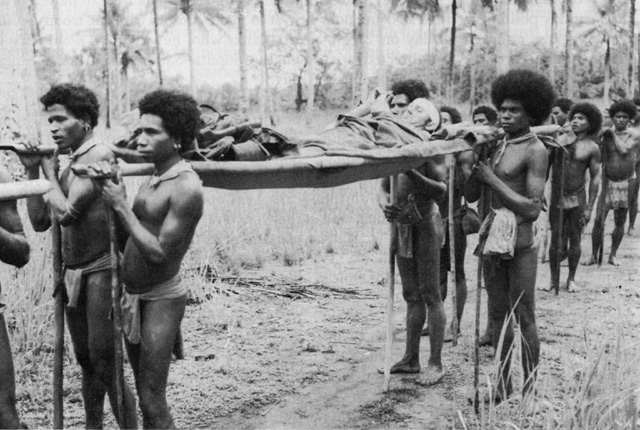 The Fuzzy Wuzzy Angels are a group of Papua New Guinean people who, during World War II, assisted and escorted injured Australian troops down the Kokoda trail. The term Fuzzy Wuzzy had come into use during the eighteenth century and referred to the frizzy hair of the Papuans. In the year 1942, during the Pacific invasion, the Japanese had built up a force of 13,500 in the Gona region of Papua with the intention of invading Port Moresby, they would use this as a front to invade Australia. The key to the offensive was an overland track across the Owen Stanley Ranges. The track ranged from the small village of Buna on the north coast of Papua and went up the slopes through Gorari and Oivi to Kokoda. The track was approximately 100 miles long, folded into a series of ridges, rising higher and to 7,000 feet and then declining again to 3,000 feet. It was covered in thick jungle, short trees and tall trees tangled with vines. On the 29th of August, the Japanese task force broke through the Australian line forcing them to retreat further back to Templeton's Crossing. Eventually, they were forced to retreat to the shipping port of Myola. The native people to Papua New Guinea were blissfully unaware of the Pacific war around them until it reached their own homes. They had lived a traditional life, with only occasional contact with Australian patrol officers. The Australians soon occupied these villages. As the fighting came closer, most villagers "went bush" to camps away from the main tracks. While they were away, Australian and Japanese troops wrecked many huts and, when villages were occupied by the Japanese, Allied aircraft bombed and strafed them. Hungry soldiers raided the village crops and shot their pigs. With villages wrecked by the two armies, and dead often lying in the vicinity, the villages were no longer habitable and were not reoccupied after the battle. New villages had to be constructed nearby. 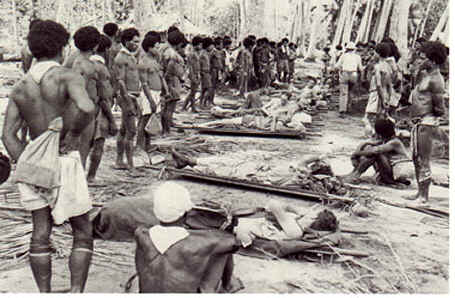 A group of natives called the Fuzzy Wuzzy Angels carried injured Australian soldiers to ADS (Advanced dressing Stations) and often escorted them to military hospitals. They often used fabric sheets stretched over bamboo poles to carry them to safety. Eight natives were assigned to a stretcher and escorted the injured to safety, often under heavy Japanese gunfire. 600 Australian lives were lost in the campaign. This would have been much larger had it not be for the help of the Fuzzy Wuzzy Angels. As one Australian digger has noted: "They carried stretchers over seemingly impassable barriers, with the patient reasonably comfortable. The care they give to the patient is magnificent. If night finds the stretcher still on the track, they will find a level spot and build a shelter over the patient. They will make him as comfortable as possible fetch him water and feed him if food is available, regardless of their own needs. They sleep four each side of the stretcher and if the patient moves or requires any attention during the night, this is given instantly. These were the deeds of the "Fuzzy Wuzzy Angels"-for us! " No known injured soldier that was still alive was ever abandoned by the Fuzzy Wuzzy Angels. Even during heavy combat.  After the battle for Kokoda ended, many villagers continued working for the Allies, carrying supplies and building tracks, bridges and huts. Others joined the Papuan Infantry Battalion or the New Guinea Infantry Battalion. Gradually life returned to normal after the war but the friendship between the people of Australia and Papua New Guinea has continued to this day.  There is a famous poem by Sapper Bert Beros which illustrates the heroism shown by the Fuzzy Wuzzy Angels: Fuzzy Wuzzy Angels Many a mother in Australia when the busy day is done Sends a prayer to the Almighty for the keeping of her son Asking that an angel guide him and bring him safely back Now we see those prayers are answered on the Owen Stanley Track For they haven't any halos only holes slashed in their ears And their faces worked by tattoos with scratch pins in their hair Bringing back the badly wounded just as steady as a horse Using leaves to keep the rain off and as gentle as a nurse Slow and careful in the bad places on the awful mountain track The look upon their faces would make you think Christ was black Not a move to hurt the wounded as they treat him like a saint It's a picture worth recording that an artist's yet to paint Many a lad will see his mother and husbands see their wives Just because the fuzzy wuzzy carried them to save their lives From mortar bombs and machine gun fire or chance surprise attacks To the safety and the care of doctors at the bottom of the track May the mothers of Australia when they offer up a prayer Mention those impromptu angels with their fuzzy wuzzy hair. NOW SOMETHING TOTALY DIFRENT Fuzzy Wuzzy was a bear Fuzzy Wuzzy had no hair Fuzzy Wuzzy wasn't fuzzy, was he? This Childrens rhyme has nothign to do with the Fuzzy Wuzzy Angels. The Beja people were one of two broad multi-tribal groupings supporting the Mahdi, and were divided into three tribes. One of these, the Hadendoa, was nomadic along Sudan's Red Sea coast and provided a large number of cavalry and mounted infantry(called jehadiya). They carried breech-loaded rifles, and many of them had acquired military experience in the Egyptian army.   People from the Beja Tribe. The name "Fuzzy Wuzzy" may be purely English in origin, or it may incorporate some sort of Arabic pun (possibly based on ghazi, "warrior"). It alludes to their butter-matted hair which gave them a "frizzy" look. This represents a rather weak attempt at humor on the part of British imperial troops, which had learned to respect the Hadendoa on the battlefield. Few today are aware of the nineteenth-century Sudanese origins of this familiar nursery rhyme. The first line, "...was a bear" translates roughly as "The Hadendoa warriors gave us (British) a great deal of trouble." The second line is odd as the "Fuzzy Wuzzy" were in fact well-known for their full heads of wooly hair The Fuzzy Wuzzy Fallacy is a name for a wargaming theory coined by Richard Hamblen in the September 1976 of the Avalon Hill General wargaming magazine, loosely based on historical records of battles between the British and the Sudanese Mahdi. The Fuzzy Wuzzy Fallacy states that a single soldier with 2× firepower or attack strength does not equal to two soldiers with 1× firepower or attack strength. Instead, the soldier with 2× firepower actually worth root 2 of the 1× soldier, if either soldier can be killed in a single hit. As a result, tactics and strategy designed around this theory emphasize greater numbers and time, which the speed and mobility of the units in action can effect.  My Fuzzy Wuzzy This post has been edited by FeezyWeezy: 03/22/06 10:53pm -------------------- C'est pas l' histoire d'un jour
Qui rime avec amour, Plutôt un long séjour Mais pas: un "pour toujours" |
|
|
|
| FeezyWeezy |
03/22/06 11:17pm
Post
#26
|
|
Major Group: Banned Posts: 609 Joined: January 14th 2006 From: Gone Member No.: 1533 |
QUOTE(Stickman @ 03/23/06 4:48am)  I have read that the in the German air force in both world wars, individual pilots were celebrated much more than in the allied air forces. The allies were more "team oriented". As glory was heaped upon german aces, german tactics often were based on the squadron providing backup for one or two leading aces, allowing them to boost their scores. Also, German standards for confirming kills were less strict on the German side. With the pilots getting decorations for racking up high kill numbers, and the great propaganda value of such kill scores, it was to nobodies advantage to question kill claims too closely. This is why the top german pilots numbers of kills are so much higher than the top scores of aces of other nations. Comments, Feezy? Or anyone else? Allied tactics where mainly focused towards bombing strategic areas and protect the bombers with fighter. After '42 germany was mainly focused on repeling the bombers, and german fighters where send in in small amounts at a time, breaking up formations and making kills. If you look at the amount of allied fighters, you'll see that the list is HUGE, loads of 5 till 20 kill aces. Axis pilots to my opinion where better trained. The confirmed kills are AIR TO AIR only, and allies mainly picked off planes when they where on the ground. I will have to do some aditional research on the victory calculation. -------------------- C'est pas l' histoire d'un jour
Qui rime avec amour, Plutôt un long séjour Mais pas: un "pour toujours" |
|
|
|
| FeezyWeezy |
03/25/06 4:29pm
Post
#27
|
|
Major Group: Banned Posts: 609 Joined: January 14th 2006 From: Gone Member No.: 1533 |
Operation Windsor, Carpiquet Aerodrome.
Battle for Carpiquet Airfield Painted in 1946 by Orville Fisher (1911–1999)  The 7th Canadian Infantry Brigade at Carpiquet airfield on July 4, 1944. Orville Fisher, an official war artist serving in the Canadian Army, used the image of a destroyed, but still standing, aircraft hangar to symbolize this determined, but ultimately unsuccessful, effort. http://archives.cbc.ca/IDC-1-71-221-1119-1..._war/carpiquet/ A CBC Radio Broadcast about Carpiquet http://aerostories.free.fr/events/torture/carpiquet.JPG A Airial Photo of Carpiquet Aerodrome http://www.canadianbattleofnormandyfoundat...es/authie-1.jpg Monument at the Carpiquet airfield http://www.caen.aeroport.fr/ Official site of Modern Caen-Carpiquet Operation Windsor was launched on July 4th, 1944 and it became known to the Canadians that fought in it as the Battle of Carpiquet. Major-General Rod Keller's 3d Division was given a simple enough task: capture Carpiquet airport. It was held by only 150 boys from Kurt Meyer's 12th SS, but the Canadians had no illusions. Operation Windsor would demand four battalions - Brigadier Ken Blackader's 8th Brigade plus the Royal Winnipeg Rifles for a separate attack on the south side of the field. Tanks of the Fort Garry Horse, engineer assault vehicles, a flame-throwing Crocodile tank and all the artillery the division could muster would back the attack. In the event, it seemed little enough. At dawn, the Canadians rose, crossed the start line and walked into fields of waist-high wheat. Suddenly, their rolling artillery barrage seemed to stop forward. Some Canadians never lived to learn that the Germans had dumped their shells on the Canadian barrage line; they probably died thinking they were killed by their own side. The rest kept going, pausing only to mark the bodies of dead and wounded with a symbol hat soon sprouted quickly on the field - a bayoneted rifle jabbed into the dirt. At Carpiquet village, survivors from the North Shores and the Chaudieres waged pitiless warfare in the ruins. For the North Shores, it was the bloodiest day of the campaign: 132 casualties, 46 of them dead. "That first night alone," the padre of the North Shores wrote, "we buried 40 of our boys. You could fancy the wheat field had once been just like any wheat field back home. Now it was torn with shell holes and everywhere you could see the pale upturned faces of the dead." On the opposite side of Carpiquet airfield, the Royal Winnipeg Rifles fared even worse. For them, there was no cover at all. Pillboxes and concrete bunkers, built long before by the Luftwaffe, allowed the Germans to sweep the approaches. Guns and tanks blasted the attackers and when Captain Alec Christian of the Fort Garry Horse brought his squadron forward, half of his tanks were destroyed. At dusk, the remnants of the battalion were ordered back. At Carpiquet, a village on the outskirts of Caen, France, the 3rd Canadian Division, under Major-General Rod Keller, is engaged in the drive to the first major objective of the Allied invasion of Normandy.The target today is an airport defended by a small but formidable force: 150 soldiers from the 12th SS Panzer Division, commanded by Brigadeführer Kurt Meyer. The force assembled for Operation WINDSOR includes battalions from the North Shore Regiment, the Régiment de la Chaudière, the Queen's Own Rifles of Canada and the Royal Winnipeg Rifles, plus The Fort Garry Horse mounted in Sherman tanks, military engineers with assault vehicles, a flame-throwing Crocodile tank, and all the artillery the division can muster.The North Shores, the Chaudières and the Queen's Own will secure the village. The Royal Winnipeg Rifles and The Fort Garry Horse will attack from the south and take the airfield itself. The infantry will advance under the protection of a rolling artillery barrage. The operation begins at dawn and continues all day and all night. When the Germany artillery scores a direct hit on the Canadian barrage line, the infantry keep going without covering fire. The North Shores, Chaudières and Queen's Own fight a vicious battle in the ruins of Carpiquet. For the North Shore Regiment, with 132 casualties including 46 dead, it is the bloodiest day of the entire Normandy campaign. The Royal Winnipeg Rifles, under Lieutenant- Colonel J. M. Meldram, make two full-scale attacks across flat, open country, driven back both times by the constant fire from the pillboxes and concrete bunkers built by the Luftwaffe to defend the airfield. When Captain Alec Christian of The Fort Garry Horse brings his squadron forward to help, half his tanks are destroyed. After a dreadful night of German bombardment and counterattacks, the Canadians in Carpiquet find themselves more or less victorious-at a price: of the 2000 men engaged in the battle, 371 are casualties, including more than 100 dead.  Photos such as this one would have been used during the planning stages of the operation. Notice the significant amount of bomb damage visible in this photo. 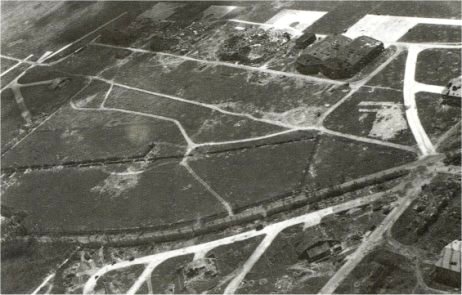 Operation Windsor to seize Carpiquet airfield - is very interesting; the Canadians committed a very reinforced brigade, complete with battleship support, to seize a small area held by only 150 Germans. Amazingly, the Canadians failed to seize the entire airfield and suffered 4-1 casualties. It took 5 days to take Carpiquet Aerodome. The 3rd Canadian Division suffered massive loses.  church of Saint-Martin, Carpiquet A piece from CanHistory about Normandy. A little over a mile to the east of Caen on the main highway connecting Caen with Bayeux the village of Carpiquet sits astride ground several metres higher than the surrounding countryside. Below it to the south was the plain on which the Carpiquet airfield is located. We drove through the village which showed not a trace of the almost total destruction that made it as deadly a killing ground as any other acre of ground in the beachhead or elsewhere in the war. We lingered for only a few minutes since there was nothing Alex could point out to me that would help in describing the fierce fighting that swirled in and around the village. We rode around the west perimeter of the airfield to the administration buildings at the east end. The area around these buildings had been the Queen's Own Rifles' objective, while the hangars at the south end were the focal point of the Royal Winnipeg Rifles attention. It was the Chaudieres job to take out the hangars at the north end close to the village limits. Battlefield intelligence, as it so often happened, was faulty or inadequate in Normandy. The Regiments of 8th Brigade were to soon find this out as they prepared to mount a concerted attack against enemy positions scattered all over the airfield. As Alex mentioned, they were told not to expect too much opposition because there was supposed to be little out there in the naked field that would hold them up. How wrong! How bloody wrong! There was a hell of a lot more out there in the open space of the airfield, and in and around the hangars and control buildings than what our Intelligence people picked up from interrogating prisoners. There had to be at least two dozen hull-down tanks with their powerful 88mm guns covering every square foot of the ground over which the forth-coming attack had to traverse. There were also a few towed 88s and 75s in position around the hangars. As for manpower, here again were the 12th S.S. Hitler Youth manning the tanks, the big guns, the MG nests and the hundreds of individual rifle positions. Also, there was a huge concrete bunker directly behind the control buildings that could shelter an entire company under even the heaviest bombing delivered by our Lancasters. Not too much to worry about? Like hell, there wasn't! 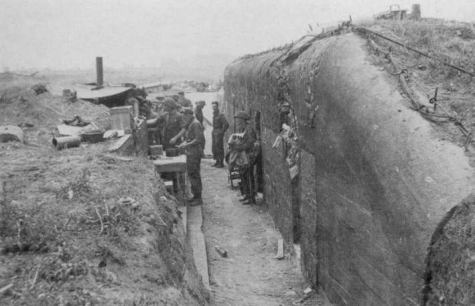 Canadian "Royal Winnipeg Rifles" at a Carpiquet Bunker. For the better of a week 8th Brigade fought the battle of its life at Carpi-quet airfield. It was only after Caen was taken that resistance slackened and the airfield finally taken on July 9th after a stiff artillery bombardment and a combined assault by tanks of the Fort Garry Horse and two companies of the Queen's Own. Alex was amongst those in that intrepid group that crossed the naked airfield under heavy fire to wrest it from the tenacious enemy.  Allied soldier with German HY Prisoner  12.SS-Panzer-Division Logo  In 1943 the 12 SS Hitlerjugend Panzer Division was formed. Mainly from boys born in 1926 who'd been in the Hitlerjugend previously. The division trained in Belgium more specifically in Beverloo. Many NCOs and Officers from the 1 SS Leibstandarte Adolf Hitler (LAH), they were combat veterans with knowledge in successful tactics and training. The training was hard for the teenagers, the LAH NCOs didn't know how to properly train younger soldiers and often pushed them past their limits. However in doing this the 12th SS became one of the hardest units in the German forces. 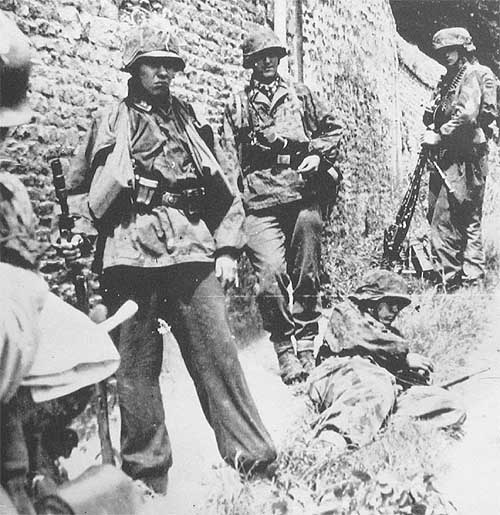 http://www.servicepub.com/pictures.htm On 6 June 1944, the Western Allies launched Operation Overlord, the invasion of Normandy. The HJ, along with the 21.Panzer-Division, was the closest armoured unit to the landing beaches. Due to Hitler's authorisation being required to release the panzer units, the HJ was not ordered to the front until 1430 on 6 June. The division's advance to the areas near Sword and Juno Beaches was severely hampered by incessant allied Jabo (fighter-bomber) attacks. Forward elements of the HJ finally reached their assembly area near Evrecy at 2200 on 6 June. On 7 June, SS-Standartenführer Kurt Meyer's ("Panzermeyer") SS-Panzergrenadier-Regiment 25, along with the II./Abteilung from SS-Obersturmbannfuhrer Max Wunsche's SS-Panzer-Regiment 12, were supported by artillery and ordered to crush advancing Canadian infantry and armour and drive through to the coast, still only a few miles away. In Meyers words they were to "throw the little fish into the sea". Although they destroyed many Canadian tanks and overran a company of the North Nova Scotia Highlanders in Authie, the attack failed to break through the advancing Canadians. Meyer had relied on the shock value of the rapid attacks that had served his units so well on the Eastern front but here in Normandy, as both sides were to discover, effective scouting was a key element to an attack. The 25 Regiment had been forced to launch their attack into the flank of the Canadian advance a full hour before Meyer initially planned to strike. Without support from other units on his own flanks and no reconnaissance information with which to plan his attack it was initially very successful but rapidly lost its momentum. The North Novas in Authie bought time for the other companies of their regiment to establish defensive positions. The Sherbrooke Fusiliers lost over 25 Sherman tanks to the Panzer IV tanks and anti tank guns of 12th SS in the opening minutes of the counterattack. The 12 SS managed to push the portion of the Canadian spearhead they attacked back two miles but the remaining North Nova Scotia Highlanders, without artillery support or any armour halted the 25th regiment and established a firm defence. According to accounts from Canadian prisoners who survived the events, the youth of the Hitler Jugend were frustrated and mad with rage and there were numerous incidences of North Nova prisoners being shot, bludgeoned to death and even run over with a truck while they were being marched along a road. Battle casualties for the day on both sides were virtually even. Both forces suffered approximately 80 killed and around 175 wounded or captured. It was a hard and bloody fight to a draw. Meyer set up his command post in the Abbey Ardennes, whose towers provided an excellent view of the countryside. In the early evening of June 7th, as he planned the regiment's next moves, a further 18 Canadians were interrogated and then executed on the grounds of Abbey. In all over 100 Canadians from several regiments are documented as having been killed after surrendering to the 12SS. Meyer's regiment was deployed near the villages of Authie and Buron, in positions covering the vital Carpiquet Aerodrome. Forced to stay in place to contain the North Nova's brigade they were unavailable the next day to support the 26th Regiment in its attacks. They would remain on the same ground until driven off in vicious hand to hand fighting with the Highland Light Infantry of Canada on July 8th. On 8 June, SS-Panzergrenadier-Regiment 26 under command of SS-Obersturmbannfuhrer Wilhelm Mohnke arrived on the battlefield. Meyers attack had pushed back one part of the Canadian advance but another brigade had occupied a group of small villages two miles into the German line. They crossed behind Meyer's regiment and the 26th took up positions to their west. After planning and positioning the regiment for a powerful thrust the 26th launched an attack towards Norrey-en-Bessin. Their orders were to drive over the Canadians and force a deep wedge between them and the British division to the west. Again, no reconnaissance of the Canadian positions was done and this time the youth of the 12th SS infantry would wade into a maelstrom of defensive fire from firmly established defensive positions. The attack, launched at 0330 hours some 8 hours after Meyer's battle ended, had little initial success. The various companies in the attacking 12th SS failed to co-ordinate their moves towards the Canadians and despite heavy casualties during repeated attempts by the infantry, Canadian artillery and supporting heavy machine guns of the Cameron Highlanders of Ottawa took a heavy toll of each attacking company of SS troops. On the Canadian left where fighting initially began, extremely brave actions on the part of the German infantry managed to push the Winnipeg Rifles out of Norrey in vicious fighting but the attack stalled when the successes could not be followed up. On the Canadian right, over 1,000 12 SS attacked the 250 Canadian troops defending their village areas just as the fight around Norrey was ending. Able to switch defensive fire onto the new threat, artillery, tank and heavy machine gun fire broke up the attacks and killing and wounding many infantry of 12 SS and destroying 8 Panthers of Wunche's supporting panzer company. In some cases the attacking companies broke off their attacks but others pressed in despite casualties only to be forced back by intense small arms fire from the Canadian infantry. When Monke's bloodied companies were withdrawn from their attacks on the other villages near Norrey, the Canadians were sitting in a firm position well within the critical area near Caen and the Carpiquet airfield. Again both sides had suffered serious losses. Again many Canadian prisoners were executed after their surrender. The SS-Aufklärungs-Abteilung 12(reconnaissance battalion) under SS-Sturmbannführer Gerhard Bremer participated in the attacks on June 8th and they were responsible for the after the battle killing of over a dozen Canadian troops. Bremer himself is reported to have been directly involved. The 2nd Battalion of the Monke's 26th Regiment murdered a further 20 some odd men, most from the Winnipeg Rifles in Norrey. Before their capture the men who defended Norrey had inflicted numerous casualties on the 2nd Battalion but the bodies of the murdered Canadians were found well away from the village. Following the battle SS-Aufklärungs-Abteilung 12 deployed to the west of Mohnke's regiment, and by the evening of 8 June the division, having failed in its assignment to drive the Canadians into the sea, they had effectively halted the units of the 3rd Canadian Infantry Division in the Allied advance on Caen. These Canadian units were the only ones in the entire D-Day effort that managed to reach their assigned objectives. Despite the ferocity and local successes of the 12th SS counterattacks, the Division failed to fulfil its orders to throw the attacking allies back into the sea. Once British troops had moved up to the positions now firmly held by the troops of the 3rd Canadian Infantry Division that faced the 12th SS, the British dug in and established a firm line of defence from which they could launch future attacks. The allies were firmly on the continent to stay. The panzer army that contained the 12SS and the 21st Army Group they opposed, settled into a bitter series of battles that would finally lead to the liberation of Normandy -------------------- C'est pas l' histoire d'un jour
Qui rime avec amour, Plutôt un long séjour Mais pas: un "pour toujours" |
|
|
|
| UNDEAD 1 |
03/25/06 5:46pm
Post
#28
|
|
Major General Group: {MOB} Posts: 2753 Joined: January 17th 2006 Member No.: 1540 Xfire: UNDEADJAMES |
HOW COME THERES NOT A MAP FOR THIS BATTLE! do you work for the history channel? hehe.
-------------------- |
|
|
|
| FeezyWeezy |
03/25/06 6:04pm
Post
#29
|
|
Major Group: Banned Posts: 609 Joined: January 14th 2006 From: Gone Member No.: 1533 |
Well maybe Bob and I can make a map about this one day
 I'd love to I'd love toI don't work for history channel. I don't know if I would like to either. "War does not determine who is right - only who is left." - Bertrand Russell "In war, there are no unwounded soldiers." - Jose Narosky War isnt fun, talking about it isnt great. Forget about War, Enjoy peace aslong it lasts. -------------------- C'est pas l' histoire d'un jour
Qui rime avec amour, Plutôt un long séjour Mais pas: un "pour toujours" |
|
|
|
| FeezyWeezy |
03/26/06 6:45am
Post
#30
|
|
Major Group: Banned Posts: 609 Joined: January 14th 2006 From: Gone Member No.: 1533 |
QUOTE(Stickman @ 03/23/06 5:48am) I have read that the in the German air force in both world wars, individual pilots were celebrated much more than in the allied air forces. The allies were more "team oriented". As glory was heaped upon german aces, german tactics often were based on the squadron providing backup for one or two leading aces, allowing them to boost their scores. Also, German standards for confirming kills were less strict on the German side. With the pilots getting decorations for racking up high kill numbers, and the great propaganda value of such kill scores, it was to nobodies advantage to question kill claims too closely. This is why the top german pilots numbers of kills are so much higher than the top scores of aces of other nations. Comments, Feezy? Or anyone else? Many publications of past times openly disputed the many 100-plus victories claimed by Luftwaffe aces. Since Britain's James "Johnnie" Johnson had scored but 38 victories during the war on the Western Front along with American Richard Bong's 40 in the Pacific, Erich Hartmann's 352 was thought to be Nazi propaganda. It was reasoned early on that the 100-plus scores included damaged and probables given by a liberal system. Some even went so far as to say that the numbers were points awarded by some Luftwaffe scoring system. It is puzzling that no one in the 1950s-60s was casting doubt on Japan's aces' scores. Saburo Sakai's 64 and Hiroyoshi Nishizawa's 103 were never questioned. Sakai's book about his combat experiences, Samurai, vividly depicted most of these kills from his war time flight logs. It was reasoned that since aces that survived many years of the war against a numerically superior enemy would have ample opportunity to score. Japan's pilots never rotated out of combat except for brief relaxation periods or hospital stays for wounds received. Of course there were figures claiming that the top 35 Luftwaffe scorers had amassed 6,848 kills where the Japanese aces seem modest by comparison. Partly due to the flammability of Japanese planes, not many aces survived to score more. Allied pilots almost to a man were taken out of combat and posted to flight schools or given organizational duties after a certain number of missions were flown. Guys like Bong did fudge at times while on training flights in battle areas to shoot down aircraft that "threatened the flight." If he'd been sent to non-combatant areas to train men he would have scored less, of course. The Japanese and German pilots had no such luxury. Both systems in place in the 1930s aimed at producing a few excellent pilots. By contrast Allied thinking was to produce a lot of very good pilots and give them very good or excellent equipment. By rate of attrition the latter theory would triumph as more men were fed into the training systems. Japan and Germany seemed to count on a finite number of individuals with long, rigorous training bounded by very high goals. So we know what worked to win the war. On the other hand, these very circumstances allowed skilled aces to excel in scoring. Most of the high scorers flew and fought for several years. Sakai's score was cut short when in mid-1942 he was severely wounded. He had over two years of recuperation. In Germany it was the same. Pilots were needed for as long as the war would last. During WWI Germany's von Richtofen's 80 victories were not later questioned nor were Britain's Billy Bishop's 72. There were far fewer planes in the air at any time since far fewer even existed. Perhaps the ratio between the top scorers on each side was not relatively lopsided. At any rate the opportunity to encounter enemy aircraft was much lower than WWII. In WWI a rigorous two-part claim system dictated that the enemy aircraft be found on the ground after destruction and that the kill be witnessed by air or ground personnel. Obviously when ships crashed behind enemy lines confirmation was impossible. During the first three-fourths of the war the Germans were favored by the geography of things. By WWII a witness was still absolutely required for a claim to be awarded. German gun cameras were not widespread. As we skip back to WWII we note that most Allied pilots flew 100-150 missions generally before being rotated to non-combatant duties. Dick Bong scored his 40 during 146 missions over 400 hours. Thunderbolt ace, Bob Johnson, tallied 28 after just 91 missions. German pilots by luck and skill survived many more missions forced by the necessity of their country's survival attempt. American bomber crews were relegated to 25 missions for their tours before going home. The average plane and crew lasted just 15 missions before being shot down so the odds weren't with them. But a growing number did make their 25 after long-range fighter escort became common. Germany was fighting on two fronts early on. In the West several pilots excelled in the African desert against British and American enemies. A stand-out was Hans Marseille with 158 victories (151 NA- NorthArfica/7 in Battle of Britain WF- Western front) scored in 382 missions. But since we cannot determine on how many of these missions he or any pilot actually met enemy aircraft we must draw ratios from total missions flown and total victories produced. Before he struck the tail bailing out of his Bf 109G and died in September 1942 he'd been fighting for just two years. When the African campaign closed Marseille's group JG 27 went to the Eastern Front. It stands to reason that he could have doubled the number there if he'd survived. The point is that many did survive. Now we must confront the meat of the large claims. This was the state of affairs on the Russian Front itself. Most aces that ended up there had begun their scoring in the Battle of Britain, like Marseille, with a few even commencing in the Spanish Civil War. When the Luftwaffe entered the area it was easy pickings. This statement is not meant to diminish any ace's score. Many American aces in Europe figured their counterparts in the Pacific had it easier with so many flammable Japanese planes to shoot at. Too many variables make serious comparison valid. But when German fighters and bombers opened up operations the Red Air Force was a sorry outfit. The quality of pilots and equipment was deplorable. Early Soviet aircraft were outdated, poorly armed and armored and had dubious maneuverability. Couple this with unskilled pilots and we have a formula for disaster. The formula was a windfall for Luftwaffe pilots however. Their onslaught resulted in escalating kill totals for pilots that were just "good" much less excellent. This was a target rich environment at first until the Red planes' ranks were decimated. While things did not go as well in the long term on the ground the Luftwaffe rarely failed to stay ahead in the aerial kill-to-loss ratios. Stalin drew in his manufacturing facilities as a squid retracts its wounded tentacles. East of the Ural mountains plants were set up to manufacture weapons for the Soviet forces, which were out of range of Luftwaffe bombers. With a full-bore effort to modernize the Russian aircraft types better planes soon debuted to blunt the German war lance. Were they superior to Bf 109s and FW 190s? This opens an endless debate. Certainly they were produced in vast numbers as the Americans did their planes. Both the USA and USSR had immense natural resources within their national borders and exploited the fact. LaGGs, Yaks, Ilyushins and MiGs were assembled like so many Big Macs at the lunch rush. They swarmed en masse at the fronts to counter the Luftwaffe. But the elements of the big picture were still favoring the German ace. Relative to the time line of the war, the German aces were at the zenith of their strength. They enjoyed sufficient serviceable aircraft and spare parts and possessed the crucial ingredient—experience. It is quite detached to sit over half century hence and state that Luftwaffe aces rapidly escalated their scores. They did, but the intricate details of battles, living conditions and service of planes in the harsh conditions must be recognized. It was not a flight sim experience of safely knocking down several Russian planes a day. Much fighting was over and behind moving battle lines that dictated a sad end if a plane made a forced landing or a bail out was needed. The danger was present from the large numbers of Red fighters and the constant threat of anonymous ground fire. As stated earlier, the typical American pilot was in a combat arena for usually about a year to make his tour. Missions were long and not scheduled every day so the opportunity to encounter enemies to shoot at were reduced. The defenders, on the other hand, had short defensive missions and often flew several sorties a day for years. In Russia even the offensive missions were of short duration due to the forward location of most combatant airfields in relation to the ground action. So, again, multiple missions could be flown in the span of a day. We can conclude that the Luftwaffe had their cake and ate it too with the best circumstances of encountering targets no matter how the war was going in the East or West. So we are left with the math. How many kills did a pilot achieve versus the number of missions flown? This does not take into account any marksmanship or rounds expended per kill as most of this is unknown save for rare cases. We can develop a kill ratio by this method keeping in mind the wild card factor of missions flown where no contact was made. This is regrettable but necessary since those figures do not exist. Certain pilots probably have better KRs, Kill Ratios, than stated but we'll never know. The premier ace Erich Hartmann accumulated 352 kills (K), over a staggering 1,425 missions (M), and made his combat debut (CD) in October 1942 producing a kill ratio (KR) of 4.05. All victories were Eastern Front (EF). Note that any ratio less that Hartmann's 4.05 is better. We divide the number of missions flown by the number of kills credited for our kill ratio. Hartmann got a kill on average every four missions. That's our formula. Click here or on the image below to open a table showing how some top, well-known Luftwaffe pilots rank: The total number of victories does not mean the KR was high. Many were actually better than Hartmann. He excelled due to high number of missions flown. Others with the best KRs had fewer kills and missions flown but scored better in the ratio. Here are the best showing kills and kill ratios only: Relative to kill ratio, Marseille at 2.42 KR ranks 17th and Hartmann at 4.05 KR is only 70th with Galland at 4.09 KR being 72nd. Only a handful of fighter pilots flew 1,000 or more sorties. Hartmann's 1,425 is the highest found recorded. It seems to correlate that more missions equals more total kills with all else on a par. The best baseball players play in more games and have more at-bats to amass high totals. By the same token, other players hit the ball in a higher ratio to times at bat but have played in less games so totals are lower. So it was in the Luftwaffe during World War II. The few superb could not make up for the many average that were rushed through pilot training in Japan and Germany later on. Starting off the war with a "few good men" system never allowed them to balance things out. The few that excelled were highly talented and lucky either by surviving or being immersed in target rich arenas of combat. The reader can be the judge of whether all these claims are valid. Over 200 aces claim 60 or more. We know that confirmation is not always 100 percent. All nation's pilots have over estimated kills in heated battles. Some "probables" land and fly again. Some "damaged" crash and burn. The area where most of these victories occurred is Russia and numbers have never been honestly established nor have simple production figures for all aircraft come forth. It is natural that the closed society of Russia in WWII would not publish that they lost so many planes on such and such dates all the while boasting of high production amounts. Basically by not saying much they are actually saying, "we built a lot of planes but didn't lose that many." Official Soviet figures state that over 36,000 IL-2s alone were built. Published figures for Yak, LaGG and others planes would make at least 100,000. Then with all the rest of the types we know of, a great many more aircraft were constructed. Is over 6,000 kills possible amongst the top 35 Luftwaffe aces against the Red Air Force? Absolutely. This was the method of counting kills: A kill divides by a number of pilots, and each pilot gets a part of a kill (0.25 , 0.33 , 0.5 and so on). And, of course, no-fractional figures are for individual kills. Or: Any kill (individual or shared) counts as individual. Also, it was easy for a pilot to confirm any his claim. Many probable kills counted as sure kills. This post has been edited by FeezyWeezy: 03/26/06 6:46am -------------------- C'est pas l' histoire d'un jour
Qui rime avec amour, Plutôt un long séjour Mais pas: un "pour toujours" |
|
|
|
|
1 User(s) are reading this topic (1 Guests and 0 Anonymous Users)
0 Members:

|
Lo-Fi Version | Time is now: 05/04/26 10:17am |
Invision Power Board
© 2026 IPS, Inc.