

 Notable People of WW2, Hero's, veterans, leaders, the famous and alike. Notable People of WW2, Hero's, veterans, leaders, the famous and alike. |

  |
| Hellfighter |
 03/26/06 9:22am 03/26/06 9:22am
Post
#31
|
|
Major General  Group: {MOB} Posts: 2111 Joined: November 15th 2005 From: Quebec, Canada Member No.: 1424 Xfire: hellfighter1x  |
QUOTE(UNDEAD 1 @ 03/25/06 5:46pm)  HOW COME THERES NOT A MAP FOR THIS BATTLE! ..... hehe. lol, that was my exact thought too. I'm actually playing a company level strategy game on Operation Epsom, it was a huge British offensive... when you see the numbers of units involved in the attack you can only imagine the ruthless tenacity of the German defenders to be able to stem such Allied tides of men and armour...... Hey Feezy... can you do something on the Tukegee Airmen with their stellar performance of providing fighter cover for bombers in Europe. This post has been edited by Hellfighter: 03/26/06 9:23am --------------------   |
   |

 
|
| UNDEAD 1 |
03/27/06 3:38am
Post
#32
|
|
Major General Group: {MOB} Posts: 2753 Joined: January 17th 2006 Member No.: 1540 Xfire: UNDEADJAMES |
HEY HELL,for your info- about 8 years ago i was working at a bar in fort lauderdale and served the last remaining tusk airman (i think ) they were doing a memorial for south florida and his daughter and him flew in . i almost feel a little responsible for it because there was an argument between him and the city rep (whoever the hell he was) and i settled the situation down and poured some good ones-they almost came to blows! hehe ,he was tuff!
--------------------  |
|
|
|
| FeezyWeezy |
03/27/06 7:56am
Post
#33
|
|
Major  Group: Banned Posts: 609 Joined: January 14th 2006 From: Gone Member No.: 1533 |
I will do Gen. Paulas, Tukegee Airmen and some german snipers.
But first I want to add this guy as he was a true division of his own. (shame that there was not much about his Biography..) Hans-Ulrich Rudel  http://www.geocities.com/la_censura3/Perso...lrich_Rudel.JPG Rudel was born to a Protestant minister in Konradswaldau (Silesia), Germany (it became part of Poland after 1945). After a limited education, he joined the German Luftwaffe in 1936 as an officer cadet. He was initially trained as a reconnaissance observer pilot, primarily because of his poor educational background. When war broke out in 1939 he was in the reconnaissance wing of the Luftwaffe, and spent the Polish Campaign as a Lieutenant flying long-range missions. He earned the Iron Cross Second Class on October 11, 1939. He was then admitted to dive-bombing Stuka training in May 1940, and after completing it, was assigned to a Stuka wing near Stuttgart. Rudel spent the French campaign as an Oberleutnant, however, in a non-combat role. Although he took part in the invasion of Crete, it was also in a non-combat role.  Junkers Ju87 "Stuka" Rudel flew his first combat mission on June 23, 1941, with the German invasion of the Soviet Union. His piloting skills earned the Iron Cross First Class on July 18, 1941. On September 23 1941, Rudel sank the Soviet battleship Marat during an air attack on Kronstadt harbour in the Leningrad area. In total, Rudel flew about 2,530 combat missions (a world record), during which time he destroyed almost 2,000 ground targets (among them claiming 519 tanks, 70 landing boats and more than 150 anti-air and anti-tank defenses), as well as a battleship, two cruisers, a destroyer and 13 planes. He was shot down or force-landed 32 times (several times behind enemy lines), always somehow managing to escape capture despite Stalin himself having a 100,000 ruble bounty placed on his head. The vast majority of his missions were piloting the various models of the Junkers Ju87 bomber though by the end of the war he was flying the ground-attack variant of the FW190. 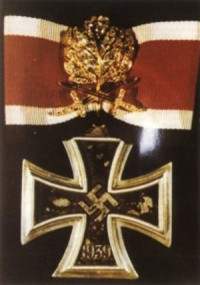 Ritterkreuzes des Eisernen Kreuzes mit dem Goldenem Eichenlaub mit Schwertern und Brillanten. Knight's Iron Cross with Golden Oak Leaves, Swords and Diamonds. He went on to become the most highly decorated combatant in Germany, earning by early 1945 the German Cross in Gold, the Pilots and Observer's Badge with Diamonds, the Close Combat Clasp with 2000 sorties in Diamonds, and the only holder of Knight's Cross of the Iron Cross with Golden Oak Leaves, Swords, and Diamonds. In February, 1945, he was wounded in the right thigh by anti-aircraft fire; the leg was later amputated, although he returned to combat duties with an artificial limb. Eventually, he surrendered to American forces in May, 1945. He moved to Argentina in 1948. After the war Rudel became a close friend and confidante of the Argentine president Juan Peron. Rudel wrote a book titled In Spite of Everything, and memoirs book titled Stuka Pilot which supported most of the Nazi policy. Even without a leg, he remained an active sportsman, playing tennis, skiing and even climbing the highest peak in the Americas, Aconcagua (6,959 metres (22,831 feet)), as well as three times up the highest volcano on Earth, Llullay-Yacu in the Argentine Andes (6,920 meters). Rudel's input was also used during development of A-10 attack craft. 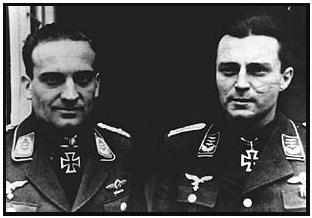 Hans-Ulrich Rudel with Ernst Gadermann, Hans-Ulrich Rudel's rear gunner in his Junkers Ju 87 Stuka dive bomber after the death of Henschel in 1944. Rudel returned to West Germany in 1953 and joined the German Reich Party. He was a successful businessman in post-war Germany. He died in Rosenheim in 1982, and was buried in Dornhausen. After the War. 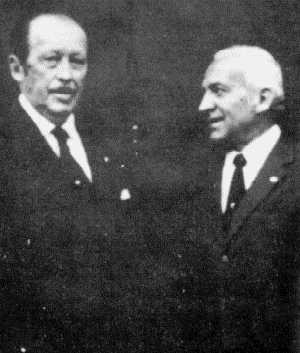 Rudel with President Strössner, Paraguay. Rudel was extremely fortunate to avoid capture by the Soviets, who had put a 100,000 ruble bounty on his head, payable dead or alive. Many other pilots who had the misfortune of being captured by the Soviets, or who were handed over to them by the Americans later, during the Summer of 45, suffered up to 11 years of forced labor in the Siberian gulags after the war. Hundreds of thousands of German soldiers, from generals to privates, died in post-war captivity behind the Iron Curtain. There has never been a complete accounting, and many are still listed by the modern German government as MIAs. Joined former members of Focke-Wulf aircraft corporation in Argentina; close personal friend of Juan Peron. Despite being disabled, Rudel made a name for himself as a mountaineer in the Andes, even climbing the highest peak in the Americas, Aconcagua (7,020 meters), as well as three times up the highest volcano on Earth, Llullay-Yacu in the Argentine Andes (6,920 meters), the final time to bury a climbing companion who didn't survive the second climb. Discrimination against former war heroes forced Rudel to become a ski instructor after returning to Kufstein, Tirol, Austria in the early 1960s. Hans Ulrich Rudel finally followed Hentschel across the river in the early 1980s. His Grave http://www.xs4all.nl/~ejnoomen/rudel.html Some interesting Notes: He got Shot down 32 times. Innumerable aircraft brought back to base that were later written off, due to heavy combat damage. Wounded on many occasions, including the partial amputation of his right leg in the Spring of 45, after which he continued to fly with a prosthetic limb. March 44: Disaster struck when Rudel landed behind Soviet lines to retrieve a downed German aircrew. Snow and mud bogged down the airplane, making it impossible to take off. Approaching Soviet troops forced everyone to flee on foot, but barring their escape was the 900 foot wide river Dnjestr. The Germans stripped to their longjohns, and swam across the ice-clogged river. Rudel's close friend and crewman, Erwin Henstchel, drowned a few feet from the far shore. They had flown 1490 missions together at the time of Hentschel's death. His body was never recovered. Rudel was pursued by hundreds of Soviet troops who were intent on collecting the 100,000 ruble bounty which Stalin had placed on his head, and he was shot in the shoulder while they chased him with dogs and on horseback. Through incredible ingenuity, audacity, and raw determination, Rudel escaped and made his way, alone and unarmed, back home, despite being more than 30 miles behind Soviet lines when he began his 24 hour trek. He was barefoot and almost naked in the sub-freezing winter weather, without food, compass, or medical attention. His escape stands as the single most legendary example of personal bravery and luck during the Second World War, but he never fully recovered emotionally from Hentschel's death, for which he blamed himself throughout the remainder of his life.  Han-Ulrich Rudel getting decorated by Hitler. During his career, Rudel flew over 2530 (around 400 of his sorties were flown in a Focke-Wulf 190 fighter plane during which he was credit with 11 air victories) missions and destroyed around 150 various artillery pieces, 519 tanks, around 1000 various vehicles, 70 landing crafts, 2 Lavochkin La-3 fighters, Il-2 Stormovik and sunk Battleship "Marat", 2 Cruisers and a Destroyer. Rudel was responsible for such huge damages to the Red Army that Joseph Stalin himself put a price of 100,000 rubles on his head.He flew more than 600,000km and used more than 5,000,000 liters of fuel. Hans Rudel dropped over 1,000,000kg of bombs, fired over 1,000,000 of machine gun rounds, over 150,000 20mm rounds and over 5000 37mm rounds. Rudel thought that the Lend-Lease American tanks were easier to kill than the Soviet T-34s, but he hated their machine guns, because once he was shotdown by one. Rudel was an outstanding pilot with experience,who loved to fly and destroy. He hated to take homeleave or sickleave and even when he got his leg amputated he was not depressed since he could still do what he loved - fly and destroy.During his career, Hans Rudel showed remarkable power, toughness, fearlessness, unparalleled determination and arrogance but none of his photos show any impact of the hardship of war on his face. His personal bravery was beyond belief and his place in the annals of military history thoroughly deserved, although it is important to remember the words of an American Protocol-Officer, who absolutely correctly named Rudel "the typical Nazi Officer". The "Marat", A Russian battleship sunk by Rudel:  The Marat Class Battleship had three Battleships planned. the Marat , Oktyabrskaya and the Frunze. The Frunze was never Commissioned as the ship was badly damaged by Fire in 1923 and finally broken up in Leningrad in 1939. The Marat was sunk by German Stukas off Kronshtadt on the 23rd September 1939. But the ship was in shallow water and was raised and was used as a floating Battery. (The Stukas had caused considerable damage destroying the forward turret, bridge and fore funnel). The ship was renamed the Petropavlovsk. The Petropavlovsk was converted into a training hulk after the second world war and again renamed Volchov in 1950. The Oktyabrskaya Revolutsia was damaged by German Bombing at Kronshtadt on the 21st September 1941. So badly damaged that she just managed to stay afloat. On the 27th the battleship was again hit by bombing and half her main armament was destroyed. At Leningrad she was repaired which took until November 1942. The repairs did not include all her main armament and it was not until 1944 that she had a full main armament operational. After the war she became a training ship in 1954 and was eventually scrapped in February 1956. Quotes from and about Rudel: "Verloren ist nur, wer sich selbst aufgibt" - Rudel ("Lost are only those, who give up themselves"). "They refuse to believe me when I tell them that I have never even seen a concentration camp. I add that if excesses have been committed they are regrettable and reprehensible, and the real culprits should be punished. I point out that such cruelties have been perpetrated not only by our people, but by all peoples in every age. I remind them of the Boer War. Therefore these excesses must be judged by the same criterion. I cannot imagine that the mounds of corpses depicted in the photographs were taken in concentration camps. I tell them that we have seen such sights, not on film, but in fact, after the air attacks on Dresden and Hamburg and other cities when Allied four-engined bombers deluged them indiscriminately with phosphorus and high explosive bombs and countless women and children were massacred." - Rudel about the concentration camps. "Rudel alone replaces a whole division." - Field Marshal Schörner. "How it harms, that he did not carry our uniform!" - Pierre Clostermann. -------------------- C'est pas l' histoire d'un jour
Qui rime avec amour, Plutôt un long séjour Mais pas: un "pour toujours" |
|
|
|
| Hellfighter |
03/27/06 9:07am
Post
#34
|
|
Major General Group: {MOB} Posts: 2111 Joined: November 15th 2005 From: Quebec, Canada Member No.: 1424 Xfire: hellfighter1x |
QUOTE(UNDEAD 1 @ 03/27/06 3:38am) HEY HELL,for your info- about 8 years ago i was working at a bar in fort lauderdale and served the last remaining tusk airman (i think ) they were doing a memorial for south florida and his daughter and him flew in . i almost feel a little responsible for it because there was an argument between him and the city rep (whoever the hell he was) and i settled the situation down and poured some good ones-they almost came to blows! hehe ,he was tuff! Sweet geezus, you lucky guy UNDEAD.....!!! I always would like to run into these vets and chat with them; whenever I see them being interviewed on TV shows it's obvious they have some kinda hardcore character...... you probably saved the city-reps arse with your Solomon wisdom  QUOTE(FeezyWeezy @ 03/27/06 7:56am) I will do Gen. Paulas, Tukegee Airmen and some german snipers. But first I want to add this guy as he was a true division of his own. (shame that there was not much about his Biography..) Hans-Ulrich Rudel ..................... Great choice Feez, I see bits on him once in a while on TV.... I can't imagine someone flying 1500 missions literally into the heat of battle... it's really beyond belief. Not to mention his escape you detailed! This post has been edited by Hellfighter: 03/27/06 9:07am -------------------- |
|
|
|
| UNDEAD 1 |
03/27/06 10:23am
Post
#35
|
|
Major General Group: {MOB} Posts: 2753 Joined: January 17th 2006 Member No.: 1540 Xfire: UNDEADJAMES |
feezy i have to say these bios are very interesting. ive heard of and read of all the pilots youve done but didnt really know the back round.cant believe this guy evaded capture for 30 miles barefoot. now that would make a good movie.question-how many ex nazis made it to argentina?
also hellfighter,despite seeing shows on the history channel and theyr glorified movie ( fishbourne) i really dont know much-what i gatherd from the meeting was he was the last,so hopefully im not giving false info.maybe feezy can find out if there is a memorial in south florida?and when ? it was 1997 -98 when they were here. -------------------- |
|
|
|
| FeezyWeezy |
03/27/06 3:09pm
Post
#36
|
|
Major Group: Banned Posts: 609 Joined: January 14th 2006 From: Gone Member No.: 1533 |
Well I could find any detailed record from the number of Nazi's in Argentina... But some records mentioned about 180.
"The Nazis who found refuge in Argentina included 30 Germans, 50 Croats and 100 officials from France and Belgium." - http://www.jewishaz.com/jewishnews/991203/report.shtml "Carlota Jäckisch, told the audience the results of her investigation for CEANA about the quantification of Nazi war criminals according to Argentine sources, with an amount of 180 criminals who arrived Argentina between 1946 y and the mid fifties. " - http://www.raoulwallenberg.net/?en/news/930.htm "In November 1999, Foreign Minister Guido di Tella issued a report of the Government's Commission of Inquiry into the activities of Nazism in the country (CEANA). The report included a preliminary count of at least 180 "war criminals" from Germany, France, and Croatia, who entered Argentina after World War II, and identified a shipment of stolen gold from Croatia's central bank that was sent to Argentina. The report also addressed the extent of Nazi influence on the country during the 1930's and 1940's. CEANA also has published the results of its research in academic journals and has organized seminars in various universities. In April 2001, President De la Rua extended CEANA's mandate through September 2001. In June 2000, President de la Rua, during an official overseas visit, made a formal apology for the country's acceptance of Nazi war criminals as immigrants after World War II." - http://www.state.gov/g/drl/rls/irf/2001/5537.htm "Probing Nazi past President Néstor Kirchner has ordered a probe into whether officials covered up the extent of exiled Nazis’ links to country’s government after World War II. Responding to requests from the Simon Wiesenthal Centre and the US Congress, the government launched an investigation into the history of Nazis — such as Holocaust architect Adolf Eichmann — who found refuge in Argentina after the war. The country became a refuge for German war criminals, partly due to the fascist sympathies of then President Juan Perón. Between 1946 and 1950 about 180 Nazi war criminals arrived in Argentina, as well as hundreds of others who had collaborated with Adolf Hitler’s régime, according to a state commission investigating the issue. After years of official reluctance to bring this chapter of Argentina’s history to light, the country’s National Institute Against Discrimination (INADI) has been ordered by Kirchner’s month-old government to find immigration documents recently reported missing by an investigative journalist. “We are going to investigate and find these documents because we have the obligation to make them public,” Institute Director Enrique Oteyza said." - http://www.buenosairesherald.com/argentina/note.jsp?idContent=15955 Tuskegee Airmen: http://www.nbbd.com/godo/VeteransMemorial/gallery/index.htm -------------------- C'est pas l' histoire d'un jour
Qui rime avec amour, Plutôt un long séjour Mais pas: un "pour toujours" |
|
|
|
| FeezyWeezy |
03/28/06 9:32am
Post
#37
|
|
Major Group: Banned Posts: 609 Joined: January 14th 2006 From: Gone Member No.: 1533 |
"Night Ghost of St. Trond"
Heinz-Wolfgang Schnaufer Top Scoring Nachtjäger  http://www.aeronautics.ru/archive/wwii/pho...20Schnaufer.jpg Schnaufer was born in a Stuttgart maternity home on the 16th February 1922. His home was in the Black Forest township of Calw, and he was to be the eldest of four children, three boys and a girl. Although christened 'Heinz Wolfgang" ("Wolfgang" after his godfather) he was universally known simply as "Heinz". He grew up in prosperous circumstances, his father being a wine-merchant of some substance. He was gifted both academically and athletically, and in 1938, at the age of 16, entered the NPEA (National Political Educational Establishment) at Backnang, moving the following year to the NPEA at Potsdam. An NPEA was a training school for young men specially selected for advancement in the service of the National Socialist Party, and Potsdam was the NPEA at which those opting for a flying career in the Luftwaffe were introduced to flying training. Heinz Schnaufer entered the Luftwaffe as a trainee officer-pilot in November 1939, and completed his flying training in 1941. At the Heavy Fighter School (Zerstorerschule) at Wunstorf he met Fritz Rumpelhardt, who became his Funker (radio/radar operator) and flew with him, with a break in 1943, until the end of the war. At this time Schnaufer and Rumpelhardt agreed to volunteer to fly with the newly-formed Nachtjagd, the night-fighter arm of the Luftwaffe. In November 1941, on completion of their flying training, they were posted to II./NJG 1 at Stade, near Hamburg, later transferring with the same unit to Saint-Trond, Belgium. Throughout his career Schnaufer only flew the Bf 110 operationally, despite subsequently commanding a Geschwader equipped with the Ju 88. Schnaufer's first operational experience came in February 1942, when II./NJG 1 were detached to fly escort for the capital ships Scharnhorst, Gneisenau and Prinz Eugen when they broke out from Brest en route for Norway. His first 'kill', however, did not come until the night of 1st/2nd June 1942, when he shot down a Handley-Page Halifax near Louvain, Belgium. By the end of the year his score stood at only 7, including three in a night on 1 August. It has often been said that Schnaufer was a "slow starter", but at that time Bomber Command activity in his area was only moderate.  Schnaufer was promoted Oberleutnant in July 1943, when his score stood at 17. In August he transferred to IV./NJG 1 at Leeuwarden, Holland, where he became Staffelkapitan 12./NJG 1 (IV./NJG 1). He remained there, with a detachment to Quakenbruck in September/December 43, until March 1944, when he was appointed Kommandeur IV./NJG 1 and moved with the unit back to Saint-Trond. By this time he had shot down 47 RAF bombers. There was also, by this time, a third man in Schnaufer's crew, Wilhelm Gansler, employed mainly as a look-out, an "extra pair of eyes". In December 1943 Schnaufer had been awarded the Ritterkreuz, with his score standing at 42. Schnaufer remained as Kommandeur IV./NJG 1 until November 1944, being promoted Hauptmann in May 1944 and receiving the Eichenlaub in June after 84 victories. He was awarded the Schwerter in July, with his score at 89. In July, too, his two crewmen, Rumpelhardt and Gansler, were awarded the Ritterkreuz. In September 1944 IV./NJG 1 retreated back into Germany, being stationed temporarily at Dusseldorf and Dortmund. Schnaufer achieved his 100th night-time victory on 9 October 1944, for which achievement he was awarded the Brillanten by Adolf Hitler.  Nachtjagdgeschwader 1 The following month Heinz Schnaufer, still only 22 years old, was made Kommodore NJG 4, based at Gutersloh. At the end of the year his score was 106. In December he was promoted Major. Schnaufer's greatest one-off success came on 21 February 1945, when he destroyed 9 RAF heavy bombers in the course of one day, two in the early hours of the morning and a further seven in the evening. Post-war research suggests that in fact his total that day was 10, one claim not having been acknowledged. At the end of the war Schnaufer's official tally stood at 121. He was taken prisoner by the British in May 1945 at Eggebek in Schleswig-Holstein, but was released later that year and returned to Calw, where he took over the reins of the family wine business, his father having died during the war. By the time of his death in 1950 he had built up the business to a very prosperous concern. His end came when, during a wine-purchasing visit to France, his open sports car was in collision with a lorry on the main road south from Bordeaux. The lorry had failed to observe right of way and entered the main road illegally. Heavy gas cylinders from the lorry fell on to Schnaufer's car, at least one of them hitting Schnaufer on the head. He died in hospital two days later, on 15 July 1950. Heinz-Wolfgang Schnaufer was the top-scoring Nachtjäger of World War 2. He was credited with 121 victories recorded in 164 combat missions. His victory total includes 114 four-engine bombers.  Messerschmitt Bf 110 Based around the concept of the long-range Zerstörer or "Destroyer Fighter" the Bf 110 enjoyed some success in the Polish and French campaigns. However, the Battle of Britain revealed its fatal weaknesses as a daylight fighter against single-engine aircraft. Its size and weight meant that it had high wing loading, which limited its manoeuvrability. Furthermore, although it had a slightly higher top speed than contemporary RAF Hurricanes, it had poor acceleration. Eventually withdrawn from daylight fighting, the Bf 110 enjoyed later success as a night fighter where its range, firepower and ability to mount a radar stood it in good stead. It was also used as a ground attack aircraft starting with the C-4/B model, and as a bomber interceptor, where its heavy firepower was particularly useful. Later on there were dedicated ground attack versions which proved reasonably successful. The Bf 110 served the Luftwaffe extensively in various roles, except in its intended role as a heavy fighter. After the Battle of Britain Bf 110 units were largely moved to the Russian and Mediterranean theatres of war. The production of the Bf 110 was put on a low priority in 1941, although it was stepped up again in 1942 due to problems and delays in the development of the Bf 110's successor, the Me 210. Although the Me 210 entered service in mid-1941, it was eventually withdrawn in favour of a further development, between it and the Me 410, which did not enter service until early 1943; there were insufficient aircraft to fully replace the Bf 110 in that role and it fought until the end of the war. The lack of a real replacement even resulted in the increase of Bf 110 production in 1944, in spite of hopes of phasing out the type. Werner Streib  Born in Pforzheim Baden in 1911. As a civilian he worked in a Bank before entering in the Wehrmacht in 1934. Later he asked to be transfered from the Heer (Army) to the Luftwaffe. When his request was accepted he began his new pilot career as an observer in a recconnaissance unit. In 1937 Streib was transferred to the Richthofen Geschwader in Jueterbog-Damm. In 1939 was pilot in Wolfgang Falck's I./ZG 1 Zerstörergeschwader. He was known as the "father of the nigh fighters" both because he was the first to score a night victory and he was the oldest among the other night fighter pilots. His first victory over an enemy plane was on a Blenheim bomber during day operations. When in 1940 ZG/I was to undertake the development of night fighting techniques Streib felt very pessimistic about it all. During that period in which propaganda over the victories achieved by an attacking powerful German Luftwaffe shadowed the efforts of the few defending night fighter pilots. Falck refused Streib's deceptioined request of being transferred to a day fighting unit just some days before the latter achieved his first night victory. This success of Streib was morale encouraging for his collegues. These soldiers developed the night fighting techniques that were used for the rest of the conflict. These techniques found basis in those developed during WWI. In 20 July 1940 Streib scored the first night fighting victory over German territory over a RAF Whitley bomber. Since then his career was always raising celebrity. In october 1940 he was already Hauptmann and Gruppenkommandeur of I./NJG1. From that time till may 1941 he reached an amazing score of 26 night victories. In June 1943 he was Major with 50 night victories. He was regarded as a technical authority and appointed to Ernst Heinkel for the development of the He 219 night fighter, which indeed was a good weapon. When the first prototypes of the He 219 were available Streib had his own and was the first to combat test the type. It happened the night of 11.6.43 when British bombers were in mission against Berlin. Helped by his radio operator Fischer, Streib shot down -with short but powerful bursts of six 30-20 mm cannons- an amazing five victories in just half an hour! One of the victims threw oil from one engine before exploding. This oil covered the aeroplane's glass and when the blind approaching Streib touched down the impact was so strong that the plane broke into four pieces. Fortunately both Streib and Fischer survived the accident with minor injuries thanks to the robust nose and cockpit section which separated entire from the rest of the aircraft. He of course continued to promote the Heinkel He 219 in spite of Milch's contrary opinion. 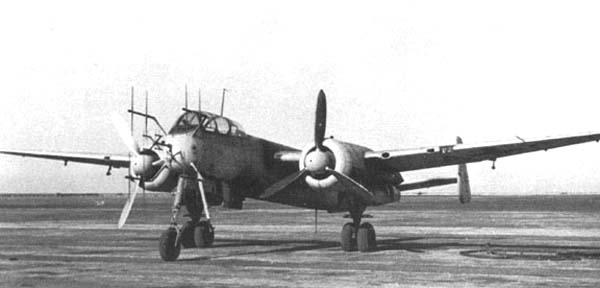 He.219 A-5 "Uhu" (Owl), You can clearly see the radar. On 1.7.43 Streib became Kommodore of NJG1. He formed part in 29.7.43 of the commission wich studied and approved the immediate use of Hajo Herrmanns "wilde Sau". By the end of war 65 was his final score of victories. http://www.jzg23.de/images/Guncams/ww2_guncam_clip0001.mpeg -------------------- C'est pas l' histoire d'un jour
Qui rime avec amour, Plutôt un long séjour Mais pas: un "pour toujours" |
|
|
|
| Hellfighter |
03/28/06 9:47am
Post
#38
|
|
Major General Group: {MOB} Posts: 2111 Joined: November 15th 2005 From: Quebec, Canada Member No.: 1424 Xfire: hellfighter1x |
You've got to wonder, if the Allies new there were such lethal Aces tearing holes in their sky fleets [114 bombers = a bit under 1000 skilled aircrewmen casualties/or captured!], would they send commandos and agents to track them down and knock them off! Speculation.......
This post has been edited by Hellfighter: 03/28/06 9:49am -------------------- |
|
|
|
| FeezyWeezy |
03/28/06 3:59pm
Post
#39
|
|
Major Group: Banned Posts: 609 Joined: January 14th 2006 From: Gone Member No.: 1533 |
It was hard to figure out who killed who at most times. Sending comandos out to kill a individual is just...wrong. These are all normal soldiers that are doing the job that they are told to do. It would make more sense to send a SAS taskforce to, for instance NJG1. And kill thewhole lot..
But still.. I think doing this is extreamly risky.. you have to go far into enemy tertory. And there is a great chance anyway that these regular people get killed during the next periods by doing their job.Its like focusing efforts on a individual, sort of "blaming" him because hes just good at the job hes ment to do.I would putt effort into the people behind the scenes. The man in charge. The man that makes him shoot down bombers. "It is war: if the enemy burns your house down, you go and burn one of the enemy's houses!" - Juutilainen About his record he has been noted to say: "I did what I was told to as well as I could." - Häyhä Its all: Kill or be killed...If you dont take down that enemy bomber, He'll be back next time for your house. Take down the leaders, then the soldiers won't know what to do. [/size] Boris Ivanovich Kovzan  He was born in 1922. Boris Ivanovich, the native of our city they called as "man from legend". He 4 times rammed in air enemy planes within Great Patriotic war. Since the first days of war, Kovzan Boris was in army and covered from enemy bombers Gomel city (Belorussia). On October 29, 1941 Kovzan, having arrived in 42-nd fighters of air regiment, battled under Tula. Here, for the first time in the battle practice, has accepted the decision to go on the collision. It was the unique chance to leave by the winner from fight and Kovzan has won. When the ammunition was finished, pilot has directed the fighter on "ME-5" and compartment tail part of it. Skillfully operating the damaged machine, he has made landing to air station. After some months in area Torghok, Kovzan have gone on collision second time. For unprecedented courage and skill of the fight with an enemy Kovzan Boris was awarded with an order by Lenin. Battling on Northwestern front, in area Old Russa, Kovzan Boris twice applied collision. At last impact, when both planes have scattered, heavy wounded pilot has allowed to open a parachute. After that fight, within 3 months Kovzan Boris was on treatment, and then was direct in 144 fighters brigade AAD. In a strip of near rear, he battled to the enemy planes - scouts. Dews the battle account dropped down by him of planes. For bravery and courage shown in fights with enemy Kovzan is awarded with eighteen governmental awards. On August 24, 1943 to him appropriated a rank of the Hero of the Soviet Union. After war, Kovzan Boris has finished military-air academy and in a rank of the lieutenant colonel has continued a military service. Until August 31, 1985 lived at city Ryazan, where has died and is buried. He ended with a score of 28. [size="1"]Ramming attack was a tactic in air combat. The goal is to either outright ram the enemy aircraft or to destroy its controls using either the attackers propeller or wing. It was often practised when pilot ran out of ammunition and was too eager to destroy an enemy, or his plane had already been damaged. A ramming attack is not the same as kamikaze attack since the pilot stands a fair chance of surviving, though it was very risky. Ramming was used in air warfare in the first half of the 20th century, in both World Wars and in the interwar period. Ramming was first used by the Russian pilot, Pyotr Nesterov on September 8, 1914, against an Austrian plane. That incident was fatal to both parties. In World War II ramming (Russian: taran) became a legendary technique of VVS pilots against the Luftwaffe, especially in the early days of the hostilities in the war's Eastern Front. In the first year of the war, the Soviet machines were considerably inferior to the German ones and the taran was sometimes perceived as the only way to guarantee the destruction of the enemy. Trading an outdated fighter to a technologically advanced bomber was considered a good trade. In some cases, heavily wounded pilots or in damaged aircraft decided to perform a suicidal taran attack against air, ground or naval targets, similar to kamikaze (see Nikolai Gastello). The first taran attack in World War II was carried out by the Polish pilot, Lt. Col. Leopold Pamuła on his damaged PZL P.11c on September 1, 1939, over Łomianki near Warsaw (taran is also a Polish word). Nine rammings took place on the very first day of German invasion to the Soviet Union. About 200 (some estimates give the number closer to 500) taran attacks were made by Soviets between the beginning of Operation Barbarossa and the middle of 1943 when enough modern aircraft had been produced to make the tactic obsolete, even if Russian fighter pilots still are trained to perform it. Boris Kovzan survived the record of four ramming attacks in the war. Three types of taran attacks were made: Using the propeller to go in from behind and chop off the controls in the tail of the enemy aircraft. This was the most difficult to perform, but it had the best chance of survival. Using the wing to cut off the wing or tail of the enemy aircraft. Some Soviet aircraft like Polikarpov I-16 had strengthened wings for this purpose. Direct ram was the easiest to perform, but also the most dangerous. More Masters of Ramming will come later. (and a bit more, I hope.. Wasn't much about Kovzan...  ) )-------------------- C'est pas l' histoire d'un jour
Qui rime avec amour, Plutôt un long séjour Mais pas: un "pour toujours" |
|
|
|
| Hellfighter |
03/28/06 7:48pm
Post
#40
|
|
Major General Group: {MOB} Posts: 2111 Joined: November 15th 2005 From: Quebec, Canada Member No.: 1424 Xfire: hellfighter1x |
QUOTE(FeezyWeezy @ 03/28/06 3:59pm) It was hard to figure out who killed who at most times. Sending comandos out to kill a individual is just...wrong. These are all normal soldiers that are doing the job that they are told to do. It would make more sense to send a SAS taskforce to, for instance NJG1. And kill thewhole lot.. But still.. I think doing this is extreamly risky.. you have to go far into enemy tertory. And there is a great chance anyway that these regular people get killed during the next periods by doing their job.Its like focusing efforts on a individual, sort of "blaming" him because hes just good at the job hes ment to do.I would putt effort into the people behind the scenes. The man in charge. The man that makes him shoot down bombers. "........ Maybe some misunderstanding here.... It's really all about speculation... [I edited out a blob here, lol] 1) Speculating.... Depending on where the Ace would be quartered, commandoes or SOE could be sent out to take out a guy who singlehandedly [ok Me110s had two aircrew] tookout the equivalent of several squadrons of bombers.... Allied Bomber aircrew morale was extremely shaken by such ordeals in their missions..... So speculation wouldn't be 'wrong' if the Allies knew they had a chance on getting such a lethal individual. 2]Quite a few 'select' Allied and Axis commando missions in WW2 were near-suicidal too- deep into enemy territory and extremely risky - operatives signing up into these forces knew very well if captured there fate would likely not end up in a POW camp - in one Brit commando raid, several captured commandos were put to death by air bubbles injected into their veins! So 'risky' for special forces in armies of WW2 days was not the exception. 3] Risky raids of WW2 would not be frowned upon as they would be in today's world - where political consequences of failure are far greater. Back then, the idea "all's fair in war" was not frowned upon. Even Churchill, upset by German Rocket bombings over England, had to be dissuaded by his staff for bringing up the serious idea of retaliating on German cities with Poison Gas!!! 4] You perhaps think I'm belittling these Ace's 'work'. My speculation was about being practical in reducing the slaughter such tenacious fighters can wreak. Noone's blaming soldier's for doing there 'job'.... it's war - understandably everyone's doing what they can to fulfil their duty! In a previous post about an Ace you detailed the vast amount of resources Stalin put into trying to get this airman in particular captured/killed. Being 'good' at killing while looked upon professionally sometimes by the enemy with grudging admiration, might not put off a special effort being made to take him out so that many comrades have a greater chance of returning home safely if that threat is removed. But I see how you maybe shifting my point though.... I feel the same way you do when I read about sieges throughout history where defenders doing a 'good job' defending against besiegers are more often than not slaughtered should the attackers finally break the defence - as in 'no quarter'- the attackers blame their retribution on the defenders for them not giving up easily. ps,Feezy I know you got tons of articles lined up..... but anychance you can do SOEs [Special Operations Executive], male and female. This post has been edited by Hellfighter: 03/28/06 7:55pm -------------------- |
|
|
|
| Hellfighter |
03/28/06 8:00pm
Post
#41
|
|
Major General Group: {MOB} Posts: 2111 Joined: November 15th 2005 From: Quebec, Canada Member No.: 1424 Xfire: hellfighter1x |
QUOTE(FeezyWeezy @ 03/28/06 3:59pm) [size="1"]Ramming attack was a tactic in air combat. The goal is to either outright ram the enemy aircraft or to destroy its controls using either the attackers propeller or wing. It was often practised when pilot ran out of ammunition and was too eager to destroy an enemy, or his plane had already been damaged. A ramming attack is not the same as kamikaze attack since the pilot stands a fair chance of surviving, though it was very risky. Ramming was used in air warfare in the first half of the 20th century, in both World Wars and in the interwar period. Interestingly, I recently watched a Battle of Britain documentary... they had a segment with a female air-ground staff coordinator mentioning the dialogue she heard of Brit pilots in battle. She recalled an instance of a badly wounded Brit pilot making a kamikaze ram attack. -------------------- |
|
|
|
| FeezyWeezy |
03/29/06 9:49am
Post
#42
|
|
Major Group: Banned Posts: 609 Joined: January 14th 2006 From: Gone Member No.: 1533 |
Special Operations Executive
When Henri-Philippe Petain signed an armistice with Nazi Germany on 22nd June, 1940, the British government began to consider what it could do to help those French people who wanted to continue fighting. A meeting was held at the Foreign Office on 1st July and the following day Hugh Dalton, Minister of Economic Warfare, wrote to Lord Halifax, the Foreign Secretary, suggesting "a new organization to co-ordinate, inspire, control and assist the nationals of the oppressed countries who must themselves be the direct participants." Lord Halifax passed the letter onto Neville Chamberlain and Winston Churchill and after much discussion it was decided to ask Hugh Dalton to implement the project. Churchill directive to Dalton was "now set Europe ablaze." The new organization became known as Special Operations Executive (SOE) and the staff were given an office at 64 Baker Street in London. Colonel Colin Gubbins was Director of Operations and Training at SOE. Those recruited usually had considerable experience of the country they were to be sent to help the local resistance. Recruits were sent for initial training to Wanborough Manor near Guildford. Later they would be toughened up for the field by attending a commando course in the Scottish highlands. They were taught how to use guns and explosives, sabotage, wireless telegraphy, and how to live secretly in occupied territories. They also needed to master the techniques of unarmed combat and silent killing. Some members of the armed forces were unhappy about this type of warfare. Air Chief Marshal Charles Portal, the chief of the air staff, wrote to a fellow officer: "I think that the dropping of men dressed in civilian clothes for the purpose of attempting to kill members of the opposing forces is not an operation with which the Royal Air Force should be associated. I think you will agree that there is a vast difference, in ethics, between the time honoured operation of the dropping of a spy from the air and this entirely new scheme for dropping what one can only call assassins." In 1940 Colin Gubbins made contact with the commandant of the First Aid Nursing Yeomanry and arranged for her to provide personnel for the SOE. At first the women were used to produce passports, ration cards, and other forged documents for use in occupied Europe. They were also employed to transmit, encode and decode messages to and from the field. SOE agents were sent to any country under the occupation of Nazi Germany including France, Belgium, Netherlands, Poland, Denmark and Yugoslavia. The SOE was extremely active in helping the French Resistance. The French Section of the SOE was led by Maurice Buckmaster. His deputy was Major Nicholas Bodington and Vera Atkins was put in charge of preparing the agents for the field. In April 1942, Winston Churchill gave his approval for women in the SOE to be sent into Europe. It was argued that women would less conspicuous than men. In countries such as France women were expected to be out and around whereas the Gestapo were suspicious of men on the streets. Women were used as couriers and wireless operators. Women were never sent to Europe as circuit leaders although Pearl Witherington became leader of the Wrestler Network after the arrest of Maurice Southgate in May 1944. She organized over 1,500 members of the Maquis and they played an important role fighting the German Army during the D-Day landings. During the Second World War the SOE sent 470 agents into France including 39 women. This included Jack Agazarian, Claude de Baissac, Lise de Baissac, Gustave Bieler, Yolande Beekman, Andrée Borrel, Francis Cammaerts, Peter Churchill, Madeleine Damerment, Henri Dericourt, Victor Gerson, Christine Granville, Virginia Hall, Noor Inayat Khan, Andrezej Kowerski, Cecily Lefort, Vera Leigh, Gilbert Norman, Sonya Olschanezky, Harry Peulevé, Eliane Plewman, Harry Rée, Lilian Rolfe, Diana Rowden, Odette Sansom, George Starr, Brian Stonehouse, Francis Suttill, Violette Szabo, Michael Trotobas, Edward Yeo-Thomas, Nancy Wake, Pearl Witherington and Yvonne Rudelatt. SOE wireless operators took with them a short-wave morse transceiver that could send and receive messages. It weighed 30 pounds and fitted into a two foot long suitcase. Its frequency range was 3.5 to 16 megacycles a second. The main problem for the operator was that the transceiver needed seventy feet of aerial to function properly. It was estimated that in towns it would take the Germans around 30 minutes to discover where the transceiver was being used. Where possible, operators worked in isolated areas. They were also under strict instructions to transmit briefly, at irregular intervals, at various wavelengths and from various places. Each wireless operators was instructed to always spell certain words incorrectly. The reason for this was that if the Germans captured the operator and code books and tried to use the transceiver to trap other agents, the SOE in London would be able to discover what had happened and would warn all its agents in the field. SOE agents were taught that once captured they must try to stay silent when interrogated by the Gestapo for 48 hours. During that time all the people who had been in contact with the arrested agent were supposed to move house and cover their tracks. In 1942 the SOE decided to establish a new network in and around Paris. Called Prosper it was to be led by Francis Suttill. On 24th September, 1942, Andrée Borrel was parachuted into France to prepare the way for Suttill who arrived on 1st October. A wireless operator, Gilbert Norman arrived in November and a second operator, Jack Agazarian, arrived the following month. On 22nd January 1943, Henri Déricourt, a former pilot in the French Air Force, arrived back in France. His main task was to find suitable landing grounds and organize receptions for agents brought by air. He worked mainly for the Prosper Network and over the next few months he arranged the transport by plane of over 67 agents. Jack Agazarian became increasing concerned about the loyalty of Henri Déricourt and after being taken out of France on 16th June, he passed on these fears to Nicholas Bodington and Maurice Buckmaster. However, they were unconvinced and refused to recall Déricourt to Britain. On 23rd June, 1943, three key members of the network, Andrée Borrel, Francis Suttill and Gilbert Norman, were arrested by the Gestapo. When Noor Inayat Khan discovered what happened she reported back the disaster to the Special Operations Executive in London. The three agents were taken to the Gestapo headquarters at 84 Avenue Foch. Francis Suttill was tortured for several days and according to Ernest Vogt he eventually did a deal with the Germans. This included Suttill giving the Germans details of ammunition dumps in exchange for the promise that the people guarding them would not be killed. However, according to another German agent, Joseph Kieffer, it was Gilbert Norman who gave the Gestapo this information. In July, 1943, Nicholas Bodington persuaded Maurice Buckmaster to let him go to France to find out what had happened. Jack Agazarian was recalled from leave and the two men were taken to France. Messages from the wireless owned by Gilbert Norman were still being sent to the Special Operations Executive in London. Instructions were passed on to Bodington by the SOE to arrange a meeting with Norman at the address he had sent them. Bodington later claimed that he and Agazarian tossed to decide who should visit the address. Agazarian, who was convinced it was a trap, lost, and when he arrived at the address he was immediately arrested. Over the next few months Gilbert Norman, Francis Suttill, Andrée Borrel, Jack Agazarian and Noor Inayat Khan, were all executed. A more successful circuit was the Jockey Network led by Francis Cammaerts. By the autumn of 1943, Cammaerts had established a network of small independent groups up and down the left bank of the Rhone Valley. He developed a secure system where although he knew how to get in touch with members of the group, they had no idea where he was living and could only leave messages for him in letter boxes (somebody with whom one could leave a message to be collected later by another person giving the right password). Cammaerts's two main lieutenants sent by the SOE were Cecily Lefort and Pierre Reynaud. In September 1943 Lefort was arrested while visiting the house of a corn-merchant at Montélimar. She was tortured by the Gestapo but the system Cammaerts had set up enabled the Jockey Network to survive. On 6th July 1944 Lefort was replaced by another woman agent from Britain, Christine Granville. By the time of the D-Day landings Cammaerts had built up an army of 10,000 men and women. His area of operations went from Lyons to the Mediterranean coast and to the Italian and Swiss frontiers. It is estimated that around 200 agents lost their lives. Most of these were executed on instructions from Adolf Hitler in September 1944 and March 1945. Those who did not return included Jack Agazarian, Gustave Bieler, Yolande Beekman, Andrée Borrel, Madeleine Damerment, Noor Inayat Khan, Cecily Lefort, Vera Leigh, Gilbert Norman, Sonya Olschanezky, Eliane Plewman, Lilian Rolfe, Diana Rowden, Odette Sansom, Francis Suttill, Violette Szabo, Michael Trotobas and Yvonne Rudelatt. Thorsteinn Jonsson  Thorsteinn Jonsson is Iceland's only ace! Born in Reykjavik in 1921, his father was Icelandic and his mother was English. He grew up in Iceland but as a young child traveled to England often for visits. Jonnson was an adventurous and high-spirited lad and at age 18 left boarding school. He hitched a ride on a fishing trawler bound for England -- his goal was to become a fighter pilot. After two months working through the bureaucracy, he was permitted to join the Royal Air Force. Jonsson attended ground school during the Battle of Britain and then began flying training in October 1940. His first flight was in a DeHavilland Tiger Moth and he went on to complete advanced training in the Supermarine Spitfire. At first he was posted to a Hawker Hurricane squadron in Scotland as a sergeant but soon transferred to 111 Squadron near London to fly Spitfires. Jonsson was soon promoted to flight sergeant and saw his first combat flying sweeps over the English Channel and the coast of France. Over France, the 111 Squadron was met by German fighter units including the famous "Abbeville Boys" who had been led by 104 victory ace Adolph Galland. In October 1942, his squadron shipped out to Gibraltar, and on 11 November, after the Operation Torch landings in North Aftrica, they deployed to an airfield in Algeria. In the next two weeks, Jonsson was credited with three Luftwaffe aircraft destroyed and one probable. He scored another victory in early 1943 and then was sent to Scotland for "rest" as an instructor in a training unit. Shortly, King George VI personally presented Jonnson with a Distinguished Flying Medal. In January 1944, he reported to 65 Squadron to again fly Spitfires, but the unit soon converted to the North American Mustang III. Jonsson would become an ace over Normandy in June 1944 when he downed two Focke Wulf 190s. During the war, Jonsson's victories included 8 aircraft destroyed, 1 probable, and 2 damaged. http://www.loftleidir.com/ http://www.asstr.de/HTML/tf-fiw.jpg http://www.icelandair.com/ http://www.boeing.com/randy/images/icelandair787_lg.jpg http://www.cargolux.com/ http://thetrek.co.uk/images/Cargolux%20_%20Dacid.JPG In 1946, Jonsson left the RAF and returned to Iceland. With Icelandic pilot license number 13, he joined Icelandair. In the late 1950s, he flew for Sabina in the Congo, but in 1960 returned to Iceland and flew for Loftleidir and Icelandair. Later, during the Nigerian civil war, he flew food and medicine on 413 perilous humanitarian missions into Biafra. After dodging Nigerian MiGs for a year and a half, he moved to Luxembourg and flew Douglas DC-8s and later Boeing 747s for Cargolux. He flew worldwide until March 1987 when he went into active retirement. His books include Dancing in the Skies which relates his childhood and World War II experiences. His second book in Icelandic and a draft in English cover his years as an airline pilot. His works have all been bestsellers in Iceland.  Thorsteinn Jonsson in 2002 15 November 1942 was one of the most memorable days of Jonsson's life. "I scored my first victory, came very close to being blown sky high, and suffered my first, and only wound from enemy action." Jonsson's day began in his Spitfire with a dawn chase through the clouds and a shootdown of a German bomber. After lunch, a delayed action bomb, buried in the latrine, exploded just as he approached. In the afternoon, four German fighters strafed the flightline. Jonsson sprinted for a ditch, dove in, and cut his knee on a rusty tin can. This post has been edited by FeezyWeezy: 03/29/06 9:51am -------------------- C'est pas l' histoire d'un jour
Qui rime avec amour, Plutôt un long séjour Mais pas: un "pour toujours" |
|
|
|
| UNDEAD 1 |
03/29/06 11:06am
Post
#43
|
|
Major General Group: {MOB} Posts: 2753 Joined: January 17th 2006 Member No.: 1540 Xfire: UNDEADJAMES |
before i played cod i played bf 1942. that was the only multiplaayer that had the same battle tactics as cod but had planes as well. i think united offensive is the best gameplay ww2 shooter but it needs planes. how can they make desert maps with out planes (el alimien ,gazala etc..) these articles ive read here reminds me of playing that game for some reason because you could fly the me109 ,spit,p51must,corsair and having the air support was crucial .if you had an idiot up there or a selfish player your team would get ownd.im suprised not that many people played bf42 or talk about it .i miss flying missions,hehe!
the maps in cod that are missing planes bigtime are -kursk (big time),BARB,smol ,pon and italy cod2 -never make a desert map other than aberdeen with out planes!!! -------------------- |
|
|
|
| FeezyWeezy |
03/29/06 11:24am
Post
#44
|
|
Major Group: Banned Posts: 609 Joined: January 14th 2006 From: Gone Member No.: 1533 |
Matthäus Hetzenauer
Born on December 23rd 1924 in Steiermark, Matthäus Hetzenauer was a German sniper serving on the Eastern Front of the Second World War, and was credited with shooting 345 enemies. Hetzenauer trained as a sniper from March 27th through July 16th 1944, before being assigned to the 3rd Gebirgsjäger Division, issued both a K98 rifle with 6x scope and a Gewehr 43 rifle with 4x scope. On November 6th 1944, he suffered head trauma from artillery fire, and was awarded the Verwundeten-Abz three days later.  Award given to soldiers that where injured. Awarded the Ritterkreuz on April 17th 1945, Hetzenauer was captured by Soviet troops the following month, and eventually served 5 years in a Soviet prison camp. His longest confirmed kill was alternatingly reported at 1000 or 1100 metres. He died on either October or November 3rd 2004, after several years of deteriorating health. [/size] Other germans snipers, just like Mr. Hetzenauer, seem to be good at hiding... only the disputed König. Anthony Beevor himself, probable one of the most educated men on the Battle of Stalingrad said this: 'I've been through the Soviet Ministry of Defense's archive in Podolsk and there is no record of such a duel.' William Craig's book 'Enemy at the Gate: The Battle of Stalingrad' describes a sniper duel on Mamaev Hill and the Red October Plant in Stalingrad, in the fall of 1942. The fact is, Zeitzev himself never admitted this battle occurred. Soviet War Records never show that this battle occurred. The fact is, it didn't. Think about it, if this SS-Sturmbannführer Koenig, it has been stated that he had almost 400 kills. Gefreiter Matthäus Hetzenauer, a German sniper, he had 345 confirmed kills, he was Germany's best sniper ever and Germany's highest scoring sniper of WW2. I think he died a few years ago. Anyway, Hetzenauer received his Ritterkreuz when he got his 145th kill. It seems weird that a man with 400+ kills doesn't receive such an award and doesn't even exist on paper. But, there is also the existence of a man named Thorwald. He supposedly was a SS-Obersturmbannfuehrer in the Waffen SS. There is also one little problem in this theory, HE DIDN'T EXIST EITHER. There is also no evidence to support his existence. The fact is, these men are high ranking officers. They are Majors and Colonels. Usually, a sniper in the field hardly ever excided the rank of SS-Oberstlieutenant. Having an Obersturmbannfuehrer or even a Sturmbannführer in the field of battle was extremely unlikely, even in the worst situations. [size="3"]THE GERMAN SNIPERS The following article first appeared in the official Austrian military publication called TRUPPSNDEINST (Troop Service) in the year 1967 and was written by an Austrian Army Officer, Captain Hans Widhofner. Among persons questioned were the two most proficient German snipers of the war with the comments of another good sniper added to obtain a well-rounded picture concerning the use of snipers in the German army. Questions asked of the Snipers Widhofner questioned three seasoned snipers individually. They are designated in the order A, B and C. All three were members of the Third Mountain Division of the former German Army. With respect to their person please note the following: A. Matthais Hetzenauer of Tyrol fought at the Eastern Front from 1943 to the end of the war, and with 345 certified hits is the most successful German sniper. B. Sepp Allerberger of Salzburg fought at the Eastern Front from December 1942, to the end of the war, and with 257 certified hits is the second-best German sniper. C. HelMut Wirnsberger of Styria fought at the Eastern Front from September 1942, to the end of the war and scored 64 certified hits (after being wounded he served for some time as instructor on a sniper training course). 1. Weapons used? A. K98 with six-power telescopic sights. G43 with four-power telescopic sights. B. Captured Russian sniper rifle with telescopic sight; I cannot remember power. K98 with six-power telescopic sights. C. K98 with 1.5-power sights. K98 with four-power telescopic sights. G43 with four-power telescopic sights. 2. Telescopic sights used? A. Four-power telescopic sight was sufficient up to a range of approximately 400 meters, Six-power telescopic sight was good up to 1,000 meters. B. Used for two years a captured Russian rifle with telescopic sight; yielded good results, Six-power telescopic sight mounted on K98 was good. C. 1.5-power telescopic sight was not sufficient; four-power telescopic sight was sufficient and proved good. 3. What is your opinion on increasing the magnification of your telescopic sights? A. & B. Six-power was sufficient. There was no need for stronger scope. No experience with greater magnification. C. Four-power is sufficient in both cases. 4. At what range could you hit the following targets without fail? A. Head up to 400 meters. Breast up to 600 meters. Standing Man up to 700-800 meters. B. Head up to 400 meters. Breast up to 400 meters. Standing up to 600 meters. C. Head up to 400 meters. Breast up to 400 meters. Standing Man up to 600 meters. 5. Do the ranges indicated by you apply only to you, i.e. the best snipers, or also to the majority of snipers? A. & B. Only to the best snipers. C. To me personally as well as to the majority of snipers. A few outstanding snipers could hit also at longer ranges. B added: Absolutely positive hitting is possible only up to about 600 meters. 6. What was the range of the furthest target you ever fired at, and what kind of target, size? A. About 1,000 meters. Standing soldier. Positive hitting not possible, but necessary under the circumstances in order to show enemy that he is not safe even at that distance! Or superior wanted to satisfy himself about capability. B. 400 to 700 meters. C. About 600 meters, rarely more. I usually waited until target approached further for better chance of hitting. Also confirmation of successful hit was easier. Used G43 only to about 500 meters because of poor ballistics. 7. How many second shots / Additional shots were necessary per ten hits? A. Almost never. B. One to two. Second shot is very dangerous when enemy snipers are in the area. C. One to two at the most. 8. If you had a choice, what weapon would you use and why? A. K98. Of all weapons available at that time it had the highest accuracy for permanent use, besides it did not jam easily. G43 was only suitable to about 400 meters. It also had inferior precision. B. K98 was best. The G43 was to heavy. C. The G43 would be good if it did not jam easily and its capacity was as good as K98. 9. Today if you had the choice between the K98 and a semi-automatic rifle that does not easily jam and has the same capacity as the K98, which weapon would you take and why? A. Snipers do not need a semi-automatic weapon if they are correctly used as snipers. B. Semi-automatic loader, if its weight does not increase. C. Semi-automatic loader. Faster firing possible when attacked by the enemy. 10. Were you incorporated into a troop unit? All three belonged to the sniper group of the battalion. C was the commander of this group. They numbered up to 22 men; six of them usually stayed with battalion, the rest were assigned to the companies. Observations and use of ammunition as well as successful hits had to be reported daily to the battalion staff. In the beginning, the snipers were called up cut of the battalion, as the war continued and the number of highly-skilled snipers decreased, they were often assigned and given their orders by the division. In addition, a few marksmen in each company were equipped with telescopic sights. These men did not have special training but were able to hit accurately up to about 400 meters and carried out a great deal of the work to be done by "actual snipers". These specially equipped riflemen served in the company as regular soldiers. This is why they could not achieve such high scores as the "snipers". 11. Strategy and Targets? a. Attack: A, B, C, Always two snipers at a time; one shoots, the other spots. Usual general order:- Elimination of observers, of the enemy's heavy weapons and of commanders, or special order, when all important or worthwhile targets were eliminated; for example! Anti-tank gun positions, machine gun positions. Etc. Snipers followed closely the attacking units and whenever necessary. Eliminated enemies who operated. Heavy weapons and those who were dangerous to our advance. A added: In a few cases, I had to penetrate the enemies main line of resistance at night before our own attack. When our own artillery had opened fire. I had to shoot at enemy commanders and gunners because our own forces would have been too weak in number and ammunition without this support. B. Attack during night: A, B, C, As far as we can remember, no major attacks during night were conducted, snipers were not used at night; they were too valuable. C. Winter attacks: A. Clothed in winter camouflage I followed behind the front units. When the attack slowed down had to help by engaging machine gunners and Anti tank guns etc. B, C, Good camouflage and protection against cold was necessary. No extensive ambushing possible. b. Defense: A, B, C, Usually on my own within company detachment; order fire at any target or only worthwhile targets. Great success during enemy attacks since commanders can often be recognized and shot at long range due to their special clothing and gear such as belts crossed on chest, white camouflage in winter, etc. As a consequence, enemy's attack was prevented in most cases. Shot the respective leaders of enemys attack eight times during one attack. As soon as enemy snipers appeared we fought them until they were eliminated; we also suffered great losses. As a rule, the sniper watched for worthwhile targets at the break of dawn and remained in position until dusk with few interruptions. We were often in position in front of our own lines in order to fight the enemy more successfully. When enemy knew our position, we were forced to remain without provisions or reinforcements at such advanced position. During alarm or enemy attack, a good sniper did not shoot at just any target, but only at the most important ones such as commanders, gunners, etc. e. Defense during night: A, B, C, Snipers not used during night; not even assigned to guard duty or other duties. If necessary he had to take position in front of own lines in order to fight the enemy more effectively during the day. 12. Did you score successful hits by moonlight? A. I was often called to action when there was sufficient moonlight since reasonably accurate hitting is possible with a six-power telescopic sight, but not with point and rear sight. B. C. No. g. Delaying action: A, C, In most cases four to six snipers were ordered to rear guard and eliminate any enemy appearing; very good results. Use machine guns for rear guard only in emergencies since snipers delayed enemy's advance by one or two hits without easily revealing his own position. B. No actual use of snipers, actual sniping not possible in mobile warfare since anybody shoots at appearing enemy. 12. In what warfare could the sniper be most successful? A. The best success for snipers did not reside in the number of hits, but in the damage caused the enemy by shooting commanders or other important men. As to the merit of individual hits, the snipers best results could be obtained in defense since the target could be best recognized with respect to merit by careful observation. Also with respect the numbers, best results could be obtained in defense since the enemy attacked several times during a the day. B. Defense. Other hits were not certified. C. Best results during extended positional warfare and during enemy attacks; good results also during delaying action. 13. Percentage of successful hits at various ranges? Up to 400 meters A. 65 percent C. 80 percent Up to 600 meters A. 30 percent C. 20 percent Additional information: A. This is why about 65 percent of my successful hits were made below 400 meters. B. Do not remember. Mass of hits were below the range of 600 meters. C. Shot mainly within range of 400 meters due to great possibility of successful hit. Beyond this limit hits could not be confirmed without difficulty. 14. Do these percentages and ranges apply to you personally or are they valid for the majority of snipers? A. This information is applicable to the majority of snipers as well as to the beat snipers, for: the majority of snipers could hit with absolute certainty only within a range of 400 meters due to their limited skills, the best snipers could hit with reasonable certainty at longer ranges; they in most cases, however, waited until enemy was closer or approaching the enemy in order to better choose the target with respect to its merit. B. Information is applicable to all snipers known to me in person. C. Information is applicable to myself as well as to the majority of snipers. 15. On the average, how many shots were fired from one position ? a. Attack: A, B, C. As many as necessary. b. Defence from secure position: A, B, C, One to three at most. c. Enemy attack: A, B, C, Depending on worthwhile targets. d. Combat against enemy snipers: A, B, C, One to two at most. e. Delaying action: A, B, C, One to two was sufficient since sniper was not alone. B added: During own attack as well as enemy's attack, hits were not confirmed. 16. What else is especially important in addition to excellent marksmanship? A: Besides the generally known quality of a sniper it is especially important to be able to outsit the enemy. The better "Tactician at detail" wins in combat against enemy snipes. The exemption from commitment to any other duties contributes essentially to the achievement of high scores. B. Calmness, good judgment courage. C. Patience and Perseverance, excellent sense of observation. 17. From what group of persons were snipers selected? A. Only people born for individual fighting such as hunters, even poachers, forest rangers, etc without taking into consideration their time of service. B. Do not remember. I had scored 27 successful hits with Russian sniper rifle before I was ordered to participate in sniper training course. C. Only soldiers with experience at the front who were excellent riflemen; usually after second year of service; had to comply with various shooting requirements to be accepted in the sniper training courses. 18. In what sniper training courses did you participate? A, B, C: Sniper courses at the training area Seetaleralpe. C. I was later assigned to the same course as an instructor. 19. Was it advisable to equip the sniper with a double telescope? What magnification did the double telescope have? A. 6 x 30 enlargement was insufficient for longer distances. Later I had a 10 x 50 telescope which was satisfactory. B. Double telescope was equally important as rifle. No further information. C. Every sniper was equipped with a double telescope. This was useful and necessary. An enlargement of 6 x 30 was sufficient up to a range of about 500 meters. 20. Would you prefer a periscope which allows observation under full cover? A. Was very useful as supplement (Russian trench telescope). B. No. C. Was used when captured. 21. Were scissor stereo telescopes (positional warfare) used? A, C. Yes, when available. Was used mutually by sniper and artillery observer. B. No. 22. What type of camouflage was used? A,B,C. I have never used a fake tree stump, but I have used camouflage clothing. Camouflage of my face and hands and camouflage of my weapon in winter. (White cover, white wrapping, white paint) B added: For two years I used an umbrella which was painted to match the terrain. In the beginning I always camouflaged face and hands well. Later on, less often. 23. Did you use technical means to mislead the enemy? A. Yes, stuffed dummies, etc. B. Yes; for example, dummy position with installed carbines which could be fired by means of a wirepull. C. No. 24. Did you use protective shields in positional warfare? A, B, C. No. 25. What is your opinion on the use of tracer ammunition? A, B, C. If possible, they should not be used at all in combat since they have easily revealed the position of the sniper. Tracer ammunition was mainly used for practice shooting as well as ranging at various distances. For this purpose every sniper carried with him a few tracer cartridges. 26. Did you use observation ammunition, i.e. cartridges that fired projectiles, which detonate upon impact? A, B, C. Yes; upon impact a small flame as well as a small puff of smoke could be seen which allowed good observation of impact. By this method we could force the enemy to leave wooden houses, etc by setting tire to them. Observation cartridges were used up to a range of about 600 meters; their dispersion was somewhat larger than that of heavy pointed cartridges (heavy pointed bullet). 27. How did you overcome side wind? A. By my own judgment and experience. When necessary, I used tracer ammunition to determine wind drift. I was well prepared for side wind by my training at Seetaleralpe where we practiced often in strong winds. B. By own judgment. We did not shoot when side wind was too heavy. C. No explanation since snipers do not shoot with strong winds. 28. Can you recall the rules pertaining to your behavior when shooting at moving targets? A, B, C: No; importance is own judgment and experience as well as fast aiming and fast firing. 29. Do you have any experience with armor piercing rifles? A. Yes, several times I have fought against a "machine-gunner with a protective shield". I could hit small targets only up to 300 meters since dispersion was considerably larger than with K98. Besides, it was very heavy and clumsy and was not suitable as a sniper weapon. I did not use it against unarmored targets. B, C. No. 30. What was the method by which your hits were certified? A, B, C, By observation and confirmation by an officer, non-commissioned officer or two soldiers. This is why the number of certified hits is smaller than the actual score. -------------------- C'est pas l' histoire d'un jour
Qui rime avec amour, Plutôt un long séjour Mais pas: un "pour toujours" |
|
|
|
| FeezyWeezy |
03/29/06 12:55pm
Post
#45
|
|
Major Group: Banned Posts: 609 Joined: January 14th 2006 From: Gone Member No.: 1533 |
QUOTE(UNDEAD 1 @ 03/29/06 6:06pm) before i played cod i played bf 1942. that was the only multiplaayer that had the same battle tactics as cod but had planes as well. i think united offensive is the best gameplay ww2 shooter but it needs planes. how can they make desert maps with out planes (el alimien ,gazala etc..) these articles ive read here reminds me of playing that game for some reason because you could fly the me109 ,spit,p51must,corsair and having the air support was crucial .if you had an idiot up there or a selfish player your team would get ownd.im suprised not that many people played bf42 or talk about it .i miss flying missions,hehe! Well I think I could call myself one of the true BF '42 Aces of Europe. CCBP Kayro Kursk, I was flying a Yak 1 I had my aim on the stuka who was flying from the russian barn towards the Russian lumbercamp. Distance was 600m. So I ddint shoot. I let him go and turned above the lumber camp right.. flying directly over the unoccupied flad20mm. I spotted to my Right a Me-109 taking off and I noticed that to my left the stuka was dropping bombs on our russian T34s. so I turned on to the right untill I ended up left from where I first was. Lined up at the same hight as the low flying Stuka. I Had more speed than the stuka so he was easy pickings, I got at his 7 and shot a burst in his cockpit and engine.. He parashuted out and got sniped. I was now flying towards the russian airflied and noticed the Me-109 to my left, over the lumbercamp tank spawn. I made a sharp turn to left and because I saw that he was out of range far time, I started to climb to avoid ground fire. Dropped some bombs at APC's that shot at me.. destroyed the APC and a Panzer IV. I climbed on and saw the ME-109 flying Directly underneat me.. going from the german airfield to the lumbercamp..the otherway I was going (I was going going from the lumbercamp tank spawn to the german airfield). I got my plane upside down and dived as fast as I could, making speed and ending right up behind the ME-109. (I made a looping) Opened fire from a distance of 70m. Like most pilots, when fired upon. they start to fly unpredictible, doing acrobatics. barrel rolls. But this Me, he made a sharp left, followed by a a long sharp right. Trying to outmanouver me. Meanwhile he we where going in a slight dive, and that while we where flying 30m above ground. I Had my aim fixed at the tail and fired. Missed. We now had made a 340 degree turn and now flew 15m above ground. BOOOOM His ME 109 embraced a tree near the Lumbercamp. I saw that the same fate would come to me, as I had been tailing him at the end at a distance of 40m. Pulling up wasnt a option, so I made a barrel roll. And I flew passed all the tree's while flying Vertical. Lived on to kill some more tanks. After this dogfight I had to take a 50 minute break to get calm again. This was like 4 years ago or so so my memories can be vague at times. This is just a example of the numberous of dogfights I had. The Mustang was the best plane, very fast. The maps that it was in sucked. The Spitfire was agile, sturdy and good overall. The Me-109 was fast and good at killing, good overall. The Yak 1 was Slow, Rusty and extreamly hard to fly. Crapped mainly. The Corssair was slow, unpredictible. Disliked flying it. The Zero, the plain I prevered to fly as the rival of the Zero was the Corssair. Fast Sturdy. Perfect handling. I could always be found on EA 14, Coral Sea. Flying for the Japanese. Mostly together with my Wingman CCBP Joop (these days hes a member of C3ll, Mastercane) This post has been edited by FeezyWeezy: 03/29/06 12:56pm -------------------- C'est pas l' histoire d'un jour
Qui rime avec amour, Plutôt un long séjour Mais pas: un "pour toujours" |
|
|
|
|
1 User(s) are reading this topic (1 Guests and 0 Anonymous Users)
0 Members:

|
Lo-Fi Version | Time is now: 05/03/26 1:56pm |
Invision Power Board
© 2026 IPS, Inc.