
 German, Russian, American Weapons Of WWII, LoL I got bored and decided to teach a history leason. German, Russian, American Weapons Of WWII, LoL I got bored and decided to teach a history leason. |

  |

| Spartan |
 02/13/07 5:57pm 02/13/07 5:57pm
Post
#1
|
 Major  Group: Forum Member Posts: 668 Joined: January 19th 2006 From: Miami, Florida Member No.: 1545 Xfire: Cknife187  |
STG 44 ( Sturmgeweher 44 )
The German Army determine that most firefights took place at short ranges, around 400 meters. This conclusion resulted from a detail analysis of engagements during the years of 1939 and 1940. The primary German weapon of the time, the bolt-action Kar98K rifle, was ill-suited for the mission. It was designed for longer-range precision fire between the ranges of 800 -1000 meters. On the other side, the existing sub-machine guns like the MP40 lacked the range or stopping power with the 9mm ammunition. The solution: first design compact ammunition, ideal for a new automatic weapon, with the proper balance between range and power. The cartridge designed was the 7.92x33 Kurtz cartridge, which provided an excellent balance between hitting power and control. Next came the rifle design. Carbine submachine gun specifications were issued to the firms of Haenel and Walther in 1942. Limited numbers of trail weapons were produced and tested on the Eastern Front. The Maschinkarabiner 42 (H) or MKb42(H) came from Haenel while the Walther weapon designation was Maschinkarabiner 42 (W) or MKb42(W). Trials for both proved quite successful. Troops embraced these first ever assault guns. Yet Hitler decided that these development programs should be stopped. Haenel did not comply with the order and resorted to subterfuge to be able to continue development. The Haenel weapon was renamed to hide its true identity, now the carbine designation changed to a sub-machine gun, the Maschinenpistole 43 or sub-machine gun 43, or MP43. With further modification and improvement, came the first production version, the Maschinenpistole 44 or MP44. Limited numbers reached the troops. His generals raved about its capabilities and boldly demanded more. Hitler decided to support the weapon, giving it the new designation, the Sturmgewehr 44 (StG44) or Storm Assault Rifle 44  MP40 ( Schmeisser 40 ) They referred to it as the 'Schmeisser', even though the company of weapons designer Hugo Schmeisser, famous for the Bergmann MP-18 submachine gun from WW I, had nothing to do with the MP38 or the MP40. The MP-40 was a blowback operated, full auto submachine gun that fires open bolt. The charging handle on the left side of the receiver is also used as a safety, locking the bolt in its forward or rearward position when placed into slots in the receiver. The rate of fire was controlled to 400-500 rounds per minute of the 9mm Parabellum cartridge, a good rate for control by the operator. The metal "bump" on the underside, near the end of the barrel was designed to help steady the weapon when firing from the port of an armored vehicle. More than a million MP-40s were produced by Germany during the war. Its folding metal stock made it compact and easy to carry. (The MP-38 had wodden stocks.) The foregrip was made of high-pressure molded phenolin resin, reinforced with paper pulp. This innovative material also insulated the operator from the heat of the barrel and other metal parts. The 25 or 32 round single column magazine was considered troublesome, a weakness of the design.  Ok the rest I'll leave to find for those who are interested in learning more.  --------------------  "Wars come and go, But my soldiers they stay eternal" - Tupac Shakur  |
   |

 
|
| T/A6Pak |
02/13/07 6:15pm
Post
#2
|
 Major General  Group: {MOB} Posts: 3274 Joined: January 14th 2006 Member No.: 1535 |
Barkmann where is your picture???
--------------------  Signature designed by Old Man Mike Never take life seriously. Nobody gets out alive anyway.  |
|
|
|
| Spartan |
02/13/07 7:17pm
Post
#3
|
|
Major Group: Forum Member Posts: 668 Joined: January 19th 2006 From: Miami, Florida Member No.: 1545 Xfire: Cknife187 |
Btw the guy holding the Mp40 is Goose...Iam the guy in the background.
 -------------------- "Wars come and go, But my soldiers they stay eternal" - Tupac Shakur |
|
|
|
| Spartan |
02/13/07 9:36pm
Post
#4
|
|
Major Group: Forum Member Posts: 668 Joined: January 19th 2006 From: Miami, Florida Member No.: 1545 Xfire: Cknife187 |
PPSH 41
an urgent demand for a light and simple weapon capable of a high volume of fire, and the answer to this was the PPSh-41, designed by Georgii Shpagin. It was much cheaper and quicker to make than the preceeding models and was finished roughly; the barrel was still chromed, however, and there was never any doubt about the weapon's effectiveness. Stripping was simplicity itself, as the receiver hinged open to reveal the bolt and spring. There was no selector lever on some of the late models, when the gun was capable of only automatic fire, and the magazine was the proved and tried 71 round Suomi drum. The rate of fire was high, but a rudimentary compensator helped to steady the climb of the muzzle. About 5 million PPSh guns had been made by 1945, and the Soviets adapted their infantry tactics to take full advantage of such huge numbers: often complete units were armed with nothing else. In Russia, the PPSh went out of service in the late 1950s, but it has been supplied in enormous quantities to the satellite and pre-Communist countries, so that it will still be seen for many years. It has been made in various Communist countries, and in Iran, there are a multitude of variants. At one time, the German Army converted a few captured guns to 9mm by changing the barrel and magazine housing. 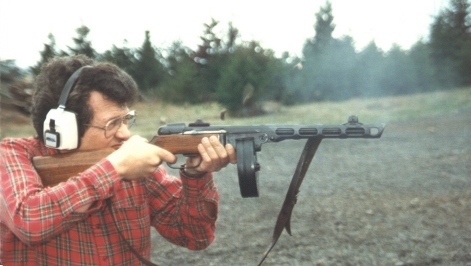 Kar98 The Mauser Karabiner 98k was the German army's standard rifle during World War II. Although officially designated as a carbine (karabiner), the 98k was only slightly shorter than the Gewehr 98 and Karabiner 98b, the World War I era rifles that it replaced. The "k" in 98k stood for kurz, the German word for "short." The bolt-action 98k was based on a Mauser Standard Model and went into production in 1935. The 98k was considered an accurate and reliable weapon, and approximately 14 million of them were produced before the end of the war. The 98k probably would have been replaced by the Sturmgewehr 44 had World War II lasted longer.  FG42 The FG42 was designed by Rheinmettal-Borsig for the Luftwaffe and introduced a number of features which were later copied on other firearms (most notably the U.S. M60 machinegun). By firing from a closed bolt in semiautomatic mode and an open bolt in full automatic mode, it combined the best of both a rifle and a light machinegun. Although it was made to fire the full-sized 7.92mm Mauser cartridge, felt recoil was reduced by the provision of an in-line stock, a muzzle brake, and an integral (albeit somewhat flimsy) bipod. The bayonet was also built in and could be stored beneath the bipod, it's weight effectively helping to reduce muzzle climb. Later models had wooden furniture and a more traditional pistol grip, as well as an improved muzzle brake. The rifle was also designed to accept the ZF4 (Zielfernrohr 4-fach) and ZF42 telescopic sights. These sights were nearly identical, both 4x, and were graduated from 100 to 800 meters in 50 meter increments, with a reticle consisting of a centre post with side bars. 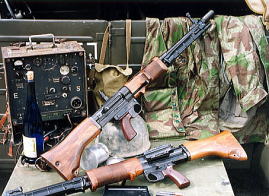 MG34 MG-34 is a recoil-operated, selective fire weapon. It uses short recoiling barrel with muzzle recoil booster which also serves as a flash hider. Barrel locking is achieved by the rotating bolt head, with interrupted threads locking lugs, that lock into the barrel extension. Bolt head has a set of rollers, located just behind the lugs. These rollers are used to rotate bolt heads to lock and unlock, when riding inside the curved grooves, cut on the inner walls of the receiver. Rollers also act as a bolt accelerator, when bolt unlocks, due to interoperation with the barrel extension. Tubular receiver is linked to the tubular barrel sleeve by the swinging stud, set at the right side of the receiver, so receiver can be turned up and to the right relatively tho the barrel sleeve, thus exposing the barrel rear end. When receiver is opened, barrel can be simply withdrawn from its sleeve to the back, but when barrel is hot, this requires some sort of the heat protection, so MG-34 operator had to use asbestos glove which was a standard acessory to the gun. MG-34 usually was issued with belt feed, which was operated by the stud on the top of the bolt body. Belt feed could be easily set up to take the belt from the left or from the right side of the gun. With special replacement feed cover, a double-drum, saddle-type 75 rounds magazines can be used. MG-34 was a selective fire weapon, with mode of fire being controlled by dual trigger. A pull on the upper part of the trigger produced single shots, while a pull on the lower part produced full auto bursts.  -------------------- "Wars come and go, But my soldiers they stay eternal" - Tupac Shakur |
|
|
|
| Barkmann |
02/14/07 1:52am
Post
#5
|
 Colonel  Group: {MOB} Regs Posts: 1034 Joined: December 1st 2006 From: Toronto/Canada Member No.: 2291 Xfire: barkmann77 |
You could say Barkmann was a weapon of WWII with his Panther Tank:
SS-Oberscharführer Ernst Barkmann was one of the best tank commanders of the 2nd SS Panzer Division Das Reich during his service on the Eastern Front. Born on 25 August 1919, he joined the SS-Standarte Germania in 1936, and was wounded during the Polish campaign in 1939. After fighting during operation Barbarossa, he was transferred to the 2nd Panzer Regiment, 2nd Kompanie of the SS Panzer Division Das Reich. On 8 July, he scored his first kill on the Western front when a American M4 Sherman tank fell victim to his panther's high velocity 75mm gun. On 12 July, three more Shermans were added to his score, but it was on 27 July that Barkmann earned his place as one of Germany's top panzer aces at an isolated crossroads on the St. Lo-Coutances road, which subsequently became known as "Barkmann Corner". His Panther parked in the shade of a large oak tree, Barkmann watched as a large American armored column of some 15 M4s and some other vehicles approached his position. Once they were well within range he opened fire, knocking out the first two lead Shermans. Behind them came a fuel tanker truck, and the panzer ace lost no time in taking out his choice target. As the wreckage of the Shermans and tanker truck blazed furiously, two more Shermans attempted to edge past the blockage. The first was quickly destroyed, though the second managed to get off a couple of shots. They were no match for the Panther's thick armor however, and this Sherman was also soon ablaze, as Barkmann's gunner picked off his targets. The Panther then came under attack from Allied fighter-bombers, wounding some crew members, blowing off a track and damaging the ventilation system. Under the cover of the air strike two more Shermans approached, only to find that Barkmann's tank had not suffered any serious damage and was still more than capable of fending off their challenge. The two Shermans were soon reduced to burning hulks. Barkmann managed to destroy one more Sherman before deciding discretion was the better part of valour and ordered his driver to reverse their way back out of danger. This in itself was no mean feat in a badly damaged Panther tank. Nine out of the 15 Shermans which had attacked his lone Panther were destroyed, together with other vehicles. In addition, despite fighter-bomber attacks and his tank being severely damaged, Barkmann managed to get his vehicle and crew back safely to German lines. He was decorated with the Knights Cross of the Iron Cross on 27 August for his achievements. Barkmann also fought in the Ardennes offensive in December 1944, and had an amazing escape near Manhay when his lone Panther encountered a large number of tanks of the US 2nd Armored Division. Despite being outnumbered Barkmann managed to knock out a few Sherman tanks. At one period in the battle his Panther collided with a Sherman and the two vehicles were locked together, the Panther's engine then cutting out. His driver managed to get the engine started and the Panther pulled itself away from the American tank and retreated with a blocked turret. He was followed by another Sherman, which was destroyed by Barkmann with a single shot. He then headed off the road and drove through snowy woods to reach his battalion. Oberscharfuhrer Ernst Barkmann in Panther 401 accidentally found himself as the spearhead of the 2nd SS Panzer Division's night assault on the crossroads at Manhay. Initially mistaking a lone Sherman of US 7th Armoured Division as that of his own commander, he pulled alongside the enemy tank, and only realised his mistake when he noticed it's unusual red interior lights. In a brief close quarter fight he managed to destroy the M4 with the Panther's anti-personnel mortar (Panzergranate). He then proceeded along the moonlit forest roads past a succession of surprised American units to Manhay and on towards Liege, having left several destroyed vehicles in his wake. His appearance caused havoc in the US defences, culminating in a rout. This post has been edited by Barkmann: 02/14/07 1:53am --------------------  Everything is funny as long as it is happening to somebody else. |
|
|
|
| The mad Camel |
02/16/07 6:12pm
Post
#6
|
 PFC Group: Forum Member Posts: 13 Joined: October 21st 2006 From: New Hampshire, USA Member No.: 2101 |
Cool thread. I'm not much of a writer so I'll cut and past, from http://mosinnagant.net/
Mosin Nagant Model 1938 Carbine "In accord with it's western counterparts, the Soviet Union followed the pattern of the United States, Britain, and Germany in discontinuing the production of a long infantry rifle in favor of a shortened all purpose weapon of an intermediate barrel length, usually a barrel length of 24 to 30 inches. The Russians also issued short carbines based on this intermediate length rifle to mounted troops, crew served weapons teams and general support troops. An exhaustive series of trials and field tests lasting almost eight years (1922-1930) were conducted concerning the adoption of a modernized infantry rifle based upon the basic design of the day- the m/91 Dragoon which was nothing more than a shortened m/1891. The Dragoon rifle did have some advantages over the earlier m/1891 design though. Chief amongst these were that the rifle utilized a simplified set of barrel bands and a new handguard. The simple fact remained though that the standard infantry rifle of the Red Army needed to be brought up to date with the current military standards. A modernized version of the rifle was finally adopted on April 28th 1930 and adopted as the m/1891-30 rifle. (4) In short the rifle is referred to as simply the m/91-30. This new rifle was produced with a new tangent rear sight graduated in meters and a fully protected front sight to replace the earlier Dragoons unprotected blade. The new m/91-30 also saw simplified barrel bands and band springs as well as a newly designed handguard. These updates further simplified production and reduced the cost of each rifle. The adoption of the new m/91-30 found the Red Army placed in the awkward position though of having a modernized infantry rifle adopted for service but an antiquated carbine fulfilling the auxiliary and crew served weapons role. The carbine model of 1907 was the standard weapon adopted to fulfill this role for the infantry and support troops of the Red Army. This mismatch in equipment created some problems because the 1907 carbine was not based on the same modernized and updated design of the new infantry rifle and further more had been out of production for some 15 years. As the serviceable condition of the m/1907 carbines deteriorated, it was decided that an updated carbine based upon the modernized designs and upgrades of the m/91-30 was also needed to replace the m/1907 and to complement the new rifle of 1930. (1)" To read the rest of this article please visit http://mosinnagant.net/USSR/Model-1938-Carbine.asp A pic of my M38 (not a very good one though)  This post has been edited by The mad Camel: 02/16/07 6:14pm --------------------  |
|
|
|
|
1 User(s) are reading this topic (1 Guests and 0 Anonymous Users)
0 Members:


|
Lo-Fi Version | Time is now: 05/03/26 11:16am |
Invision Power Board
© 2026 IPS, Inc.