The German Army determine that most firefights took place at short ranges, around 400 meters. This conclusion resulted from a detail analysis of engagements during the years of 1939 and 1940. The primary German weapon of the time, the bolt-action Kar98K rifle, was ill-suited for the mission. It was designed for longer-range precision fire between the ranges of 800 -1000 meters. On the other side, the existing sub-machine guns like the MP40 lacked the range or stopping power with the 9mm ammunition. The solution: first design compact ammunition, ideal for a new automatic weapon, with the proper balance between range and power. The cartridge designed was the 7.92x33 Kurtz cartridge, which provided an excellent balance between hitting power and control.
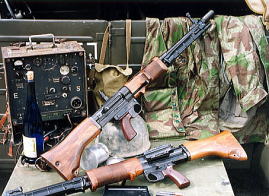
Next came the rifle design. Carbine submachine gun specifications were issued to the firms of Haenel and Walther in 1942. Limited numbers of trail weapons were produced and tested on the Eastern Front. The Maschinkarabiner 42 (H) or MKb42(H) came from Haenel while the Walther weapon designation was Maschinkarabiner 42 (W) or MKb42(W). Trials for both proved quite successful. Troops embraced these first ever assault guns. Yet Hitler decided that these development programs should be stopped. Haenel did not comply with the order and resorted to subterfuge to be able to continue development. The Haenel weapon was renamed to hide its true identity, now the carbine designation changed to a sub-machine gun, the Maschinenpistole 43 or sub-machine gun 43, or MP43. With further modification and improvement, came the first production version, the Maschinenpistole 44 or MP44. Limited numbers reached the troops. His generals raved about its capabilities and boldly demanded more. Hitler decided to support the weapon, giving it the new designation, the Sturmgewehr 44 (StG44) or Storm Assault Rifle 44

MP40 ( Schmeisser 40 )
They referred to it as the 'Schmeisser', even though the company of weapons designer Hugo Schmeisser, famous for the Bergmann MP-18 submachine gun from WW I, had nothing to do with the MP38 or the MP40.
The MP-40 was a blowback operated, full auto submachine gun that fires open bolt. The charging handle on the left side of the receiver is also used as a safety, locking the bolt in its forward or rearward position when placed into slots in the receiver. The rate of fire was controlled to 400-500 rounds per minute of the 9mm Parabellum cartridge, a good rate for control by the operator. The metal "bump" on the underside, near the end of the barrel was designed to help steady the weapon when firing from the port of an armored vehicle.
More than a million MP-40s were produced by Germany during the war. Its folding metal stock made it compact and easy to carry. (The MP-38 had wodden stocks.) The foregrip was made of high-pressure molded phenolin resin, reinforced with paper pulp. This innovative material also insulated the operator from the heat of the barrel and other metal parts. The 25 or 32 round single column magazine was considered troublesome, a weakness of the design.

Ok the rest I'll leave to find for those who are interested in learning more.