Do one on Dieppe....Another "sacrifice" made by the Canadians. It seems to me, that if there was a dirty job from which there was no hope of victory, the British usually gave this to the Canadians. and If the Canadians turned it down, it went to the Poles.....
You could also do my Barbarossa Favorites: Hoepner, Hoth and Guderian.
Lead
Full Version: Notable People of WW2
getting backed up? when do you play feezy,hehe!
Time for one of the best Aces during the Finnish Winterwar.
Strix Nebulosa - Lapinpöllö
FR: Chouette lapone Owl of Lapland
ES: Cárabo lapón Owl of Lapland
DE: Bartkauz Beardowl
NL: Lapland Uil Lapland Owl
Da: Lapugle Lapowl
FI: Lapinpöllö Lapland Owl
(I think you can think of the reason why Europeans call it Lapland Owl)
Strix is latin for the Owls (Genus), The etymological root of "nebula" means "cloud". Nabulaso is plural.
So it should be named Cloud Owl or Clouded Owl.

Great Grey Owl
They breed in North America from Lake Superior to the Pacific coast and Alaska, and from Scandinavia across northern Asia. They are permanent residents, but may move south and southeast when food is scarce. A small population, estimated at less than 100 birds, occurs in the Sierra Nevada mountains of California. This population is the southernmost population of the species range.
Their breeding habitat is dense coniferous forest near open areas, such as meadows or bogs. Great grey owls do not build nests, so typically use nests previously used by another large bird, such as a raptor. They will also nest in broken-top trees and cavities in large trees. Four eggs is the usual clutch.
The Great Grey Owl is 61–84 cm (24–33 in) in length, averaging 72 cm (28 in) for females, 69 cm (27 in) for males. The wingspan is up to 152 cm (60 in) averaging 142 cm (56 in) for female, 140 cm (55 in) for males. The adult weight is 790–1454 g (28–51 oz) averaging 1,390g (49 oz) for females, 1,290 g (45½ oz) for males.
Adults have a round head with a grey face and yellow eyes with darker circles around them. The underparts are light with dark streaks; the upper parts are grey with pale bars. This owl does not have ear tufts.
These birds wait, listen and watch for prey, then swoop down; they also may fly low through open areas in search of prey. They mainly eat small mammals, with voles being their most important food source, and sometimes small birds. In California, gophers provide important secondary prey when vole populations are low. On the nesting grounds, they mainly hunt at night and near dawn and dusk; at other times, they may be active day or night. They have excellent hearing and may capture prey moving beneath the snow. Their large facial disks focus sound, and the asymmetrical placement of their ears assists them in locating prey.
Captive birds have been know to live as long as 40 years. Mortality in the wild is mostly due to starvation. These birds have no fear of vehicles, hence are often victims of collisions when they venture into populated areas seeking food.
Bubo scandiacus
FR: Chouette harfang Owl (always sucked at french)
ES: Búho Nival Let alone that I studied Spanish
DE: Schnee-Eule Snow Owl
NL: Sneew Uil Snow Owl
Da: Sneugle Snow Owl
FI: Tunturipöllö Hill Owl (Tunturi is a dificult word to proper translate)

Snowy Owl
The Snowy Owl (Bubo scandiacus) is a large owl of the typical owl family Strigidae. Until recently, it was regarded as the sole member of a distinct genus, as Nyctea scandiaca, but genetic analysis showed that it is very closely related to the horned owls in the genus Bubo. It is also known in North America as the Arctic Owl or the Great White Owl.
This huge yellow-eyed white bird is unmistakable. It is 53-65 cm long with a 125-150 cm wingspan. The adult male is virtually pure white, but females and young birds have some dark scalloping; the young are heavily barred, and dark spotting may even predominate. Its thick plumage, heavily-feathered feet, and coloration render the Snowy Owl well-adapted for life north of the Arctic Circle.
Snowy Owl calls are varied, but the alarm call is a barking, almost quacking krek-krek-krek-krek; the female also has a softer mewling pyee-pyee-pyee-pyee. The song is a deep repeated gawh.They may also clap their beak in response to threats or annoyances. While called clapping, it is believed this sound may actually be a clicking of the tongue, not the bill.
The Snowy Owl is typically found in the northern circumpolar region, where it makes its summer home north of latitude 60 degrees north. However, it is a particularly nomadic bird, and because population fluctuations in its prey species can force it to relocate, it has been known to breed at more southerly latitudes than this.
This species of owl nests on the ground, building a scrape on top of a mound or boulder. A site with good visibility, ready access to hunting areas, and a lack of snow is chosen. Gravel bars and abandoned eagle nests may be used. Breeding occurs in May, and depending on the amount of prey available, clutch sizes range from 5 to 14 eggs, which are laid singly, approximately every other day over the course of several days. Hatching takes place approximately five weeks after laying, and the pure white young are cared for by both parents. Snowy Owls winter south through Canada and northernmost Eurasia, with irruptions occurring further south in some years. They have been reported as far south as Texas, Georgia, the American Gulf states, southern Russia and northern China. Between 1967 and 1975, Snowy Owls bred on the remote island of Fetlar in the Shetland Isles north of Scotland, UK. Females summered as recently as 1993, but their status in the British Isles is now that of a rare winter visitor to Shetland, the Outer Hebrides and the Cairngorms.
This powerful bird relies primarily on lemmings and other rodents for food, but at times when these prey are not available, or during the ptarmigan nesting period, they may switch to ptarmigan young. As opportunistic hunters, they feed on a wide variety of small mammals and birds, and will take advantage of larger prey, frequently following traplines to find food. Nesting birds require roughly two lemmings per day, and a family may eat up to 1500 lemmings before the young birds set off to fend for themselves.
Due to their beauty Snowy Owls are kept in captivity by wildlife centers, zoological gardens and by serious hobbyists. They are known to be sensitive to disease, stress and heat, frequently perishing during attempts to train a wild owl during the summer. These owls are not suitable for beginning raptor keepers.

Bubo scandiacus probaly can be translated like Scandinavian Owl. If you're bored and want to know more about the name Scandinavia..
The etymology for the names Scandinavia and Skåne (Scania) is considered to be the same. The earliest source is Pliny the Elder's "Natural History". Pliny lived and wrote in the 1st century AD. As the Goths had already left Sweden four or five hundred years previously and were probably already speaking east Germanic (Gothic), Pliny's names were were of west Germanic origin. North Germanic had not yet divided from west Germanic.
Pliny, an admiral, says that there were 23 islands "Romanis armis cognitae", "known to Roman arms." His descriptions are not always clear, even though he was speaking of geography he considered revealed by a "clarior fama", "a clearer story." He begins (4.96) with the huge mountain of Saevo, which forms the Codanian Bay surrounding the Cimbrian promontory. These features are the mountainous coasts of Norway and Sweden, the Skagerrak and Skagen. Saevo is most likely an early form of Zeeland, which Pliny applied to southern Scandinavia. The Cod- in Codanian is a form of the second element in Katte-gat.
According to Pliny, in the Codanian Bay is an island, Scatinavia, of unknown size. There live the Hilleviones, who can probably be identified with what is now Halland. As described, Saevo and Scatinavia are the same place.
Pliny mentions Scandinavia one more time: in 8.39 he says that the animal called achlis (given in the accusative, achlin), was born on the island of Scadinavia. Achlis is not Latin. As well as having some mythical attributed, the animal grazes and has a big upper lip. Pliny also uses the name Scandiae to mean some islands near Britain.
This is all we are granted to know. The several derivations are based on alternative segmentations of the word. Is it Scan-din-avia or Scand-in-avia? One segment on which almost everyone agrees is -avia, "island", seeing that Pliny calls it an island. The segment is used in many other names in just this way. But what did Pliny mean by this? Scandinavia is not an island. The Romana arma would have known if it was.
To make a long story short, we don't know what Scandin- means and probably never will. The island part of it, however, was once true. At various times in the prehistory of Scandinavia, when much of it was occupied by Mesolithic indigenes, Skåne was an island. The sea passed through where Stockholm now is. It would not be contrary to the prehistory if in fact the indigenes were responsible for the first segment and also passed on the tradition of the island. Perhaps they also called the reindeer ochlis.
The Germanic reconstruction based on Pliny is *Skaðinawjo, without the n, which can be seen as a later assimilation to the second n, and with the thorn, which Latin does not have, and which might be represented in Latin by t or d. You can obtain quite a few meaning from Scadin-: "climbing island" (*scand-), "island of the Scythian people", "island of the woodland of *sca-", and others no doubt.
One strong derivation is from the Germanic *Skaðin- meaning "danger" (cf. English scathing and unscathed, and German Schade and beschädigen) and *awjo meaning "island". It may have referred to the dangerous banks around Skanör (skan- is the same as in Scandinavia, and -ör means "sandbanks") and Falsterbo in Skåne in southernmost Sweden. This root also may not be Indo-european.
Alternatively, the first element is sometimes attributed to the Scandinavian giantess Skaði from Norse mythology. If it is she, it is even less likely to be Indo-European, as a people moving in among another people typically take on their gods and goddesses (not quite daring to reject them).
The original form gave rise to different forms in Germanic languages often transliterated by non-Germanic scribes. Ptolemy uses the form Scandia, showing that the n had appeared by then. In Beowulf we meet the forms Scedenigge and Scedeland. Pomponius Mela used Codanovia, based on the ancient name of the Kattegat. This usage appears to support the "sealand" idea. The form Scadinavia, the original home of the Langobards, appears in Paulus Diaconus' Historia Langobardorum, but in other versions of Historia Langobardorum appear the forms Scadan, Scandanan, Scadanan and Scatenauge. In Jordanes' history of the Goths (AD 551) we meet the form Scandza their original home, separated by sea from the land of Europe. If the -za represents an early form of zee, then Scand-, whatever it means, might have replaced "sea" by being linked with it in some way: "scand- sealand". On the other hand, Jordanes' spelling, being late Latin, may just be an attempt to capture the palatalization of the d by a following i.
The name of the Scandinavian mountain range, Skanderna in Swedish, was artificially derived from Skandinavien in the 19th century, in analogy with Alperna for the Alps. The commonly used names are bergen or fjällen; both names meaning "the mountains.
Strix Nebulosa - Lapinpöllö
FR: Chouette lapone Owl of Lapland
ES: Cárabo lapón Owl of Lapland
DE: Bartkauz Beardowl
NL: Lapland Uil Lapland Owl
Da: Lapugle Lapowl
FI: Lapinpöllö Lapland Owl
(I think you can think of the reason why Europeans call it Lapland Owl)
Strix is latin for the Owls (Genus), The etymological root of "nebula" means "cloud". Nabulaso is plural.
So it should be named Cloud Owl or Clouded Owl.
Great Grey Owl
They breed in North America from Lake Superior to the Pacific coast and Alaska, and from Scandinavia across northern Asia. They are permanent residents, but may move south and southeast when food is scarce. A small population, estimated at less than 100 birds, occurs in the Sierra Nevada mountains of California. This population is the southernmost population of the species range.
Their breeding habitat is dense coniferous forest near open areas, such as meadows or bogs. Great grey owls do not build nests, so typically use nests previously used by another large bird, such as a raptor. They will also nest in broken-top trees and cavities in large trees. Four eggs is the usual clutch.
The Great Grey Owl is 61–84 cm (24–33 in) in length, averaging 72 cm (28 in) for females, 69 cm (27 in) for males. The wingspan is up to 152 cm (60 in) averaging 142 cm (56 in) for female, 140 cm (55 in) for males. The adult weight is 790–1454 g (28–51 oz) averaging 1,390g (49 oz) for females, 1,290 g (45½ oz) for males.
Adults have a round head with a grey face and yellow eyes with darker circles around them. The underparts are light with dark streaks; the upper parts are grey with pale bars. This owl does not have ear tufts.
These birds wait, listen and watch for prey, then swoop down; they also may fly low through open areas in search of prey. They mainly eat small mammals, with voles being their most important food source, and sometimes small birds. In California, gophers provide important secondary prey when vole populations are low. On the nesting grounds, they mainly hunt at night and near dawn and dusk; at other times, they may be active day or night. They have excellent hearing and may capture prey moving beneath the snow. Their large facial disks focus sound, and the asymmetrical placement of their ears assists them in locating prey.
Captive birds have been know to live as long as 40 years. Mortality in the wild is mostly due to starvation. These birds have no fear of vehicles, hence are often victims of collisions when they venture into populated areas seeking food.
Bubo scandiacus
FR: Chouette harfang Owl (always sucked at french)
ES: Búho Nival Let alone that I studied Spanish
DE: Schnee-Eule Snow Owl
NL: Sneew Uil Snow Owl
Da: Sneugle Snow Owl
FI: Tunturipöllö Hill Owl (Tunturi is a dificult word to proper translate)
Snowy Owl
The Snowy Owl (Bubo scandiacus) is a large owl of the typical owl family Strigidae. Until recently, it was regarded as the sole member of a distinct genus, as Nyctea scandiaca, but genetic analysis showed that it is very closely related to the horned owls in the genus Bubo. It is also known in North America as the Arctic Owl or the Great White Owl.
This huge yellow-eyed white bird is unmistakable. It is 53-65 cm long with a 125-150 cm wingspan. The adult male is virtually pure white, but females and young birds have some dark scalloping; the young are heavily barred, and dark spotting may even predominate. Its thick plumage, heavily-feathered feet, and coloration render the Snowy Owl well-adapted for life north of the Arctic Circle.
Snowy Owl calls are varied, but the alarm call is a barking, almost quacking krek-krek-krek-krek; the female also has a softer mewling pyee-pyee-pyee-pyee. The song is a deep repeated gawh.They may also clap their beak in response to threats or annoyances. While called clapping, it is believed this sound may actually be a clicking of the tongue, not the bill.
The Snowy Owl is typically found in the northern circumpolar region, where it makes its summer home north of latitude 60 degrees north. However, it is a particularly nomadic bird, and because population fluctuations in its prey species can force it to relocate, it has been known to breed at more southerly latitudes than this.
This species of owl nests on the ground, building a scrape on top of a mound or boulder. A site with good visibility, ready access to hunting areas, and a lack of snow is chosen. Gravel bars and abandoned eagle nests may be used. Breeding occurs in May, and depending on the amount of prey available, clutch sizes range from 5 to 14 eggs, which are laid singly, approximately every other day over the course of several days. Hatching takes place approximately five weeks after laying, and the pure white young are cared for by both parents. Snowy Owls winter south through Canada and northernmost Eurasia, with irruptions occurring further south in some years. They have been reported as far south as Texas, Georgia, the American Gulf states, southern Russia and northern China. Between 1967 and 1975, Snowy Owls bred on the remote island of Fetlar in the Shetland Isles north of Scotland, UK. Females summered as recently as 1993, but their status in the British Isles is now that of a rare winter visitor to Shetland, the Outer Hebrides and the Cairngorms.
This powerful bird relies primarily on lemmings and other rodents for food, but at times when these prey are not available, or during the ptarmigan nesting period, they may switch to ptarmigan young. As opportunistic hunters, they feed on a wide variety of small mammals and birds, and will take advantage of larger prey, frequently following traplines to find food. Nesting birds require roughly two lemmings per day, and a family may eat up to 1500 lemmings before the young birds set off to fend for themselves.
Due to their beauty Snowy Owls are kept in captivity by wildlife centers, zoological gardens and by serious hobbyists. They are known to be sensitive to disease, stress and heat, frequently perishing during attempts to train a wild owl during the summer. These owls are not suitable for beginning raptor keepers.
Bubo scandiacus probaly can be translated like Scandinavian Owl. If you're bored and want to know more about the name Scandinavia..
The etymology for the names Scandinavia and Skåne (Scania) is considered to be the same. The earliest source is Pliny the Elder's "Natural History". Pliny lived and wrote in the 1st century AD. As the Goths had already left Sweden four or five hundred years previously and were probably already speaking east Germanic (Gothic), Pliny's names were were of west Germanic origin. North Germanic had not yet divided from west Germanic.
Pliny, an admiral, says that there were 23 islands "Romanis armis cognitae", "known to Roman arms." His descriptions are not always clear, even though he was speaking of geography he considered revealed by a "clarior fama", "a clearer story." He begins (4.96) with the huge mountain of Saevo, which forms the Codanian Bay surrounding the Cimbrian promontory. These features are the mountainous coasts of Norway and Sweden, the Skagerrak and Skagen. Saevo is most likely an early form of Zeeland, which Pliny applied to southern Scandinavia. The Cod- in Codanian is a form of the second element in Katte-gat.
According to Pliny, in the Codanian Bay is an island, Scatinavia, of unknown size. There live the Hilleviones, who can probably be identified with what is now Halland. As described, Saevo and Scatinavia are the same place.
Pliny mentions Scandinavia one more time: in 8.39 he says that the animal called achlis (given in the accusative, achlin), was born on the island of Scadinavia. Achlis is not Latin. As well as having some mythical attributed, the animal grazes and has a big upper lip. Pliny also uses the name Scandiae to mean some islands near Britain.
This is all we are granted to know. The several derivations are based on alternative segmentations of the word. Is it Scan-din-avia or Scand-in-avia? One segment on which almost everyone agrees is -avia, "island", seeing that Pliny calls it an island. The segment is used in many other names in just this way. But what did Pliny mean by this? Scandinavia is not an island. The Romana arma would have known if it was.
To make a long story short, we don't know what Scandin- means and probably never will. The island part of it, however, was once true. At various times in the prehistory of Scandinavia, when much of it was occupied by Mesolithic indigenes, Skåne was an island. The sea passed through where Stockholm now is. It would not be contrary to the prehistory if in fact the indigenes were responsible for the first segment and also passed on the tradition of the island. Perhaps they also called the reindeer ochlis.
The Germanic reconstruction based on Pliny is *Skaðinawjo, without the n, which can be seen as a later assimilation to the second n, and with the thorn, which Latin does not have, and which might be represented in Latin by t or d. You can obtain quite a few meaning from Scadin-: "climbing island" (*scand-), "island of the Scythian people", "island of the woodland of *sca-", and others no doubt.
One strong derivation is from the Germanic *Skaðin- meaning "danger" (cf. English scathing and unscathed, and German Schade and beschädigen) and *awjo meaning "island". It may have referred to the dangerous banks around Skanör (skan- is the same as in Scandinavia, and -ör means "sandbanks") and Falsterbo in Skåne in southernmost Sweden. This root also may not be Indo-european.
Alternatively, the first element is sometimes attributed to the Scandinavian giantess Skaði from Norse mythology. If it is she, it is even less likely to be Indo-European, as a people moving in among another people typically take on their gods and goddesses (not quite daring to reject them).
The original form gave rise to different forms in Germanic languages often transliterated by non-Germanic scribes. Ptolemy uses the form Scandia, showing that the n had appeared by then. In Beowulf we meet the forms Scedenigge and Scedeland. Pomponius Mela used Codanovia, based on the ancient name of the Kattegat. This usage appears to support the "sealand" idea. The form Scadinavia, the original home of the Langobards, appears in Paulus Diaconus' Historia Langobardorum, but in other versions of Historia Langobardorum appear the forms Scadan, Scandanan, Scadanan and Scatenauge. In Jordanes' history of the Goths (AD 551) we meet the form Scandza their original home, separated by sea from the land of Europe. If the -za represents an early form of zee, then Scand-, whatever it means, might have replaced "sea" by being linked with it in some way: "scand- sealand". On the other hand, Jordanes' spelling, being late Latin, may just be an attempt to capture the palatalization of the d by a following i.
The name of the Scandinavian mountain range, Skanderna in Swedish, was artificially derived from Skandinavien in the 19th century, in analogy with Alperna for the Alps. The commonly used names are bergen or fjällen; both names meaning "the mountains.
QUOTE(Leadmagnet @ 03/30/06 6:42pm) 
Do one on Dieppe....Another "sacrifice" made by the Canadians. It seems to me, that if there was a dirty job from which there was no hope of victory, the British usually gave this to the Canadians. and If the Canadians turned it down, it went to the Poles.....
You could also do my Barbarossa Favorites: Hoepner, Hoth and Guderian.
Lead
You could also do my Barbarossa Favorites: Hoepner, Hoth and Guderian.
Lead
oh , Lord Mountbatten ......... well let's let Feezy tell the story. 50 US Rangers were in the raid too.
Actually a Mountbatten/Dieppe article might be very very interesting.
Monty at times griped to the talented Canuck generals when they came up with intelligent plans of attack that went a long way to saving lives in the Canadian Army.... but losses were very heavy in very tough fighting in Hong Kong, Italy, the Netherlands, and northern Germany.
Tuskegee Airmen
"Schwarze Vogelmenschen" "Redtails"

Bit Big picture, but to lovely to not add..
http://www.wemba-music.org/Tuskegee_Airmen...hia_Chapter.jpg
Prior to the Tuskegee Airmen all combat pilots had been white. However a series of legislative moves by the United States Congress in 1941 forced the Air Corps to form an all-black combat unit, much to the War Department's chagrin. In response they set up a system to accept only those with a level of flight experience or higher education that they expected to be hard to fill, a half-hearted effort to eliminate the unit before it could begin. This policy backfired, and soon the Air Corps was receiving applications from men who clearly met the grade.
The U.S. Army Air Corps had established the Psychological Research Unit 1 at Maxwell Army Air Field, Alabama, and other units around the country for Aviation Cadet Training, which included the identification, selection, education, and training of pilots, navigators, and bombardiers. Psychologists were employed in these studies and training programs using some of the first standardized tests to quantify IQ, dexterity, and leadership qualities in order to select and train the right personnel for the right role (pilot, navigator, bombardier). The Air Corps determined that the same existing programs would be used as well for all-black units. At Tuskegee, this effort would continue with the selection and training of the Tuskegee Airmen.

99th Fighter Squadron
On March 19, 1941, the 99th Pursuit Squadron (Pursuit being an early WWII synonym for "Fighter") was activated at Chanute Field in Rantoul, Illinois Over 250 enlisted men were trained at Chanute in aircraft ground support trades. This small number of enlisted men was to become the core of other black squadrons forming at Tuskegee and Maxwell Fields in Alabama — the famed Tuskegee Airmen.
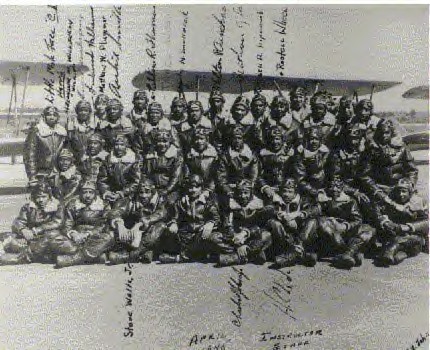
In June 1941, the Tuskegee program was officially started with the formation of the 99th Fighter Squadron, formed up at the Tuskegee Institute, a famous school founded by Booker T. Washington in Tuskegee, Alabama. The unit included an entire service arm, including ground crew, and not just pilots. After basic training at Moton Field, they were moved to the nearby Tuskegee Army Air Field about 10 miles to the west for conversion training onto operational types. They were put under the command of Captain Benjamin O. Davis Jr., a West Point graduate. Colonel Noel Parrish took over as commander. Parrish, though white, was open-minded and petitioned Washington to allow the Airmen to serve in combat.

USS Mariposa
The 99th was ready for combat duty during the USA's first actions and was transported to Casablanca, Morocco on the USS Mariposa. From there, they travelled by train to Oujda near Fes. From here, they made their way to Tunis to operate against the Luftwaffe. The flyers and ground crew were largely isolated by the segregation policies of the military, and left with little guidance from battle-experienced pilots. The 99th's first mission was to take the island of Pantelleria. For a time they were attached to the 33d Fighter Group, whose commander left them out of most missions. Things changed when they were moved to Sicily and attached to the 79th Fighter Group, whose commander involved them fully. The Airmen were initially equipped with P-39 Airacobras, later with P-47 Thunderbolts, and finally with the airplane that would become their signature, the P-51 Mustang. The squadron took bomber escort duty, helping make the Anzio Campaign a success. Here they quickly racked up an impressive combat record, often entering combat against greater numbers of superior planes, and coming out victorious. The Luftwaffe soon awarded them the nickname, "Schwarze Vogelmenschen," or Black Birdmen, and started to avoid them when possible. The Allies called the Airmen "Redtails" or "Redtail Angels" because of the distinctive crimson paint jobs on their aircraft' vertical stabilizers. Although bomber groups would request Redtail escort when possible, most bomber crewmen never knew at the time that the Redtails were black. The Redtails were the only fighter group who never lost a bomber to enemy fighters.
http://www.aviation-artist.com/images/Red_Tails.jpg RedTails.
By this point more graduates were ready for combat, and the all-black 332d Fighter Group had been created from three new squadrons, the 100th, 301st and 302d. Under the command of Colonel Benjamin O. Davis, these were moved to mainland Italy, where they were eventually joined by the 99th. The Airmen eventually served on bombing raids into Austria, Hungary, Poland, and Germany. The 477th Bombardment Group (Medium), was forming in the US, but completed training too late to see action.
By the end of the war the 332d had claimed over 400 Luftwaffe aircraft (including 3 of the 8 Me-262s shot down by Allied aircraft), a destroyer sunk only by machine gun fire, and numerous fuel dumps, trucks and trains. They flew more than 15,000 sorties and 1500 missions. The unit received recognition through official channels, and won two Presidential Unit Citations, 744 Air Medals, 150 Distinguished Flying Crosses, fourteen Bronze Stars and several Silver Stars.
In all, 992 pilots were trained in Tuskegee from 1940 to 1946. About 450 deployed overseas and 150 lost their lives in training or combat.
http://www.coax.net/people/lwf/tairmen.jpg Tuskegee Airmen Memorial!
"Schwarze Vogelmenschen" "Redtails"
Bit Big picture, but to lovely to not add..
http://www.wemba-music.org/Tuskegee_Airmen...hia_Chapter.jpg
Prior to the Tuskegee Airmen all combat pilots had been white. However a series of legislative moves by the United States Congress in 1941 forced the Air Corps to form an all-black combat unit, much to the War Department's chagrin. In response they set up a system to accept only those with a level of flight experience or higher education that they expected to be hard to fill, a half-hearted effort to eliminate the unit before it could begin. This policy backfired, and soon the Air Corps was receiving applications from men who clearly met the grade.
The U.S. Army Air Corps had established the Psychological Research Unit 1 at Maxwell Army Air Field, Alabama, and other units around the country for Aviation Cadet Training, which included the identification, selection, education, and training of pilots, navigators, and bombardiers. Psychologists were employed in these studies and training programs using some of the first standardized tests to quantify IQ, dexterity, and leadership qualities in order to select and train the right personnel for the right role (pilot, navigator, bombardier). The Air Corps determined that the same existing programs would be used as well for all-black units. At Tuskegee, this effort would continue with the selection and training of the Tuskegee Airmen.
99th Fighter Squadron
On March 19, 1941, the 99th Pursuit Squadron (Pursuit being an early WWII synonym for "Fighter") was activated at Chanute Field in Rantoul, Illinois Over 250 enlisted men were trained at Chanute in aircraft ground support trades. This small number of enlisted men was to become the core of other black squadrons forming at Tuskegee and Maxwell Fields in Alabama — the famed Tuskegee Airmen.
In June 1941, the Tuskegee program was officially started with the formation of the 99th Fighter Squadron, formed up at the Tuskegee Institute, a famous school founded by Booker T. Washington in Tuskegee, Alabama. The unit included an entire service arm, including ground crew, and not just pilots. After basic training at Moton Field, they were moved to the nearby Tuskegee Army Air Field about 10 miles to the west for conversion training onto operational types. They were put under the command of Captain Benjamin O. Davis Jr., a West Point graduate. Colonel Noel Parrish took over as commander. Parrish, though white, was open-minded and petitioned Washington to allow the Airmen to serve in combat.
USS Mariposa
The 99th was ready for combat duty during the USA's first actions and was transported to Casablanca, Morocco on the USS Mariposa. From there, they travelled by train to Oujda near Fes. From here, they made their way to Tunis to operate against the Luftwaffe. The flyers and ground crew were largely isolated by the segregation policies of the military, and left with little guidance from battle-experienced pilots. The 99th's first mission was to take the island of Pantelleria. For a time they were attached to the 33d Fighter Group, whose commander left them out of most missions. Things changed when they were moved to Sicily and attached to the 79th Fighter Group, whose commander involved them fully. The Airmen were initially equipped with P-39 Airacobras, later with P-47 Thunderbolts, and finally with the airplane that would become their signature, the P-51 Mustang. The squadron took bomber escort duty, helping make the Anzio Campaign a success. Here they quickly racked up an impressive combat record, often entering combat against greater numbers of superior planes, and coming out victorious. The Luftwaffe soon awarded them the nickname, "Schwarze Vogelmenschen," or Black Birdmen, and started to avoid them when possible. The Allies called the Airmen "Redtails" or "Redtail Angels" because of the distinctive crimson paint jobs on their aircraft' vertical stabilizers. Although bomber groups would request Redtail escort when possible, most bomber crewmen never knew at the time that the Redtails were black. The Redtails were the only fighter group who never lost a bomber to enemy fighters.
http://www.aviation-artist.com/images/Red_Tails.jpg RedTails.
By this point more graduates were ready for combat, and the all-black 332d Fighter Group had been created from three new squadrons, the 100th, 301st and 302d. Under the command of Colonel Benjamin O. Davis, these were moved to mainland Italy, where they were eventually joined by the 99th. The Airmen eventually served on bombing raids into Austria, Hungary, Poland, and Germany. The 477th Bombardment Group (Medium), was forming in the US, but completed training too late to see action.
By the end of the war the 332d had claimed over 400 Luftwaffe aircraft (including 3 of the 8 Me-262s shot down by Allied aircraft), a destroyer sunk only by machine gun fire, and numerous fuel dumps, trucks and trains. They flew more than 15,000 sorties and 1500 missions. The unit received recognition through official channels, and won two Presidential Unit Citations, 744 Air Medals, 150 Distinguished Flying Crosses, fourteen Bronze Stars and several Silver Stars.
In all, 992 pilots were trained in Tuskegee from 1940 to 1946. About 450 deployed overseas and 150 lost their lives in training or combat.
http://www.coax.net/people/lwf/tairmen.jpg Tuskegee Airmen Memorial!
QUOTE(FeezyWeezy @ 04/02/06 10:22pm)
Tuskegee Airmen
By the end of the war the 332d had claimed over 400 Luftwaffe aircraft (including 3 of the 8 Me-262s shot down by Allied aircraft), ..............
By the end of the war the 332d had claimed over 400 Luftwaffe aircraft (including 3 of the 8 Me-262s shot down by Allied aircraft), ..............
Good job Feezy.......... In fact, they were requested as escorts since none of the bombers they escorted were lost to enemy fighters. .... and shooting down jets with propeller planes>I can't imagine such a feat. I think there's footage of that too. Thanks too, to Eleanor Roosevelt and her efforts in the war pushing to get everyone working together equally in the war effort.
Bram van der Stok
"Bob Vanderstok"
Dutch Greatest

RNAF / RAF - Officer Order of Orange Nassau with swords
Bronze Lion, the Flying cross (x2), The Bronze Cross, OBE,
Officer Order of Leopold II with swords, War Cross (Poland)
Croix the Guerre (Belgium), Croix the Guerre (France) &
an Honorary Commodore of the US Auxiliary Coast Guard</H2>

Bram van der Stok (Born October 13, 1915 in Pladjoe, Sumatra, Died 8 Feb 1993 in Honolulu), also referred to as Bob Vandertok, was the most decorated aviator in Dutch history, as well as one of three to escape from the German POW camp Stalag Luft III and make it back to England.
He spent his childhood between Sumatra, the Netherlands and the Dutch West Indies. After finishing his education at the Lyceum Alpinum in Switzerland he studied medicine at Leiden University where he became enamored with rowing and ice hockey, and in 1936 he joined the Royal Netherlands Air Force where he flew a Fokker D-XXI, and continued his medical training at Utrecht University.
When the Netherlands was attacked by German forces in 1940, Bram scored the first victory when he shot down two Messerschmitt Bf 109s while on patrol over De Kooy airfield. After the Netherlands' capitulation, he made three unsuccessful attempts to escape to England, before finally reaching Scotland by raft in June 1941. He was awarded the Dutch Bronze Cross for his actions by Queen Wilhelmina, and flew briefly in the 91st Squadron before being transferred to the 41st Squadron where he racked up another six kills to become an ace pilot.
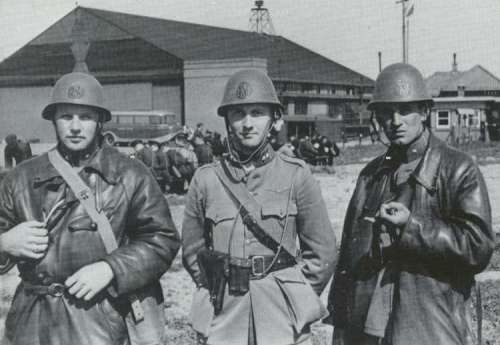
Bram van der Stok, Foquin de Grave and Jan Bosch
He was awarded the Order of Orange Nassau from the Netherlands, and two years after the war he was inducted as a Member of the Order of the British Empire.
He later moved to the USA with his wife Petie and their three children. There he worked as an OB-GYN in Syracuse, New York - though he later joined NASA's space lab research team in Huntsville, Alabama. In 1970 van der Stok moved to Honolulu, where he practiced medicine, and in 1987 published "War Pilot of Orange". He later joined the US Coastguard, took part in 162 rescues and was honored 3 times for his involvement in rescues before his death in 1993.
In the movie "The Great Escape," he was "transformed" into the character of Sedgwick, played by James Coburn.
Obituary
Bram van der Stok, who has died in Hawaii aged 77, was one of only three Allied airmen prisoners of war to make the "home run" to Britain after the "Great Escape" from Stalag Luft III. Of the 75 who escaped from the camp in Lower Silesia on the night of March 24, 1944, all but Flt Lt "Bob" van der Stok, Sgt Per Bergsland and Pilot Officer Jen Muller were recaptured Angered by the escape, Hitler ordered 50 of those recaptured to be shot. For almost a year before the escape van der Stok had helped with the construction of three tunnels, named "Tom", "Dick" and "Harry"; Tom was discovered, Dick was abandoned, Harry was used. When the great night came some 220 escapers prepared to crawl through the tunnel, but disruptions - due to its falling short, to cave-ins and to a heavy Bomber Command raid on Berlin - restricted the escapers to 75. Van der Stok was the 18th to emerge from the tunnel, posing as Hendrik Beeldman, a Dutch draughtsman taking home leave from Siemens.
He wore a dark blue Royal Australian Air Force greatcoat, Dutch naval trousers and a beret. His passes were lodged in an imitation leather wallet made by Flt Lt G W Walenn, head of the camp forgery department - and one of the 50 murdered officers. When he walked to Sagan railway station van der Stok was asked by a German civilian what he was doing in the woods. He replied that he was a Dutch worker, afraid that the police might arrest him for being out during an air raid. "It's all right if you're with me", said the German, who escorted him to the station, where he had to wait three hours because trains were delayed by the raid on Berlin. Thirty-six hours later he arrived at Utrecht, after changing trains at Breslau, Dresden and Halle. His parents and other members of the family were living there, but van der Stok resisted the temptation to go home and holed up two streets away in a friend's house. After six weeks he was fed into the Dutch-Paris Escape Line and smuggled by skiff across the Maas and into Belgium. He then bicycled to Brussels, where he was put up by a Dutch family for six weeks until the Line could send him on by train. Van der Stok had by now changed his cover story, and represented himself as a Flemish worker in a Belgian firm. When he reached Toulouse he sold his watch to raise money towards the 10.000 francs required for guidance across the Pyrenees. His guide, though, was shot dead in a skirmish with frontier guards. Van der Stok fell in with a maquis band which led him through the mountains to the edge of Spain. From Madrid he was passed to Gibraltar, and then flown in a Douglas Dakota transport to Bristol. Bram van der Stok was born on Oct 13, 1915 on Sumatra, where his father was a Shell engineer. He spent his boyhood there, in Holland and the Dutch West Indies. After finishing his education at the Lyceum Alpinum in Switzerland he studied medicine at Leiden University. But rowing and ice hockey distracted him from his studies and in 1936 he joined the Dutch Air Force. Commissioned the next year, he joined a fighter squadron. After a year he transferred to the reserve and resumed his medical training, this time at Utrecht University. He was mobilized in 1939 and in May 1940 fought as a fighter pilot until the Dutch capitulation. He was then permitted to continue his medical studies. He formed a resistance cell, and made three unsuccessful attempts to reach Britain. On the fourth attempt he reached Scotland in a boat in June 1941, and Queen Wilhelmina decorated him with the Dutch Bronze Cross. Van der Stok was commissioned into the RAFVR and posted to No 91, a Spitfire squadron based at Tangmere. Shortly afterwards he was transferred to No 41 Squadron, flying Spitfires from Westhampnett. Promoted flight lieutenant, he became a flight commander and was credited with six victories before baling over France. "Only six kills", said his German captors. "You are just a beginner".
At Stalag Luft III his medical knowledge obtained him a job in the hospital. A first escape attempt was thwarted when a fellow PoW, unaware that van der Stok was hoping to dig his way out under the barbed wire fence, climbed on to his hut roof to retrieve a German cap he had stolen. This alerted the guards and van der Stok was discovered. A second attempt was foiled when guards discovered his forged pass had not been updated. After the Great Escape van der Stok rejoined 91 Squadron and took part in D-Day and anti-V1 operations. In 1945, following a period with 74 Squadron, he moved to No 322, a Dutch squadron serving in the RAF and based in Holland. This enabled him to visit his family and learn that his two brothers had died in concentration camps and his father had been blinded by the Gestapo. After the war he joined the Dutch air staff at The Hague and helped introduce the new Dutch Air Force before returning in 1946 to Utrecht University, where he finally qualified as a doctor in 1951.
Later he emigrated to America with his wife, Petie, and their three small children. He specialized in obstetrics and gynecology at Syracuse, New York, before joining Nasa's space lab research team at Huntsville, Alabama. In 1970 van der Stok moved to Honolulu, where he practiced medicine, joined the US Coastguard and took part in 162 rescues. Van der Stok published "War Pilot of Orange" (1987). He was appointed MBE in 1945 and received numerous other awards.
"Bob Vanderstok"
Dutch Greatest
RNAF / RAF - Officer Order of Orange Nassau with swords
Bronze Lion, the Flying cross (x2), The Bronze Cross, OBE,
Officer Order of Leopold II with swords, War Cross (Poland)
Croix the Guerre (Belgium), Croix the Guerre (France) &
an Honorary Commodore of the US Auxiliary Coast Guard</H2>
Bram van der Stok (Born October 13, 1915 in Pladjoe, Sumatra, Died 8 Feb 1993 in Honolulu), also referred to as Bob Vandertok, was the most decorated aviator in Dutch history, as well as one of three to escape from the German POW camp Stalag Luft III and make it back to England.
He spent his childhood between Sumatra, the Netherlands and the Dutch West Indies. After finishing his education at the Lyceum Alpinum in Switzerland he studied medicine at Leiden University where he became enamored with rowing and ice hockey, and in 1936 he joined the Royal Netherlands Air Force where he flew a Fokker D-XXI, and continued his medical training at Utrecht University.
When the Netherlands was attacked by German forces in 1940, Bram scored the first victory when he shot down two Messerschmitt Bf 109s while on patrol over De Kooy airfield. After the Netherlands' capitulation, he made three unsuccessful attempts to escape to England, before finally reaching Scotland by raft in June 1941. He was awarded the Dutch Bronze Cross for his actions by Queen Wilhelmina, and flew briefly in the 91st Squadron before being transferred to the 41st Squadron where he racked up another six kills to become an ace pilot.
Bram van der Stok, Foquin de Grave and Jan Bosch
He was awarded the Order of Orange Nassau from the Netherlands, and two years after the war he was inducted as a Member of the Order of the British Empire.
He later moved to the USA with his wife Petie and their three children. There he worked as an OB-GYN in Syracuse, New York - though he later joined NASA's space lab research team in Huntsville, Alabama. In 1970 van der Stok moved to Honolulu, where he practiced medicine, and in 1987 published "War Pilot of Orange". He later joined the US Coastguard, took part in 162 rescues and was honored 3 times for his involvement in rescues before his death in 1993.
In the movie "The Great Escape," he was "transformed" into the character of Sedgwick, played by James Coburn.
Obituary
Bram van der Stok, who has died in Hawaii aged 77, was one of only three Allied airmen prisoners of war to make the "home run" to Britain after the "Great Escape" from Stalag Luft III. Of the 75 who escaped from the camp in Lower Silesia on the night of March 24, 1944, all but Flt Lt "Bob" van der Stok, Sgt Per Bergsland and Pilot Officer Jen Muller were recaptured Angered by the escape, Hitler ordered 50 of those recaptured to be shot. For almost a year before the escape van der Stok had helped with the construction of three tunnels, named "Tom", "Dick" and "Harry"; Tom was discovered, Dick was abandoned, Harry was used. When the great night came some 220 escapers prepared to crawl through the tunnel, but disruptions - due to its falling short, to cave-ins and to a heavy Bomber Command raid on Berlin - restricted the escapers to 75. Van der Stok was the 18th to emerge from the tunnel, posing as Hendrik Beeldman, a Dutch draughtsman taking home leave from Siemens.
He wore a dark blue Royal Australian Air Force greatcoat, Dutch naval trousers and a beret. His passes were lodged in an imitation leather wallet made by Flt Lt G W Walenn, head of the camp forgery department - and one of the 50 murdered officers. When he walked to Sagan railway station van der Stok was asked by a German civilian what he was doing in the woods. He replied that he was a Dutch worker, afraid that the police might arrest him for being out during an air raid. "It's all right if you're with me", said the German, who escorted him to the station, where he had to wait three hours because trains were delayed by the raid on Berlin. Thirty-six hours later he arrived at Utrecht, after changing trains at Breslau, Dresden and Halle. His parents and other members of the family were living there, but van der Stok resisted the temptation to go home and holed up two streets away in a friend's house. After six weeks he was fed into the Dutch-Paris Escape Line and smuggled by skiff across the Maas and into Belgium. He then bicycled to Brussels, where he was put up by a Dutch family for six weeks until the Line could send him on by train. Van der Stok had by now changed his cover story, and represented himself as a Flemish worker in a Belgian firm. When he reached Toulouse he sold his watch to raise money towards the 10.000 francs required for guidance across the Pyrenees. His guide, though, was shot dead in a skirmish with frontier guards. Van der Stok fell in with a maquis band which led him through the mountains to the edge of Spain. From Madrid he was passed to Gibraltar, and then flown in a Douglas Dakota transport to Bristol. Bram van der Stok was born on Oct 13, 1915 on Sumatra, where his father was a Shell engineer. He spent his boyhood there, in Holland and the Dutch West Indies. After finishing his education at the Lyceum Alpinum in Switzerland he studied medicine at Leiden University. But rowing and ice hockey distracted him from his studies and in 1936 he joined the Dutch Air Force. Commissioned the next year, he joined a fighter squadron. After a year he transferred to the reserve and resumed his medical training, this time at Utrecht University. He was mobilized in 1939 and in May 1940 fought as a fighter pilot until the Dutch capitulation. He was then permitted to continue his medical studies. He formed a resistance cell, and made three unsuccessful attempts to reach Britain. On the fourth attempt he reached Scotland in a boat in June 1941, and Queen Wilhelmina decorated him with the Dutch Bronze Cross. Van der Stok was commissioned into the RAFVR and posted to No 91, a Spitfire squadron based at Tangmere. Shortly afterwards he was transferred to No 41 Squadron, flying Spitfires from Westhampnett. Promoted flight lieutenant, he became a flight commander and was credited with six victories before baling over France. "Only six kills", said his German captors. "You are just a beginner".
At Stalag Luft III his medical knowledge obtained him a job in the hospital. A first escape attempt was thwarted when a fellow PoW, unaware that van der Stok was hoping to dig his way out under the barbed wire fence, climbed on to his hut roof to retrieve a German cap he had stolen. This alerted the guards and van der Stok was discovered. A second attempt was foiled when guards discovered his forged pass had not been updated. After the Great Escape van der Stok rejoined 91 Squadron and took part in D-Day and anti-V1 operations. In 1945, following a period with 74 Squadron, he moved to No 322, a Dutch squadron serving in the RAF and based in Holland. This enabled him to visit his family and learn that his two brothers had died in concentration camps and his father had been blinded by the Gestapo. After the war he joined the Dutch air staff at The Hague and helped introduce the new Dutch Air Force before returning in 1946 to Utrecht University, where he finally qualified as a doctor in 1951.
Later he emigrated to America with his wife, Petie, and their three small children. He specialized in obstetrics and gynecology at Syracuse, New York, before joining Nasa's space lab research team at Huntsville, Alabama. In 1970 van der Stok moved to Honolulu, where he practiced medicine, joined the US Coastguard and took part in 162 rescues. Van der Stok published "War Pilot of Orange" (1987). He was appointed MBE in 1945 and received numerous other awards.
Hi Feezy, can you tell us in a short piece Spain's role/policy regarding escaped prisoners... were they interned or allowed to go back to a country of origins?
I'm only doing this because I feel crap personaly... I just have alot of time for killing...
http://www.combinedops.com/St%20Nazaire.htm
http://flyhi.de/games/nazaire3.html
http://www.stnazairesociety.org/Sections/cambeltown.html
Operation Chariot, the ramming of the main dock gate in the German occupied French port of St Nazaire, was an audacious plan with a high risk of casualties and capture. With tons of high explosive packed into the bows the crew and accompanying commandos ran the gauntlet of hostile fire from the shore when their attempts to conceal their vessel's identity were unmasked. The damage inflicted on the docks was never repaired by the Germans.
Background:

The Tirpitz in Kafjord, Norway
In the second week of January 1942 the powerful German battleship Tirpitz moved from the Baltic through the Kiel canal and north to Trondheim on the Norwegian coast. There was a very real danger that it would break out into the North Atlantic and wreak havoc on allied Atlantic convoys. C in C Home Fleet, Admiral Tovey, held the view that to sink the Tirpitz would be "of incomparably greater importance to the conduct of the war than the safety of any convoy." Churchill shared this view commenting that "the entire naval situation throughout the world would be altered."
Four separate attempts to bomb the Tirpitz failed with the loss of 12 aircraft. Clearly a different strategy was required. The Germans needed dry-dock facilities on the Atlantic coast before the battleship could be deployed effectively against allied convoys. The only port capable of handling it was St. Nazaire on the French coast. There were others world-wide in Germany, Genoa and Singapore but none of operational value to the Germans. St. Nazaire lay on the north bank of the River Loire about 6 miles from the river mouth which itself was about 6 miles wide.
From within the Planning Division in the Admiralty the idea emerged to destroy the lock gate at St Nazaire. It was picked up by Captain Charles Lambe (who became First Sea Lord from 1959 to 1960 when he died a few months after resigning on the grounds of ill-health). He took the idea to Mountbatten head of Combined Operations - the first outside client for COHQ. The target area was sandwiched between the River Loire and the waters of the outer harbour and the Basin of St Nazaire - a total area of less than one square mile. But it was arguably the most heavily defended area along the whole of the German occupied Atlantic coast. In this confined space there were power stations, pumping stations, warehouses, lock installations and the old town of St Nazaire. Denying the Germans use of the dry-dock would effectively neutralize the threat the Tirpitz posed... but how?
Preparation:
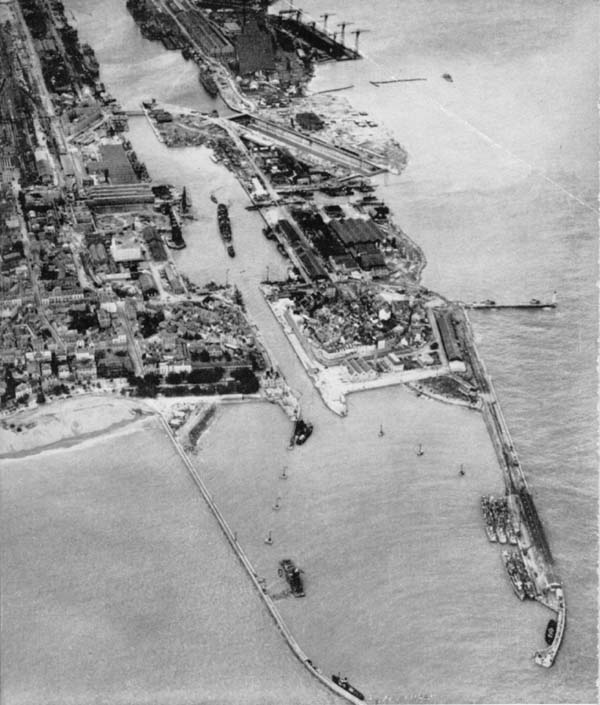
Overview of the St. Nazaire harbor Area.
The estuary was a complex mixture of mud flats and channels and for a frontal assault a shallow draught vessel running on a high tide would be required. Although heavily defended the German planners had not considered the possibility of an attack across the mud flats and shoals. Meticulous planning was undertaken including taking advice on the two important variables of tide and winds and studying French charts and tables up to 100 years old.
The outline plan was simple. The selected vessel, packed with high explosives in the bow, with troops and crew in protected areas, would ram the outer lock gate at speed and stick there. They would disembark and take cover behind a nearby air-raid shelter. The ship would then blow up destroying the gate. An MTB would then pass through and fire specially designed torpedoes at the inner gate which would collapse under pressure when the tide went out damaging the submarines berthed in their protected pens. The troops and crew would then destroy as many dockyard targets and withdraw in fast motor launches which had followed them in. All this was to be achieved under cover of an air raid.
The planners themselves had doubts about the withdrawal phase. There were likely to be unknown and variable factors that could not be planned for but the risks were less than the potential rewards. However, outside the planning circle there were those, notably the Naval C in C Plymouth, who thought the vessel would bounce off the gate. He held to his view even against the advice of the engineer who built it. He also thought that anyone within half a mile of the explosion would be killed.
Mountbatten conceded the point about the destructive power of the explosion and delayed action fuses were to be fitted to allow time for the troops and crew to evacuate the area. However on the question of the use of a boat to ram the lock gate he held firm. A further concession was to spread the raiding force between the main ship and the supporting motor launches simply to avoid total loss of the force in the event of disaster befalling the main ship.
 The raid was to be led by HMS Campbeltown, an American lend-lease destroyer (USS Buchanan). It was especially refitted for the task. Her interior was stripped, the bridge armour-plated, and additional protection provided for the Commandos she would carry. The accompanying motor launches (MLs) were tocarry 150 Commandos. The boats were fitted with two Oerlikon 20mm guns and additional fuel tanks to increase their range. As the needs of the raid were reassessed, the ML fleet was firstly increased to ten and then to 14. Only one motor gun boat (MGB) was available - MGB 314, a C-Class Fairmile, commanded by Lt. Dunstan Curtis. She would lead the attack and in reserve there would be motor torpedo boat (MTB) 74. This was equipped with unproven flying torpedoes to breach the dry dock gates if the Campbeltown failed to reach the target.
Action:
The fleet sailed from Falmouth at 3 pm on the 26th of March with MGB 314 at the head and two escort destroyers flanking the MLs and HMS Campbeltown. South west of Ushant they came across a U-Boat and damaged it. They left the area of action on a false course which the submarine duly reported to their command and control HQ. Five German torpedo boats were sent from St Nazaire to engage the vessels but in entirely the wrong direction. They were still at sea during the period of the raid. Around midnight on the 26th/27th March the raiders saw bomb flashes and tracers light the sky. The diversionary bombing air raid had started but low cloud rendered it inaccurate which caused an alert in the town and its approaches rather than the intended effect of keeping the German forces in their bunkers. The bombers had been briefed to target only specific military installations to avoid civilian casualties. Those who failed to acquire their targets did not drop their bombs.
Each boat flew the German flag to confuse the enemy and delay identification. HMS Sturgeon, a submarine, provided the exact position for the task force from which to make its run into the estuary. The Campbeltown crept through at 5 knots, touching bottom twice. At 0120 hours search lights illuminated the entire fleet but, for a short time, the Germans were reluctant to open fire possibly because of confusion caused by spoof signals and a general disbelief amongst and the Germans that such an audacious raid could be undertaken. The German flags were replaced with the White Ensign when the fleet was still two miles from its target. The Germans opened fire during the final 15 minutes of the run in during which half the men aboard the MLs were either killed or wounded from the intense shelling.
The Campbeltown cleared the estuary and increased speed to drive her bows through the torpedo barrier and into the dock gate. The MLs were all but stopped only two succeeded in landing their full complement of Commandos. Other MLs approached the landing zones but were forced to re-embark their Commandos in the face of very heavy fire from 20mm cannons. On shore fighting was ferocious and close quartered. At 0134 hours Campbeltown was successfully driven at speed into the dock gates just 4 minutes behind schedule and was relieved of most of her crew by MGB 314 while MTB 74 deployed her delayed action torpedoes in the foundations of the old entrance dock gate.
Captain Ryder, CO of the Naval forces, went ashore and satisfied himself that Campbeltown was both scuttled and embedded in the loch gate. At 0230 hours Ryder decided to withdraw. By this time more than half of his craft had been destroyed and the remainder were riddled.... if he didn't withdraw soon he would lose them all. The MTB then left for her rendezvous with British destroyers in the open sea off the Loire with 26 men on board accompanied by 7 other craft.. It stopped to pick up two more survivors but was hit by accurate shelling from the shore batteries. Only three of the 34 aboard survived. On the way they met the 5 German torpedo boats returning from their fruitless mission. In further enemy fire more craft were destroyed or scuttled and their crews transferred to the remaining craft. Of the 18 coastal craft which set out from Falmouth only four returned.

Outcome:
The delayed action fuses detonated the high explosives in the Campbeltown's hold at noon on the 28th. Forty German officers were aboard at the time and 400 other ranks were nearby on the quay. All were killed in the blast. The dock gates were destroyed and were not repaired until after the war. On the evening of the 29th the delayed torpedoes were activated causing further damage and German casualties. Regrettably many needless French casualties were caused by jittery German soldiers who believed that the raiders were still in their midst.
Of the 241 Commandos who took part 59 were posted as killed or missing and 109 captured. 85 Royal Navy personnel were killed or missing and a further 20+ captured. Many others were wounded. 5 other ranks returned to England via Spain. The Tirptitz was never able to leave Norwegian waters for want of a safe haven on the Atlantic coast. The value of the shipping saved in terms of men, armaments and food, can only be guessed at but it was very significant contribution to the Allied cause.
The air raid had hindered rather than helped the amphibious raid on St Nazaire. The experience had regrettable consequences 5 months later when a planned bombing raid at Dieppe was dispensed with.
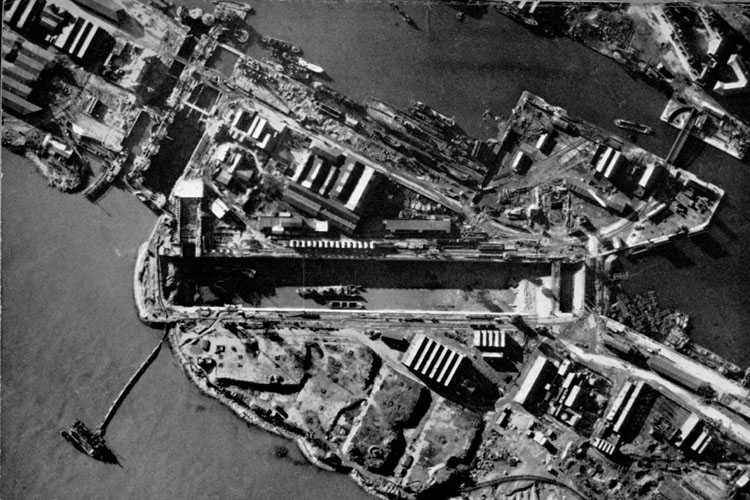
1942 Airal photo, taken months after the attack. The drydock had been taken out till the end of the second world war.
Be sure to check the links..
http://www.stnazairesociety.org/
http://www.combinedops.com/St%20Nazaire.htm
http://flyhi.de/games/nazaire3.html
http://www.stnazairesociety.org/Sections/cambeltown.html
ST. NAZAIRE - OPERATION CHARIOT
28th MAR 1942
28th MAR 1942
Operation Chariot, the ramming of the main dock gate in the German occupied French port of St Nazaire, was an audacious plan with a high risk of casualties and capture. With tons of high explosive packed into the bows the crew and accompanying commandos ran the gauntlet of hostile fire from the shore when their attempts to conceal their vessel's identity were unmasked. The damage inflicted on the docks was never repaired by the Germans.
Background:
The Tirpitz in Kafjord, Norway
In the second week of January 1942 the powerful German battleship Tirpitz moved from the Baltic through the Kiel canal and north to Trondheim on the Norwegian coast. There was a very real danger that it would break out into the North Atlantic and wreak havoc on allied Atlantic convoys. C in C Home Fleet, Admiral Tovey, held the view that to sink the Tirpitz would be "of incomparably greater importance to the conduct of the war than the safety of any convoy." Churchill shared this view commenting that "the entire naval situation throughout the world would be altered."
Four separate attempts to bomb the Tirpitz failed with the loss of 12 aircraft. Clearly a different strategy was required. The Germans needed dry-dock facilities on the Atlantic coast before the battleship could be deployed effectively against allied convoys. The only port capable of handling it was St. Nazaire on the French coast. There were others world-wide in Germany, Genoa and Singapore but none of operational value to the Germans. St. Nazaire lay on the north bank of the River Loire about 6 miles from the river mouth which itself was about 6 miles wide.
From within the Planning Division in the Admiralty the idea emerged to destroy the lock gate at St Nazaire. It was picked up by Captain Charles Lambe (who became First Sea Lord from 1959 to 1960 when he died a few months after resigning on the grounds of ill-health). He took the idea to Mountbatten head of Combined Operations - the first outside client for COHQ. The target area was sandwiched between the River Loire and the waters of the outer harbour and the Basin of St Nazaire - a total area of less than one square mile. But it was arguably the most heavily defended area along the whole of the German occupied Atlantic coast. In this confined space there were power stations, pumping stations, warehouses, lock installations and the old town of St Nazaire. Denying the Germans use of the dry-dock would effectively neutralize the threat the Tirpitz posed... but how?
Preparation:
Overview of the St. Nazaire harbor Area.
The estuary was a complex mixture of mud flats and channels and for a frontal assault a shallow draught vessel running on a high tide would be required. Although heavily defended the German planners had not considered the possibility of an attack across the mud flats and shoals. Meticulous planning was undertaken including taking advice on the two important variables of tide and winds and studying French charts and tables up to 100 years old.
The outline plan was simple. The selected vessel, packed with high explosives in the bow, with troops and crew in protected areas, would ram the outer lock gate at speed and stick there. They would disembark and take cover behind a nearby air-raid shelter. The ship would then blow up destroying the gate. An MTB would then pass through and fire specially designed torpedoes at the inner gate which would collapse under pressure when the tide went out damaging the submarines berthed in their protected pens. The troops and crew would then destroy as many dockyard targets and withdraw in fast motor launches which had followed them in. All this was to be achieved under cover of an air raid.
The planners themselves had doubts about the withdrawal phase. There were likely to be unknown and variable factors that could not be planned for but the risks were less than the potential rewards. However, outside the planning circle there were those, notably the Naval C in C Plymouth, who thought the vessel would bounce off the gate. He held to his view even against the advice of the engineer who built it. He also thought that anyone within half a mile of the explosion would be killed.
Mountbatten conceded the point about the destructive power of the explosion and delayed action fuses were to be fitted to allow time for the troops and crew to evacuate the area. However on the question of the use of a boat to ram the lock gate he held firm. A further concession was to spread the raiding force between the main ship and the supporting motor launches simply to avoid total loss of the force in the event of disaster befalling the main ship.
The raid was to be led by HMS Campbeltown, an American lend-lease destroyer (USS Buchanan). It was especially refitted for the task. Her interior was stripped, the bridge armour-plated, and additional protection provided for the Commandos she would carry. The accompanying motor launches (MLs) were tocarry 150 Commandos. The boats were fitted with two Oerlikon 20mm guns and additional fuel tanks to increase their range. As the needs of the raid were reassessed, the ML fleet was firstly increased to ten and then to 14. Only one motor gun boat (MGB) was available - MGB 314, a C-Class Fairmile, commanded by Lt. Dunstan Curtis. She would lead the attack and in reserve there would be motor torpedo boat (MTB) 74. This was equipped with unproven flying torpedoes to breach the dry dock gates if the Campbeltown failed to reach the target. Action:
The fleet sailed from Falmouth at 3 pm on the 26th of March with MGB 314 at the head and two escort destroyers flanking the MLs and HMS Campbeltown. South west of Ushant they came across a U-Boat and damaged it. They left the area of action on a false course which the submarine duly reported to their command and control HQ. Five German torpedo boats were sent from St Nazaire to engage the vessels but in entirely the wrong direction. They were still at sea during the period of the raid. Around midnight on the 26th/27th March the raiders saw bomb flashes and tracers light the sky. The diversionary bombing air raid had started but low cloud rendered it inaccurate which caused an alert in the town and its approaches rather than the intended effect of keeping the German forces in their bunkers. The bombers had been briefed to target only specific military installations to avoid civilian casualties. Those who failed to acquire their targets did not drop their bombs.
Each boat flew the German flag to confuse the enemy and delay identification. HMS Sturgeon, a submarine, provided the exact position for the task force from which to make its run into the estuary. The Campbeltown crept through at 5 knots, touching bottom twice. At 0120 hours search lights illuminated the entire fleet but, for a short time, the Germans were reluctant to open fire possibly because of confusion caused by spoof signals and a general disbelief amongst and the Germans that such an audacious raid could be undertaken. The German flags were replaced with the White Ensign when the fleet was still two miles from its target. The Germans opened fire during the final 15 minutes of the run in during which half the men aboard the MLs were either killed or wounded from the intense shelling.
The Campbeltown cleared the estuary and increased speed to drive her bows through the torpedo barrier and into the dock gate. The MLs were all but stopped only two succeeded in landing their full complement of Commandos. Other MLs approached the landing zones but were forced to re-embark their Commandos in the face of very heavy fire from 20mm cannons. On shore fighting was ferocious and close quartered. At 0134 hours Campbeltown was successfully driven at speed into the dock gates just 4 minutes behind schedule and was relieved of most of her crew by MGB 314 while MTB 74 deployed her delayed action torpedoes in the foundations of the old entrance dock gate.
Captain Ryder, CO of the Naval forces, went ashore and satisfied himself that Campbeltown was both scuttled and embedded in the loch gate. At 0230 hours Ryder decided to withdraw. By this time more than half of his craft had been destroyed and the remainder were riddled.... if he didn't withdraw soon he would lose them all. The MTB then left for her rendezvous with British destroyers in the open sea off the Loire with 26 men on board accompanied by 7 other craft.. It stopped to pick up two more survivors but was hit by accurate shelling from the shore batteries. Only three of the 34 aboard survived. On the way they met the 5 German torpedo boats returning from their fruitless mission. In further enemy fire more craft were destroyed or scuttled and their crews transferred to the remaining craft. Of the 18 coastal craft which set out from Falmouth only four returned.
Outcome:
The delayed action fuses detonated the high explosives in the Campbeltown's hold at noon on the 28th. Forty German officers were aboard at the time and 400 other ranks were nearby on the quay. All were killed in the blast. The dock gates were destroyed and were not repaired until after the war. On the evening of the 29th the delayed torpedoes were activated causing further damage and German casualties. Regrettably many needless French casualties were caused by jittery German soldiers who believed that the raiders were still in their midst.
Of the 241 Commandos who took part 59 were posted as killed or missing and 109 captured. 85 Royal Navy personnel were killed or missing and a further 20+ captured. Many others were wounded. 5 other ranks returned to England via Spain. The Tirptitz was never able to leave Norwegian waters for want of a safe haven on the Atlantic coast. The value of the shipping saved in terms of men, armaments and food, can only be guessed at but it was very significant contribution to the Allied cause.
The air raid had hindered rather than helped the amphibious raid on St Nazaire. The experience had regrettable consequences 5 months later when a planned bombing raid at Dieppe was dispensed with.
1942 Airal photo, taken months after the attack. The drydock had been taken out till the end of the second world war.
Be sure to check the links..
http://www.stnazairesociety.org/
Galland Borthers
Adolf
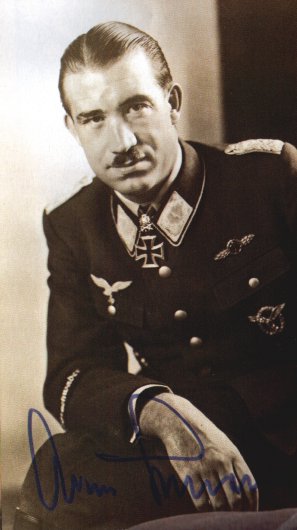
Adolf Galland is probably the most known Luftwaffe pilot of WWII. Not because of number of his kills, but special kind of charisma , a characteristic for all great aces. He was the youngest general grade officer of either side in World War II, and at age 29, he was more competent in aerial combat, strategy and tactics than many of the experts nearly twice his age. As a fighter pilot he was credited with 104 aerial victories. He was also famous for making a lot of modifications to his Bf 109 fighters. He enhanced their fire power, installed better pilot armour and, a cockpit cigar lighter!
He was born in Westerholt, a small village in Westphalia on 19 March 1912. His father was an administrator of private lands and properties. Adolf was the second son, after Fritz. His younger brothers were Wilhelm and Paul. These two younger brothers followed Adolf into the Luftwaffe fighter forces. However they were not as lucky in combat. Paul (17 victories) was killed on 31 October 1943, mistakenly shot down by another pilot of JG26. Wilhelm (54 victories, Knight's Cross) was shot down a year later. Since childhood Adolf Galland was fascinated by aviation. He started building model aircraft when he was 12 years old. When he was 16, he began glider flights. In 1933 Galland realized a dream when he received his first pilot's license. During training in 1935, he crashed in a Focke-Wulf Fw-44 biplane and he was in a coma for three days. He had serious skull fractures, a broken nose, and a partially blinded left eye from glass fragments. His commander, Major Rheitel, an aviator from the First World War, assisted him during his recovery and getting back into flying. He returned to air duty, but a year later he crashed again, this time on Arado Ar-68. Galland again spent a lot of time in the hospital.
In 1937 he volunteered to go with a group of German pilots for service in the Spanish Civil War. In this group were other future aces like Hannes Trautloft, Wilhelm Balthasar, Günther Lützow, Eduard Neumann and Hajo Herrmann. They arrived in El Ferrol on 7 May 1937. Galland became a squadron leader in the Legion Fighter Group, equipped with Heinkel He-51 biplane fighters. Lützow led a squadron of the newest Messerschmitt Bf 109Bs. Galland entered action over Brunete in July 1937. He flew over 300 missions as a leader and he was awarded the Spanish Cross in Gold with Diamonds, only awarded 12 times in Spanish history. In 1938 he returned to Germany. Having great experience, was ordered to begin the organization of Luftwaffe ground attack units.
At the beginning of WW II, Galland flew in Poland in the Henschel Hs 123, until October 1, 1939, performing ground attack missions and proving the dive-bombing concept. For his efforts Galland was awarded by Iron Cross. Next, he was assigned to JG 27, commanded by Oberst Max Ibel. During the French campaign Adolf Galland scored his first kills on 12 May 1940, when he went with Gustav Rödel on a mission. Galland shot down two "Hurricanes" from 87th Squadron in two sorties. He had 12 victories by 9 June 1940.

Adolf Galland, Kommodore JG 26, 1940 Note ever present cigar and experimental telescopic gun sight. Galland had ashtray & lighter installed in planes.
When "Battle of Britain" started, Galland was assigned to JG26 Schlageter as Gruppenkommandeur of III/JG26. His debut in that unit was very successful: he shot down two fighters on his first mission. On 18 July 1940, he was promoted to Major and a month later (on 22 August) he received the Ritterkreuz (Knights Cross) after his 17th victory. During the "Battle of Britain" his score increased rapidly, and on 25 September he was decorated with the Oak Leaves (for 40 kills) by Hitler. Galland also succeeded Gotthard Handrick as Kommodore of JG26. On 1 November 1940, he scored his 50th victory and was promoted to Oberstleutnant (lieutenant colonel). One month later he became a full colonel.

Major Adolf Galland after scoring his 40th victory on 23 September 1940. Galland is greeted first by his crew chief Uffz. Mayer.
Galland experienced being shot down himself on 21 June 1941, when JG26 was stationed at Pas de Calais. The Germans attacked Bristol "Blenheim" bombers and Galland downed two of them. However, some escorting "Spitfires" shot up his plane. He was forced to belly-land in a field. This same day, after lunch, he went on his next sortie. On that mission he shot down his number 70, but when following the burning "Spitfire", he was bounced and shot up badly. His plane caught fire, and he was wounded. He tried to bail out, but the canopy was jammed. After a dramatic struggle with the canopy, he was able to bail out at the last moment. His parachute opened just as he hit the ground. He was bleeding from his head and arm and he had damaged his ankle on landing. On 2 July 1941 Galland again was in trouble, but that is another story. Please check the text: Adolf Galland and the dramatic air combat July of 1941. On 9 August 1941 Galland 'welcomed' the famous Douglas Bader, who was just shot down by JG26 fighters.
At the end of 1941 Galland become General der Jagdflieger ("commander of fighter forces"), and went to Berlin. Gerhard Schoepfel became Kommodore of Galland's beloved JG26. On 28 January 1942, Hitler awarded him again, this time with the Brillanten (Diamonds). Galland still was at the rank of Colonel, but in 1942 he was promoted to General, then General Leutnant. He was enthusiastic about the new jet fighter project, and he gave great support to the Me 262 program. However, the protracted development time and Hitler's idea to turn the aircraft into a bomber "Schwalbe" slowed the entrance of this revolutionary fighter by a year.
In January of 1945 Galland and other officers (Lützow, Johannes, Steinhoff) had a notorious confrontation with Göring over the performance and future of the Fighter Arm. Galland was removed from his position and even arrested and threatened with a court-martial. Eventually he was allowed to organize a special jet unit using the Me 262. He created Jagdverband 44 a unit with most experienced pilots. His 'recruiting' officer, Steinhoff, traveled to all of the major bases, selecting pilots who wanted join to new adventure. Some very famous pilots joined over a period of weeks: Gerhard Barkhorn, Walter Krupinski, Heinz Bär , Erich Hohagen, Günther Lützow, Wilhelm Herget.
The newly organized unit flew several missions with varying success. Some aircraft used the anti-bomber R4M rockets. During his first attack with rockets Galland, with Walter Krupinski as a wingman, attacked a group of American B-26 "Marauders". Galland's rocket attack knocked down two of them.
In his last aerial combat in WWII, Adolf Galland took off on 26 April 1945. During an attack against Marauders his rockets would not fire, so he had use the 30 mm cannons. His Me 262 was hit by return fire from a rear gunner. The Allied bomber withstood Galland's fire. When Galland turned to finish the bomber, he was surprised by a P-47D flown by James Finnegan. Shells from the P-47's eight 12,7 mm guns destroyed Galland's instrument panel, shattered the jet's canopy, and struck his right knee. With his plane losing power and in great pain, Galland returned to his base, arriving just at the moment when a strafing attack by enemy fighters was underway. He successfully landed and escaped the wreck of his Me 262, avoiding the fire of the straffing attackers.

An autographed photo of German General Adolf Galland and his wife Heidi. Galland is wearing the watch he wore as a pilot in WWII. This photo was taken at a dinner aboard the Queen Mary in Long Beach, CA, on February 28, 1987. 3-1/2 by 5 inches. Condition is excellent. RARE photo, since Heidi rarely signed.
After war Galland was invited by Juan Perón to help build Argentinian Air Forces. Here he established a training and operations school, developed tactical training program. In 1955 he returned to Germany. Adolf Galland, a holder of the Knight's Cross with Oak Leaves, Swords and Diamonds, died in 1996.
Wilhelm-Ferdinand

Wilhelm-Ferdinand Galland is probably the best example that sometimes aeronautics become a family's bussines. His elder brother was the reputed ace and General of the Fighter Forces of Germany, Adolf "Dolfo" Galland (104 victories along WW2), and his younger brother Paul also became ace (17 kills). Originally the young Wilhelm was recruited to serve in the flak regiments (1935), but when the war began in 1939 he volunteered for flying training in the Ergänzungsgruppe./JG 26. When he completed the training in 1941, he immediatelly reported for active duty in the II./JG 26 on June 27. At this time the whole JG 26 was leaded by his elder brother Adolf, so he was anxious for getting a reputation of his own, for showing that he was more than only the younger brother of the already famous "Dolfo". On July 23 1941 "Wutz" began to gain such reputation when he knocked out a British Spitfire at the NW of Hesdin. By the end of the year, he already had three Spitfire kills in his scoreboard.
Those were happy times for the Luftwaffe units in the Channel Front, as is clearly shown by the figures of losses reported for both sides: Between June 13 and December 31 1941, the RAF lost over 600 aircraft (including fighters and bombers) in air combat and 411 airmen KIA or POW, while the Luftwaffe's actual losses in the air in that same period of time were only 135 aircraft, a kill ratio of 4:1 in favour of the Germans. It is also interesting to note that the Hurricane and Spitfire pilots at that time claimed 731 aerial victories, so they had a huge overclaiming ratio of 82 % !!!
Assigned to the 6./JG 26, "Wutz"'s personal tally began to increase fast when the JG 26 was re-equipped with the outstanding Focke-Wulf Fw 190A-1 in early 1942. On April 10 1942 Wilhelm Galland finally became an ace when blasted out of the sky his fifth victim: one Spitfire Mk.V of the No.340 Sqn RAF over Etaples. The command abilities of Wilhelm did not remain unnoticed, and he became Staffelkapitän of the 5./JG 26 on May 5. That same day he scored his 8th kill, another Spitfire (No.41 Sqn RAF). On June 2 1942 flew magnificently his Fw 190 when bagged two Spitfires (victories Nos.9-10), and repeated such success on July 31 when he piled up other two Spitfires into his scoreboard in less than a minute (Nos.12-13). During the period February - July 1942 the Experten of the JG 2 and JG 26 shot down at least 335 aircraft of the RAF, while losing only 84 Focke-Wulf Fw 190s and Bf 109Fs.
On August 19 1942 the RAF launched Operation "Jubilee", the air support to the assault against the portuary city of Dieppe. The JG 2 "Richthoffen" and JG 26 "Schlageter" (about 20 squadrons) faced the whole No.11 Group of the RAF with 48 squadrons of fighters and fighter-bombers. Despite being out-numbered, the German pilots beaten up their British adversaries, claiming 96 aerial victories that day, and it is highly likely that all the German claims are confirmed, because the RAF admitts the loss of 103 aircraft that day, including 88 Spitfires. Against such carnage, the Luftwaffe lost only 21 fighters and 14 pilots. Many German Experten increased their respective tallies that day, for example Joseph "Sepp" Würmheller (he shot down 7 Spitfires and 1 Blenheim bomber), Egon Mayer (1 Hurricane and 1 Spitfire), Siegfried Schnell (5 Spitfires), Wilhelm Roth (one Spitfire) and Adolf Glunz (one Spitfire too). Wilhelm Galland wasn't the exception, because he destroyed one Spitfire in the afternoon (17:55 hs) N of Dieppe.

Few days later (August 27) the 5./JG 26 intercepted the raid "Circus 208", consisting in 12 Bostons escorted by Spitfires of the No.350 Sqn (Belgian), and Wilhelm Galland shot down the Spit of H. Picard (POW), his 15th kill. "Wutz" suffered a hard strike on October 31 when his younger brother Paul was killed in action, but such tragic personal loss only reinforced his determination, and by the end of 1942, his tally rised to 21 kills (all Spitfires).
On January 3 1943 Wilhelm-Ferdinand Galland was promoted to the rank of Hauptmann and took command of II./JG 26, and exactly one month later (February 3 1943) achieved his greatest succeses: that day "Wutz" leaded 40 Fw 190A-5 to intercepte 12 British two-engines bombers Ventura of the No.21 Sqn RAF escorted by Supermarine Spitfires of the No.64, 122 and 308 Sqns, which went to attack Courtrai-Wevelghem airfield. At 11:05 hs Galland sent downwards in flames the Ventura flown by Sgt G. K. Moodley, and only seven minutes later he blasted one Spitfire of the No.308 Sqn out of the sky (probably the one piloted by Fg Off J. Wiejsky). Besides, because of his excellent leadership, his men literally thrashed the escort when shot down other two Polish Spitfires and forced the pilot of a fourth one (Lt. Tadeusz Koc) to bail out over the waters of the Channel. During another Ventura raid in the afternoon, the Fw 190s of the I./JG 2 and II./JG 26 engaged one of the escorting squadrons, the No.416 of the Royal Canadian Air Force, and again the Experten of "Wutz" Galland beaten them up: three Spitfires were shot down in few minutes, one of them by Wilhelm (probably the Spitfire flown by Fg Off J. S. McKenty). A fourth Spitfire flown by Fg Off Rainville ditched in the waters of the Channel, Rainville was rescued safe and sound. So, that day the Luftwaffe shot down eight Spitfires and one Ventura (two Spitfires and the Ventura by Galland himself), and lost only one Fw 190. Ten days later "Wutz" added two more marks to the rudder of his personal Fw 190A-5 WNr 530125, when in only 3 minutes (10:17-10:20 hs) bagged a Spitfire of the No.340 Sqn and a second one of the No.485 Sqn (his victories Nos.28-29), scoring his 30th kill on February 15 (another Spitfire).
However, despite the Experten of the JG 2 and JG 26 were at the top of their skills, they were engaging more frequently a new adversary: the 8th Air Force of the USAAF, with its fighter wings equipped with P-47s and the bomber wings equipped with the four-engine B-17s and B-24s. So far, the two German fighter wings had been fully capables to keep the Axis' air superiority over Northern France and to beat up the RAF, but the massive arrival of this new contendor threatened with neutralize the German advantage. "Wutz" faced that new threat for the very first time in the afternoon on March 8, when he shot down an USAAF B-24 of the 44th BG over Totes.
His next battle against the "Vërmoten" (the German nickname for the four-engine bombers) happened on April 4, when he leaded the II./JG 26 to intercepte the enemy bombers and the escort near Fécamp. In first place shot down one of the escorting Spitfires, and later riddled two B-17s which went down in flames. On the next day the victim of his lethal Fw 190 was a B-17 of the 384th BG, which was wiped out near Antwerp. April was a good month for "Wutz": besides the already mentioned victories, he blasted out of the sky one Typhoon of No.56 Sqn on the 17th and two Venturas of the No.21 Sqn on April 21 1943.
After a well deserved rest, on May 18 "Wutz" was awarded with the Ritterkreuz (Knight's Cross) and promoted to the rank of Major. Ironically, when Wilhelm had his finest moments as a fighter pilot, the Luftwaffe was begining to be overwhelmed by the crushing numerical superiority of the Western Allies. In May 1943 the JG 2 and JG 26 lost 91 fighters, and other 53 were seriously damaged; but the worse was that one Gruppenkommandeur and 15 Staffelkapitänen were killed in action. Germany simply just could not replace such losses of experienced pilots. Even worse, the Western Allies were not only growing in strenght with the arrival of more and more USAAF squadrons, but also their pilots were gaining combat experience, closing the gap of skills with the German Experten.
Anyway, the Luftwaffe was still able to cause a tremendous defeat to the American 8th Air Force on June 26 1943: that day 250 B-17 Flying Fortresses attacked Villacoublay airfield escorted by 300 fighters (RAF Spitfires and Typhoons, and P-47s of the 56th FG). At 17:45 hs the Fw 190s of the JG 2 leaded by Major Egon Mayer met the B-17s over Liseaux and flamed five of them in few minutes with head-on attacks. An hour later, the Fw 190A-5s of the II./JG 26 caught by surprise the P-47s of the 56th FG, and in the blink of an eye its commander Wilhelm-Ferdinand Galland, Oberleutnant Heinz Hoppe and Feldwebel Günther Scholz had bagged one Thunderbolt each. Twelve minutes later (19:04) "Wutz" piled up another P-47 of the 56th FG into his scoreboard, his 46th aerial victory. By the end of the day, seven Thunderbolts and five B-17s had been downed, against no losses in the German side.
Wilhelm Galland shot down his 54th and last victim on August 12 (a B-17). Five days later, he took off in the cockpit of his beloved Fw 190A-5 WNr 530125 leading the whole II./JG 26 against a group of 200 bombers which were returning to England after bombing Schweinfurt. When he was about to order the assault against the four-engine bombers, his Gruppen was suddenly jumped by P-47 Thunderbolts of the 56th FG. One of them was flown by Walker "Bud" Mahurin, who riddled Galland's Fw 190 with 12.7 mm machinegun fire and sent it downwards in flames. Probably we never know whether the unfortunate "Wutz" was killed instantly or he tried to bail out, but what is out of question was the fact that he didn't make it: he died when his aircraft crashed W of Maastricht, leaving a huge crater in the ground. The American 56th Fighter Group took revenge that day of its defeat on June 26, and Galland's defeater, Walker Mahurin, ended the war with 24.25 victories (20.8 in Europe and the remaining ones in the Pacific).
In a certain way, it was like his fate was linked with the one of the whole Luftwaffe: as long as he was alive and bagging Allied planes, the Luftwaffe in the Channel Front could mantain the air superiority, but few months after his death, the P-47s and Mustangs of the 8th AF controlled the airspace over Northern France, allowing the massive Allied landing in Normandy on June 6 1944, and the begining of Third Reich's end. However, his outstanding war career is one of the best examples of the patriotism and skills shown by the brave German pilots who fought against all odds in the Western Front.
Paul

Paul Galland was the youngest of the Galland brothers. He joined JG 26 as a Leutnant in February 1941 having completed his operational training with Ergänzungsgruppe/JG 26. He was assigned to 8./JG 26. He scored his first victory on 6 July when he shot down a RAF Spitfire. By the end of 1941 his score had reached three. He recorded his 10th victory on 3 May 1942, another Spitfire shot down over Calais. On 31 October 1942 Galland participated in the vengeance raid on Canterbury. On the return flight Galland answered a call from a German pilot being attacked by a Spitfire. The Spitfire spotted Galland's approach and pulled up into the cloud cover. Galland attempted to follow but stalled and had to dive away to regain speed. The Spitfire took the opportunity to dive from the clouds and shoot down Galland's Fw 190 A-4 (WNr 2402) "Black 1".
Paul Galland was credited with 17 victories in 107 combat missions.
Adolf
Adolf Galland is probably the most known Luftwaffe pilot of WWII. Not because of number of his kills, but special kind of charisma , a characteristic for all great aces. He was the youngest general grade officer of either side in World War II, and at age 29, he was more competent in aerial combat, strategy and tactics than many of the experts nearly twice his age. As a fighter pilot he was credited with 104 aerial victories. He was also famous for making a lot of modifications to his Bf 109 fighters. He enhanced their fire power, installed better pilot armour and, a cockpit cigar lighter!
He was born in Westerholt, a small village in Westphalia on 19 March 1912. His father was an administrator of private lands and properties. Adolf was the second son, after Fritz. His younger brothers were Wilhelm and Paul. These two younger brothers followed Adolf into the Luftwaffe fighter forces. However they were not as lucky in combat. Paul (17 victories) was killed on 31 October 1943, mistakenly shot down by another pilot of JG26. Wilhelm (54 victories, Knight's Cross) was shot down a year later. Since childhood Adolf Galland was fascinated by aviation. He started building model aircraft when he was 12 years old. When he was 16, he began glider flights. In 1933 Galland realized a dream when he received his first pilot's license. During training in 1935, he crashed in a Focke-Wulf Fw-44 biplane and he was in a coma for three days. He had serious skull fractures, a broken nose, and a partially blinded left eye from glass fragments. His commander, Major Rheitel, an aviator from the First World War, assisted him during his recovery and getting back into flying. He returned to air duty, but a year later he crashed again, this time on Arado Ar-68. Galland again spent a lot of time in the hospital.
In 1937 he volunteered to go with a group of German pilots for service in the Spanish Civil War. In this group were other future aces like Hannes Trautloft, Wilhelm Balthasar, Günther Lützow, Eduard Neumann and Hajo Herrmann. They arrived in El Ferrol on 7 May 1937. Galland became a squadron leader in the Legion Fighter Group, equipped with Heinkel He-51 biplane fighters. Lützow led a squadron of the newest Messerschmitt Bf 109Bs. Galland entered action over Brunete in July 1937. He flew over 300 missions as a leader and he was awarded the Spanish Cross in Gold with Diamonds, only awarded 12 times in Spanish history. In 1938 he returned to Germany. Having great experience, was ordered to begin the organization of Luftwaffe ground attack units.
At the beginning of WW II, Galland flew in Poland in the Henschel Hs 123, until October 1, 1939, performing ground attack missions and proving the dive-bombing concept. For his efforts Galland was awarded by Iron Cross. Next, he was assigned to JG 27, commanded by Oberst Max Ibel. During the French campaign Adolf Galland scored his first kills on 12 May 1940, when he went with Gustav Rödel on a mission. Galland shot down two "Hurricanes" from 87th Squadron in two sorties. He had 12 victories by 9 June 1940.
Adolf Galland, Kommodore JG 26, 1940 Note ever present cigar and experimental telescopic gun sight. Galland had ashtray & lighter installed in planes.
When "Battle of Britain" started, Galland was assigned to JG26 Schlageter as Gruppenkommandeur of III/JG26. His debut in that unit was very successful: he shot down two fighters on his first mission. On 18 July 1940, he was promoted to Major and a month later (on 22 August) he received the Ritterkreuz (Knights Cross) after his 17th victory. During the "Battle of Britain" his score increased rapidly, and on 25 September he was decorated with the Oak Leaves (for 40 kills) by Hitler. Galland also succeeded Gotthard Handrick as Kommodore of JG26. On 1 November 1940, he scored his 50th victory and was promoted to Oberstleutnant (lieutenant colonel). One month later he became a full colonel.
Major Adolf Galland after scoring his 40th victory on 23 September 1940. Galland is greeted first by his crew chief Uffz. Mayer.
Galland experienced being shot down himself on 21 June 1941, when JG26 was stationed at Pas de Calais. The Germans attacked Bristol "Blenheim" bombers and Galland downed two of them. However, some escorting "Spitfires" shot up his plane. He was forced to belly-land in a field. This same day, after lunch, he went on his next sortie. On that mission he shot down his number 70, but when following the burning "Spitfire", he was bounced and shot up badly. His plane caught fire, and he was wounded. He tried to bail out, but the canopy was jammed. After a dramatic struggle with the canopy, he was able to bail out at the last moment. His parachute opened just as he hit the ground. He was bleeding from his head and arm and he had damaged his ankle on landing. On 2 July 1941 Galland again was in trouble, but that is another story. Please check the text: Adolf Galland and the dramatic air combat July of 1941. On 9 August 1941 Galland 'welcomed' the famous Douglas Bader, who was just shot down by JG26 fighters.
At the end of 1941 Galland become General der Jagdflieger ("commander of fighter forces"), and went to Berlin. Gerhard Schoepfel became Kommodore of Galland's beloved JG26. On 28 January 1942, Hitler awarded him again, this time with the Brillanten (Diamonds). Galland still was at the rank of Colonel, but in 1942 he was promoted to General, then General Leutnant. He was enthusiastic about the new jet fighter project, and he gave great support to the Me 262 program. However, the protracted development time and Hitler's idea to turn the aircraft into a bomber "Schwalbe" slowed the entrance of this revolutionary fighter by a year.
In January of 1945 Galland and other officers (Lützow, Johannes, Steinhoff) had a notorious confrontation with Göring over the performance and future of the Fighter Arm. Galland was removed from his position and even arrested and threatened with a court-martial. Eventually he was allowed to organize a special jet unit using the Me 262. He created Jagdverband 44 a unit with most experienced pilots. His 'recruiting' officer, Steinhoff, traveled to all of the major bases, selecting pilots who wanted join to new adventure. Some very famous pilots joined over a period of weeks: Gerhard Barkhorn, Walter Krupinski, Heinz Bär , Erich Hohagen, Günther Lützow, Wilhelm Herget.
The newly organized unit flew several missions with varying success. Some aircraft used the anti-bomber R4M rockets. During his first attack with rockets Galland, with Walter Krupinski as a wingman, attacked a group of American B-26 "Marauders". Galland's rocket attack knocked down two of them.
In his last aerial combat in WWII, Adolf Galland took off on 26 April 1945. During an attack against Marauders his rockets would not fire, so he had use the 30 mm cannons. His Me 262 was hit by return fire from a rear gunner. The Allied bomber withstood Galland's fire. When Galland turned to finish the bomber, he was surprised by a P-47D flown by James Finnegan. Shells from the P-47's eight 12,7 mm guns destroyed Galland's instrument panel, shattered the jet's canopy, and struck his right knee. With his plane losing power and in great pain, Galland returned to his base, arriving just at the moment when a strafing attack by enemy fighters was underway. He successfully landed and escaped the wreck of his Me 262, avoiding the fire of the straffing attackers.
An autographed photo of German General Adolf Galland and his wife Heidi. Galland is wearing the watch he wore as a pilot in WWII. This photo was taken at a dinner aboard the Queen Mary in Long Beach, CA, on February 28, 1987. 3-1/2 by 5 inches. Condition is excellent. RARE photo, since Heidi rarely signed.
After war Galland was invited by Juan Perón to help build Argentinian Air Forces. Here he established a training and operations school, developed tactical training program. In 1955 he returned to Germany. Adolf Galland, a holder of the Knight's Cross with Oak Leaves, Swords and Diamonds, died in 1996.
Wilhelm-Ferdinand
Wilhelm-Ferdinand Galland is probably the best example that sometimes aeronautics become a family's bussines. His elder brother was the reputed ace and General of the Fighter Forces of Germany, Adolf "Dolfo" Galland (104 victories along WW2), and his younger brother Paul also became ace (17 kills). Originally the young Wilhelm was recruited to serve in the flak regiments (1935), but when the war began in 1939 he volunteered for flying training in the Ergänzungsgruppe./JG 26. When he completed the training in 1941, he immediatelly reported for active duty in the II./JG 26 on June 27. At this time the whole JG 26 was leaded by his elder brother Adolf, so he was anxious for getting a reputation of his own, for showing that he was more than only the younger brother of the already famous "Dolfo". On July 23 1941 "Wutz" began to gain such reputation when he knocked out a British Spitfire at the NW of Hesdin. By the end of the year, he already had three Spitfire kills in his scoreboard.
Those were happy times for the Luftwaffe units in the Channel Front, as is clearly shown by the figures of losses reported for both sides: Between June 13 and December 31 1941, the RAF lost over 600 aircraft (including fighters and bombers) in air combat and 411 airmen KIA or POW, while the Luftwaffe's actual losses in the air in that same period of time were only 135 aircraft, a kill ratio of 4:1 in favour of the Germans. It is also interesting to note that the Hurricane and Spitfire pilots at that time claimed 731 aerial victories, so they had a huge overclaiming ratio of 82 % !!!
Assigned to the 6./JG 26, "Wutz"'s personal tally began to increase fast when the JG 26 was re-equipped with the outstanding Focke-Wulf Fw 190A-1 in early 1942. On April 10 1942 Wilhelm Galland finally became an ace when blasted out of the sky his fifth victim: one Spitfire Mk.V of the No.340 Sqn RAF over Etaples. The command abilities of Wilhelm did not remain unnoticed, and he became Staffelkapitän of the 5./JG 26 on May 5. That same day he scored his 8th kill, another Spitfire (No.41 Sqn RAF). On June 2 1942 flew magnificently his Fw 190 when bagged two Spitfires (victories Nos.9-10), and repeated such success on July 31 when he piled up other two Spitfires into his scoreboard in less than a minute (Nos.12-13). During the period February - July 1942 the Experten of the JG 2 and JG 26 shot down at least 335 aircraft of the RAF, while losing only 84 Focke-Wulf Fw 190s and Bf 109Fs.
On August 19 1942 the RAF launched Operation "Jubilee", the air support to the assault against the portuary city of Dieppe. The JG 2 "Richthoffen" and JG 26 "Schlageter" (about 20 squadrons) faced the whole No.11 Group of the RAF with 48 squadrons of fighters and fighter-bombers. Despite being out-numbered, the German pilots beaten up their British adversaries, claiming 96 aerial victories that day, and it is highly likely that all the German claims are confirmed, because the RAF admitts the loss of 103 aircraft that day, including 88 Spitfires. Against such carnage, the Luftwaffe lost only 21 fighters and 14 pilots. Many German Experten increased their respective tallies that day, for example Joseph "Sepp" Würmheller (he shot down 7 Spitfires and 1 Blenheim bomber), Egon Mayer (1 Hurricane and 1 Spitfire), Siegfried Schnell (5 Spitfires), Wilhelm Roth (one Spitfire) and Adolf Glunz (one Spitfire too). Wilhelm Galland wasn't the exception, because he destroyed one Spitfire in the afternoon (17:55 hs) N of Dieppe.
Few days later (August 27) the 5./JG 26 intercepted the raid "Circus 208", consisting in 12 Bostons escorted by Spitfires of the No.350 Sqn (Belgian), and Wilhelm Galland shot down the Spit of H. Picard (POW), his 15th kill. "Wutz" suffered a hard strike on October 31 when his younger brother Paul was killed in action, but such tragic personal loss only reinforced his determination, and by the end of 1942, his tally rised to 21 kills (all Spitfires).
On January 3 1943 Wilhelm-Ferdinand Galland was promoted to the rank of Hauptmann and took command of II./JG 26, and exactly one month later (February 3 1943) achieved his greatest succeses: that day "Wutz" leaded 40 Fw 190A-5 to intercepte 12 British two-engines bombers Ventura of the No.21 Sqn RAF escorted by Supermarine Spitfires of the No.64, 122 and 308 Sqns, which went to attack Courtrai-Wevelghem airfield. At 11:05 hs Galland sent downwards in flames the Ventura flown by Sgt G. K. Moodley, and only seven minutes later he blasted one Spitfire of the No.308 Sqn out of the sky (probably the one piloted by Fg Off J. Wiejsky). Besides, because of his excellent leadership, his men literally thrashed the escort when shot down other two Polish Spitfires and forced the pilot of a fourth one (Lt. Tadeusz Koc) to bail out over the waters of the Channel. During another Ventura raid in the afternoon, the Fw 190s of the I./JG 2 and II./JG 26 engaged one of the escorting squadrons, the No.416 of the Royal Canadian Air Force, and again the Experten of "Wutz" Galland beaten them up: three Spitfires were shot down in few minutes, one of them by Wilhelm (probably the Spitfire flown by Fg Off J. S. McKenty). A fourth Spitfire flown by Fg Off Rainville ditched in the waters of the Channel, Rainville was rescued safe and sound. So, that day the Luftwaffe shot down eight Spitfires and one Ventura (two Spitfires and the Ventura by Galland himself), and lost only one Fw 190. Ten days later "Wutz" added two more marks to the rudder of his personal Fw 190A-5 WNr 530125, when in only 3 minutes (10:17-10:20 hs) bagged a Spitfire of the No.340 Sqn and a second one of the No.485 Sqn (his victories Nos.28-29), scoring his 30th kill on February 15 (another Spitfire).
However, despite the Experten of the JG 2 and JG 26 were at the top of their skills, they were engaging more frequently a new adversary: the 8th Air Force of the USAAF, with its fighter wings equipped with P-47s and the bomber wings equipped with the four-engine B-17s and B-24s. So far, the two German fighter wings had been fully capables to keep the Axis' air superiority over Northern France and to beat up the RAF, but the massive arrival of this new contendor threatened with neutralize the German advantage. "Wutz" faced that new threat for the very first time in the afternoon on March 8, when he shot down an USAAF B-24 of the 44th BG over Totes.
His next battle against the "Vërmoten" (the German nickname for the four-engine bombers) happened on April 4, when he leaded the II./JG 26 to intercepte the enemy bombers and the escort near Fécamp. In first place shot down one of the escorting Spitfires, and later riddled two B-17s which went down in flames. On the next day the victim of his lethal Fw 190 was a B-17 of the 384th BG, which was wiped out near Antwerp. April was a good month for "Wutz": besides the already mentioned victories, he blasted out of the sky one Typhoon of No.56 Sqn on the 17th and two Venturas of the No.21 Sqn on April 21 1943.
After a well deserved rest, on May 18 "Wutz" was awarded with the Ritterkreuz (Knight's Cross) and promoted to the rank of Major. Ironically, when Wilhelm had his finest moments as a fighter pilot, the Luftwaffe was begining to be overwhelmed by the crushing numerical superiority of the Western Allies. In May 1943 the JG 2 and JG 26 lost 91 fighters, and other 53 were seriously damaged; but the worse was that one Gruppenkommandeur and 15 Staffelkapitänen were killed in action. Germany simply just could not replace such losses of experienced pilots. Even worse, the Western Allies were not only growing in strenght with the arrival of more and more USAAF squadrons, but also their pilots were gaining combat experience, closing the gap of skills with the German Experten.
Anyway, the Luftwaffe was still able to cause a tremendous defeat to the American 8th Air Force on June 26 1943: that day 250 B-17 Flying Fortresses attacked Villacoublay airfield escorted by 300 fighters (RAF Spitfires and Typhoons, and P-47s of the 56th FG). At 17:45 hs the Fw 190s of the JG 2 leaded by Major Egon Mayer met the B-17s over Liseaux and flamed five of them in few minutes with head-on attacks. An hour later, the Fw 190A-5s of the II./JG 26 caught by surprise the P-47s of the 56th FG, and in the blink of an eye its commander Wilhelm-Ferdinand Galland, Oberleutnant Heinz Hoppe and Feldwebel Günther Scholz had bagged one Thunderbolt each. Twelve minutes later (19:04) "Wutz" piled up another P-47 of the 56th FG into his scoreboard, his 46th aerial victory. By the end of the day, seven Thunderbolts and five B-17s had been downed, against no losses in the German side.
Wilhelm Galland shot down his 54th and last victim on August 12 (a B-17). Five days later, he took off in the cockpit of his beloved Fw 190A-5 WNr 530125 leading the whole II./JG 26 against a group of 200 bombers which were returning to England after bombing Schweinfurt. When he was about to order the assault against the four-engine bombers, his Gruppen was suddenly jumped by P-47 Thunderbolts of the 56th FG. One of them was flown by Walker "Bud" Mahurin, who riddled Galland's Fw 190 with 12.7 mm machinegun fire and sent it downwards in flames. Probably we never know whether the unfortunate "Wutz" was killed instantly or he tried to bail out, but what is out of question was the fact that he didn't make it: he died when his aircraft crashed W of Maastricht, leaving a huge crater in the ground. The American 56th Fighter Group took revenge that day of its defeat on June 26, and Galland's defeater, Walker Mahurin, ended the war with 24.25 victories (20.8 in Europe and the remaining ones in the Pacific).
In a certain way, it was like his fate was linked with the one of the whole Luftwaffe: as long as he was alive and bagging Allied planes, the Luftwaffe in the Channel Front could mantain the air superiority, but few months after his death, the P-47s and Mustangs of the 8th AF controlled the airspace over Northern France, allowing the massive Allied landing in Normandy on June 6 1944, and the begining of Third Reich's end. However, his outstanding war career is one of the best examples of the patriotism and skills shown by the brave German pilots who fought against all odds in the Western Front.
Paul
Paul Galland was the youngest of the Galland brothers. He joined JG 26 as a Leutnant in February 1941 having completed his operational training with Ergänzungsgruppe/JG 26. He was assigned to 8./JG 26. He scored his first victory on 6 July when he shot down a RAF Spitfire. By the end of 1941 his score had reached three. He recorded his 10th victory on 3 May 1942, another Spitfire shot down over Calais. On 31 October 1942 Galland participated in the vengeance raid on Canterbury. On the return flight Galland answered a call from a German pilot being attacked by a Spitfire. The Spitfire spotted Galland's approach and pulled up into the cloud cover. Galland attempted to follow but stalled and had to dive away to regain speed. The Spitfire took the opportunity to dive from the clouds and shoot down Galland's Fw 190 A-4 (WNr 2402) "Black 1".
Paul Galland was credited with 17 victories in 107 combat missions.
This is a "lo-fi" version of our main content. To view the full version with more information, formatting and images, please click here.